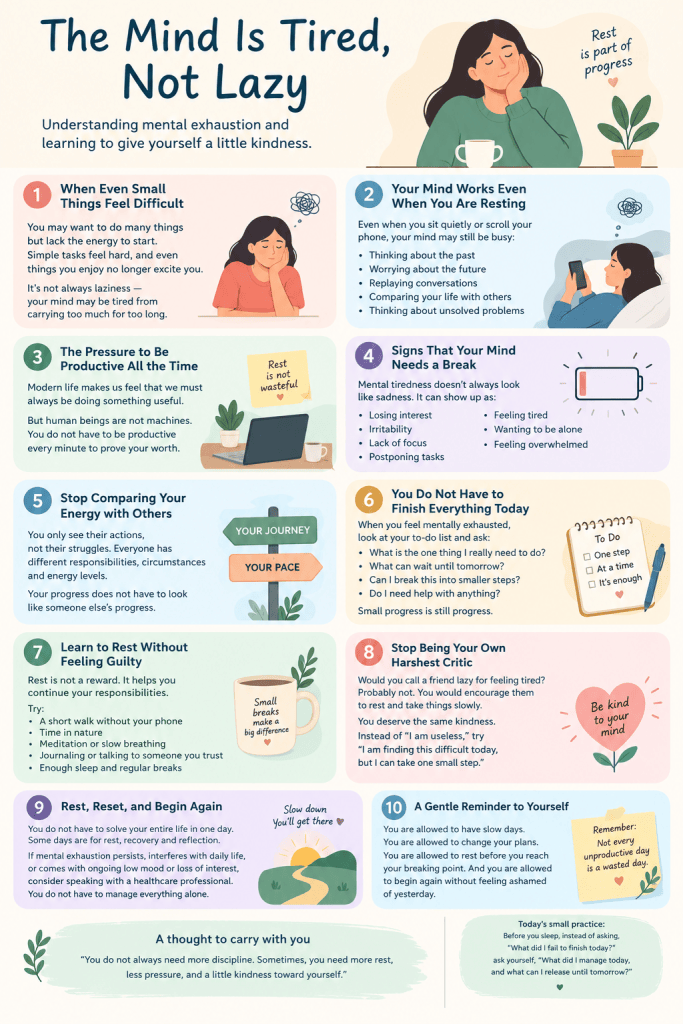
Toxic Productivity: When Being Busy Becomes Harmful

Introduction

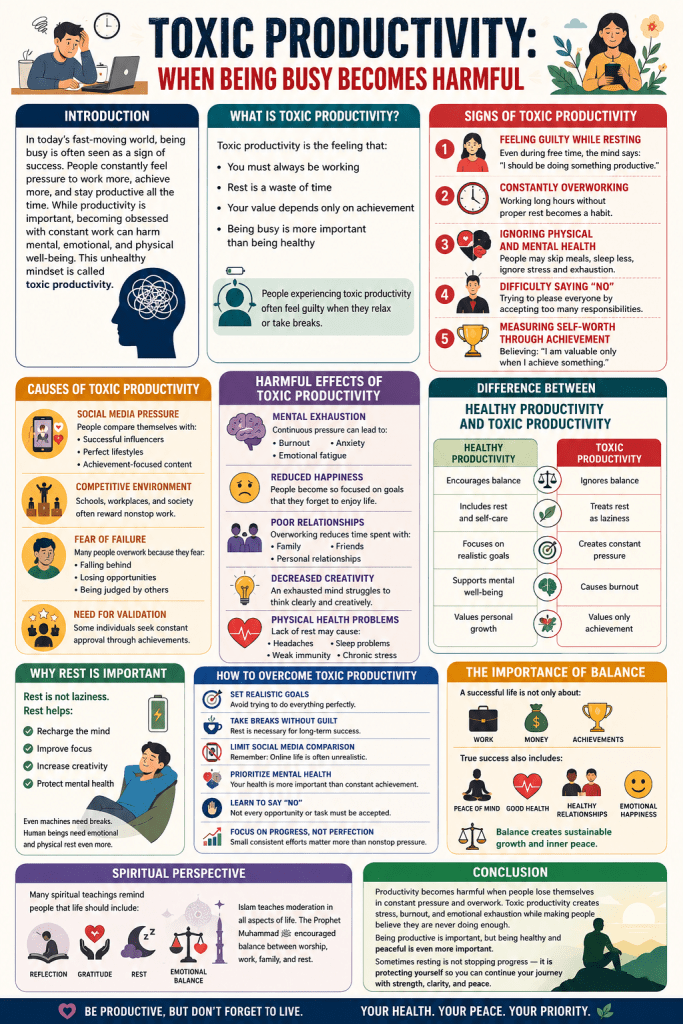
In today’s fast-moving world, being busy is often seen as a sign of success. People constantly feel pressure to work more, achieve more, and stay productive all the time. While productivity is important, becoming obsessed with constant work can harm mental, emotional, and physical well-being. This unhealthy mindset is called toxic productivity.


What is Toxic Productivity?

Toxic productivity is the feeling that:

  • You must always be working
  • Rest is a waste of time
  • Your value depends only on achievement
  • Being busy is more important than being healthy

People experiencing toxic productivity often feel guilty when they relax or take breaks.


Signs of Toxic Productivity

1. Feeling Guilty While Resting

Even during free time, the mind says:

  • “I should be doing something productive.”

2. Constantly Overworking

Working long hours without proper rest becomes a habit.

3. Ignoring Physical and Mental Health

People may:

  • Skip meals
  • Sleep less
  • Ignore stress and exhaustion

4. Difficulty Saying “No”

Trying to please everyone by accepting too many responsibilities.

5. Measuring Self-Worth Through Achievement

Believing:

  • “I am valuable only when I achieve something.”

Causes of Toxic Productivity

Social Media Pressure

People compare themselves with:

  • Successful influencers
  • Perfect lifestyles
  • Achievement-focused content

Competitive Environment

Schools, workplaces, and society often reward nonstop work.

Fear of Failure

Many people overwork because they fear:

  • Falling behind
  • Losing opportunities
  • Being judged by others

Need for Validation

Some individuals seek constant approval through achievements.


Harmful Effects of Toxic Productivity

Mental Exhaustion

Continuous pressure can lead to:

  • Burnout
  • Anxiety
  • Emotional fatigue

Reduced Happiness

People become so focused on goals that they forget to enjoy life.

Poor Relationships

Overworking reduces time spent with:

  • Family
  • Friends
  • Personal relationships

Decreased Creativity

An exhausted mind struggles to think clearly and creatively.

Physical Health Problems

Lack of rest may cause:

  • Headaches
  • Sleep problems
  • Weak immunity
  • Chronic stress

Difference Between Healthy Productivity and Toxic Productivity

Healthy ProductivityToxic Productivity
Encourages balanceIgnores balance
Includes rest and self-careTreats rest as laziness
Focuses on realistic goalsCreates constant pressure
Supports mental well-beingCauses burnout
Values personal growthValues only achievement

Why Rest is Important

Rest is not laziness.
Rest helps:

  • Recharge the mind
  • Improve focus
  • Increase creativity
  • Protect mental health

Even machines need breaks. Human beings need emotional and physical rest even more.


How to Overcome Toxic Productivity

Set Realistic Goals

Avoid trying to do everything perfectly.

Take Breaks Without Guilt

Rest is necessary for long-term success.

Limit Social Media Comparison

Remember:

  • Online life is often unrealistic.

Prioritize Mental Health

Your health is more important than constant achievement.

Learn to Say “No”

Not every opportunity or task must be accepted.

Focus on Progress, Not Perfection

Small consistent efforts matter more than nonstop pressure.


The Importance of Balance

A successful life is not only about:

  • Work
  • Money
  • Achievements

True success also includes:

  • Peace of mind
  • Good health
  • Healthy relationships
  • Emotional happiness

Balance creates sustainable growth and inner peace.


Spiritual Perspective

Many spiritual teachings remind people that life should include:

  • Reflection
  • Gratitude
  • Rest
  • Emotional balance

Islam teaches moderation in all aspects of life. The Prophet Muhammad ﷺ encouraged balance between worship, work, family, and rest.


Conclusion

Productivity becomes harmful when people lose themselves in constant pressure and overwork. Toxic productivity creates stress, burnout, and emotional exhaustion while making people believe they are never doing enough.

Being productive is important, but being healthy and peaceful is even more important.

Sometimes resting is not stopping progress — it is protecting yourself so you can continue your journey with strength, clarity, and peace.

The Power of Thoughts in Shaping Life

Introduction

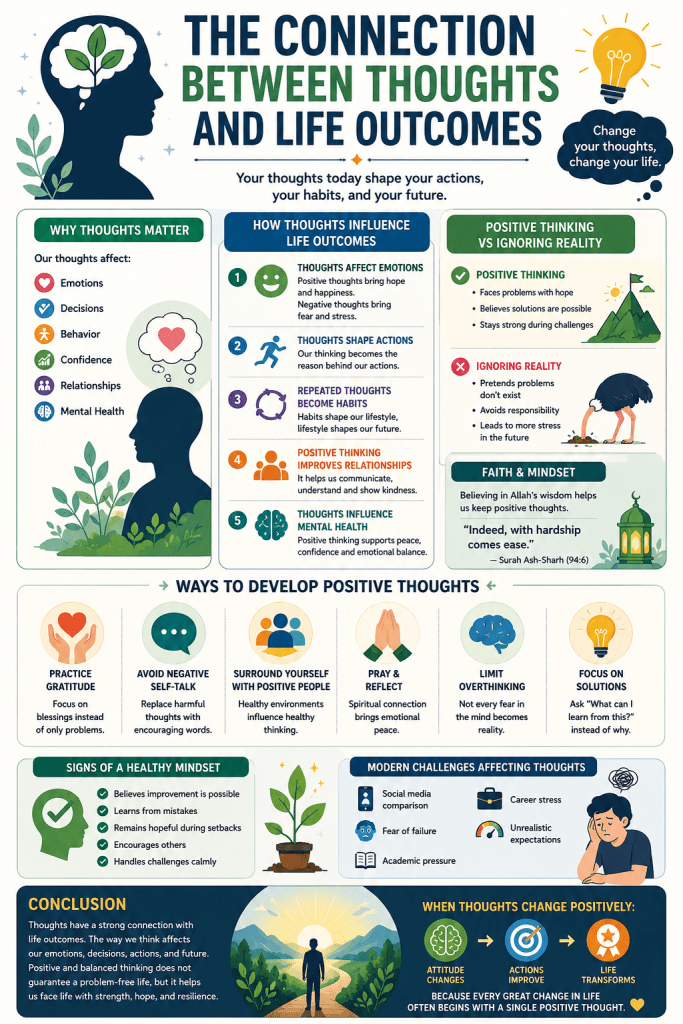
Our thoughts shape the way we see ourselves, others, and the world around us. Positive and healthy thinking can motivate growth and success, while negative thinking can create fear, stress, and hopelessness. The mind is powerful, and the thoughts we repeat daily often influence our actions, habits, and life outcomes.


Why Thoughts Matter

Thoughts are not just ideas in the mind. They affect:

  • Emotions
  • Decisions
  • Behavior
  • Confidence
  • Relationships
  • Mental health

What we think repeatedly often becomes part of our attitude and lifestyle.


How Thoughts Influence Life Outcomes

1. Thoughts Affect Emotions

Positive thoughts create:

  • Hope
  • Peace
  • Motivation
  • Happiness

Negative thoughts create:

  • Fear
  • Anxiety
  • Anger
  • Stress

Example:

  • Thinking “I can improve” builds confidence.
  • Thinking “I will always fail” creates self-doubt.

2. Thoughts Shape Actions

Our actions usually begin with our thinking.

For example:

  • A student who believes in success studies with confidence.
  • A person who constantly doubts themselves may stop trying.

Healthy thoughts encourage:

  • Hard work
  • Discipline
  • Courage
  • Consistency

3. Repeated Thoughts Become Habits

The mind learns through repetition.

If someone repeatedly thinks:

  • “I am capable,” they become more confident.
  • “Nothing good happens to me,” they may become negative and hopeless.

Over time:

  • Thoughts influence habits
  • Habits influence lifestyle
  • Lifestyle influences future outcomes

4. Positive Thinking Improves Relationships

Thoughts affect how we treat people.

Positive thinking helps people:

  • Show kindness
  • Communicate calmly
  • Forgive easily
  • Build healthy relationships

Negative thinking may lead to:

  • Misunderstanding
  • Jealousy
  • Anger
  • Isolation

5. Thoughts Influence Mental Health

Constant negative thinking can increase:

  • Stress
  • Overthinking
  • Anxiety
  • Emotional exhaustion

Positive thinking supports:

  • Emotional balance
  • Mental peace
  • Better coping skills
  • Self-confidence

The Difference Between Positive Thinking and Ignoring Reality

Positive thinking does not mean pretending problems do not exist.

It means:

  • Facing difficulties with hope
  • Believing solutions are possible
  • Staying mentally strong during challenges

Healthy thinking is realistic, balanced, and hopeful.


The Role of Faith and Mindset

Faith helps people maintain positive thoughts during difficult times.

Believing in Allah’s wisdom reminds us:

  • Every hardship has purpose
  • Difficulties are temporary
  • Patience brings reward

The Quran says:

“Indeed, with hardship comes ease.”
— Surah Ash-Sharh (94:6)

This verse teaches believers to remain hopeful even during struggles.


Ways to Develop Positive Thoughts

Practice Gratitude

Focus on blessings instead of only problems.

Avoid Negative Self-Talk

Replace harmful thoughts with encouraging words.

Surround Yourself with Positive People

Healthy environments influence healthy thinking.

Pray and Reflect

Spiritual connection brings emotional peace.

Limit Overthinking

Not every fear in the mind becomes reality.

Focus on Solutions

Instead of asking:

  • “Why is this happening to me?”
    Ask:
  • “What can I learn from this?”

Signs of a Healthy Mindset

A person with healthy thoughts:

  • Believes improvement is possible
  • Learns from mistakes
  • Remains hopeful during setbacks
  • Encourages others
  • Handles challenges calmly

Modern Challenges Affecting Thoughts

Today many people struggle with:

  • Social media comparison
  • Fear of failure
  • Academic pressure
  • Career stress
  • Unrealistic expectations

These can create negative thought patterns if not managed carefully.


Conclusion

Thoughts have a strong connection with life outcomes. The way we think affects our emotions, decisions, actions, and future. Positive and balanced thinking does not guarantee a problem-free life, but it helps people face life with strength, hope, and resilience.

A healthy mind creates a healthier life.
When thoughts change positively:

  • Attitude changes
  • Actions improve
  • Life gradually transforms

Because every great change in life often begins with a single positive thought.

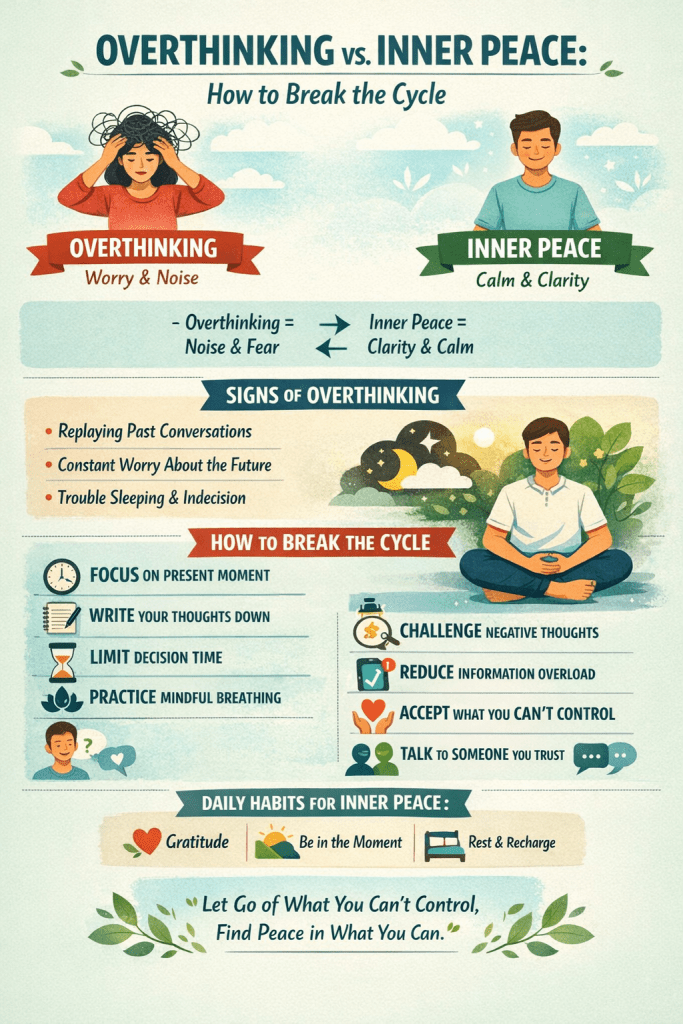
🧠 Overthinking vs. Inner Peace: How to Break the Cycle

🌪️ What is Overthinking?

  • Overthinking means constantly analyzing, worrying, or replaying situations in your mind
  • It often focuses on “what if” and worst-case scenarios
  • Instead of solving problems, it creates more stress and confusion

🕊️ What is Inner Peace?

  • Inner peace is a state of mental calm and emotional balance
  • It means accepting things you cannot control
  • A peaceful mind stays present, steady, and less reactive

⚖️ Overthinking vs. Inner Peace

  • Overthinking = Noise, doubt, fear
  • Inner Peace = Clarity, acceptance, calmness
  • Overthinking drains energy, while inner peace restores it

🚨 Signs You Are Overthinking

  • Replaying past conversations again and again
  • Constant worry about the future
  • Difficulty making decisions
  • Trouble sleeping due to racing thoughts
  • Feeling mentally exhausted without doing much

🌿 Why Do We Overthink?

  • Fear of failure or rejection
  • Need for control over everything
  • Lack of confidence in decisions
  • Past negative experiences
  • Trying to please everyone

🔓 How to Break the Overthinking Cycle

1. ⏳ Focus on the Present

  • Train your mind to stay in the current moment
  • Ask yourself: “Is this happening right now?”

2. ✍️ Write Your Thoughts Down

  • Journaling helps release thoughts instead of trapping them in your mind
  • It brings clarity and reduces mental pressure

3. 🎯 Limit Decision Time

  • Give yourself a time limit to think and decide
  • Avoid endless analysis—done is better than perfect

4. 🧘 Practice Mindfulness or Deep Breathing

  • Simple breathing exercises can calm your nervous system
  • Even 5 minutes daily makes a difference

5. 🚫 Challenge Negative Thoughts

  • Not every thought is true
  • Replace “What if everything goes wrong?” with
    “What if things turn out okay?”

6. 📵 Reduce Information Overload

  • Too much social media and comparison increase mental noise
  • Take breaks to protect your peace

7. 🤝 Accept What You Cannot Control

  • Peace begins when you stop trying to control everything
  • Focus only on your actions, not outcomes

8. 💬 Talk It Out

  • Sharing your thoughts with someone you trust reduces mental burden
  • You gain perspective and emotional relief

🌸 Daily Habits for Inner Peace

  • Start your day with gratitude
  • Spend time in silence or reflection
  • Keep your environment clean and calm
  • Practice self-compassion (be kind to yourself)
  • Get enough rest and take breaks

✨ Key Insight

  • Overthinking is not a sign of intelligence—it’s often a sign of unmanaged fear
  • Inner peace is not something you find outside—it’s something you build within

🌈 Conclusion

  • You don’t need to control every thought
  • You just need to choose which thoughts deserve your attention
  • The more you let go, the more peaceful your mind becomes

Everything Happens for a Reason

In everyday life, we often hear the phrase “Everything happens for a reason.” In Islam, this idea is deeply rooted in the belief of Qadr (Divine Decree)—that Allah has a perfect plan for everything that happens in our lives. Even when we don’t understand it, there is always wisdom behind it.


🌙 1. Allah Knows What We Do Not Know

Sometimes we feel confused, hurt, or disappointed when things don’t go our way. But Islam teaches us that Allah’s knowledge is far greater than ours.

Quran Verse:

“Perhaps you dislike something and it is good for you; and perhaps you love something and it is bad for you. And Allah knows, while you do not know.”
(Surah Al-Baqarah 2:216)

Meaning:
What we think is bad may actually protect us, and what we desire may not be good for us. Allah sees the full picture—we only see a small part.


🌱 2. Every Test Has a Purpose

Difficulties are not punishments, but tests meant to strengthen our faith and character.

Quran Verse:

“Do people think they will be left alone because they say, ‘We believe,’ and will not be tested?”
(Surah Al-Ankabut 29:2)

Meaning:
Life’s challenges are part of our journey. They help us grow, become patient, and get closer to Allah.


💭 3. Hardship Comes with Ease

No pain or struggle is permanent. Allah promises relief along with difficulty.

Quran Verse:

“Indeed, with hardship comes ease.”
(Surah Ash-Sharh 94:6)

Meaning:
After every difficulty, ease will come—sometimes in ways we don’t expect.


🤲 4. Allah’s Plan is Always the Best

Even when our plans fail, it doesn’t mean life is failing. It means Allah is redirecting us to something better.

Quran Verse:

“And Allah is the best of planners.”
(Surah Aal-e-Imran 3:54)

Meaning:
We plan based on what we want, but Allah plans based on what is best for us.


🌸 5. Nothing Happens Without Allah’s Permission

Every event in our life—big or small—is part of Allah’s decree.

Quran Verse:

“No disaster strikes except by permission of Allah.”
(Surah At-Taghabun 64:11)

Meaning:
This reminds us that everything is under Allah’s control, and nothing happens randomly.


🕊️ 6. Trust (Tawakkul) Brings Peace

When we truly trust Allah, our hearts become calm even in uncertain situations.

Quran Verse:

“And whoever relies upon Allah – then He is sufficient for him.”
(Surah At-Talaq 65:3)

Meaning:
When we depend on Allah, He takes care of our needs in ways we cannot imagine.


🌟 7. Real-Life Reflection

  • You didn’t get the job → Maybe a better opportunity is coming
  • A relationship ended → Maybe Allah is protecting your heart
  • You faced failure → Maybe it is preparing you for success

What feels like a setback today may be a blessing tomorrow.

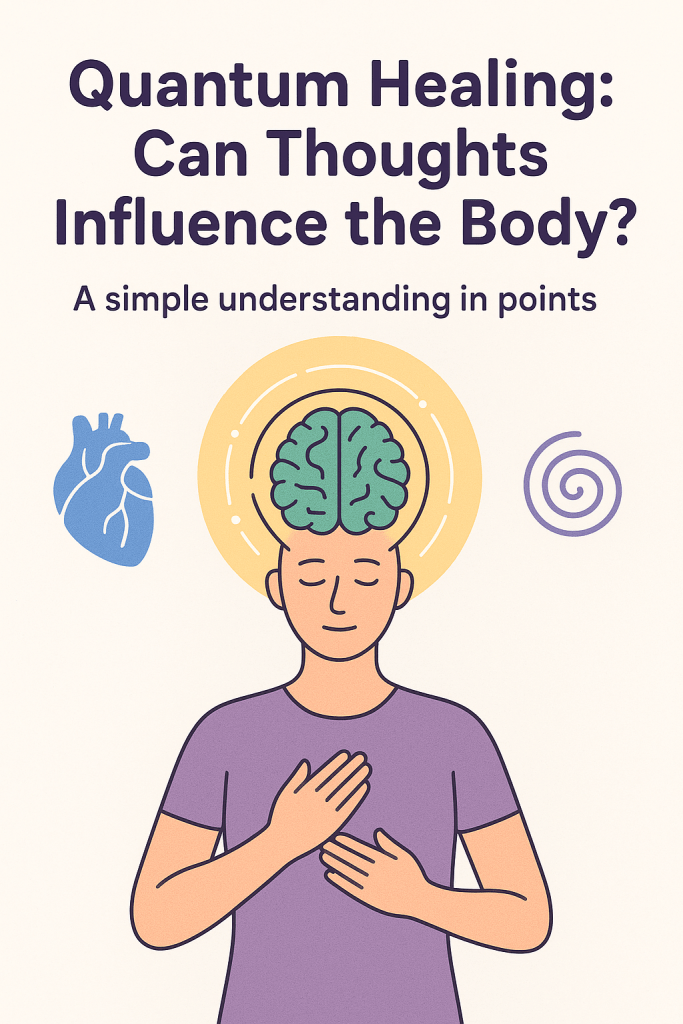
Quantum Healing: Can Thoughts Influence the Body?

1. Introduction: What is Quantum Healing?

  • Quantum healing is the idea that the mind and body are deeply connected.
  • It suggests that your thoughts, emotions, and beliefs can influence your physical health.
  • This concept is inspired by principles from quantum physics, which show that energy and consciousness can affect matter.

2. Everything in the Body Is Energy

  • At the smallest level, your body is made of atoms and energy—not just solid matter.
  • Your heartbeat, breathing, emotions, and thoughts all produce energy signals.
  • If your energy is balanced, you feel healthy; if it is disturbed, you feel unwell.

3. Thoughts Create Real Changes in the Body

  • When you think positively, your brain releases “good chemicals” like dopamine and serotonin.
  • When stressed or worried, your brain releases cortisol, which can weaken immunity.
  • This shows that thoughts have a direct physical impact.

4. The Observer Effect: Why Attention Matters

  • In quantum physics, particles behave differently when observed.
  • Similarly, when you focus your mind on healing, your body responds to that attention.
  • Meditation, prayer, and positive intention activate the body’s natural repair systems.

5. Emotions Carry Energy

  • Joy, gratitude, and love create high-energy states that support healing.
  • Fear, anger, and sadness create low-energy states that may slow down healing.
  • Shifting emotional energy can shift physical well-being.

6. Placebo Effect: Proof That Belief Heals

  • Doctors around the world have seen patients recover simply because they believed a treatment would work.
  • The mind convinced the body to heal—this is a real scientific example of quantum-like healing.

7. Daily Practices That Encourage Quantum Healing

  • Meditate for a few minutes every day to calm your energy.
  • Use positive affirmations (“My body is healing. I am strong.”).
  • Practice gratitude to raise emotional energy.
  • Visualize healing, imagining your body becoming healthier.
  • Stay conscious of your thoughts—replace negative ones gently.

8. Final Thoughts

  • Quantum healing doesn’t replace medical treatment, but it supports it.
  • Your mind is powerful—your thoughts can influence your body more than you realize.
  • When you change your thoughts, you change your energy.
  • When you change your energy, your body responds.

Peaceful Eternal Life

🌸 Introduction

Everyone seeks peace — not just in moments, but in life itself. A peaceful eternal life is about living with calmness, clarity, and contentment that lasts beyond temporary highs and lows. It’s not about how long we live, but how peacefully we live.


☀️ 1. Peace Begins Within

  • True peace starts from the mind and heart, not from the outside world.
  • Calm thoughts create calm actions.
  • When you learn to quiet your inner noise, life automatically feels lighter.

“Peace comes from within. Do not seek it without.” – Buddha


🌊 2. Let Go of What You Can’t Control

  • Life becomes peaceful when we stop fighting every situation.
  • Acceptance is the first step to inner harmony.
  • Control your reactions, not the world around you.

“The greatest weapon against stress is our ability to choose one thought over another.” – William James


🌿 3. Live with Kindness and Compassion

  • A peaceful heart is a kind heart.
  • Helping others, forgiving mistakes, and spreading love bring eternal satisfaction.
  • Compassion connects us to something divine and everlasting.

🌤 4. Stay Grateful Every Day

  • Gratitude transforms ordinary days into blessings.
  • Appreciate simple joys — sunrise, laughter, loved ones, good health.
  • Gratitude invites peace and pushes away negativity.

“Gratitude turns what we have into enough.” – Anonymous


🌙 5. Connect with the Spiritual Side

  • Meditation, prayer, or quiet reflection can calm your soul.
  • Believe that life has a higher purpose beyond material success.
  • Spiritual awareness helps you feel eternal peace, beyond fear or loss.

🌻 6. Live in Harmony with Nature

  • Nature teaches balance and serenity.
  • Spend time under the sky, near trees or water — it heals silently.
  • When you live close to nature, you live close to peace.

🌈 7. Simplicity is the Secret

  • The less you chase, the more you rest.
  • Simplify your wants, declutter your mind, and value peace over possessions.
  • Eternal peace comes when you stop competing and start living mindfully.

🌟 Conclusion

Peaceful eternal life isn’t a faraway dream — it’s a state of being we can nurture every day.
It’s in our thoughts, choices, and the love we share.
When you live with peace in your heart, you live eternally — even in moments.

“Peace is not the destination, it is the way.” – Thich Nhat Hanh

From Resistance to Release: Learning to Trust Life’s Flow

🌸 Introduction

Life often feels like a river — sometimes calm, sometimes stormy. Yet, instead of floating, we often resist the current, trying to control everything. This resistance creates stress and exhaustion. True peace begins when we release control and learn to trust life’s natural flow.


💧 1. Resistance Creates Tension

  • When we cling too tightly to expectations, we struggle.
  • Resistance is like swimming against the current — tiring and frustrating.
  • Life is not meant to be forced; it is meant to be lived.

“What you resist, persists. What you accept, transforms.”


💧 2. The Power of Release

  • Release is not giving up; it is letting go of unnecessary struggle.
  • It means surrendering what you cannot control.
  • Trust that every setback is a redirection toward growth.

“Surrender is not weakness; it is strength aligned with wisdom.”


💧 3. Trusting the Flow

  • Life has its own rhythm — just like seasons, tides, and sunrise.
  • Trusting the flow means believing that life carries lessons, opportunities, and healing.
  • Sometimes, what looks like an ending is actually a beginning.

“Trust the process, even when the path is unclear.”


💧 4. Practical Ways to Flow with Life

  • Practice mindfulness – be present instead of worrying about tomorrow.
  • Breathe deeply – calm your mind when overwhelmed.
  • Write a gratitude journal – focus on what’s working.
  • Release control – accept that not everything is in your hands.

🌸 Conclusion

Moving from resistance to release is a journey. When we stop fighting life and start trusting its flow, we discover inner peace. Life is not about controlling the current but learning to float gracefully with it.

“Flow with life, and life will flow through you with peace.”

Calmness and Clarity in Everyday Life

🌿 Introduction

Life today often feels rushed, noisy, and overwhelming. Between responsibilities, technology, and constant demands, our minds rarely find rest. Yet, calmness and clarity are not luxuries—they are essential for balance, decision-making, and happiness. With simple practices, we can bring peace into our everyday life.


🌸 Simple Ways to Cultivate Calmness and Clarity

  1. Start Your Day Slowly
    • Avoid rushing into your phone or work.
    • Begin with a few minutes of quiet breathing, stretching, or gratitude.
  2. Practice Mindful Breathing
    • A few deep breaths can instantly reduce stress.
    • Breathing anchors the mind and helps you focus better.
  3. Declutter Your Surroundings
    • A clean space clears mental clutter.
    • Keep only what is useful and meaningful around you.
  4. Take Short Breaks
    • Step away from work, screens, or noise.
    • Even 5 minutes of silence refreshes the mind.
  5. Limit Information Overload
    • Too much news, social media, or notifications creates anxiety.
    • Be selective with what you consume daily.
  6. Spend Time in Nature
    • Walking in a park, sitting under a tree, or listening to birds brings instant calm.
    • Nature naturally clears the mind.
  7. Write It Out
    • Journaling helps release confusion and emotions.
    • Clarity often comes when thoughts are on paper.
  8. Stay Present
    • Worrying about the future or replaying the past disturbs peace.
    • Focus on what you can do right now.
  9. Practice Gratitude
    • Recognize small blessings daily.
    • Gratitude shifts the mind from chaos to calm.
  10. End the Day with Reflection
    • Review your day with kindness, not judgment.
    • Let go of stress before you sleep.

🌟 Conclusion

Calmness and clarity don’t come from escaping life—they come from how we live each moment. By slowing down, simplifying, and staying present, we can handle challenges with peace instead of pressure. A calm mind sees clearly, and a clear mind lives fully.

Nothing In Life Is Free

Introduction

In life, we often come across things that seem free—opportunities, favors, or even knowledge. But if we look closely, nothing is truly free. Behind every blessing lies someone’s effort, time, or sacrifice. Understanding this truth helps us value what we receive and inspires us to work harder for what we desire.

Key Points

  1. Every Blessing Has a Price
    • Life may offer you opportunities, knowledge, or support, but each comes with a price—hard work, patience, or sacrifice.
  2. Time Is the Greatest Currency
    • The hours you invest in learning, relationships, or dreams are far more valuable than money. Nothing grows without your time.
  3. Behind Every Gift Lies Effort
    • The love of parents, guidance of teachers, or kindness of friends may seem free, but they carry countless sacrifices and selfless efforts.
  4. Success Demands Investment
    • No shortcut, no magic formula. Success requires sweat, discipline, and resilience. What looks “free” often hides years of struggle.
  5. Gratitude Opens Your Eyes
    • When you receive something without paying, pause and reflect. Someone else has already paid the price. Respect it.
  6. Life’s Silent Rule
    • The universe whispers a simple truth: You get what you work for, not what you wish for. Nothing is truly free.

Conclusion

The truth is simple: nothing in life is free. Every achievement, every gift, and every opportunity has a cost—whether paid in time, effort, or sacrifice. When we embrace this reality, we stop taking things for granted and start valuing both our own efforts and the sacrifices of others. Success, love, and growth are never free, but they are always worth the price we pay.

Design Your Tomorrow: Habits That Shape a Better You

✨ The life you want tomorrow is built on the choices you make today. Developing the right habits can transform your mindset, health, and future. Here are some simple habits to shape a better you:


1. Start Your Day with Intention

  • Wake up early and avoid rushing.
  • Spend a few minutes planning your day.
  • Set 1–2 top priorities instead of an overwhelming list.

2. Practice Gratitude

  • Write down 3 things you’re thankful for.
  • Gratitude shifts focus from problems to possibilities.
  • It builds positivity and emotional strength.

3. Fuel Your Body Right

  • Eat balanced meals with whole foods.
  • Stay hydrated throughout the day.
  • Avoid excess sugar and processed foods.

4. Move Your Body Daily

  • Even 20–30 minutes of walking, stretching, or yoga helps.
  • Exercise improves energy and mental clarity.
  • Consistency matters more than intensity.

5. Prioritize Learning

  • Read, listen to podcasts, or take short courses.
  • Learning keeps the brain sharp and boosts confidence.
  • Even 10 minutes a day compounds over time.

6. Declutter Your Mind

  • Journal your thoughts to reduce stress.
  • Practice mindfulness or meditation.
  • Create digital boundaries by limiting screen time.

7. Build Strong Connections

  • Spend time with people who uplift you.
  • Practice active listening and empathy.
  • Meaningful relationships improve happiness and health.

8. End Your Day with Reflection

  • Review what went well and what can improve.
  • Celebrate small wins.
  • Prepare for tomorrow with clarity.

Remember:
Small habits shape big results. You don’t need to change everything at once—just start with one habit today. Over time, your daily actions will design a tomorrow you’ll be proud of.