
Introduction
Have you ever replayed a conversation over and over in your mind? Or spent hours worrying about something that hasn’t even happened yet? If yes, you’re not alone.
Overthinking is a common experience. While thinking carefully before making decisions is helpful, overthinking happens when our thoughts become repetitive, negative, and unproductive. Instead of solving problems, it often creates more stress and confusion.
Let’s explore why we overthink and how we can overcome it.
What Is Overthinking?
Overthinking means spending too much time analyzing situations, worrying about the future, or dwelling on the past.
It often includes:
- Replaying conversations repeatedly.
- Worrying about “what if” situations.
- Constantly questioning your decisions.
- Imagining the worst possible outcomes.
- Feeling mentally exhausted without finding solutions.
Why Do We Overthink?
Our brain is designed to protect us from danger. Sometimes, it mistakes everyday challenges as serious threats, causing us to think excessively.
Common reasons include:
1. Fear of Making Mistakes
Many people worry that one wrong decision will lead to failure.
Example:
“I hope I didn’t say something wrong during the meeting.”
2. Perfectionism
People who want everything to be perfect often spend too much time thinking before taking action.
They may believe:
- “I must never make mistakes.”
- “Everything has to be perfect.”
3. Anxiety About the Future
Uncertainty makes many people uncomfortable.
Questions like:
- “What if I fail?”
- “What if something goes wrong?”
can keep the mind trapped in endless worry.
4. Low Self-Confidence
When people doubt themselves, they often seek certainty before making even simple decisions.
5. Past Experiences
Negative experiences, criticism, or failures can make people more cautious and lead to repeated thinking.
Signs That You’re Overthinking
You may be overthinking if you:
- Replay conversations repeatedly.
- Struggle to make simple decisions.
- Lose sleep because of constant thoughts.
- Imagine worst-case scenarios.
- Feel mentally tired most of the time.
- Find it difficult to enjoy the present moment.
How Overthinking Affects Your Life
Mental Health
- Increases stress.
- Raises anxiety levels.
- Reduces peace of mind.
Physical Health
- Poor sleep.
- Headaches.
- Muscle tension.
- Fatigue.
Relationships
- Misunderstandings.
- Constant need for reassurance.
- Difficulty trusting others.
Work and Studies
- Delayed decisions.
- Reduced productivity.
- Missed opportunities.
- Difficulty concentrating.
The Psychology Behind Overthinking
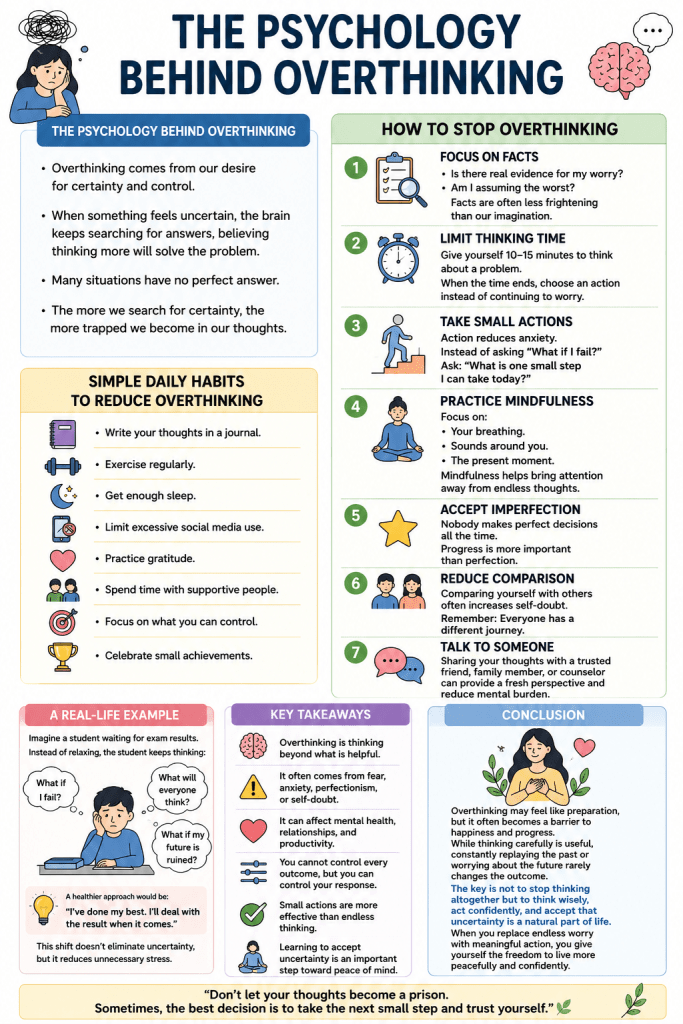
Psychologists explain that overthinking often comes from our desire for certainty and control.
When something feels uncertain, the brain keeps searching for answers, believing that thinking more will solve the problem.
Unfortunately, many situations in life have no perfect answer.
The more we search for certainty, the more trapped we become in our thoughts.
How to Stop Overthinking
1. Focus on Facts
Ask yourself:
- Is there real evidence for my worry?
- Am I assuming the worst?
Facts are often less frightening than our imagination.
2. Limit Thinking Time
Give yourself 10–15 minutes to think about a problem.
When the time ends, choose an action instead of continuing to worry.
3. Take Small Actions
Action reduces anxiety.
Instead of asking:
“What if I fail?”
Ask:
“What is one small step I can take today?”
4. Practice Mindfulness
Focus on:
- Your breathing.
- Sounds around you.
- The present moment.
Mindfulness helps bring attention away from endless thoughts.
5. Accept Imperfection
Nobody makes perfect decisions all the time.
Progress is more important than perfection.
6. Reduce Comparison
Comparing yourself with others often increases self-doubt.
Remember:
Everyone has a different journey.
7. Talk to Someone
Sharing your thoughts with a trusted friend, family member, or counselor can provide a fresh perspective and reduce mental burden.
Simple Daily Habits to Reduce Overthinking
✔ Write your thoughts in a journal.
✔ Exercise regularly.
✔ Get enough sleep.
✔ Limit excessive social media use.
✔ Practice gratitude.
✔ Spend time with supportive people.
✔ Focus on what you can control.
✔ Celebrate small achievements.
A Real-Life Example
Imagine a student waiting for exam results.
Instead of relaxing, the student keeps thinking:
- “What if I fail?”
- “What will everyone think?”
- “What if my future is ruined?”
The result hasn’t even arrived, but the mind has already created many stressful stories.
A healthier approach would be:
“I’ve done my best. I’ll deal with the result when it comes.”
This shift doesn’t eliminate uncertainty, but it reduces unnecessary stress.
Key Takeaways
- Overthinking is thinking beyond what is helpful.
- It often comes from fear, anxiety, perfectionism, or self-doubt.
- It can affect mental health, relationships, and productivity.
- You cannot control every outcome, but you can control your response.
- Small actions are more effective than endless thinking.
- Learning to accept uncertainty is an important step toward peace of mind.
Conclusion
Overthinking may feel like preparation, but it often becomes a barrier to happiness and progress. While thinking carefully is useful, constantly replaying the past or worrying about the future rarely changes the outcome.
The key is not to stop thinking altogether but to think wisely, act confidently, and accept that uncertainty is a natural part of life.
When you replace endless worry with meaningful action, you give yourself the freedom to live more peacefully and confidently.
“Don’t let your thoughts become a prison. Sometimes, the best decision is to take the next small step and trust yourself.” 🌿

