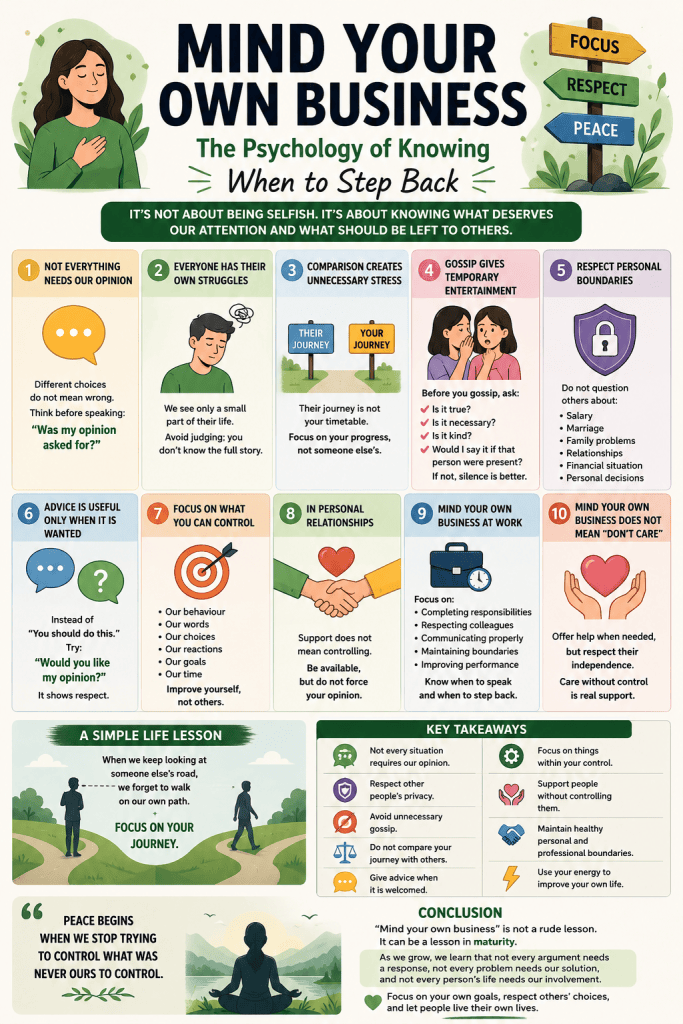
Mind Your Own Business: The Psychology of Knowing When to Step Back

In everyday life, we often become interested in other people’s choices, problems, relationships, careers, and personal matters. Sometimes we give advice because we care. But sometimes, without realizing it, we cross personal boundaries. “Mind your own business” is not about being selfish or uncaring. It is about knowing what deserves our attention and what should be left to others.

1. Not Everything Needs Our Opinion

We do not need to have an opinion about everything.

A person’s career choice, lifestyle, appearance, relationship, or personal decision may be different from ours. Different does not always mean wrong.

Think before speaking:
“Was my opinion asked for?”

2. Everyone Has Their Own Struggles

We often see only a small part of someone’s life.

A person who looks happy may be dealing with problems privately. A person who seems successful may have faced many failures before reaching that position.

Therefore, judging someone based on what we see can be unfair.

3. Comparison Creates Unnecessary Stress

Constantly watching what others are doing can make us feel that we are behind.

Someone may get a job before us.
Someone may get married earlier.
Someone may earn more.
Someone may appear more successful.

Their journey is not our timetable.

Focus on your progress instead of measuring your life against someone else’s.

4. Gossip Gives Temporary Entertainment

Talking about other people’s personal matters may feel interesting, but gossip can damage relationships and trust.

Before sharing something about another person, ask:

  • Is it true?
  • Is it necessary?
  • Is it kind?
  • Would I say it if that person were present?

If not, silence is often the better choice.

5. Respect Personal Boundaries

Everyone has a right to privacy.

We should not unnecessarily question someone about:

  • Their salary
  • Marriage
  • Family problems
  • Personal relationships
  • Financial situation
  • Personal decisions

Caring about someone does not mean having access to every part of their life.

6. Advice Is Useful Only When It Is Wanted

Good advice can help, but unwanted advice can feel like criticism.

Instead of saying:

“You should do this.”

Try:

“Would you like my opinion?”

This simple question shows respect.

7. Focus on What You Can Control

We cannot control other people’s decisions.

We can control:

  • Our behaviour
  • Our words
  • Our choices
  • Our reactions
  • Our goals
  • Our time

Life becomes easier when we spend more energy improving ourselves than correcting everyone else.

8. In Personal Relationships

Sometimes we become too involved in the lives of friends or relatives.

For example, a friend may choose to stay in a difficult relationship. We can express concern, but repeatedly forcing our opinion may push the person away.

Support does not always mean controlling. Sometimes it means being available when they need us.

9. Mind Your Own Business at Work

In the workplace, unnecessary involvement in colleagues’ personal matters can create conflict.

A professional person focuses on:

  • Completing responsibilities
  • Respecting colleagues
  • Communicating properly
  • Maintaining boundaries
  • Improving performance

Professionalism means knowing when to speak and when to step back.

10. Mind Your Own Business Does Not Mean “Don’t Care”

There is an important difference between indifference and healthy boundaries.

If someone genuinely needs help, we should offer support.

But if someone is capable of making their own decision, we should respect their independence.

Care without control is a healthy form of support.

We lose focus on our own journey.

Key Takeaways

  • Not every situation requires our opinion.
  • Respect other people’s privacy.
  • Avoid unnecessary gossip.
  • Do not compare your journey with others.
  • Give advice when it is welcomed.
  • Focus on things within your control.
  • Support people without controlling them.
  • Maintain healthy personal and professional boundaries.
  • Use your energy to improve your own life.

Conclusion

“Mind your own business” is not a rude lesson. It can be a lesson in maturity.

As we grow, we learn that not every argument needs a response, not every problem needs our solution, and not every person’s life needs our involvement.

Sometimes, the healthiest thing we can do is simply focus on our own goals, respect other people’s choices, and let people live their own lives.

“Peace begins when we stop trying to control what was never ours to control.” 🌿

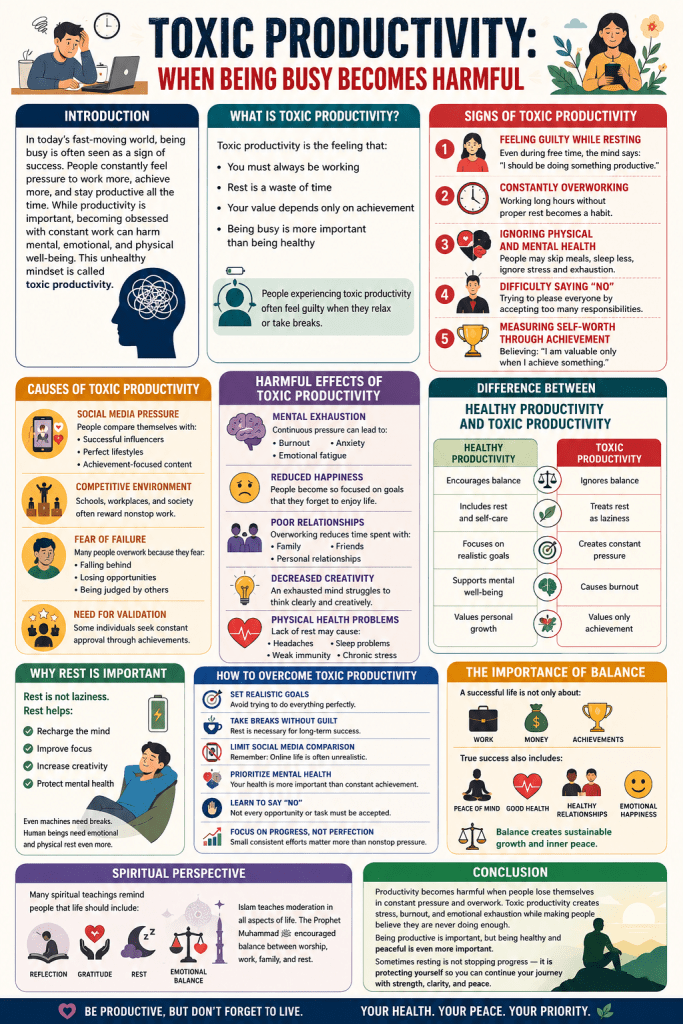
Toxic Productivity: When Being Busy Becomes Harmful

Introduction

In today’s fast-moving world, being busy is often seen as a sign of success. People constantly feel pressure to work more, achieve more, and stay productive all the time. While productivity is important, becoming obsessed with constant work can harm mental, emotional, and physical well-being. This unhealthy mindset is called toxic productivity.


What is Toxic Productivity?

Toxic productivity is the feeling that:

  • You must always be working
  • Rest is a waste of time
  • Your value depends only on achievement
  • Being busy is more important than being healthy

People experiencing toxic productivity often feel guilty when they relax or take breaks.


Signs of Toxic Productivity

1. Feeling Guilty While Resting

Even during free time, the mind says:

  • “I should be doing something productive.”

2. Constantly Overworking

Working long hours without proper rest becomes a habit.

3. Ignoring Physical and Mental Health

People may:

  • Skip meals
  • Sleep less
  • Ignore stress and exhaustion

4. Difficulty Saying “No”

Trying to please everyone by accepting too many responsibilities.

5. Measuring Self-Worth Through Achievement

Believing:

  • “I am valuable only when I achieve something.”

Causes of Toxic Productivity

Social Media Pressure

People compare themselves with:

  • Successful influencers
  • Perfect lifestyles
  • Achievement-focused content

Competitive Environment

Schools, workplaces, and society often reward nonstop work.

Fear of Failure

Many people overwork because they fear:

  • Falling behind
  • Losing opportunities
  • Being judged by others

Need for Validation

Some individuals seek constant approval through achievements.


Harmful Effects of Toxic Productivity

Mental Exhaustion

Continuous pressure can lead to:

  • Burnout
  • Anxiety
  • Emotional fatigue

Reduced Happiness

People become so focused on goals that they forget to enjoy life.

Poor Relationships

Overworking reduces time spent with:

  • Family
  • Friends
  • Personal relationships

Decreased Creativity

An exhausted mind struggles to think clearly and creatively.

Physical Health Problems

Lack of rest may cause:

  • Headaches
  • Sleep problems
  • Weak immunity
  • Chronic stress

Difference Between Healthy Productivity and Toxic Productivity

Healthy ProductivityToxic Productivity
Encourages balanceIgnores balance
Includes rest and self-careTreats rest as laziness
Focuses on realistic goalsCreates constant pressure
Supports mental well-beingCauses burnout
Values personal growthValues only achievement

Why Rest is Important

Rest is not laziness.
Rest helps:

  • Recharge the mind
  • Improve focus
  • Increase creativity
  • Protect mental health

Even machines need breaks. Human beings need emotional and physical rest even more.


How to Overcome Toxic Productivity

Set Realistic Goals

Avoid trying to do everything perfectly.

Take Breaks Without Guilt

Rest is necessary for long-term success.

Limit Social Media Comparison

Remember:

  • Online life is often unrealistic.

Prioritize Mental Health

Your health is more important than constant achievement.

Learn to Say “No”

Not every opportunity or task must be accepted.

Focus on Progress, Not Perfection

Small consistent efforts matter more than nonstop pressure.


The Importance of Balance

A successful life is not only about:

  • Work
  • Money
  • Achievements

True success also includes:

  • Peace of mind
  • Good health
  • Healthy relationships
  • Emotional happiness

Balance creates sustainable growth and inner peace.


Spiritual Perspective

Many spiritual teachings remind people that life should include:

  • Reflection
  • Gratitude
  • Rest
  • Emotional balance

Islam teaches moderation in all aspects of life. The Prophet Muhammad ﷺ encouraged balance between worship, work, family, and rest.


Conclusion

Productivity becomes harmful when people lose themselves in constant pressure and overwork. Toxic productivity creates stress, burnout, and emotional exhaustion while making people believe they are never doing enough.

Being productive is important, but being healthy and peaceful is even more important.

Sometimes resting is not stopping progress — it is protecting yourself so you can continue your journey with strength, clarity, and peace.

Quantum Superposition: You Can Be More Than One Version of Yourself

Introduction

In quantum physics, superposition means a particle can exist in multiple states at the same time until someone observes it. This mind-bending idea isn’t just for scientists. It mirrors our personal journey. In life, we often forget that we too carry many possible versions of ourselves waiting to unfold.


1. You carry many possibilities within you

In superposition, a particle can be here and there.
In life, you can be strong and scared. Brave and unsure. Learning and leading.
You don’t have to fit into one fixed label.

Your identity is a wide horizon, not a locked room.


2. You don’t have to decide who you are immediately

Superposition teaches that reality settles only when observed.
Similarly, you don’t need to rush your life decisions.
Career, relationships, dreams — these don’t always need instant clarity.
Give yourself permission to explore before choosing.


3. You can reinvent yourself anytime

Just like a particle collapses into a specific state when observed, you can choose which version of yourself to activate today.
Want to be more confident? More disciplined? More patient?
You can select that version and let it grow.

The choice becomes the turning point.


4. Your circumstances do not define your potential

Superposition reminds us that there is always more happening beneath the surface.
Your potential isn’t limited by your past or present situation.
There are countless paths hidden inside you, waiting to be chosen.


5. You are allowed to grow in different directions

People often feel pressure to be consistent, predictable, or a “single type” of person.
But you can be a creative thinker and a practical planner.
A dreamer and a doer.
A calm person and a bold decision-maker.

Life becomes richer when you embrace your complexity instead of hiding it.


6. Your future is a collection of possibilities

Superposition shows that reality isn’t fixed.
Your future isn’t fixed either.
Small shifts in choice, mindset, and habits can unlock entirely new paths.

Every day, you decide which version of yourself steps forward.


Final Thoughts

Quantum superposition gently reminds us that we are not stuck. We are not one-dimensional. We are not limited to a single identity or destiny. Within each of us lives a constellation of possibilities, waiting to be chosen at the right moment.

You are allowed to evolve.
You are allowed to change.

💫 You Are Exactly Where You’re Meant to Be

🌸 Introduction

There are times in life when we question everything — our choices, timing, and even our direction. We wonder if we’ve missed opportunities or fallen behind. But what if everything is actually happening just as it’s supposed to? What if, right now, you are exactly where you’re meant to be?
Sometimes, peace doesn’t come from changing your situation, but from trusting the path you’re already on.


Life unfolds with purpose


Every experience, whether joyful or painful, is shaping you into the person you’re meant to become. Nothing in your journey is wasted.

  1. God’s timing is perfect
    Delays aren’t denials. They are divine pauses, preparing you for something greater. You’re not late — you’re aligned with a higher plan.
  2. Every season has a reason
    Life has seasons of growth, waiting, and healing. Each one serves its own purpose in helping you evolve.
  3. Stop comparing your journey
    Someone else’s progress doesn’t define your own. Your path is uniquely yours, designed with care and intention.
  4. Embrace the present moment
    True peace comes from acceptance. When you stop resisting where you are, you begin to see the beauty hidden in this phase.
  5. Challenges are part of the process
    Struggles don’t mean you’re lost. Often, they’re lessons in disguise, guiding you toward greater strength and wisdom.
  6. You are growing, even in silence
    Growth isn’t always visible. Sometimes, God works quietly behind the scenes, aligning everything perfectly for your next step.
  7. Trust the divine plan
    Even when you don’t understand why things happen, believe that everything unfolds for your ultimate good.
  8. Be grateful for the now
    Gratitude transforms your outlook. When you focus on what’s good right now, life feels lighter and more meaningful.
  9. You are not behind — you’re becoming
    Every step, even the confusing ones, is leading you closer to where you’re supposed to be. You are learning, evolving, and becoming stronger with each experience.

Final Thoughts

Life isn’t a race, and you’re not missing out on anything meant for you. Every chapter — even the slow or difficult ones — is essential to your story. Trust that this moment has a purpose, even if you can’t see it yet.
When you let go of resistance and lean into faith, you’ll realize that you are right where you’re supposed to be — growing, healing, and preparing for what’s next.


🌼 Quote to Reflect On:

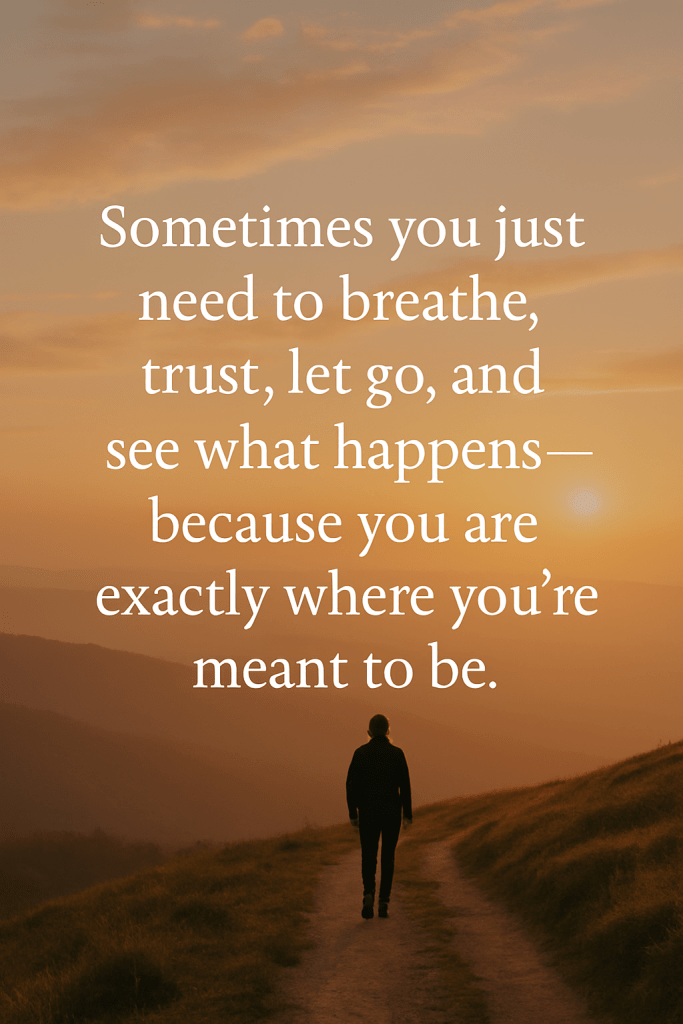
“Sometimes you just need to breathe, trust, let go, and see what happens — because you are exactly where you’re meant to be.”

Life Never Stops Teaching Us

Introduction

Life is the greatest teacher we will ever have. Unlike classrooms or formal education, life teaches us through experiences—some sweet, some bitter, but all meaningful. Each day holds lessons waiting to be discovered, and the best part is that the learning never ends.

Lessons from Life

  • Life is the best teacher
    Books may give us information, but real wisdom comes from living through ups and downs.
  • Every experience carries a lesson
    Joy teaches gratitude, while pain builds strength. Both are equally important for growth.
  • Success is a reminder of effort
    Achievements show us the importance of dedication, focus, and belief in ourselves.
  • Failures are stepping stones
    Mistakes guide us toward better choices and remind us that failure is not the end but a new beginning.
  • People shape our learning
    Some people inspire us with kindness, others test our patience, and a few show us whom not to trust. Every person leaves a lesson behind.
  • Challenges bring growth
    Life’s struggles are not punishments but opportunities to become stronger, braver, and wiser.
  • Change keeps us adaptable
    Seasons, situations, and circumstances keep changing. Accepting change teaches us flexibility and resilience.
  • Small things hold deep wisdom
    A sunrise inspires hope, a smile spreads joy, and silence teaches peace. Life whispers wisdom in simple ways.

Conclusion

Life never stops teaching us. The journey of learning doesn’t end with age, success, or status—it continues every day in different forms. The real secret is to keep an open heart and mind, so that every experience, whether good or bad, becomes a stepping stone to wisdom and growth. If we remain lifelong learners, life will always guide us toward becoming our best selves.

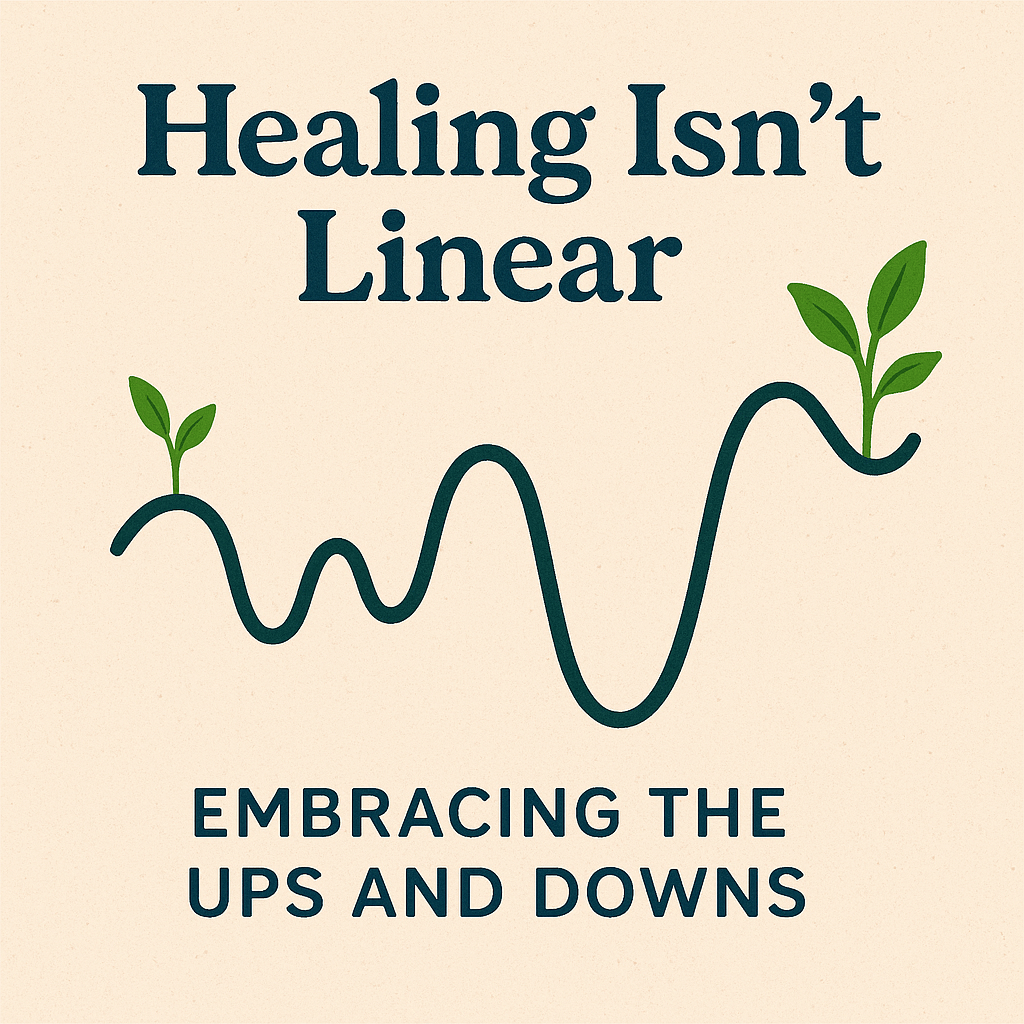
🌱 Healing Isn’t Linear: Embracing the Ups and Downs

Healing—whether emotional, mental, or physical—is not a straight path. It’s a journey filled with progress, setbacks, and moments that may feel like you’re going in circles. And that’s okay.


1. Healing Takes Time

  • Recovery doesn’t happen overnight.
  • It’s okay to take days, weeks, or even years.
  • Be patient with yourself.

2. It’s Normal to Have Good and Bad Days

  • Some days you’ll feel strong, other days you won’t.
  • Bad days don’t erase your progress.
  • Every step, even backward, is part of the journey.

3. Progress Isn’t Always Visible

  • Just because you can’t see improvement doesn’t mean it’s not happening.
  • Inner changes often take time to show on the outside.

4. Setbacks Are Not Failures

  • Falling back into old patterns is common.
  • It’s not a failure—it’s part of learning and growing.
  • Use it as a lesson, not a reason to give up.

5. Celebrate Small Wins

  • Even small steps matter—like getting out of bed, saying “no,” or smiling again.
  • Every tiny win adds up to big change.

6. Your Journey Is Unique

  • Don’t compare your healing to others.
  • Everyone heals at their own pace and in their own way.
  • What works for someone else may not work for you—and that’s okay.

7. Allow Yourself to Feel

  • Don’t hide your emotions—feel them.
  • Crying, anger, or sadness are not signs of weakness.
  • Emotions are part of processing and healing.

8. Ask for Help When You Need It

  • You don’t have to do it alone.
  • Talk to a friend, therapist, or support group.
  • Asking for help is a strength, not a weakness.

9. Be Kind to Yourself

  • Talk to yourself with love and compassion.
  • You’re doing your best, and that’s enough.
  • Replace self-criticism with encouragement.

10. Healing Is Ongoing

  • Healing doesn’t mean you’ll never feel pain again.
  • It means you learn to carry it with more strength and less fear.
  • It’s about growing through what you go through.

🌼 Final Thought:

Healing isn’t a straight line—it’s a journey of twists, turns, detours, and growth. Embrace the process, honor your progress, and trust that every step—even the tough ones—is leading you toward a stronger you.

Difficulties Strengthen the Mind, as Labor Does the Body

Life is full of challenges, and how we face them shapes our mental strength. Just as physical labor builds and strengthens the body, mental challenges and difficulties shape and strengthen the mind. Rather than avoiding challenges, we should embrace them as opportunities for growth, resilience, and self-discovery.

1. Overcoming Adversity Builds Resilience

  • Difficult situations push us to adapt and grow.
  • Every challenge faced and overcome strengthens our ability to cope with future struggles.
  • Resilience allows us to bounce back stronger from setbacks.

2. Mental Strength Comes from Pushing Limits

  • Like exercising muscles, mental strength grows when we push ourselves beyond our comfort zones.
  • Facing discomfort helps us develop the discipline and perseverance needed to overcome challenges.
  • Each time we face a difficult situation, our capacity to deal with stress and uncertainty increases.

3. Problem-Solving Skills Improve Through Struggles

  • Difficulty forces us to think creatively and find solutions.
  • Problem-solving is like a mental workout; it strengthens our ability to think critically and make decisions under pressure.
  • The more problems we tackle, the more efficient and resourceful we become.

4. Building Patience and Persistence

  • Difficulty teaches us patience, as we realize that success doesn’t come overnight.
  • Persistence, nurtured through overcoming difficulties, is key to achieving long-term goals.
  • Learning to stay committed during tough times translates into greater mental endurance.

5. Enhancing Self-Awareness

  • Difficulties often challenge our beliefs, values, and assumptions.
  • By reflecting on our reactions and thoughts during difficult times, we develop greater self-awareness.
  • Knowing ourselves better makes it easier to control emotions and maintain mental peace during challenges.

6. Transforming Failure into Growth

  • Failure is often seen as the result of difficulty, but it’s also an opportunity to learn.
  • Each failure teaches valuable lessons that build mental fortitude.
  • Embracing failure as a stepping stone helps us grow stronger and more focused on success.

7. Strengthening Focus and Determination

  • In times of difficulty, staying focused on the goal becomes even more critical.
  • Developing the ability to stay determined, even when the path is tough, strengthens mental clarity and concentration.
  • The more we push through difficult situations, the sharper our focus becomes.

8. Gratitude for the Journey

  • Embracing difficulty helps us appreciate life’s good moments more fully.
  • It teaches us gratitude for the strength we gain through hardship.
  • The challenges we face shape us into stronger, wiser individuals, ready to take on even greater tasks.

Be Proactive, Not Reactive

Introduction

Life constantly throws challenges and opportunities at us. How we handle them defines the quality of our journey. Being reactive—waiting for situations to unfold before acting—can lead to stress and missed opportunities. On the other hand, being proactive allows us to take control, plan ahead, and create positive outcomes. Proactive people don’t wait for things to happen; they make things happen.

1. What Does It Mean to Be Proactive?

  • Being proactive means taking initiative, anticipating challenges, and acting before situations demand it.
  • It’s about focusing on solutions rather than being overwhelmed by problems.

2. The Problem with Being Reactive

  • Reacting often means making decisions based on emotions, like panic or frustration.
  • It leads to rushed actions and a feeling of being out of control.

3. Benefits of Being Proactive

  • Better Control: You direct your life instead of letting circumstances dictate your path.
  • Improved Planning: You’re prepared for challenges before they arise.
  • Reduced Stress: Tackling problems early prevents them from becoming crises.
  • More Opportunities: A proactive approach often opens doors that others miss.

4. Examples of Proactive vs. Reactive

  • Proactive: Saving money regularly for emergencies.
    Reactive: Borrowing money last minute when faced with unexpected expenses.
  • Proactive: Seeking feedback at work to improve performance.
    Reactive: Waiting for a problem to occur before addressing it.

5. Steps to Be Proactive

  • Set Clear Goals: Know what you want and work steadily toward it.
  • Plan Ahead: Break tasks into smaller steps and start early.
  • Anticipate Challenges: Think about potential obstacles and prepare solutions.
  • Take Responsibility: Acknowledge your role in shaping outcomes instead of blaming circumstances.

6. Building a Proactive Mindset

  • Focus on what you can control and let go of what you can’t.
  • Practice mindfulness to stay calm and think clearly.
  • Surround yourself with people who encourage growth and positivism.

7. Overcoming Challenges to Stay Proactive

  • Stress and uncertainty can make it easy to fall back into reactive habits.
  • Build small habits like daily planning and reflecting on your actions to stay proactive.

8. Proactive People Inspire Change

  • Your proactive mindset can influence others to take charge of their lives.
  • Together, proactive actions can lead to broader positive changes in communities and workplaces.

Take Charge of Your Life

Life may not always go as planned, but a proactive mindset helps you navigate its twists and turns with confidence. Start small—create a goal, plan ahead, and take the first step. Being proactive isn’t just about solving problems; it’s about creating opportunities and leading a purposeful life. Remember, proactive people shape their destiny, while reactive people let circumstances define them.

Trust the Process: Finding Strength in the Journey

Trusting the process means having faith in the journey, even when the outcome isn’t immediately clear. It’s about believing that every step has a purpose and that growth comes with time.

1. Understand the Concept

  • Trusting the process is about patience and perseverance.
  • It acknowledges that progress isn’t always linear but is still meaningful.

2. Focus on the Present

  • Concentrate on the steps you can take today rather than worrying about the future.
  • Mindfulness can help you stay grounded in the moment.

3. Set Small, Achievable Goals

  • Break your journey into smaller milestones.
  • Celebrate small wins to stay motivated and positive.

4. Let Go of Perfection

  • Accept that mistakes are part of the process.
  • View setbacks as learning opportunities rather than failures.

5. Trust in Your Efforts

  • Believe that consistent action will lead to results over time.
  • Remind yourself that hard work pays off, even if it’s not immediately visible.

6. Seek Inspiration

  • Learn from stories of others who succeeded by trusting the process.
  • Their journeys can remind you that patience leads to rewards.

7. Be Open to Growth

  • Recognize that challenges and changes help you grow stronger and wiser.
  • Embrace the lessons that come along the way.

8. Practice Patience

  • Understand that good things take time.
  • Resist the urge to rush the outcome and trust that it will happen at the right time.

9. Stay Positive

  • Surround yourself with encouraging people, books, and content.
  • Focus on the progress you’ve made instead of dwelling on what’s left to achieve.

10. Believe in the Bigger Picture

  • Trust that everything is working together for your good, even if it’s not apparent now.
  • Have faith in the process, knowing that it’s leading you to where you’re meant to be.

11. Keep Moving Forward

  • Take consistent action, no matter how small.
  • Progress, even at a slow pace, is still progress.

12. Reflect and Adjust

  • Regularly reflect on your journey to appreciate how far you’ve come.
  • Be open to adjusting your approach while staying committed to your goals.

Trusting the process requires patience, effort, and faith. By adopting this mindset, you can navigate life’s challenges with resilience and confidence, knowing that every step contributes to your growth and success.

Accept the Surprises: It’s All Part of the Journey

Life rarely goes exactly as planned. It’s a journey filled with unexpected detours, challenges, and blessings that shape who we are. Surprises, whether good or bad, are an inevitable part of this adventure. They may push us out of our comfort zones, but they also offer opportunities for growth, learning, and resilience. Instead of resisting the unexpected, embracing surprises allows us to navigate life with greater ease and optimism. After all, it’s the unexpected moments that make life exciting and memorable.

1. “Life is what happens when you’re busy making other plans.” – John Lennon

  • Life is unpredictable, and plans often change.
  • Embrace the uncertainty as an adventure rather than a challenge.

2. “Difficulties strengthen the mind, as labor does the body.” – Seneca

  • Unplanned events are opportunities to grow.
  • They push you out of your comfort zone and reveal hidden strengths.

3. “Every moment is a fresh beginning.” – T.S. Eliot

  • Not all surprises are negative; some bring unexpected joy.
  • Stay open-minded to uncover the blessings in disguise.

4. “The measure of intelligence is the ability to change.” – Albert Einstein

  • Adaptability helps you handle surprises effectively.
  • Flexibility ensures you thrive, even when plans go awry.

5. “Trust the wait. Embrace the uncertainty. Enjoy the beauty of becoming.” – Unknown

  • Trust the process, even when the path ahead seems unclear.
  • Life’s surprises often lead to beautiful destinations.

6. “Gratitude turns what we have into enough.” – Melody Beattie

  • Practice gratitude for both challenges and blessings.
  • Gratitude transforms surprises into opportunities for growth.

7. “Life is either a daring adventure or nothing at all.” – Helen Keller

  • Find joy in the unexpected twists and turns of life.
  • Treat surprises as adventures that add excitement to your journey.

8. “Do not dwell in the past, do not dream of the future, concentrate the mind on the present moment.” – Buddha

  • Focus on the present rather than worrying about the future.
  • Embrace each day with an open heart and mind.

9. “The oak fought the wind and was broken, the willow bent when it must and survived.” – Robert Jordan

  • Surprises build resilience by teaching you how to bounce back.
  • Every challenge you overcome prepares you for future adventures.

10. “The journey is the reward.” – Chinese Proverb

  • Life’s unpredictability makes it exciting and meaningful.
  • Accept surprises as part of the adventure, and cherish every moment.

By embracing life’s surprises with an open heart and a positive mindset, you allow yourself to experience the beauty of the unexpected. Remember, every twist and turn on your journey has the potential to lead you to something extraordinary.