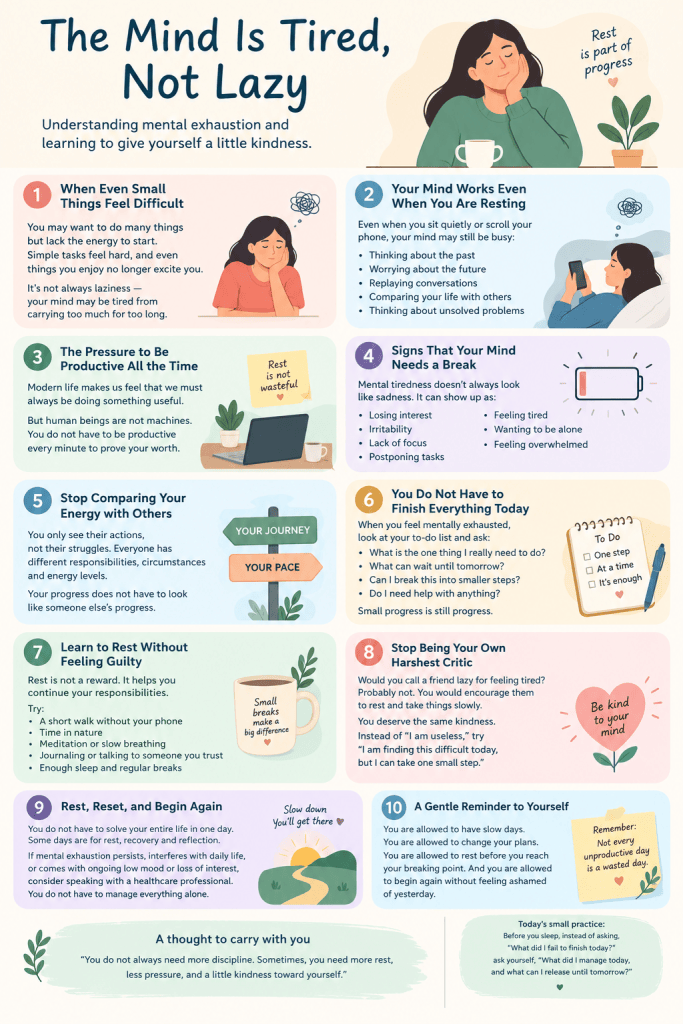
The Mind Is Tired, Not Lazy

Understanding mental exhaustion and learning to give yourself a little kindness

1. When Even Small Things Feel Difficult

Have you ever had a day when you wanted to do many things but could not find the energy to start?

Simple tasks feel difficult. Replying to a message seems exhausting. Even things you usually enjoy no longer excite you.

You may start blaming yourself: “Why am I so lazy? Why can’t I do things like before?”

But sometimes, the problem is not laziness. Your mind may be tired from carrying too much for too long.

2. Your Mind Works Even When You Are Resting

You may sit quietly, scroll through your phone, or lie on your bed, but your mind may still be busy.

  • Thinking about yesterday’s mistakes.
  • Worrying about tomorrow’s responsibilities.
  • Replaying conversations in your head.
  • Comparing your life with others.
  • Thinking about problems you cannot solve right now.

Your body may be resting, but your mind may not be getting the rest it needs.

3. The Pressure to Be Productive All the Time

Modern life often makes people feel that they must always be doing something useful.

There is work to complete, messages to answer, responsibilities to manage, and goals to achieve. Even during free time, people may feel guilty for not being productive.

Rest begins to feel like a waste of time.

But human beings are not machines. You do not have to be productive every minute to prove that you are valuable.

4. Signs That Your Mind Needs a Break

Mental tiredness does not always look like sadness. Sometimes, it appears in small everyday behaviours.

  • Losing interest in activities you once enjoyed.
  • Feeling irritated over little things.
  • Finding it difficult to concentrate.
  • Postponing even simple tasks.
  • Feeling tired despite getting some rest.
  • Wanting to be alone more often.
  • Feeling overwhelmed by ordinary responsibilities.

These signs can have different causes, including stress, poor sleep, or health concerns. They are not proof of laziness.

5. Stop Comparing Your Energy with Others

Some people seem to manage their work, family, friendships, and personal goals effortlessly. Seeing them may make you question yourself.

But you see their actions, not their entire struggles.

Everyone has different responsibilities, circumstances, energy levels, and emotional challenges. What feels easy for one person may feel difficult for another.

Your progress does not have to look like someone else’s progress.

6. You Do Not Have to Finish Everything Today

When you feel mentally exhausted, looking at your entire to-do list can make you feel even more overwhelmed.

Instead of thinking, “I have so much to do,” try asking:

  • What is the one thing I really need to do today?
  • What can wait until tomorrow?
  • Can I break this task into smaller steps?
  • Do I need help with anything?

Completing one small task is better than spending the entire day blaming yourself for not completing everything.

Small progress is still progress.

7. Learn to Rest Without Feeling Guilty

Rest is not a reward that you receive only after completing every responsibility.

Sometimes, rest is what helps you continue your responsibilities.

You can give your mind a break by:

  • Taking a short walk without looking at your phone.
  • Sitting quietly for a few minutes.
  • Spending time in nature.
  • Praying, meditating, or practising slow breathing.
  • Writing down the thoughts that keep repeating in your mind.
  • Talking to someone who makes you feel understood.
  • Getting enough sleep and taking regular breaks.

You do not need an expensive holiday or an entire free day to begin. Sometimes, a few peaceful minutes can be a good starting point.

8. Stop Being Your Own Harshest Critic

Imagine a friend telling you, “I am tired. I cannot manage everything today.”

Would you immediately call that person lazy? Probably not. You might tell them to rest, take things slowly, and try again tomorrow.

You deserve the same understanding that you offer others.

Instead of saying, “I am useless because I cannot do this,” try saying, “I am finding this difficult today, but I can take one small step.”

Self-kindness does not mean avoiding responsibility. It means approaching responsibility without unnecessary self-punishment.

9. Rest, Reset, and Begin Again

You do not have to solve your entire life in one day.

Some days are meant for achievement. Other days may require patience, recovery, and reflection.

If you have been pushing yourself too hard, give yourself permission to slow down. Review your priorities, set reasonable boundaries, and allow yourself time to recover.

If mental exhaustion persists, interferes with everyday life, or comes with ongoing low mood or loss of interest, consider speaking with a healthcare professional. You do not have to manage everything alone.

10. A Gentle Reminder to Yourself

You are allowed to have slow days.

You are allowed to change your plans.

You are allowed to rest before you reach your breaking point.

And you are allowed to begin again without feeling ashamed of yesterday.

Remember: Not every unproductive day is a wasted day. Sometimes, it is a reminder that you have been expecting too much from yourself for too long.

A thought to carry with you

“You do not always need more discipline. Sometimes, you need more rest, less pressure, and a little kindness toward yourself.”

Today’s small practice: Before going to bed, instead of asking, “What did I fail to finish today?” ask yourself, “What did I manage today, and what can I release until tomorrow?”

Your mind deserves care, too. 🌿

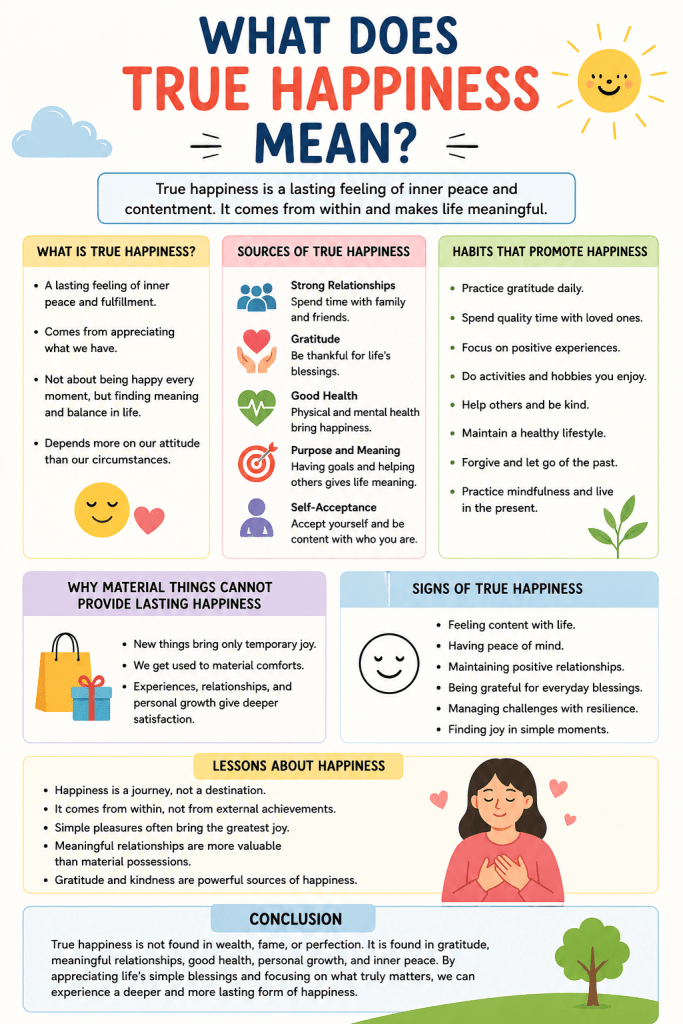
What does True Happiness means?

Introduction

In today’s fast-paced world, many people chase happiness through money, success, possessions, or social status. However, true happiness goes beyond temporary pleasures. It is a deeper sense of contentment, peace, and satisfaction with life.


What is True Happiness?

  • True happiness is a lasting feeling of inner peace and fulfillment.
  • It comes from appreciating what we have rather than constantly wanting more.
  • It is not about being happy every moment but about finding meaning and balance in life.
  • Happiness is a state of mind that depends more on our attitude than our circumstances.

Common Misconceptions About Happiness

1. Happiness Means Being Rich

  • Money can provide comfort and security.
  • However, wealth alone does not guarantee happiness.
  • Many wealthy individuals still experience stress and dissatisfaction.

2. Happiness Means Having Everything

  • No one has a perfect life.
  • True happiness comes from accepting imperfections and making the best of situations.

3. Happiness is Permanent

  • Life includes both joyful and difficult moments.
  • Experiencing sadness does not mean a person is unhappy overall.

Sources of True Happiness

1. Strong Relationships

  • Spending time with family and friends creates emotional support.
  • Meaningful connections improve overall well-being.

2. Gratitude

  • Being thankful for life’s blessings increases satisfaction.
  • Gratitude helps people focus on what they have rather than what they lack.

3. Good Health

  • Physical and mental well-being contribute greatly to happiness.
  • Regular exercise, healthy eating, and sufficient sleep improve mood.

4. Purpose and Meaning

  • Having goals and a sense of purpose makes life more fulfilling.
  • Helping others and contributing to society can create lasting happiness.

5. Self-Acceptance

  • Accepting oneself, including strengths and weaknesses, builds inner peace.
  • Comparing ourselves with others often reduces happiness.

Habits That Promote Happiness

  • Practice gratitude daily.
  • Spend quality time with loved ones.
  • Focus on positive experiences.
  • Engage in hobbies and activities you enjoy.
  • Help others through acts of kindness.
  • Maintain a healthy lifestyle.
  • Learn to forgive and let go of past mistakes.
  • Practice mindfulness and live in the present moment.

Why Material Things Cannot Provide Lasting Happiness

  • New possessions often bring temporary excitement.
  • Over time, people become accustomed to material comforts.
  • Experiences, relationships, and personal growth usually provide deeper satisfaction than material goods.

Signs of True Happiness

  • Feeling content with life.
  • Having peace of mind.
  • Maintaining positive relationships.
  • Being grateful for everyday blessings.
  • Managing challenges with resilience.
  • Finding joy in simple moments.

Lessons About Happiness

  • Happiness is a journey, not a destination.
  • It comes from within rather than external achievements.
  • Simple pleasures often bring the greatest joy.
  • Meaningful relationships are more valuable than material possessions.
  • Gratitude and kindness are powerful sources of happiness.

Conclusion

True happiness is not found in wealth, fame, or perfection. It is found in gratitude, meaningful relationships, good health, personal growth, and inner peace. By appreciating life’s simple blessings and focusing on what truly matters, we can experience a deeper and more lasting form of happiness. True happiness is not about having the best of everything—it is about making the best of everything we have. 🌸✨

Nothing Is Personal, Yet Everything Feels Personal

Introduction

In everyday life, we often take words, actions, and silences to heart. A small change in behavior, a delayed response, or a critical comment can instantly make us question ourselves. Although logic tells us that most things are not meant personally, emotions often disagree. This inner conflict is what makes life feel heavy at times—nothing is personal, yet everything feels personal.

Why Everything Feels Personal

Human beings are emotional by nature. We connect experiences to our sense of self, which makes us interpret situations through a personal lens. When someone behaves differently, the mind immediately searches for a reason and often turns inward. This reaction is natural, but it is not always accurate.

Most Actions Reflect the Other Person

People respond based on their own stress, fears, priorities, and emotional capacity. Their words and behavior are shaped by their experiences, not by our value. Silence, distance, or harshness usually reflects what someone else is struggling with internally, even though it may feel directed at us.

How Overthinking Makes It Worse

When information is incomplete, the mind fills the gaps with assumptions. Overthinking turns neutral situations into personal failures. Emotions amplify this process, making us believe that we are the cause of every change or conflict, even when there is no clear evidence.

Understanding the Truth Without Ignoring Feelings

Saying “nothing is personal” does not mean dismissing emotions. Feelings are real and valid, but they do not always represent the full truth. The key is to acknowledge emotions without tying them to self-worth. This balance helps us stay grounded and emotionally healthy.

Letting Go of Unnecessary Emotional Weight

When we stop personalizing everything, relationships feel lighter. We react less and understand more. We learn to pause, reflect, and choose responses rather than acting from hurt. This shift reduces emotional exhaustion and brings inner calm.

Final Thoughts

Nothing is personal, yet everything feels personal because we care deeply. Growth begins when care is guided by awareness instead of assumption. By separating others’ actions from our self-worth, we create space for peace, clarity, and emotional resilience. What others do is about them; how we respond defines us.

Life Never Stops Teaching Us

Introduction

Life is the greatest teacher we will ever have. Unlike classrooms or formal education, life teaches us through experiences—some sweet, some bitter, but all meaningful. Each day holds lessons waiting to be discovered, and the best part is that the learning never ends.

Lessons from Life

  • Life is the best teacher
    Books may give us information, but real wisdom comes from living through ups and downs.
  • Every experience carries a lesson
    Joy teaches gratitude, while pain builds strength. Both are equally important for growth.
  • Success is a reminder of effort
    Achievements show us the importance of dedication, focus, and belief in ourselves.
  • Failures are stepping stones
    Mistakes guide us toward better choices and remind us that failure is not the end but a new beginning.
  • People shape our learning
    Some people inspire us with kindness, others test our patience, and a few show us whom not to trust. Every person leaves a lesson behind.
  • Challenges bring growth
    Life’s struggles are not punishments but opportunities to become stronger, braver, and wiser.
  • Change keeps us adaptable
    Seasons, situations, and circumstances keep changing. Accepting change teaches us flexibility and resilience.
  • Small things hold deep wisdom
    A sunrise inspires hope, a smile spreads joy, and silence teaches peace. Life whispers wisdom in simple ways.

Conclusion

Life never stops teaching us. The journey of learning doesn’t end with age, success, or status—it continues every day in different forms. The real secret is to keep an open heart and mind, so that every experience, whether good or bad, becomes a stepping stone to wisdom and growth. If we remain lifelong learners, life will always guide us toward becoming our best selves.

🌿 Experience Life to Understand It

We often read, hear, or imagine what life is about. But true understanding comes only when we live through it. Every step, every challenge, and every joy teaches us something.

✨ Simple Points to Reflect On:

  • Books and advice guide you, but experience shapes you.
    Reading gives knowledge, but living through situations gives wisdom.
  • Mistakes are hidden lessons.
    Failing in something doesn’t mean the end — it’s life’s way of teaching you how to grow stronger.
  • Happiness feels real only when you live it.
    Smiles, laughter, travel, friendships — experiencing them gives true joy beyond words.
  • Pain deepens your understanding.
    Hard times are not punishments, but lessons that make you value patience, resilience, and hope.
  • Relationships teach the heart.
    Love, trust, misunderstandings, forgiveness — these can’t be fully understood until you experience them.
  • Life is not about knowing everything at once.
    It’s about living every moment, step by step, and letting experiences teach you.

🌸 Closing Thought

To truly understand life, don’t just watch it — live it. Welcome every experience, whether good or bad, because each one carries a hidden meaning that shapes who you are.

Rewriting Your Inner Dialogue: The Power of Self-Talk in Mental Well-being

What is Inner Dialogue?
Inner dialogue is the conversation you have with yourself in your mind every day. It shapes how you feel, think, and act.

Why Self-Talk Matters
Positive or negative, your self-talk influences your mood, confidence, and stress levels. It affects your mental well-being deeply.

Negative Self-Talk Can Harm
When your inner voice is critical or harsh, it can increase anxiety, lower self-esteem, and lead to feelings of depression.

Positive Self-Talk Builds Resilience
Encouraging and kind self-talk helps you cope better with challenges, boosts confidence, and supports emotional health.

How to Notice Your Self-Talk
Start by paying attention to your thoughts. Are they mostly positive, negative, or neutral? Awareness is the first step.

Common Negative Self-Talk Patterns

  • Catastrophizing: Expecting the worst outcome
  • Black-and-white thinking: Seeing things as all good or all bad
  • Personalizing: Blaming yourself unfairly

Steps to Rewrite Your Inner Dialogue

  1. Catch negative thoughts as they happen.
  2. Challenge them — ask if they are really true or helpful.
  3. Replace them with kinder, realistic thoughts.
  4. Practice regularly until positive self-talk becomes natural.

Examples of Positive Self-Talk

  • Instead of “I always fail,” say, “I am learning and improving every day.”
  • Instead of “I can’t handle this,” say, “I will do my best, and that is enough.”

Use Affirmations
Simple positive statements repeated daily can strengthen your new inner dialogue. For example, “I am worthy,” or “I can face challenges calmly.”

Benefits of Positive Self-Talk

  • Reduced stress and anxiety
  • Better problem-solving skills
  • Increased motivation and focus
  • Stronger emotional resilience

Self-Talk and Mental Health
Changing your inner dialogue can be a powerful tool alongside therapy, meditation, and self-care for improving mental health.

Final Thought
Your mind listens to your inner voice every moment. Choose words that heal, encourage, and empower you.

Bouncing Back: How to Build Resilience in Uncertain Times

Life often presents unexpected challenges—whether it’s a personal crisis, a global shift, or professional struggles. Resilience allows us to recover and grow through these times. Here’s how to build and maintain resilience in moments of uncertainty:


🌱 1. Accept What You Can’t Control

  • Don’t resist change; learn to adapt.
  • Let go of the need for certainty.

“You can’t stop the waves, but you can learn to surf.” – Jon Kabat-Zinn


💭 2. Shift Your Perspective

  • See challenges as opportunities for growth.
  • Ask, “What can this teach me?”

“In the middle of difficulty lies opportunity.” – Albert Einstein


🧘 3. Practice Self-Care

  • Prioritize sleep, nutrition, and physical activity.
  • Engage in hobbies that help you relax and unwind.

“Self-care is how you take your power back.” – Lalah Delia


🧠 4. Strengthen Your Mindset

  • Practice gratitude daily to shift your focus.
  • Use positive affirmations and challenge negative thoughts.

“It’s not the strongest of the species that survive, nor the most intelligent, but the one most responsive to change.” – Charles Darwin


🤝 5. Stay Connected

  • Lean on friends, family, or support groups.
  • Build a network that lifts you up in tough times.

“The best way to find yourself is to lose yourself in the service of others.” – Mahatma Gandhi


🗓️ 6. Take One Day at a Time

  • Focus on making the best of today, not worrying about tomorrow.
  • Don’t dwell on the unknown future.

“Do not anticipate trouble, or worry about what may never happen. Keep in the sunlight.” – Benjamin Franklin


📚 7. Keep Learning and Growing

  • Constantly evolve by reading, reflecting, and adapting.
  • Embrace new skills and knowledge to overcome difficulties.

“The only way to deal with this life meaningfully is to find one’s passion and follow it.” – Dalai Lama


🌟 Final Thought:

Resilience isn’t about avoiding challenges—it’s about facing them head-on, learning from them, and growing stronger. By nurturing your body, mind, and relationships, you can endure uncertainty and emerge more powerful.

Difficulties Strengthen the Mind, as Labor Does the Body

Life is full of challenges, and how we face them shapes our mental strength. Just as physical labor builds and strengthens the body, mental challenges and difficulties shape and strengthen the mind. Rather than avoiding challenges, we should embrace them as opportunities for growth, resilience, and self-discovery.

1. Overcoming Adversity Builds Resilience

  • Difficult situations push us to adapt and grow.
  • Every challenge faced and overcome strengthens our ability to cope with future struggles.
  • Resilience allows us to bounce back stronger from setbacks.

2. Mental Strength Comes from Pushing Limits

  • Like exercising muscles, mental strength grows when we push ourselves beyond our comfort zones.
  • Facing discomfort helps us develop the discipline and perseverance needed to overcome challenges.
  • Each time we face a difficult situation, our capacity to deal with stress and uncertainty increases.

3. Problem-Solving Skills Improve Through Struggles

  • Difficulty forces us to think creatively and find solutions.
  • Problem-solving is like a mental workout; it strengthens our ability to think critically and make decisions under pressure.
  • The more problems we tackle, the more efficient and resourceful we become.

4. Building Patience and Persistence

  • Difficulty teaches us patience, as we realize that success doesn’t come overnight.
  • Persistence, nurtured through overcoming difficulties, is key to achieving long-term goals.
  • Learning to stay committed during tough times translates into greater mental endurance.

5. Enhancing Self-Awareness

  • Difficulties often challenge our beliefs, values, and assumptions.
  • By reflecting on our reactions and thoughts during difficult times, we develop greater self-awareness.
  • Knowing ourselves better makes it easier to control emotions and maintain mental peace during challenges.

6. Transforming Failure into Growth

  • Failure is often seen as the result of difficulty, but it’s also an opportunity to learn.
  • Each failure teaches valuable lessons that build mental fortitude.
  • Embracing failure as a stepping stone helps us grow stronger and more focused on success.

7. Strengthening Focus and Determination

  • In times of difficulty, staying focused on the goal becomes even more critical.
  • Developing the ability to stay determined, even when the path is tough, strengthens mental clarity and concentration.
  • The more we push through difficult situations, the sharper our focus becomes.

8. Gratitude for the Journey

  • Embracing difficulty helps us appreciate life’s good moments more fully.
  • It teaches us gratitude for the strength we gain through hardship.
  • The challenges we face shape us into stronger, wiser individuals, ready to take on even greater tasks.

In the Middle of Difficulty Lies Opportunity

Life can often present us with challenges, but hidden within these challenges are opportunities for growth, learning, and transformation. Albert Einstein’s quote, “In the middle of difficulty lies opportunity,” encourages us to view obstacles as chances for progress and improvement. Here’s how to reframe difficulty into opportunity:


1. Shift Your Mindset

  • Instead of seeing difficulty as a roadblock, recognize it as a chance to learn something new.
  • Embrace challenges as opportunities for growth.

2. Find Creative Solutions

  • When faced with adversity, the need to find a solution can inspire creativity and innovation.
  • Problem-solving through difficulty often leads to fresh ideas.

3. Build Strength and Resilience

  • Overcoming challenges strengthens your ability to handle future difficulties.
  • The more challenges you face, the more resilient you become.

4. Discover New Opportunities

  • Difficult situations often lead to unexpected opportunities.
  • What seems like a setback may actually open the door to something better.

5. Learn Valuable Lessons

  • Mistakes and failures teach you lessons that lead to future success.
  • Every difficulty presents a chance to improve and grow.

6. Enhance Personal Growth

  • Difficulties push you to develop your character, resilience, and confidence.
  • Embracing challenges can lead to significant personal growth.

How to Find Opportunity in Difficulty

  1. Change Your Perspective: View challenges as learning experiences, not as problems.
  2. Take Action: Break down the problem into manageable steps and work through them.
  3. Stay Open-Minded: Be open to new solutions or paths that emerge during difficult times.
  4. Seek Support: Talk to others for guidance and ideas to help navigate the challenge.

Conclusion

Difficulties are not the end—they are the beginning of new opportunities. By embracing them and shifting your perspective, you open yourself up to growth, new possibilities, and personal transformation. As Einstein wisely said, opportunity often lies in the heart of difficulty.

Why Every Ending is a New Beginning: Embracing Change in 2025

The end of one chapter often marks the start of something new. As we step into 2025, it’s the perfect time to embrace change and welcome fresh opportunities. Here’s why every ending can be seen as a new beginning:

1. A Chance to Reflect and Learn

“Life can only be understood backwards, but it must be lived forwards.” – Søren Kierkegaard

  • Endings give us a moment to pause and reflect on what worked and what didn’t.
  • Lessons learned from past experiences can guide better decisions in the future.

2. Room for Growth

“Every next level of your life will demand a different you.” – Leonardo DiCaprio

  • Closing old chapters creates space for personal and professional growth.
  • It’s an opportunity to step out of your comfort zone and explore new possibilities.

3. The Power of Fresh Starts

“It’s never too late to be what you might have been.” – George Eliot

  • A new year like 2025 symbolizes renewal and hope.
  • Starting fresh allows us to set goals and intentions with clarity.

4. Letting Go of the Past

“Some of us think holding on makes us strong, but sometimes it is letting go.” – Hermann Hesse

  • Holding onto the past can weigh us down.
  • Embracing change means letting go of what no longer serves us, be it habits, relationships, or mindsets.

5. Building Resilience

“The oak fought the wind and was broken, the willow bent when it must and survived.” – Robert Jordan

  • Every ending teaches us resilience and the ability to adapt to change.
  • This adaptability is crucial for navigating life’s uncertainties.

6. Opportunities to Redefine Ourselves

“It’s not what we have, but what we do with what we have, that defines who we are.” – J.K. Rowling

  • Each ending offers a chance to redefine who we are and what we stand for.
  • Use 2025 to align your actions with your values and aspirations.

7. The Excitement of the Unknown

“Go confidently in the direction of your dreams. Live the life you have imagined.” – Henry David Thoreau

  • The unknown can be daunting but also exciting.
  • New beginnings come with endless possibilities and the thrill of discovery.

8. Strengthening Relationships

“In the middle of every difficulty lies opportunity.” – Albert Einstein

  • Changes often bring new people into our lives and strengthen existing bonds.
  • Embrace the chance to connect, network, and grow alongside others.

9. A Reminder of Life’s Cycles

Life is a series of endings and beginnings, much like the seasons.

  • Accepting this natural cycle helps us move forward with grace and optimism.

10. Empowering Yourself for 2025

“The best way to predict the future is to create it.” – Peter Drucker

  • View 2025 as a blank canvas to design the life you want.
  • Take small, consistent steps toward your goals, and celebrate every milestone.

Final Thoughts

“Every sunset brings the promise of a new dawn.” – Ralph Waldo Emerson
Every ending holds the seed of a new beginning. Embracing change with an open heart and mind can turn challenges into stepping stones for growth. In 2025, let go of fear and welcome the opportunities that come your way.