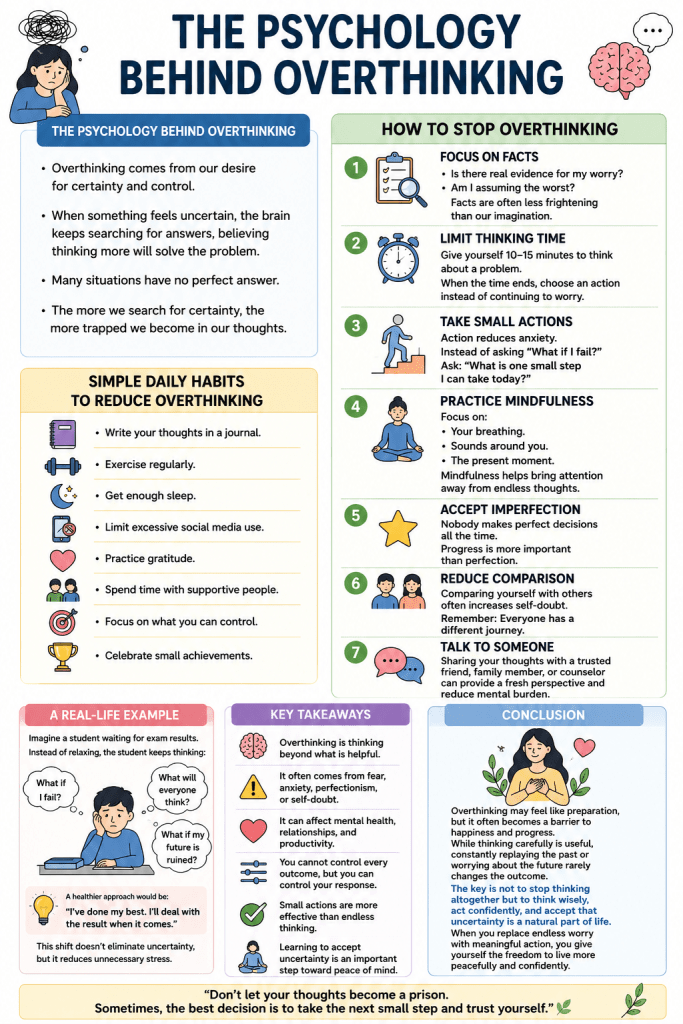
The Hidden Psychology Behind Overthinking 🧠💭

Introduction

Have you ever replayed a conversation over and over in your mind? Or spent hours worrying about something that hasn’t even happened yet? If yes, you’re not alone.

Overthinking is a common experience. While thinking carefully before making decisions is helpful, overthinking happens when our thoughts become repetitive, negative, and unproductive. Instead of solving problems, it often creates more stress and confusion.

Let’s explore why we overthink and how we can overcome it.


What Is Overthinking?

Overthinking means spending too much time analyzing situations, worrying about the future, or dwelling on the past.

It often includes:

  • Replaying conversations repeatedly.
  • Worrying about “what if” situations.
  • Constantly questioning your decisions.
  • Imagining the worst possible outcomes.
  • Feeling mentally exhausted without finding solutions.

Why Do We Overthink?

Our brain is designed to protect us from danger. Sometimes, it mistakes everyday challenges as serious threats, causing us to think excessively.

Common reasons include:

1. Fear of Making Mistakes

Many people worry that one wrong decision will lead to failure.

Example:
“I hope I didn’t say something wrong during the meeting.”


2. Perfectionism

People who want everything to be perfect often spend too much time thinking before taking action.

They may believe:

  • “I must never make mistakes.”
  • “Everything has to be perfect.”

3. Anxiety About the Future

Uncertainty makes many people uncomfortable.

Questions like:

  • “What if I fail?”
  • “What if something goes wrong?”

can keep the mind trapped in endless worry.


4. Low Self-Confidence

When people doubt themselves, they often seek certainty before making even simple decisions.


5. Past Experiences

Negative experiences, criticism, or failures can make people more cautious and lead to repeated thinking.


Signs That You’re Overthinking

You may be overthinking if you:

  • Replay conversations repeatedly.
  • Struggle to make simple decisions.
  • Lose sleep because of constant thoughts.
  • Imagine worst-case scenarios.
  • Feel mentally tired most of the time.
  • Find it difficult to enjoy the present moment.

How Overthinking Affects Your Life

Mental Health

  • Increases stress.
  • Raises anxiety levels.
  • Reduces peace of mind.

Physical Health

  • Poor sleep.
  • Headaches.
  • Muscle tension.
  • Fatigue.

Relationships

  • Misunderstandings.
  • Constant need for reassurance.
  • Difficulty trusting others.

Work and Studies

  • Delayed decisions.
  • Reduced productivity.
  • Missed opportunities.
  • Difficulty concentrating.

The Psychology Behind Overthinking

Psychologists explain that overthinking often comes from our desire for certainty and control.

When something feels uncertain, the brain keeps searching for answers, believing that thinking more will solve the problem.

Unfortunately, many situations in life have no perfect answer.

The more we search for certainty, the more trapped we become in our thoughts.


How to Stop Overthinking

1. Focus on Facts

Ask yourself:

  • Is there real evidence for my worry?
  • Am I assuming the worst?

Facts are often less frightening than our imagination.


2. Limit Thinking Time

Give yourself 10–15 minutes to think about a problem.

When the time ends, choose an action instead of continuing to worry.


3. Take Small Actions

Action reduces anxiety.

Instead of asking:
“What if I fail?”

Ask:
“What is one small step I can take today?”


4. Practice Mindfulness

Focus on:

  • Your breathing.
  • Sounds around you.
  • The present moment.

Mindfulness helps bring attention away from endless thoughts.


5. Accept Imperfection

Nobody makes perfect decisions all the time.

Progress is more important than perfection.


6. Reduce Comparison

Comparing yourself with others often increases self-doubt.

Remember:
Everyone has a different journey.


7. Talk to Someone

Sharing your thoughts with a trusted friend, family member, or counselor can provide a fresh perspective and reduce mental burden.


Simple Daily Habits to Reduce Overthinking

✔ Write your thoughts in a journal.

✔ Exercise regularly.

✔ Get enough sleep.

✔ Limit excessive social media use.

✔ Practice gratitude.

✔ Spend time with supportive people.

✔ Focus on what you can control.

✔ Celebrate small achievements.


A Real-Life Example

Imagine a student waiting for exam results.

Instead of relaxing, the student keeps thinking:

  • “What if I fail?”
  • “What will everyone think?”
  • “What if my future is ruined?”

The result hasn’t even arrived, but the mind has already created many stressful stories.

A healthier approach would be:

“I’ve done my best. I’ll deal with the result when it comes.”

This shift doesn’t eliminate uncertainty, but it reduces unnecessary stress.


Key Takeaways

  • Overthinking is thinking beyond what is helpful.
  • It often comes from fear, anxiety, perfectionism, or self-doubt.
  • It can affect mental health, relationships, and productivity.
  • You cannot control every outcome, but you can control your response.
  • Small actions are more effective than endless thinking.
  • Learning to accept uncertainty is an important step toward peace of mind.

Conclusion

Overthinking may feel like preparation, but it often becomes a barrier to happiness and progress. While thinking carefully is useful, constantly replaying the past or worrying about the future rarely changes the outcome.

The key is not to stop thinking altogether but to think wisely, act confidently, and accept that uncertainty is a natural part of life.

When you replace endless worry with meaningful action, you give yourself the freedom to live more peacefully and confidently.

“Don’t let your thoughts become a prison. Sometimes, the best decision is to take the next small step and trust yourself.” 🌿


The Psychology of Habit Formation: Creating Lasting Change

Introduction

  • Habits influence our everyday actions and overall life outcomes.
  • Understanding habit formation can help you create positive, lasting changes.
  • By applying specific strategies, you can build habits that stick.

1. What Are Habits?

  • Habits are automatic behaviors ingrained through repetition.
  • Examples include checking social media as soon as you wake up or drinking coffee every morning.
  • These behaviors become second nature over time.

2. The Habit Loop

  • Cue: The trigger that initiates the habit.
    • Example: Hearing your morning alarm (cue) prompts you to get out of bed and make coffee (routine).
  • Routine: The behavior you perform in response to the cue.
    • Example: After hearing the alarm, you automatically go to the kitchen to brew coffee.
  • Reward: The positive feeling or outcome you get from the routine.
    • Example: The enjoyment and energy boost from drinking coffee reinforces the habit.

3. Start Small

  • Begin with small, easy-to-achieve actions.
  • Example: If you want to start meditating, begin with just 2 minutes a day instead of trying to meditate for 20 minutes.
  • Small steps are less overwhelming and build confidence as you progress.

4. Be Consistent

  • Repetition is crucial to solidifying a habit.
  • Example: If you want to develop a habit of writing daily, start by writing for just 10 minutes every day.
  • Consistent practice over time makes the habit automatic, regardless of initial motivation levels.

5. Reward Yourself

  • Use positive reinforcement to make the habit enjoyable.
  • Example: After completing a workout, reward yourself with a relaxing shower or a healthy smoothie.
  • Small rewards can keep you motivated and make the habit more sustainable.

6. Know Your Triggers

  • Identify and understand what triggers your habits.
  • Example: If watching TV in the evening leads you to snack mindlessly, recognize the trigger and replace it with a healthier habit, like drinking herbal tea.
  • Being aware of triggers allows you to modify or avoid them, leading to better habits.

7. Push Through the Plateau

  • Be prepared for periods where progress seems to stall.
  • Example: You might initially lose weight quickly with a new exercise routine, but then hit a plateau. Stay committed, as consistency will eventually yield results.
  • Recognizing that plateaus are normal helps you stay motivated through the tough times.

8. Make It Easy

  • Simplify the habit to increase your chances of success.
  • Example: If you want to read more, keep a book on your nightstand so it’s the last thing you see before bed, making it easy to pick up and read.
  • Reducing barriers to action makes it easier to maintain the habit over time.

9. Get Support

  • Leverage social support and accountability to stay on track.
  • Example: Join a book club if you want to read more. Discussing books with others will keep you motivated to continue reading.
  • Support from others makes it easier to stick with your habits and provides encouragement during challenges.

10. Think About Your Identity
– Align your habits with the person you want to become. – Example: Instead of saying, “I want to exercise more,” think, “I am a person who values fitness and health.” – When your habits reflect your identity, they become more natural and sustainable over time.

Conclusion

  • Understanding the psychology behind habit formation is key to creating lasting change.
  • Start with small, consistent steps and use rewards to reinforce your progress.
  • Be mindful of triggers, simplify your habits, and seek support from others.
  • Focus on aligning your habits with your desired identity to make them long-lasting and impactful.

Fake It Until You Make It: A Path to Confidence and Success

Understanding the Concept:

“Fake it until you make it” is a popular saying encouraging individuals to act as if they already possess the qualities or achievements they desire, in order to actually attain them.

Key Points

  1. Boosts Confidence
    • “Act as if what you do makes a difference. It does.” – William James
    • Pretending to be confident can help you develop actual confidence over time.
  2. Encourages Positive Thinking
    • “Whether you think you can, or you think you can’t – you’re right.” – Henry Ford
    • Adopting a positive mindset can influence your actions and outcomes.
  3. Helps Overcome Fear
    • “Do one thing every day that scares you.” – Eleanor Roosevelt
    • Acting confidently, even when you’re scared, can help you face and overcome fears.
  4. Facilitates Skill Development
    • “Practice isn’t the thing you do once you’re good. It’s the thing you do that makes you good.” – Malcolm Gladwell
    • By acting as if you’re skilled, you put in the necessary practice to actually become skilled.
  5. Improves Interpersonal Relationships
    • “You miss 100% of the shots you don’t take.” – Wayne Gretzky
    • Acting confidently in social situations can help you form better relationships and networks.
  6. Promotes Professional Growth
    • “Success is not the key to happiness. Happiness is the key to success. If you love what you are doing, you will be successful.” – Albert Schweitzer
    • Embracing a confident persona at work can lead to more opportunities and professional advancement.
  7. Supports Mental Resilience
    • “It’s not whether you get knocked down, it’s whether you get up.” – Vince Lombardi
    • Faking confidence helps build mental toughness, enabling you to recover from setbacks more effectively.

Practical Tips

  • Dress the Part: Your appearance can significantly influence how you feel about yourself.
  • Positive Body Language: Stand tall, make eye contact, and smile.
  • Set Small Goals: Achieve small successes to build genuine confidence over time.
  • Learn Continuously: Keep improving your skills and knowledge.
  • Seek Feedback: Constructive criticism can help you improve and grow.

Conclusion

  • “Fake it until you make it” is not about deception; it’s about harnessing the power of positive thinking and acting to transform your reality. By embracing this mindset, you can build the confidence and skills needed to achieve your goals and succeed in various aspects of life.