The Hidden Psychology Behind Overthinking 🧠💭

Introduction

Have you ever replayed a conversation over and over in your mind? Or spent hours worrying about something that hasn’t even happened yet? If yes, you’re not alone.

Overthinking is a common experience. While thinking carefully before making decisions is helpful, overthinking happens when our thoughts become repetitive, negative, and unproductive. Instead of solving problems, it often creates more stress and confusion.

Let’s explore why we overthink and how we can overcome it.


What Is Overthinking?

Overthinking means spending too much time analyzing situations, worrying about the future, or dwelling on the past.

It often includes:

  • Replaying conversations repeatedly.
  • Worrying about “what if” situations.
  • Constantly questioning your decisions.
  • Imagining the worst possible outcomes.
  • Feeling mentally exhausted without finding solutions.

Why Do We Overthink?

Our brain is designed to protect us from danger. Sometimes, it mistakes everyday challenges as serious threats, causing us to think excessively.

Common reasons include:

1. Fear of Making Mistakes

Many people worry that one wrong decision will lead to failure.

Example:
“I hope I didn’t say something wrong during the meeting.”


2. Perfectionism

People who want everything to be perfect often spend too much time thinking before taking action.

They may believe:

  • “I must never make mistakes.”
  • “Everything has to be perfect.”

3. Anxiety About the Future

Uncertainty makes many people uncomfortable.

Questions like:

  • “What if I fail?”
  • “What if something goes wrong?”

can keep the mind trapped in endless worry.


4. Low Self-Confidence

When people doubt themselves, they often seek certainty before making even simple decisions.


5. Past Experiences

Negative experiences, criticism, or failures can make people more cautious and lead to repeated thinking.


Signs That You’re Overthinking

You may be overthinking if you:

  • Replay conversations repeatedly.
  • Struggle to make simple decisions.
  • Lose sleep because of constant thoughts.
  • Imagine worst-case scenarios.
  • Feel mentally tired most of the time.
  • Find it difficult to enjoy the present moment.

How Overthinking Affects Your Life

Mental Health

  • Increases stress.
  • Raises anxiety levels.
  • Reduces peace of mind.

Physical Health

  • Poor sleep.
  • Headaches.
  • Muscle tension.
  • Fatigue.

Relationships

  • Misunderstandings.
  • Constant need for reassurance.
  • Difficulty trusting others.

Work and Studies

  • Delayed decisions.
  • Reduced productivity.
  • Missed opportunities.
  • Difficulty concentrating.

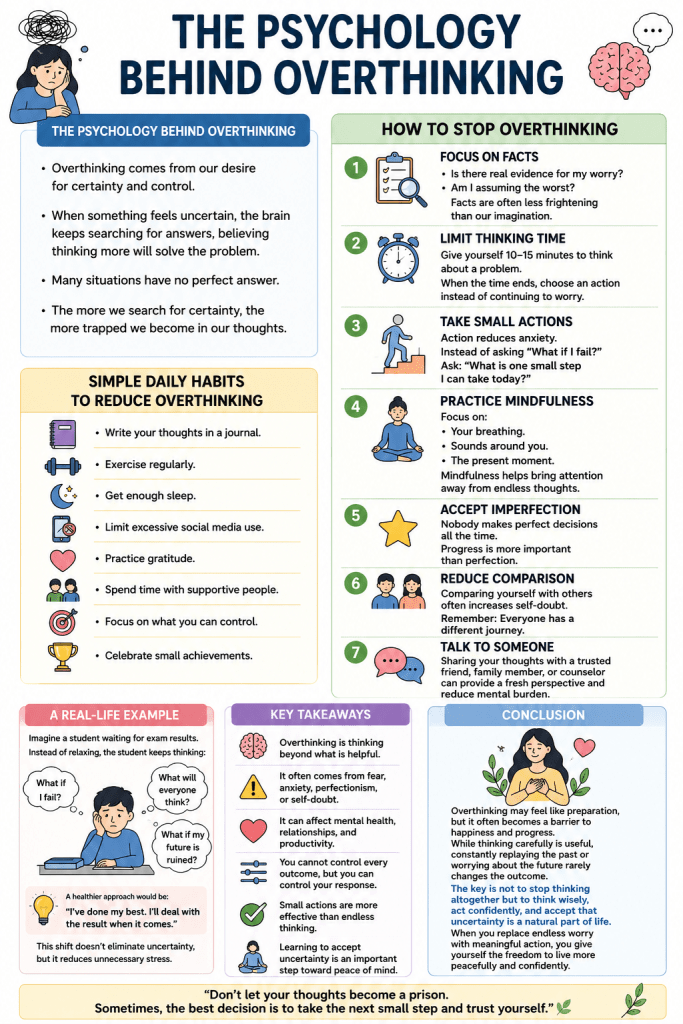
The Psychology Behind Overthinking

Psychologists explain that overthinking often comes from our desire for certainty and control.

When something feels uncertain, the brain keeps searching for answers, believing that thinking more will solve the problem.

Unfortunately, many situations in life have no perfect answer.

The more we search for certainty, the more trapped we become in our thoughts.


How to Stop Overthinking

1. Focus on Facts

Ask yourself:

  • Is there real evidence for my worry?
  • Am I assuming the worst?

Facts are often less frightening than our imagination.


2. Limit Thinking Time

Give yourself 10–15 minutes to think about a problem.

When the time ends, choose an action instead of continuing to worry.


3. Take Small Actions

Action reduces anxiety.

Instead of asking:
“What if I fail?”

Ask:
“What is one small step I can take today?”


4. Practice Mindfulness

Focus on:

  • Your breathing.
  • Sounds around you.
  • The present moment.

Mindfulness helps bring attention away from endless thoughts.


5. Accept Imperfection

Nobody makes perfect decisions all the time.

Progress is more important than perfection.


6. Reduce Comparison

Comparing yourself with others often increases self-doubt.

Remember:
Everyone has a different journey.


7. Talk to Someone

Sharing your thoughts with a trusted friend, family member, or counselor can provide a fresh perspective and reduce mental burden.


Simple Daily Habits to Reduce Overthinking

✔ Write your thoughts in a journal.

✔ Exercise regularly.

✔ Get enough sleep.

✔ Limit excessive social media use.

✔ Practice gratitude.

✔ Spend time with supportive people.

✔ Focus on what you can control.

✔ Celebrate small achievements.


A Real-Life Example

Imagine a student waiting for exam results.

Instead of relaxing, the student keeps thinking:

  • “What if I fail?”
  • “What will everyone think?”
  • “What if my future is ruined?”

The result hasn’t even arrived, but the mind has already created many stressful stories.

A healthier approach would be:

“I’ve done my best. I’ll deal with the result when it comes.”

This shift doesn’t eliminate uncertainty, but it reduces unnecessary stress.


Key Takeaways

  • Overthinking is thinking beyond what is helpful.
  • It often comes from fear, anxiety, perfectionism, or self-doubt.
  • It can affect mental health, relationships, and productivity.
  • You cannot control every outcome, but you can control your response.
  • Small actions are more effective than endless thinking.
  • Learning to accept uncertainty is an important step toward peace of mind.

Conclusion

Overthinking may feel like preparation, but it often becomes a barrier to happiness and progress. While thinking carefully is useful, constantly replaying the past or worrying about the future rarely changes the outcome.

The key is not to stop thinking altogether but to think wisely, act confidently, and accept that uncertainty is a natural part of life.

When you replace endless worry with meaningful action, you give yourself the freedom to live more peacefully and confidently.

“Don’t let your thoughts become a prison. Sometimes, the best decision is to take the next small step and trust yourself.” 🌿

The Future Belongs to Those Who Can Adapt Mentally

In a rapidly changing world, success is no longer determined only by intelligence, talent, or experience. The ability to adapt mentally has become the most important life skill. Below are simple, clear points explaining why mental adaptability shapes the future.


1. Change Is Constant, Not Optional

Technology, workplaces, and lifestyles are evolving faster than ever. Those who mentally resist change experience stress and stagnation, while adaptable minds learn to adjust and move forward.


2. Mental Flexibility Enables Faster Learning

Adaptable individuals are open to unlearning old habits and acquiring new skills. This learning mindset allows them to stay relevant in education, careers, and personal growth.


3. Resilient Minds Handle Uncertainty Better

The future is unpredictable. Mental adaptability helps individuals remain calm during uncertainty, view challenges as temporary, and respond with problem-solving rather than panic.


4. Adaptability Strengthens Emotional Intelligence

Mentally adaptable people regulate emotions effectively, accept feedback positively, and adjust behavior based on situations. This improves relationships and leadership effectiveness.


5. Fixed Mindsets Limit Growth

A rigid mindset clings to comfort zones and fears failure. In contrast, adaptable minds see failure as feedback and change as an opportunity for improvement.


6. Mental Adaptation Supports Well-Being

Being mentally flexible reduces stress, anxiety, and burnout. Acceptance and adjustment protect mental health in high-pressure environments.


7. Future Careers Demand Cognitive Agility

Jobs of the future will require continuous upskilling. Mental adaptability enables individuals to transition across roles, industries, and technologies with confidence.


8. Adaptable Minds Make Better Decisions

Open-minded thinking allows individuals to evaluate situations objectively, consider alternatives, and make informed decisions even with limited information.


9. Growth Begins with Self-Awareness

Understanding one’s thoughts, beliefs, and emotional patterns is the first step toward mental adaptability. Awareness creates choice rather than automatic reactions.


10. Adaptability Is a Trainable Skill

Mental flexibility can be developed through reflection, lifelong learning, mindfulness, and embracing new experiences.


Conclusion

The future will not favor the strongest or the smartest, but those who can think flexibly, learn continuously, and adapt emotionally. Mental adaptability is no longer optional—it is the foundation for sustainable success and well-being in an uncertain world.

🧠 Mental Fitness: Treating Your Brain Like a Muscle

🌟 Introduction

Just like your body needs exercise to stay strong, your mind also needs regular training to stay healthy, calm, and focused.
Mental fitness isn’t about fixing problems — it’s about building strength, clarity, and emotional balance every day.

💬 “The mind is just like a muscle — the more you exercise it, the stronger it gets.”


💪 1. Train Your Brain Daily

  • Think of your brain as a muscle that grows stronger with use.
  • Do puzzles, read, learn new things, or try something different every day.
  • Challenge your routine to wake up new areas of your mind.

💬 “Great things never come from comfort zones.”


🧘‍♀️ 2. Practice Mindfulness and Meditation

  • Spend at least 10 minutes daily in silence or deep breathing.
  • It reduces stress, increases focus, and helps you stay grounded.
  • Mindfulness teaches you to live in the now, not in the noise.

💬 “Quiet the mind, and the soul will speak.” – Ma Jaya Sati Bhagavati


❤️ 3. Strengthen Emotional Resilience

  • Learn to manage emotions instead of running from them.
  • Focus on what you can control and let go of what you can’t.
  • Positive thinking is mental strength training in disguise.

💬 “You cannot control the waves, but you can learn to surf.”


🧩 4. Keep Learning and Growing

  • Pick up a new hobby, language, or creative skill.
  • Growth keeps your mind flexible and curious.
  • Every new experience builds fresh neural connections.

💬 “Once you stop learning, you start declining.” – Albert Einstein


🥗 5. Fuel Your Brain Right

  • Eat foods rich in omega-3, fruits, vegetables, and nuts.
  • Drink plenty of water and sleep well.
  • A healthy body supports a sharp, peaceful mind.

💬 “Take care of your body — it’s the only place you have to live.” – Jim Rohn


🤝 6. Build Social Connections

  • Talk, share, and connect with positive people.
  • Meaningful conversations boost happiness and mental stability.
  • Laughter and empathy are powerful mental vitamins.

💬 “Connection is the energy that exists between people when they feel seen, heard, and valued.” – Brené Brown


🏃‍♀️ 7. Move Your Body for Mental Strength

  • Walk, dance, or stretch — movement releases happy hormones.
  • Exercise improves focus, memory, and confidence.
  • A fit body supports a fit mind.

💬 “A healthy outside starts from the inside.” – Robert Urich


✍️ 8. Journal and Reflect

  • Write your thoughts to understand your emotions.
  • Journaling helps release mental clutter and find clarity.
  • It’s your daily talk with your inner self.

💬 “Writing is the painting of the voice.” – Voltaire


🌈 9. Rest and Recharge

  • Strength also means knowing when to pause.
  • Sleep, relax, and let your mind recover.
  • Rest is part of progress — not the absence of it.

💬 “Rest and self-care are not wasteful. They are acts of survival.”


🌻 Conclusion

Mental fitness is not about avoiding life’s challenges — it’s about training your mind to stay calm, confident, and creative through them.
Like your body, your brain becomes stronger with consistent care and attention.
Start small, stay steady, and your mental strength will grow — one thought at a time.

💬 “The mind is everything. What you think, you become.” – Buddha

Let It Go: Free Your Mind from What Doesn’t Deserve It

💭 1. Recognize What’s Taking Up Space in Your Mind

  • Not everything deserves your attention.
  • Ask yourself: Will this matter in a week, a month, or a year?

“You can’t control everything. Sometimes you just need to relax and have faith that things will work out.” – Unknown


🧠 2. Shift Your Focus

  • Focus on what you can control, not what you can’t.
  • Replace overthinking with action or reflection.

“Where focus goes, energy flows.” – Tony Robbins


🧹 3. Declutter Your Mind Like You Declutter a Room

  • Let go of negative thoughts, regrets, and what-ifs.
  • Journal it out or talk to someone you trust.

“Holding on is believing there’s only a past; letting go is knowing there’s a future.” – Daphne Rose Kingma


🛑 4. Set Boundaries with Yourself

  • Don’t let one small mistake or comment ruin your day.
  • Practice saying mentally: “This thought is not helping me.”

“You don’t have to attend every argument you’re invited to.” – Unknown


🧘 5. Practice Mindfulness

  • Stay grounded in the present moment.
  • Deep breathing, meditation, or a mindful walk can help you reset.

“Worrying is like paying a debt you don’t owe.” – Mark Twain


❤️ 6. Be Kind to Yourself

  • Stop punishing yourself for things out of your control.
  • Forgive yourself and move forward.

“Letting go means to come to the realization that some people are a part of your history, but not part of your destiny.” – Steve Maraboli


🔁 7. Let Go to Make Room for Better Things

  • When you stop holding on to the unnecessary, life becomes lighter.
  • You make space for peace, clarity, and true priorities.

“Some of us think holding on makes us strong, but sometimes it is letting go.” – Hermann Hesse


✨ Final Thought:

Letting go is not weakness—it’s wisdom.
Release what drains you and hold on to what lifts you.

Mind Over Scroll: Reclaiming Focus in a Noisy World

🌐 The Problem: Constant Distraction

  • We live in an age of endless scrolling — social media, news feeds, and notifications.
  • Our attention is constantly pulled in different directions.
  • The average person checks their phone over 100 times a day.
  • This digital overload leads to reduced focus, stress, and productivity.

🧠 Why Focus Matters

  • Focus is the foundation of deep work and creative thinking.
  • Without it, tasks take longer and quality suffers.
  • Regaining control of your attention helps improve mental health, relationships, and overall well-being.

📱 Signs You’re Trapped in the Scroll Loop

  • You reach for your phone first thing in the morning.
  • You feel anxious when you’re offline.
  • You struggle to complete tasks without checking your phone.
  • You lose track of time while using social media.

🔁 The Cycle of Digital Distraction

  1. You feel bored or stressed.
  2. You open your phone for a “quick check.”
  3. Minutes turn into hours.
  4. You feel guilty and unproductive.
  5. You repeat the cycle.

🛠️ How to Reclaim Your Focus

1. Digital Declutter

  • Unfollow unnecessary accounts.
  • Turn off non-essential notifications.
  • Use “Do Not Disturb” mode during work hours.

2. Set Time Limits

  • Use built-in app timers (like Screen Time or Digital Wellbeing).
  • Try the Pomodoro technique – 25 minutes of focus, 5-minute break.

3. Create Phone-Free Zones

  • Keep your phone out of the bedroom and dining area.
  • Use a real alarm clock instead of your phone.

4. Practice Mindfulness

  • Start your day with 5 minutes of deep breathing or journaling.
  • Take short walks without your phone.

5. Replace Scrolling with Purposeful Habits

  • Read a physical book.
  • Do a puzzle or doodle.
  • Call a friend instead of texting.

🌟 Benefits of Reclaiming Focus

  • Improved concentration and memory.
  • Better sleep and reduced anxiety.
  • More meaningful connections with people.
  • Increased time for hobbies and passions.

✅ Final Thought

It’s not about quitting technology — it’s about using it mindfully.
When you choose mind over scroll, you gain back your most valuable asset: your attention.

The Role of Cortisol in Stress and How to Manage It

In today’s fast-paced world, stress has quietly become part of our daily routine. And behind the scenes of that constant tension? Cortisol — our body’s main stress hormone. While it’s essential for survival in small doses, too much of it for too long can lead to anxiety, weight gain, sleep problems, and even burnout.

The good news? You can naturally lower cortisol with small, doable changes in your routine. Let’s explore some realistic wellness trends that actually help.


🌿 1. Nature Walks Are the New Therapy

What to do: Spend 20–30 minutes walking in a park, beach, or any green space.

Why it works: Nature has a calming effect on the nervous system. Just being around trees or hearing birds can reduce cortisol levels.

Tip: Leave your phone at home or on silent for best results.


💤 2. Prioritize Quality Sleep (Not Just Hours)

What to do: Stick to a regular sleep schedule and avoid screens 1 hour before bed.

Why it works: Poor sleep increases cortisol and makes you more reactive to stress the next day.

Tip: Try a warm shower, low lighting, or calming music before bedtime.


🍵 3. Drink Less Coffee, Try Adaptogens Instead

What to do: Replace your second or third coffee with herbal teas or adaptogens like ashwagandha or tulsi.

Why it works: Too much caffeine can spike cortisol. Adaptogens help your body adapt to stress and calm the system.

Tip: Look for natural teas labeled “stress relief” or “calm.”


🧘 4. Slow Movement = Fast Recovery

What to do: Practice 10 minutes of stretching, yoga, or tai chi daily.

Why it works: Gentle movement lowers stress hormones without exhausting the body, unlike intense workouts that can raise cortisol if overdone.

Tip: Don’t overthink it—just move slowly and breathe deeply.


✍️ 5. Journaling = Emotional Detox

What to do: Write down your worries, wins, or simply how you feel.

Why it works: Expressing emotions on paper helps clear mental clutter and reduces the need for the brain to “hold it all in.”

Tip: Try a simple prompt: “What’s making me feel tense today?”


👥 6. Limit Time with Energy Drainers

What to do: Notice who uplifts you and who drains you—adjust your time accordingly.

Why it works: Toxic conversations and people raise cortisol unconsciously.

Tip: Set boundaries guilt-free. Protecting your peace is part of self-care.


📱 7. Digital Detox Moments

What to do: Take intentional breaks from screens, especially social media.

Why it works: Doom-scrolling and constant notifications overstimulate the brain and trigger cortisol release.

Tip: Try “no-screen mornings” or “silent Sunday afternoons.”


🧠 8. Mindfulness Over Multitasking

What to do: Do one thing at a time—eat, walk, or even talk without checking your phone or rushing.

Why it works: Multitasking keeps your brain in constant alert mode. Mindfulness brings calm and clarity.

Tip: Start with mindful eating—focus on the taste, not the screen.


🙌 9. Gratitude is a Game-Changer

What to do: End your day listing 3 things you’re grateful for.

Why it works: Gratitude shifts your focus from what’s wrong to what’s right—naturally lowering stress levels.

Tip: Keep a “small wins” journal. It builds emotional resilience over time.


🌈 Final Thought:

You don’t need expensive supplements or hours at the gym to fight stress. The real magic is in simple, intentional living. These small wellness habits might not trend forever—but their positive effect on your cortisol levels will definitely last.

The Science of Happiness: What Really Makes Us Happy

Happiness isn’t just a feeling—it’s also a subject of serious scientific research. Psychologists and researchers have been studying what makes people truly happy.


1. Happiness Comes from Within

  • External things like money or possessions can bring short-term joy.
  • True happiness often comes from internal peace, purpose, and emotional well-being.

2. Strong Relationships Matter

  • Research shows that happy people have deep, meaningful relationships.
  • Spending quality time with family and friends boosts happiness levels.

3. Gratitude Changes Everything

  • Being thankful improves mood and outlook on life.
  • Try keeping a gratitude journal—write 3 things you’re thankful for every day.

4. Helping Others Boosts Your Own Joy

  • Acts of kindness release feel-good hormones like oxytocin.
  • Volunteering or helping someone, even in small ways, makes us feel more connected and fulfilled.

5. Experiences Bring More Joy Than Things

  • Travel, hobbies, and shared memories bring lasting happiness.
  • Material items give temporary pleasure, but experiences create meaningful stories.

6. Physical Activity Improves Mood

  • Exercise releases endorphins, also known as “happy hormones.”
  • Even a 20-minute walk can lift your mood.

7. Mindfulness Reduces Stress and Increases Joy

  • Being present in the moment helps reduce anxiety about the past or future.
  • Practicing meditation or deep breathing can increase emotional balance.

8. A Sense of Purpose Fuels Long-Term Happiness

  • Doing work or activities that feel meaningful makes life more satisfying.
  • This could be a career, hobby, or helping others.

9. Sleep Is Crucial for Emotional Health

  • Lack of sleep affects mood, focus, and overall happiness.
  • Aim for 7–9 hours of quality sleep each night.

10. Happiness Is a Habit

  • Like exercise, happiness needs regular practice.
  • Surround yourself with positivity, avoid toxic environments, and choose joy daily.

Final Thought:

Happiness isn’t about always being cheerful. It’s about building a life with balance, meaning, and emotional strength. By understanding the science behind it, we can take small steps every day to live a happier life.

Building Mental Wealth: The New Definition of Success

Success has long been associated with financial wealth, status, and material possessions. However, in today’s fast-paced world, true success is increasingly being redefined as mental wealth—a state of emotional well-being, resilience, and clarity.

1. Prioritize Mental Health

  • Just as financial wealth requires investment, mental wealth needs care and attention.
  • Prioritize rest, mindfulness, and emotional well-being.
  • Seek therapy or support when needed, just as you would consult a financial advisor for money matters.

2. Develop Emotional Intelligence

  • Understand and regulate your emotions effectively.
  • Cultivate empathy and build strong interpersonal relationships.
  • Emotional intelligence enhances both personal and professional success.

3. Embrace Continuous Learning

  • Keep your mind sharp by learning new skills and expanding your knowledge.
  • Reading, problem-solving, and curiosity fuel personal growth.
  • A growth mindset leads to adaptability and long-term success.

4. Strengthen Resilience

  • Challenges and setbacks are inevitable—mental wealth equips you to handle them with strength.
  • Develop coping strategies such as mindfulness, gratitude, and positive self-talk.
  • Learn to see failures as opportunities for growth.

5. Set Boundaries and Protect Your Energy

  • Mental wealth requires saying no to negativity and energy-draining activities.
  • Limit exposure to toxic relationships, unhealthy social media habits, and unnecessary stressors.
  • Protect your peace and prioritize self-care.

6. Cultivate Meaningful Connections

  • Wealth isn’t just about money—it’s about relationships and community.
  • Build a supportive network of family, friends, and mentors.
  • Engage in deep, fulfilling conversations rather than surface-level interactions.

7. Practice Mindfulness and Gratitude

  • Being present enhances mental clarity and reduces stress.
  • Gratitude shifts your focus from what’s lacking to what’s abundant.
  • A simple daily gratitude practice can improve overall happiness and perspective.

8. Balance Work and Life

  • True success isn’t about overworking—it’s about a balanced and fulfilling life.
  • Prioritize hobbies, rest, and time with loved ones.
  • A well-rounded life contributes to both mental and financial wealth.

Conclusion

Mental wealth is the foundation of true success—it shapes how you experience life, manage challenges, and create lasting happiness. By investing in your mental well-being, you gain clarity, resilience, and fulfillment that no amount of money can buy. Start today by valuing your mind as your most precious asset!

Embracing Self-Compassion: A Pathway to Healing and Growth

What is Self-Compassion?

Self-compassion is the practice of treating yourself with the same kindness, understanding, and patience that you would offer to a close friend. It helps in managing stress, overcoming failures, and improving overall mental well-being.

Why is Self-Compassion Important?

  • Reduces stress, anxiety, and depression.
  • Improves self-esteem and emotional resilience.
  • Encourages a positive and healthy mindset.
  • Helps in dealing with setbacks without self-judgment.

Three Main Components of Self-Compassion

  1. Self-Kindness – Be gentle with yourself instead of being overly critical.
  2. Common Humanity – Understand that everyone makes mistakes and struggles in life. You’re not alone.
  3. Mindfulness – Acknowledge your feelings without ignoring or exaggerating them.

Simple Ways to Practice Self-Compassion

  • Talk to Yourself Kindly – Replace negative self-talk with encouraging words.
  • Accept Imperfections – No one is perfect. Learn and grow from your mistakes.
  • Take Breaks When Needed – Rest is essential for both mental and physical well-being.
  • Practice Gratitude – Focus on the good things in life rather than dwelling on the negatives.
  • Forgive Yourself – Let go of guilt and past regrets. Everyone deserves a second chance.
  • Engage in Self-Care – Prioritize activities that make you feel good, such as reading, meditating, or exercising.
  • Surround Yourself with Supportive People – Choose relationships that uplift you rather than bring you down.

Overcoming Barriers to Self-Compassion

  • Fear of Being Self-Indulgent – Self-compassion is not laziness; it’s about self-improvement.
  • Comparing Yourself to Others – Focus on your journey instead of worrying about where others are in life.
  • Feeling Undeserving of Kindness – Everyone deserves kindness, including you!

Final Thoughts

Practicing self-compassion takes time, but small steps can make a big difference. Be patient with yourself and remember that treating yourself with love and kindness is not a luxury—it’s a necessity for better mental health.

Guarding Your Inner Peace: Don’t Let Others’ Actions Define You

In life, we encounter many people with different personalities, moods, and behaviors. While it’s easy to let others’ actions affect how we feel, it’s important to realize that our peace of mind is in our hands. By focusing on what we can control—our responses, mindset, and emotional well-being—we can maintain inner peace no matter how others behave.

  1. Understand that you can’t control others
    • People will act according to their personalities, experiences, and emotions, and you cannot control how they behave.
    • Focus on what you can control: your reactions and mindset.
  2. Set boundaries
    • Establish healthy boundaries with people who negatively affect your peace.
    • Don’t feel guilty about protecting your emotional well-being.
  3. Practice mindfulness
    • Stay present in the moment and observe your thoughts and feelings without judgment.
    • Mindfulness can help you respond rather than react to others.
  4. Don’t take things personally
    • Recognize that someone’s behavior is more about them than it is about you.
    • Their actions are a reflection of their own emotions, not your worth.
  5. Choose your response
    • You have the power to decide how to react.
    • Instead of getting angry or upset, choose calmness and peace.
  6. Focus on positive influences
    • Surround yourself with people who uplift and support you.
    • Positive relationships nurture your inner peace, while toxic ones drain it.
  7. Let go of grudges
    • Holding onto resentment only harms you.
    • Practice forgiveness, not for the other person, but for your own peace of mind.
  8. Self-care is crucial
    • Engage in activities that relax and rejuvenate you, like meditation, exercise, or a hobby.
    • When you feel centered and calm, external negativity doesn’t affect you as much.
  9. Remember your worth
    • No one’s behavior can diminish your value.
    • Trust in your own strength and ability to maintain peace within, regardless of external circumstances.
  10. Shift your perspective
  • View challenges and difficult people as opportunities to grow in patience and understanding.
  • Inner peace often comes from mastering how we perceive and deal with the world around us.

By not letting others’ behavior dictate your peace, you can create a calm and grounded life. Focus on yourself and your inner balance, and let go of the things that don’t serve your well-being.