The Power of Thoughts in Shaping Life

Introduction

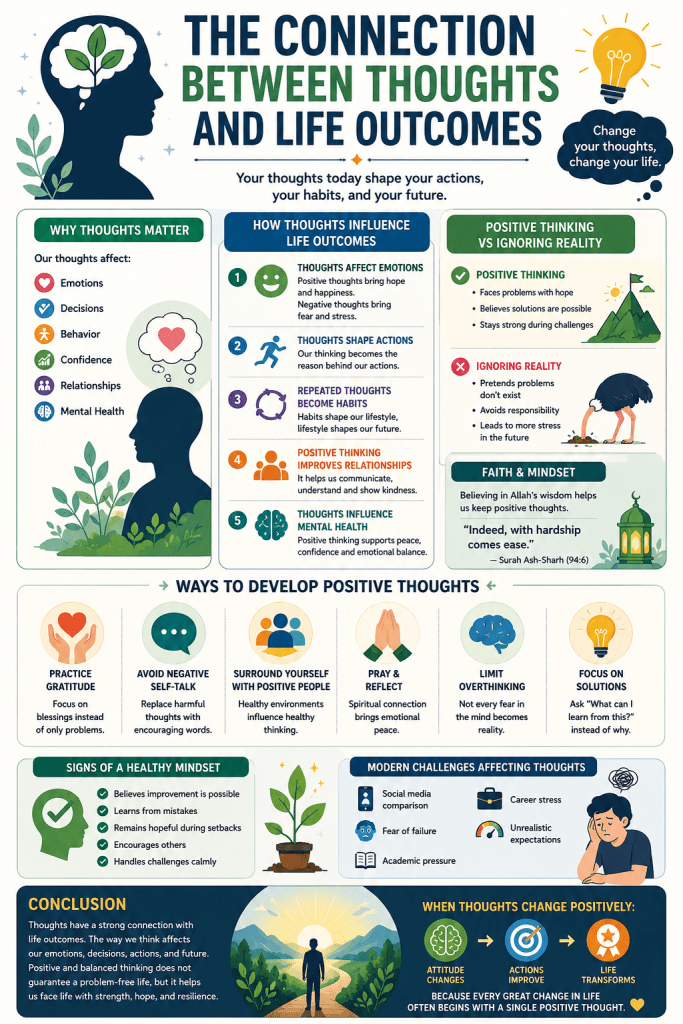
Our thoughts shape the way we see ourselves, others, and the world around us. Positive and healthy thinking can motivate growth and success, while negative thinking can create fear, stress, and hopelessness. The mind is powerful, and the thoughts we repeat daily often influence our actions, habits, and life outcomes.


Why Thoughts Matter

Thoughts are not just ideas in the mind. They affect:

  • Emotions
  • Decisions
  • Behavior
  • Confidence
  • Relationships
  • Mental health

What we think repeatedly often becomes part of our attitude and lifestyle.


How Thoughts Influence Life Outcomes

1. Thoughts Affect Emotions

Positive thoughts create:

  • Hope
  • Peace
  • Motivation
  • Happiness

Negative thoughts create:

  • Fear
  • Anxiety
  • Anger
  • Stress

Example:

  • Thinking “I can improve” builds confidence.
  • Thinking “I will always fail” creates self-doubt.

2. Thoughts Shape Actions

Our actions usually begin with our thinking.

For example:

  • A student who believes in success studies with confidence.
  • A person who constantly doubts themselves may stop trying.

Healthy thoughts encourage:

  • Hard work
  • Discipline
  • Courage
  • Consistency

3. Repeated Thoughts Become Habits

The mind learns through repetition.

If someone repeatedly thinks:

  • “I am capable,” they become more confident.
  • “Nothing good happens to me,” they may become negative and hopeless.

Over time:

  • Thoughts influence habits
  • Habits influence lifestyle
  • Lifestyle influences future outcomes

4. Positive Thinking Improves Relationships

Thoughts affect how we treat people.

Positive thinking helps people:

  • Show kindness
  • Communicate calmly
  • Forgive easily
  • Build healthy relationships

Negative thinking may lead to:

  • Misunderstanding
  • Jealousy
  • Anger
  • Isolation

5. Thoughts Influence Mental Health

Constant negative thinking can increase:

  • Stress
  • Overthinking
  • Anxiety
  • Emotional exhaustion

Positive thinking supports:

  • Emotional balance
  • Mental peace
  • Better coping skills
  • Self-confidence

The Difference Between Positive Thinking and Ignoring Reality

Positive thinking does not mean pretending problems do not exist.

It means:

  • Facing difficulties with hope
  • Believing solutions are possible
  • Staying mentally strong during challenges

Healthy thinking is realistic, balanced, and hopeful.


The Role of Faith and Mindset

Faith helps people maintain positive thoughts during difficult times.

Believing in Allah’s wisdom reminds us:

  • Every hardship has purpose
  • Difficulties are temporary
  • Patience brings reward

The Quran says:

“Indeed, with hardship comes ease.”
— Surah Ash-Sharh (94:6)

This verse teaches believers to remain hopeful even during struggles.


Ways to Develop Positive Thoughts

Practice Gratitude

Focus on blessings instead of only problems.

Avoid Negative Self-Talk

Replace harmful thoughts with encouraging words.

Surround Yourself with Positive People

Healthy environments influence healthy thinking.

Pray and Reflect

Spiritual connection brings emotional peace.

Limit Overthinking

Not every fear in the mind becomes reality.

Focus on Solutions

Instead of asking:

  • “Why is this happening to me?”
    Ask:
  • “What can I learn from this?”

Signs of a Healthy Mindset

A person with healthy thoughts:

  • Believes improvement is possible
  • Learns from mistakes
  • Remains hopeful during setbacks
  • Encourages others
  • Handles challenges calmly

Modern Challenges Affecting Thoughts

Today many people struggle with:

  • Social media comparison
  • Fear of failure
  • Academic pressure
  • Career stress
  • Unrealistic expectations

These can create negative thought patterns if not managed carefully.


Conclusion

Thoughts have a strong connection with life outcomes. The way we think affects our emotions, decisions, actions, and future. Positive and balanced thinking does not guarantee a problem-free life, but it helps people face life with strength, hope, and resilience.

A healthy mind creates a healthier life.
When thoughts change positively:

  • Attitude changes
  • Actions improve
  • Life gradually transforms

Because every great change in life often begins with a single positive thought.

Self-Care is Not Selfish – A Simple Guide for Working Women

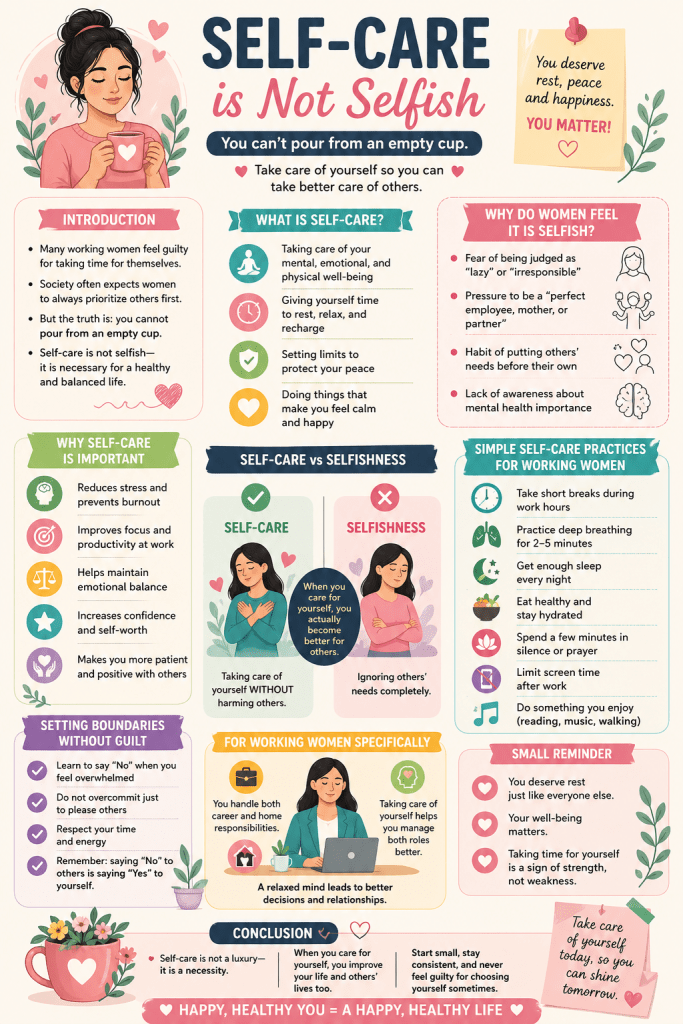
🌸 Introduction

  • Many working women feel guilty for taking time for themselves.
  • Society often expects women to always prioritize others first.
  • But the truth is: you cannot pour from an empty cup.
  • Self-care is not selfish—it is necessary for a healthy and balanced life.

💡 What is Self-Care?

  • Taking care of your mental, emotional, and physical well-being
  • Giving yourself time to rest, relax, and recharge
  • Setting limits to protect your peace
  • Doing things that make you feel calm and happy

🚫 Why Do Women Feel It is Selfish?

  • Fear of being judged as “lazy” or “irresponsible”
  • Pressure to be a “perfect employee, mother, or partner”
  • Habit of putting others’ needs before their own
  • Lack of awareness about mental health importance

🌿 Why Self-Care is Important

  • Reduces stress and prevents burnout
  • Improves focus and productivity at work
  • Helps maintain emotional balance
  • Increases confidence and self-worth
  • Makes you more patient and positive with others

⚖️ Self-Care vs Selfishness

  • Self-care → Taking care of yourself without harming others
  • Selfishness → Ignoring others’ needs completely
  • When you care for yourself, you actually become better for others

Simple Self-Care Practices for Working Women

  • Take short breaks during work hours
  • Practice deep breathing for 2–5 minutes
  • Get enough sleep every night
  • Eat healthy and stay hydrated
  • Spend a few minutes in silence or prayer
  • Limit screen time after work
  • Do something you enjoy (reading, music, walking)

🧠 Setting Boundaries Without Guilt

  • Learn to say “No” when you feel overwhelmed
  • Do not overcommit just to please others
  • Respect your time and energy
  • Remember: saying “No” to others is saying “Yes” to yourself

💼 For Working Women Specifically

  • You handle both career and home responsibilities
  • Taking care of yourself helps you manage both roles better
  • A relaxed mind leads to better decisions and relationships

🌙 Small Reminder

  • You deserve rest just like everyone else
  • Your well-being matters
  • Taking time for yourself is a sign of strength, not weakness

Conclusion

  • Self-care is not a luxury—it is a necessity
  • When you care for yourself, you improve your life and others’ lives too
  • Start small, stay consistent, and never feel guilty for choosing yourself sometimes

🌊 Go With the Flow: Embracing Life Without Overthinking

Life doesn’t always go as planned — and that’s okay. “Going with the flow” doesn’t mean being lazy or careless; it means learning to accept, adjust, and breathe when things don’t go perfectly.

💡 What Does “Go With the Flow” Really Mean?

  • It means being flexible instead of forcing things.
  • Trusting that not everything needs a solution right away.
  • Allowing life to unfold naturally, without stressing about every detail.

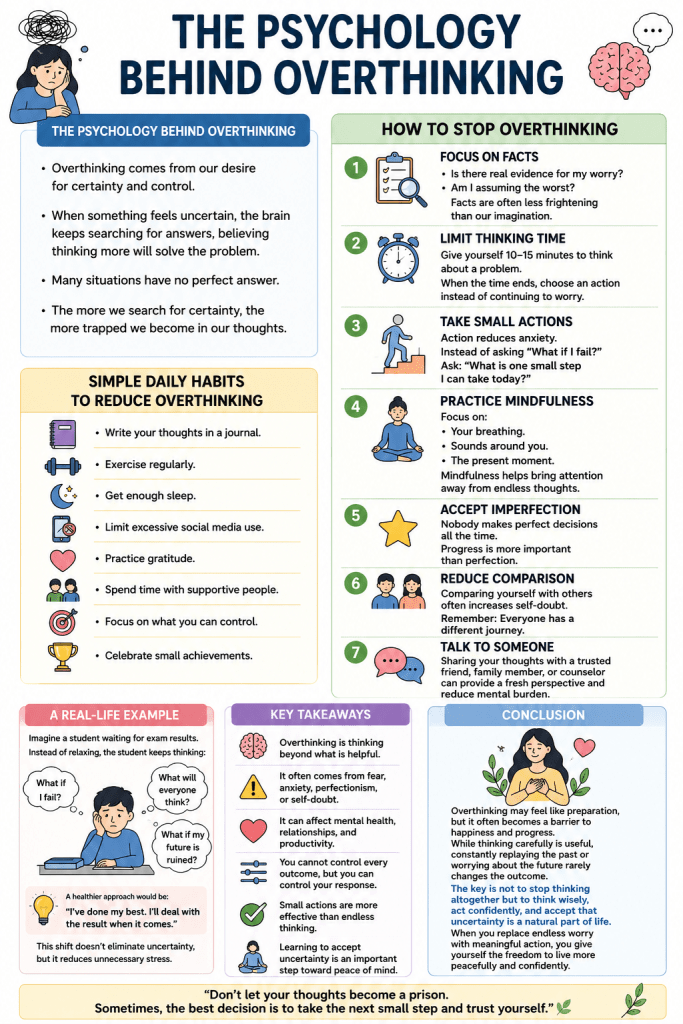
🤯 Why Overthinking Hurts You

  • Drains your energy and mental peace.
  • Creates fear of the future and regret of the past.
  • Delays decisions and action.
  • Makes small problems feel much bigger.

🌿 Benefits of Going With the Flow

  • Increases inner peace and calmness.
  • Helps you become more present and mindful.
  • Builds emotional flexibility during unexpected events.
  • Reduces stress and anxiety.

🧘‍♀️ Simple Ways to Embrace the Flow of Life

  1. Breathe Deeply When Things Feel Out of Control
    → A few slow breaths can reset your thoughts.
  2. Accept, Don’t Resist
    → Say to yourself: “This is not what I planned, but I’ll adjust.”
  3. Be Open to Change
    → Life rarely sticks to a script — stay curious, not fearful.
  4. Stop Seeking Perfection
    → Good enough is often more than enough.
  5. Let Go of “What If” Thoughts
    → Focus on “what is,” not “what could’ve been.”
  6. Practice Saying “It’s okay”
    → A simple phrase that softens overreactions and stress.
  7. Trust Life’s Timing
    → Some things happen later for a reason — have faith.

🧠 Thought to Reflect On:

“Worrying does not take away tomorrow’s troubles — it takes away today’s peace.”


✅ Final Takeaway:

Going with the flow is a strength, not a weakness. When you stop fighting life and start flowing with it, you’ll find more joy, clarity, and freedom. Less control, more calm.

Thoughts Vs. Thinking: Understanding the Difference

When we talk about our minds, we often use the terms “thoughts” and “thinking” interchangeably. However, they actually refer to different processes. Let’s explore the differences in simple comparison points.

1. Definition

  • Thoughts: Thoughts are individual ideas, images, or sensations that arise in our minds. They can be triggered by external stimuli, memories, or spontaneous mental activity.
  • Thinking: Thinking is the cognitive process of actively engaging with thoughts to analyze, synthesize, evaluate, and make decisions. It involves using reasoning and logic to work through information and problems.

2. Nature

  • Thoughts: Thoughts are often spontaneous and can occur without conscious effort. They can be random and fleeting, reflecting a wide range of subjects from mundane daily activities to deep philosophical questions.
  • Thinking: Thinking is deliberate and controlled. It involves focusing mental effort on a specific topic or problem. It requires intention and concentration to engage in this process.

3. Duration

  • Thoughts: Thoughts are usually brief and transient. They can come and go in an instant, sometimes without us even realizing it.
  • Thinking: Thinking can be sustained over longer periods. When we think, we might spend several minutes to hours concentrating on a particular subject or solving a complex issue.

4. Control

  • Thoughts: We have limited control over our thoughts. They can be influenced by our environment, emotions, and subconscious mind. Intrusive thoughts can sometimes enter our mind without our consent.
  • Thinking: We have more control over thinking. We can decide what to think about and direct our mental energy towards specific goals or problems. Thinking can be guided and structured.

5. Examples

  • Thoughts: Examples of thoughts include:
    • “I need to buy milk.”
    • “What a beautiful sunset!”
    • “I wonder what my friend is doing right now.”
  • Thinking: Examples of thinking include:
    • Planning your day or week.
    • Solving a math problem or puzzle.
    • Writing an essay or report.
    • Making a decision about a significant life event.

6. Impact

  • Thoughts: Thoughts can have an immediate impact on our emotions and mood. For example, a happy thought can make us feel joyful, while a distressing thought can cause anxiety or sadness.
  • Thinking: Thinking has a more profound and long-term impact. It helps us understand complex issues, make informed decisions, solve problems, and plan for the future. Effective thinking can lead to better outcomes in various aspects of life.

7. Frequency

  • Thoughts: Thoughts are constant and occur throughout the day. We have thousands of thoughts daily, many of which we may not even be consciously aware of.
  • Thinking: Thinking is less frequent and more effortful. It requires us to consciously engage our cognitive faculties and is often triggered by specific needs or challenges.

8. Purpose

  • Thoughts: The purpose of thoughts can be varied and sometimes seemingly purposeless. They can be reflections, reminders, or spontaneous ideas without immediate relevance.
  • Thinking: The purpose of thinking is goal-oriented. It aims to solve problems, make decisions, create plans, or understand complex concepts. Thinking is often purposeful and directed towards achieving a specific outcome.

9. Mental Effort

  • Thoughts: Thoughts require minimal mental effort as they often occur automatically.
  • Thinking: Thinking requires significant mental effort and concentration. It involves critical and analytical skills to process information effectively.

Conclusion

Understanding the difference between thoughts and thinking can help us better manage our cognitive processes. While thoughts are spontaneous and constant, thinking is a deliberate and controlled activity that allows us to engage deeply with our mental content. Recognizing these distinctions can improve our mental clarity, decision-making abilities, and overall cognitive well-being. By harnessing the power of thinking, we can turn our fleeting thoughts into meaningful actions and solutions.

Unmasking Bias: Seeing Through the Blind Spot

We often believe we see the world clearly, making judgments based on facts and logic. However, the reality is far more complex. Our minds are susceptible to biases that can cloud our judgment and distort our perception of reality. One of the most insidious of these biases is the “biased blind spot,” where we fail to recognize our own biases while readily identifying them in others.

  1. The Nature of Bias:
    • Bias refers to the inclination or prejudice for or against something or someone, often based on factors like race, gender, or personal experiences.
    • Biases can be implicit (unconscious) or explicit (conscious) and influence our thoughts, feelings, and behaviors in subtle ways.
  2. The Blind Spot Effect:
    • The biased blind spot, also known as the “bias blind spot,” describes our tendency to recognize biases in others while failing to acknowledge our own.
    • This blind spot can lead us to believe that we are objective and impartial, despite evidence to the contrary.
  3. Types of Bias:
    • Confirmation Bias: We seek out information that confirms our existing beliefs and ignore evidence that contradicts them.
    • Attribution Bias: We attribute our successes to internal factors (skill, talent) and our failures to external factors (luck, circumstances).
    • In-group Bias: We favor members of our own group over those outside it, leading to favoritism and prejudice.
    • Implicit Bias: Unconscious attitudes or stereotypes that influence our understanding, actions, and decisions.
  4. Impacts on Decision-Making:
    • The biased blind spot can distort our decision-making processes, leading to flawed judgments and missed opportunities.
    • In professional settings, biases can affect hiring, promotions, and performance evaluations, perpetuating inequalities and hindering diversity and inclusion efforts.
  5. Overcoming the Blind Spot:
    • Recognizing and acknowledging our biases is the first step toward overcoming the biased blind spot.
    • Engaging in self-reflection, seeking feedback from others, and considering alternative perspectives can help mitigate the influence of biases.
  6. Cultivating Awareness:
    • Education and training programs can raise awareness of biases and their impact on decision-making.
    • Creating environments that encourage open dialogue and constructive criticism can foster a culture of inclusivity and accountability.
  7. Embracing Diversity:
    • Embracing diversity and inclusion fosters innovation, creativity, and resilience within organizations and communities.
    • By valuing diverse perspectives and experiences, we can challenge our own biases and broaden our understanding of the world.
  8. Conclusion:
    • The biased blind spot reminds us that none of us are immune to biases, no matter how rational or well-intentioned we may be.
    • By acknowledging our biases and actively working to counteract them, we can strive for fairness, equality, and empathy in our interactions and decision-making processes.
    • Let’s embrace the journey of self-awareness and continuous learning, recognizing that overcoming biases is a collective effort that benefits us all.