What does True Happiness means?

Introduction

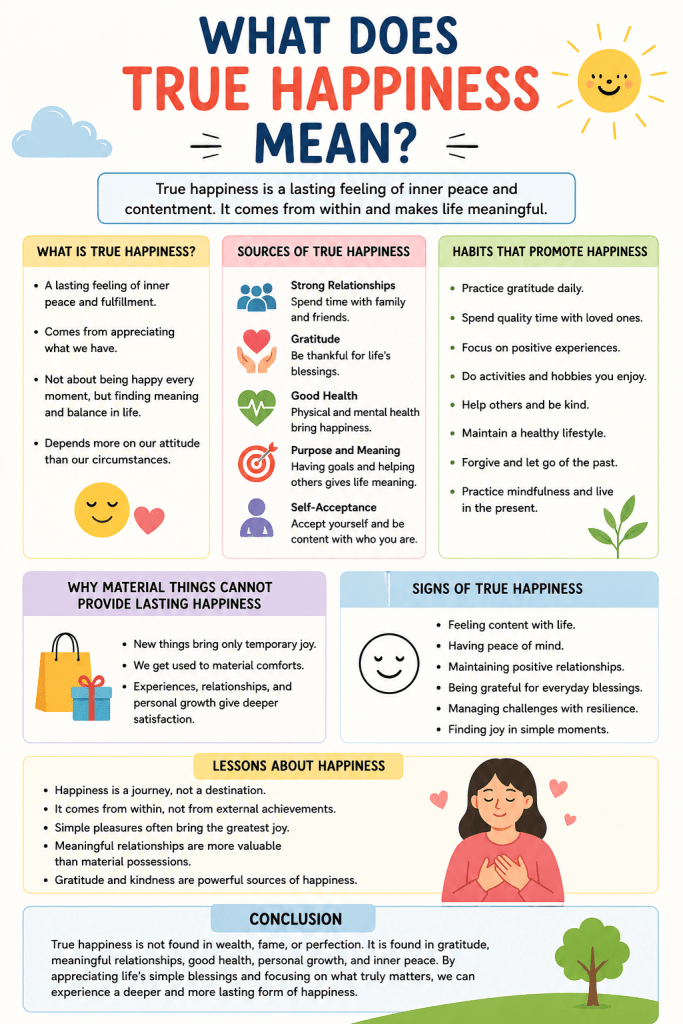
In today’s fast-paced world, many people chase happiness through money, success, possessions, or social status. However, true happiness goes beyond temporary pleasures. It is a deeper sense of contentment, peace, and satisfaction with life.


What is True Happiness?

  • True happiness is a lasting feeling of inner peace and fulfillment.
  • It comes from appreciating what we have rather than constantly wanting more.
  • It is not about being happy every moment but about finding meaning and balance in life.
  • Happiness is a state of mind that depends more on our attitude than our circumstances.

Common Misconceptions About Happiness

1. Happiness Means Being Rich

  • Money can provide comfort and security.
  • However, wealth alone does not guarantee happiness.
  • Many wealthy individuals still experience stress and dissatisfaction.

2. Happiness Means Having Everything

  • No one has a perfect life.
  • True happiness comes from accepting imperfections and making the best of situations.

3. Happiness is Permanent

  • Life includes both joyful and difficult moments.
  • Experiencing sadness does not mean a person is unhappy overall.

Sources of True Happiness

1. Strong Relationships

  • Spending time with family and friends creates emotional support.
  • Meaningful connections improve overall well-being.

2. Gratitude

  • Being thankful for life’s blessings increases satisfaction.
  • Gratitude helps people focus on what they have rather than what they lack.

3. Good Health

  • Physical and mental well-being contribute greatly to happiness.
  • Regular exercise, healthy eating, and sufficient sleep improve mood.

4. Purpose and Meaning

  • Having goals and a sense of purpose makes life more fulfilling.
  • Helping others and contributing to society can create lasting happiness.

5. Self-Acceptance

  • Accepting oneself, including strengths and weaknesses, builds inner peace.
  • Comparing ourselves with others often reduces happiness.

Habits That Promote Happiness

  • Practice gratitude daily.
  • Spend quality time with loved ones.
  • Focus on positive experiences.
  • Engage in hobbies and activities you enjoy.
  • Help others through acts of kindness.
  • Maintain a healthy lifestyle.
  • Learn to forgive and let go of past mistakes.
  • Practice mindfulness and live in the present moment.

Why Material Things Cannot Provide Lasting Happiness

  • New possessions often bring temporary excitement.
  • Over time, people become accustomed to material comforts.
  • Experiences, relationships, and personal growth usually provide deeper satisfaction than material goods.

Signs of True Happiness

  • Feeling content with life.
  • Having peace of mind.
  • Maintaining positive relationships.
  • Being grateful for everyday blessings.
  • Managing challenges with resilience.
  • Finding joy in simple moments.

Lessons About Happiness

  • Happiness is a journey, not a destination.
  • It comes from within rather than external achievements.
  • Simple pleasures often bring the greatest joy.
  • Meaningful relationships are more valuable than material possessions.
  • Gratitude and kindness are powerful sources of happiness.

Conclusion

True happiness is not found in wealth, fame, or perfection. It is found in gratitude, meaningful relationships, good health, personal growth, and inner peace. By appreciating life’s simple blessings and focusing on what truly matters, we can experience a deeper and more lasting form of happiness. True happiness is not about having the best of everything—it is about making the best of everything we have. 🌸✨

Study Smarter, Not Harder: 7 Proven Learning Techniques

Introduction

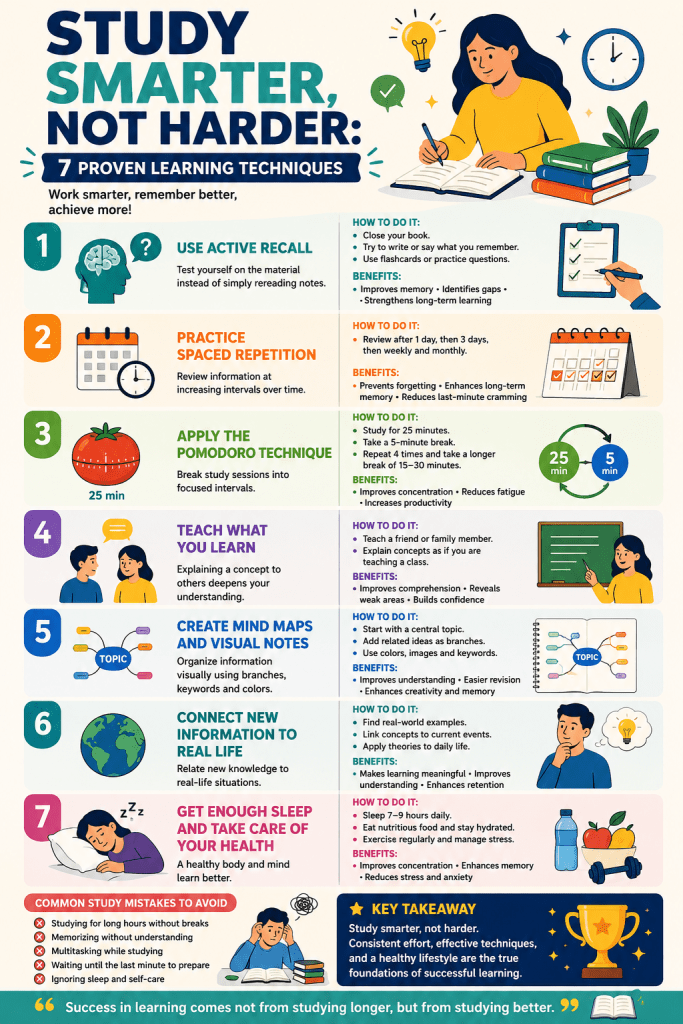
Many students spend long hours studying but still struggle to remember what they have learned. The secret to academic success is not studying harder—it’s studying smarter. By using effective learning techniques, students can improve understanding, retain information longer, and reduce stress.

Here are seven proven learning techniques that can help you learn more efficiently and achieve better results.


1. Use Active Recall

What is it?

Active recall involves testing yourself on the material instead of simply rereading notes.

How to do it:

  • Close your book after studying a topic.
  • Try to write down or explain what you remember.
  • Use flashcards or practice questions.

Benefits:

  • Improves memory retention.
  • Identifies knowledge gaps.
  • Strengthens long-term learning.

Tip: The more you retrieve information from memory, the stronger your understanding becomes.


2. Practice Spaced Repetition

What is it?

Spaced repetition means reviewing information at increasing intervals over time.

How to do it:

  • Review notes after one day.
  • Review again after three days.
  • Continue reviewing weekly and monthly.

Benefits:

  • Prevents forgetting.
  • Enhances long-term memory.
  • Reduces last-minute cramming.

Tip: Small, regular reviews are more effective than one long study session.


3. Apply the Pomodoro Technique

What is it?

A time-management method that breaks study sessions into focused intervals.

How to do it:

  • Study for 25 minutes.
  • Take a 5-minute break.
  • Repeat four times.
  • Take a longer break of 15–30 minutes.

Benefits:

  • Improves concentration.
  • Reduces mental fatigue.
  • Increases productivity.

Tip: During study periods, avoid checking your phone or social media.


4. Teach What You Learn

What is it?

Explaining a concept to someone else helps deepen understanding.

How to do it:

  • Teach a friend.
  • Explain concepts to family members.
  • Pretend you are teaching a class.

Benefits:

  • Improves comprehension.
  • Reveals areas that need more study.
  • Builds confidence.

Tip: If you cannot explain it simply, you may need to review it again.


5. Create Mind Maps and Visual Notes

What is it?

Mind maps organize information visually using branches, colors, and keywords.

How to do it:

  • Start with a central topic.
  • Add related ideas as branches.
  • Use symbols and colors.

Benefits:

  • Improves understanding.
  • Makes revision easier.
  • Enhances creativity and memory.

Tip: Visual learners often remember diagrams better than paragraphs.


6. Connect New Information to Real Life

What is it?

Relating new knowledge to personal experiences or practical situations.

How to do it:

  • Find real-world examples.
  • Link concepts to current events.
  • Apply theories to everyday situations.

Benefits:

  • Makes learning meaningful.
  • Improves understanding.
  • Enhances memory retention.

Tip: The brain remembers information better when it has personal relevance.


7. Get Enough Sleep and Take Care of Your Health

What is it?

Learning is not just about studying; it also depends on physical and mental well-being.

How to do it:

  • Sleep 7–9 hours daily.
  • Eat nutritious food.
  • Stay hydrated.
  • Exercise regularly.

Benefits:

  • Improves concentration.
  • Enhances memory formation.
  • Reduces stress and anxiety.

Tip: A well-rested brain learns faster and performs better.


Common Study Mistakes to Avoid

❌ Studying for long hours without breaks
❌ Memorizing without understanding
❌ Multitasking while studying
❌ Waiting until the last minute to prepare
❌ Ignoring sleep and self-care


Conclusion

Academic success is not determined by how many hours you study but by how effectively you learn. Techniques such as active recall, spaced repetition, teaching others, and using visual tools can significantly improve learning outcomes. By adopting these smart study strategies, students can enhance their performance, reduce stress, and enjoy the learning process.

Key Takeaway

Study smarter, not harder. Consistent effort, effective techniques, and a healthy lifestyle are the true foundations of successful learning. 📚✨

“Success in learning comes not from studying longer, but from studying better.”

Everything Happens for a Reason

In everyday life, we often hear the phrase “Everything happens for a reason.” In Islam, this idea is deeply rooted in the belief of Qadr (Divine Decree)—that Allah has a perfect plan for everything that happens in our lives. Even when we don’t understand it, there is always wisdom behind it.


🌙 1. Allah Knows What We Do Not Know

Sometimes we feel confused, hurt, or disappointed when things don’t go our way. But Islam teaches us that Allah’s knowledge is far greater than ours.

Quran Verse:

“Perhaps you dislike something and it is good for you; and perhaps you love something and it is bad for you. And Allah knows, while you do not know.”
(Surah Al-Baqarah 2:216)

Meaning:
What we think is bad may actually protect us, and what we desire may not be good for us. Allah sees the full picture—we only see a small part.


🌱 2. Every Test Has a Purpose

Difficulties are not punishments, but tests meant to strengthen our faith and character.

Quran Verse:

“Do people think they will be left alone because they say, ‘We believe,’ and will not be tested?”
(Surah Al-Ankabut 29:2)

Meaning:
Life’s challenges are part of our journey. They help us grow, become patient, and get closer to Allah.


💭 3. Hardship Comes with Ease

No pain or struggle is permanent. Allah promises relief along with difficulty.

Quran Verse:

“Indeed, with hardship comes ease.”
(Surah Ash-Sharh 94:6)

Meaning:
After every difficulty, ease will come—sometimes in ways we don’t expect.


🤲 4. Allah’s Plan is Always the Best

Even when our plans fail, it doesn’t mean life is failing. It means Allah is redirecting us to something better.

Quran Verse:

“And Allah is the best of planners.”
(Surah Aal-e-Imran 3:54)

Meaning:
We plan based on what we want, but Allah plans based on what is best for us.


🌸 5. Nothing Happens Without Allah’s Permission

Every event in our life—big or small—is part of Allah’s decree.

Quran Verse:

“No disaster strikes except by permission of Allah.”
(Surah At-Taghabun 64:11)

Meaning:
This reminds us that everything is under Allah’s control, and nothing happens randomly.


🕊️ 6. Trust (Tawakkul) Brings Peace

When we truly trust Allah, our hearts become calm even in uncertain situations.

Quran Verse:

“And whoever relies upon Allah – then He is sufficient for him.”
(Surah At-Talaq 65:3)

Meaning:
When we depend on Allah, He takes care of our needs in ways we cannot imagine.


🌟 7. Real-Life Reflection

  • You didn’t get the job → Maybe a better opportunity is coming
  • A relationship ended → Maybe Allah is protecting your heart
  • You faced failure → Maybe it is preparing you for success

What feels like a setback today may be a blessing tomorrow.

From Self-Doubt to Self-Worth: A Journey Toward Confidence

Everyone feels self-doubt sometimes. But with the right mindset and steps, you can move from questioning yourself to believing in your worth. Here’s how:


🌱 1. Understand That Self-Doubt Is Normal

  • Everyone experiences it, even successful people.
  • It means you’re growing and challenging yourself.

💭 2. Identify the Voice of Doubt

  • Pay attention to negative thoughts like “I’m not good enough” or “I can’t do this.”
  • These thoughts are often based on fear, not facts.

✨ 3. List Your Strengths

  • Write down things you’re good at or proud of.
  • It could be as small as being a good listener or as big as completing a degree.
  • Review this list often to remind yourself of your worth.

🧠 4. Replace Negative Thoughts with Positive Ones

  • Instead of saying “I always fail,” say “I’m learning and improving.”
  • Practice daily affirmations like “I am capable” or “I deserve success.”

🧩 5. Set Small, Achievable Goals

  • Confidence grows with progress.
  • Start with simple tasks you can succeed at, then move on to bigger ones.

🧍‍♀️ 6. Surround Yourself with Supportive People

  • Spend time with those who lift you up, not those who bring you down.
  • Talk to friends, mentors, or family when you feel low.

📚 7. Learn and Improve

  • Take courses, read, or practice skills you want to get better at.
  • Knowledge builds confidence.

🎯 8. Celebrate Every Win

  • Give yourself credit for progress, no matter how small.
  • Each step forward adds to your self-worth.

🧘‍♀️ 9. Practice Self-Compassion

  • Be kind to yourself when you make mistakes.
  • Nobody is perfect – mistakes are part of learning.

🌟 10. Believe in Your Potential

  • You have unique talents and strengths.
  • Trust that you are capable of achieving great things.

💬 Final Thoughts:

Moving from self-doubt to self-worth is a journey, not a race. Take it one step at a time. With patience, practice, and positivity, you’ll find your confidence growing each day.

The Power of Micro-Moments: How Small Changes Lead to Big Impact

In our fast-paced world, it’s easy to overlook the tiny moments that shape our day-to-day lives. Yet, these small shifts can lead to significant changes in our overall well-being and success. Let’s explore how focusing on “micro-moments” can create a big impact.

1. What Are Micro-Moments?

Micro-moments are small, seemingly insignificant actions or decisions that, when accumulated, lead to transformative results. They might seem trivial at first, but over time, they can reshape your habits, mindset, and life.

Quote:
“The smallest deed is better than the greatest intention.” – John Burroughs

2. The Compound Effect of Small Changes

Making small, positive changes consistently can lead to a compound effect. Just like small deposits in a bank account accumulate over time, small actions add up and create larger shifts in your life.

Example:
Reading just 10 pages of a book every day may not seem like much, but in a year, that’s over 3,650 pages—a whole library’s worth of knowledge!

Quote:
“Success is the sum of small efforts, repeated day in and day out.” – Robert Collier

3. How Micro-Moments Create Consistency

Micro-moments help build consistency. When we focus on manageable tasks rather than overwhelming goals, we stay on track and avoid burnout. A few minutes of mindfulness each morning or a short workout every day can establish long-term habits.

Example:
Start by drinking a glass of water every morning before coffee. This tiny habit sets a positive tone for the day and helps you stay hydrated.

Quote:
“It’s the little things that make the big things happen.” – John Wooden

4. Micro-Moments in Relationships

In relationships, small acts of kindness and appreciation go a long way. A genuine compliment, a simple thank you, or a quick text can strengthen bonds and improve communication.

Example:
Sending a quick “How are you?” message to a friend or family member can lift their spirits and deepen your connection.

Quote:
“Sometimes the smallest things take up the most room in your heart.” – Winnie the Pooh

5. The Power of Positive Thinking in Micro-Moments

A micro-moment can also be a shift in mindset. Changing a negative thought into a positive one, even if it’s just for a moment, can influence your day and behavior. This leads to a more optimistic outlook over time.

Example:
Instead of thinking, “I can’t do this,” try thinking, “I can try and learn.” This small shift can change your attitude toward challenges.

Quote:
“You don’t have to be great to start, but you have to start to be great.” – Zig Ziglar

6. Embracing the Moment

Sometimes, the greatest impact comes from simply being present in the moment. By embracing micro-moments of mindfulness, we can reduce stress and enhance our emotional well-being. Taking a minute to breathe deeply or smile at someone can turn your day around.

Example:
Pause for a moment to appreciate the beauty of nature around you—whether it’s a blooming flower or the sun setting. These moments of mindfulness can reset your mental state.

Quote:
“The present moment is the only moment available to us, and it is the door to all moments.” – Thich Nhat Hanh

7. Micro-Moments in Productivity

Small bursts of productivity can add up over time. Instead of waiting for the perfect conditions to start a project, start with small, actionable steps.

Example:
Set a timer for just 10 minutes to tackle a task. You’ll be surprised how much you can get done in such a short period.

Quote:
“You don’t have to be great to start, but you have to start to be great.” – Zig Ziglar

8. Small Wins Lead to Big Wins

When we accomplish small tasks, we feel a sense of achievement, boosting our motivation. These “small wins” can provide momentum to tackle bigger goals.

Example:
Completing your daily to-do list, even if it’s small, brings a sense of accomplishment and helps build confidence for tackling larger projects.

Quote:
“Success is the sum of small efforts, repeated day in and day out.” – Robert Collier


Final Thought:
Micro-moments may feel insignificant, but their cumulative power is immense. By recognizing the value of small, consistent actions, you can create profound shifts in your life. Start small, stay consistent, and watch how these moments lead to big changes over time.

Quote:
“Little things make big things happen.” – John Wooden

Rest Is Productive: Rewriting the Burnout Narrative

1. Society Glorifies Hustle Too Much

  • We are often taught that working non-stop means success.
  • But constant hustle leads to burnout, not greatness.

2. Rest Is Not Laziness

  • Taking breaks is not wasting time.
  • It is an essential part of staying healthy and productive.

3. Your Brain Needs Time to Recharge

  • Just like your phone needs charging, your brain also needs rest.
  • Regular breaks improve focus, creativity, and decision-making.

4. Quality Matters More Than Quantity

  • Working 8 straight hours without a break can lower the quality of your work.
  • Short, focused working periods with proper rest create better results.

5. Rest Helps You Solve Problems Better

  • Many great ideas come during moments of relaxation.
  • Resting allows your subconscious mind to work on challenges in the background.

6. Burnout Is a Real Threat

  • Ignoring the need for rest can lead to emotional exhaustion, low energy, and health problems.
  • Prevention is better than cure: small daily breaks are better than big recovery periods later.

7. Redefining Success Includes Well-being

  • True success includes happiness, health, and inner peace.
  • Rest is part of a balanced, meaningful life—not a break from it.

8. Practical Ways to Rest Productively

  • Take a 5-minute break every hour.
  • Get enough sleep (7-8 hours a night).
  • Go for short walks without your phone.
  • Practice deep breathing or meditation.
  • Spend time on hobbies you enjoy.

9. Final Thought: Rest Is a Power Move

  • Rest is not a weakness; it is a strategy.
  • Protecting your energy makes you stronger and more effective in everything you do.

Building Mental Wealth: The New Definition of Success

Success has long been associated with financial wealth, status, and material possessions. However, in today’s fast-paced world, true success is increasingly being redefined as mental wealth—a state of emotional well-being, resilience, and clarity.

1. Prioritize Mental Health

  • Just as financial wealth requires investment, mental wealth needs care and attention.
  • Prioritize rest, mindfulness, and emotional well-being.
  • Seek therapy or support when needed, just as you would consult a financial advisor for money matters.

2. Develop Emotional Intelligence

  • Understand and regulate your emotions effectively.
  • Cultivate empathy and build strong interpersonal relationships.
  • Emotional intelligence enhances both personal and professional success.

3. Embrace Continuous Learning

  • Keep your mind sharp by learning new skills and expanding your knowledge.
  • Reading, problem-solving, and curiosity fuel personal growth.
  • A growth mindset leads to adaptability and long-term success.

4. Strengthen Resilience

  • Challenges and setbacks are inevitable—mental wealth equips you to handle them with strength.
  • Develop coping strategies such as mindfulness, gratitude, and positive self-talk.
  • Learn to see failures as opportunities for growth.

5. Set Boundaries and Protect Your Energy

  • Mental wealth requires saying no to negativity and energy-draining activities.
  • Limit exposure to toxic relationships, unhealthy social media habits, and unnecessary stressors.
  • Protect your peace and prioritize self-care.

6. Cultivate Meaningful Connections

  • Wealth isn’t just about money—it’s about relationships and community.
  • Build a supportive network of family, friends, and mentors.
  • Engage in deep, fulfilling conversations rather than surface-level interactions.

7. Practice Mindfulness and Gratitude

  • Being present enhances mental clarity and reduces stress.
  • Gratitude shifts your focus from what’s lacking to what’s abundant.
  • A simple daily gratitude practice can improve overall happiness and perspective.

8. Balance Work and Life

  • True success isn’t about overworking—it’s about a balanced and fulfilling life.
  • Prioritize hobbies, rest, and time with loved ones.
  • A well-rounded life contributes to both mental and financial wealth.

Conclusion

Mental wealth is the foundation of true success—it shapes how you experience life, manage challenges, and create lasting happiness. By investing in your mental well-being, you gain clarity, resilience, and fulfillment that no amount of money can buy. Start today by valuing your mind as your most precious asset!

Redefining Success: Beyond Wealth and Fame

Success means different things to different people. It is not just about wealth or fame but about achieving personal and professional goals while finding happiness and fulfillment. Here’s a simple breakdown of what success truly means:

1. Success is Personal

  • Everyone has their own definition of success.
  • For some, it is financial stability; for others, it is personal growth, happiness, or good relationships.

2. Success is Not Just About Money

  • While financial success is important, true success also includes health, relationships, and peace of mind.
  • Many wealthy people still seek meaning in life, proving that money alone is not enough.

3. Success is About Progress, Not Perfection

  • Small steps toward goals matter more than instant achievements.
  • Continuous improvement and learning make a person truly successful.

4. Success Comes from Hard Work and Persistence

  • Overnight success is a myth; dedication and effort lead to real achievements.
  • Facing failures and learning from them is an essential part of success.

5. Success is About Balance

  • A successful life includes a balance between work, health, relationships, and personal growth.
  • Focusing too much on one area while ignoring others can lead to an unfulfilled life.

6. Success is Finding Inner Happiness

  • True success is not just external achievements but also inner peace and satisfaction.
  • If a person is happy and content with their life, they are already successful.

7. Success is Making a Positive Impact

  • Helping others, contributing to society, and making a difference in someone’s life define a successful person.
  • Kindness and generosity bring more long-term fulfillment than material possessions.

8. Success is Living Your Own Dream

  • Society may define success in certain ways, but real success is living life on your own terms.
  • Doing what you love and being true to yourself is the greatest achievement.

Conclusion

Success is not a one-size-fits-all concept. It is about setting goals, making progress, staying happy, and making a difference. The true meaning of success lies in finding fulfillment in what you do and living a life that aligns with your values.

Success Without Burnout: The New Work-Life Balance

We all want to succeed, but too often, success comes at the cost of exhaustion, stress, and burnout. The good news? You don’t have to choose between success and well-being. A new approach to work-life balance is emerging—one that prioritizes both productivity and peace of mind.

Here’s how you can achieve success without burning out:

1. Redefine Success

  • Success isn’t just about long hours and hustle.
  • Focus on meaningful progress rather than overworking yourself.
  • Ask yourself: What does success really mean to you?

2. Work Smarter, Not Harder

  • Prioritize high-impact tasks instead of trying to do everything.
  • Use the 80/20 rule—focus on the 20% of tasks that bring 80% of results.
  • Batch similar tasks to save mental energy.

3. Set Clear Boundaries

  • Define work hours and stick to them.
  • Say no to tasks that drain you without adding value.
  • Avoid checking emails and messages after work hours.

4. Take Breaks (They Boost Productivity!)

  • Short breaks improve focus and creativity.
  • Try the Pomodoro Technique: Work for 25 minutes, then take a 5-minute break.
  • Step away from screens—take a walk, stretch, or meditate.

5. Prioritize Self-Care

  • Get enough sleep—it’s non-negotiable for peak performance.
  • Eat nutritious foods and stay hydrated.
  • Exercise regularly to boost energy and reduce stress.

6. Embrace Rest as a Productivity Tool

  • Resting isn’t being lazy—it helps you perform better.
  • Schedule time for hobbies, relaxation, and socializing.
  • A well-rested mind is more creative and efficient.

7. Learn to Delegate

  • You don’t have to do everything alone.
  • Delegate tasks at work and home to free up time.
  • Focus on what only you can do and let others help with the rest.

8. Disconnect to Recharge

  • Limit screen time to avoid mental exhaustion.
  • Unplug from work-related notifications during downtime.
  • Take vacations and fully disconnect from work—you’ll return more refreshed.

9. Find Joy in the Process

  • Celebrate small wins instead of just chasing big goals.
  • Enjoy the journey instead of constantly stressing about the destination.
  • Success isn’t just about achievement—it’s about enjoying life along the way.

10. Listen to Your Body and Mind

  • Pay attention to signs of burnout: fatigue, stress, lack of motivation.
  • If you feel drained, take a step back and adjust your approach.
  • Remember: Your well-being comes first—success will follow.

Final Thoughts

Success and well-being can go hand in hand. By working smarter, setting boundaries, and prioritizing rest, you can achieve your goals without burning out. The key? Sustainable productivity and a balanced life.

👉 Which of these tips do you struggle with the most? Let me know in the comments! 😊

The Science of Manifestation: Does It Really Work?

1. Understanding Manifestation

  • Manifestation is the belief that thoughts shape reality.
  • Based on the Law of Attraction, it suggests that positive thinking leads to positive outcomes, while negative thinking attracts obstacles.
  • People use manifestation techniques like visualization, affirmations, and goal-setting to attract success, love, or happiness.

2. The Brain’s Role in Manifestation

While manifestation is often linked to spirituality, science explains how it works through psychology and neuroscience:

🔹 Reticular Activating System (RAS) – The Mind’s Filter

  • The RAS in the brain filters information and directs attention to what matters.
  • If you constantly think about success, your brain notices more opportunities that align with that goal.

🔹 Neuroplasticity – Rewiring Thought Patterns

  • The brain can form new neural pathways based on repeated thoughts.
  • Positive thinking and affirmations strengthen confidence and motivation, making success more achievable.

🔹 Self-Fulfilling Prophecy – Turning Beliefs into Reality

  • If you believe in a goal, you subconsciously take actions that lead to achieving it.
  • Example: If you believe you are confident, you act confidently, which makes others perceive you that way.

🔹 Psychological Priming – Preparing for Success

  • When you visualize success, your brain creates a mental rehearsal, making the real experience feel more familiar and achievable.

3. Common Myths About Manifestation

It’s not just wishful thinking – You must take action.
It’s not an instant solution – Results take time and effort.
It doesn’t work for everything – External factors like luck, timing, and competition still play a role.


4. Practical Steps to Manifest Your Goals

Be Clear About What You Want → Define specific, realistic goals.
Visualize Success Daily → Picture yourself achieving your goal with strong emotions.
Take Consistent Action → Manifestation works when combined with real effort (e.g., learning new skills, networking).
Practice Gratitude → A positive mindset attracts more opportunities and motivation.
Replace Self-Doubt with Confidence → Shift from “I can’t” to “I will.”


5. The Truth: Does Manifestation Really Work?

  • Yes, but through mindset shifts and action.
  • Science supports that focused thinking, goal-setting, and belief in success increase the chances of achieving it.
  • Manifestation alone won’t create results—it must be paired with hard work and persistence.

6. Manifest with Action

Manifestation is a powerful tool for motivation and confidence, but it’s not magic. The best way to turn dreams into reality is to think it, believe it, take action, and stay consistent.

Your thoughts create your path, but your actions build the road!