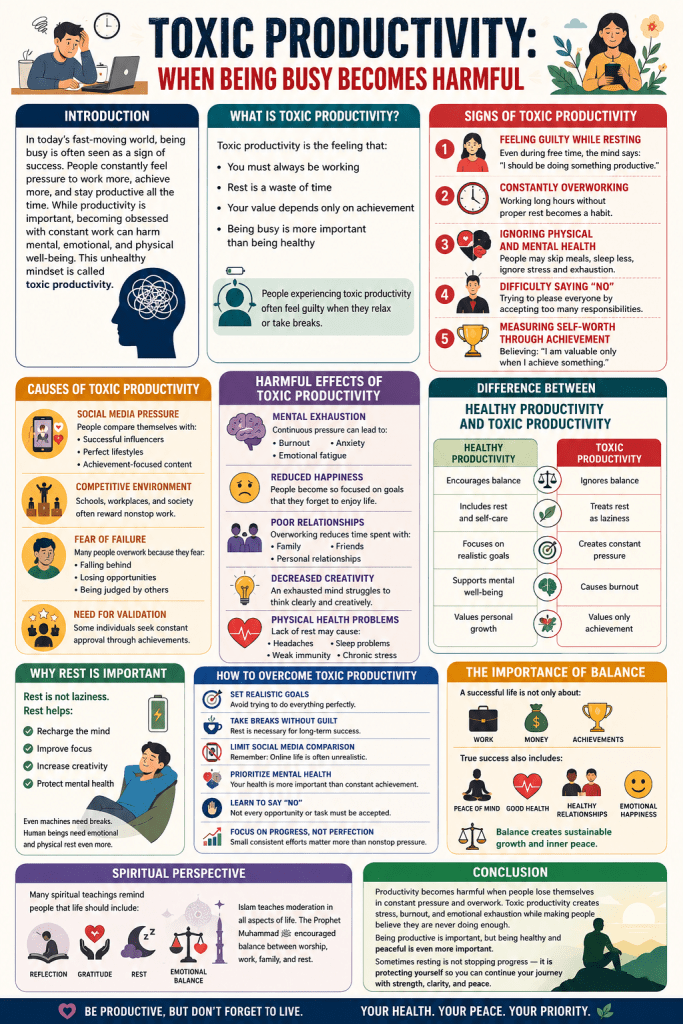
Toxic Productivity: When Being Busy Becomes Harmful

Introduction

In today’s fast-moving world, being busy is often seen as a sign of success. People constantly feel pressure to work more, achieve more, and stay productive all the time. While productivity is important, becoming obsessed with constant work can harm mental, emotional, and physical well-being. This unhealthy mindset is called toxic productivity.


What is Toxic Productivity?

Toxic productivity is the feeling that:

  • You must always be working
  • Rest is a waste of time
  • Your value depends only on achievement
  • Being busy is more important than being healthy

People experiencing toxic productivity often feel guilty when they relax or take breaks.


Signs of Toxic Productivity

1. Feeling Guilty While Resting

Even during free time, the mind says:

  • “I should be doing something productive.”

2. Constantly Overworking

Working long hours without proper rest becomes a habit.

3. Ignoring Physical and Mental Health

People may:

  • Skip meals
  • Sleep less
  • Ignore stress and exhaustion

4. Difficulty Saying “No”

Trying to please everyone by accepting too many responsibilities.

5. Measuring Self-Worth Through Achievement

Believing:

  • “I am valuable only when I achieve something.”

Causes of Toxic Productivity

Social Media Pressure

People compare themselves with:

  • Successful influencers
  • Perfect lifestyles
  • Achievement-focused content

Competitive Environment

Schools, workplaces, and society often reward nonstop work.

Fear of Failure

Many people overwork because they fear:

  • Falling behind
  • Losing opportunities
  • Being judged by others

Need for Validation

Some individuals seek constant approval through achievements.


Harmful Effects of Toxic Productivity

Mental Exhaustion

Continuous pressure can lead to:

  • Burnout
  • Anxiety
  • Emotional fatigue

Reduced Happiness

People become so focused on goals that they forget to enjoy life.

Poor Relationships

Overworking reduces time spent with:

  • Family
  • Friends
  • Personal relationships

Decreased Creativity

An exhausted mind struggles to think clearly and creatively.

Physical Health Problems

Lack of rest may cause:

  • Headaches
  • Sleep problems
  • Weak immunity
  • Chronic stress

Difference Between Healthy Productivity and Toxic Productivity

Healthy ProductivityToxic Productivity
Encourages balanceIgnores balance
Includes rest and self-careTreats rest as laziness
Focuses on realistic goalsCreates constant pressure
Supports mental well-beingCauses burnout
Values personal growthValues only achievement

Why Rest is Important

Rest is not laziness.
Rest helps:

  • Recharge the mind
  • Improve focus
  • Increase creativity
  • Protect mental health

Even machines need breaks. Human beings need emotional and physical rest even more.


How to Overcome Toxic Productivity

Set Realistic Goals

Avoid trying to do everything perfectly.

Take Breaks Without Guilt

Rest is necessary for long-term success.

Limit Social Media Comparison

Remember:

  • Online life is often unrealistic.

Prioritize Mental Health

Your health is more important than constant achievement.

Learn to Say “No”

Not every opportunity or task must be accepted.

Focus on Progress, Not Perfection

Small consistent efforts matter more than nonstop pressure.


The Importance of Balance

A successful life is not only about:

  • Work
  • Money
  • Achievements

True success also includes:

  • Peace of mind
  • Good health
  • Healthy relationships
  • Emotional happiness

Balance creates sustainable growth and inner peace.


Spiritual Perspective

Many spiritual teachings remind people that life should include:

  • Reflection
  • Gratitude
  • Rest
  • Emotional balance

Islam teaches moderation in all aspects of life. The Prophet Muhammad ﷺ encouraged balance between worship, work, family, and rest.


Conclusion

Productivity becomes harmful when people lose themselves in constant pressure and overwork. Toxic productivity creates stress, burnout, and emotional exhaustion while making people believe they are never doing enough.

Being productive is important, but being healthy and peaceful is even more important.

Sometimes resting is not stopping progress — it is protecting yourself so you can continue your journey with strength, clarity, and peace.

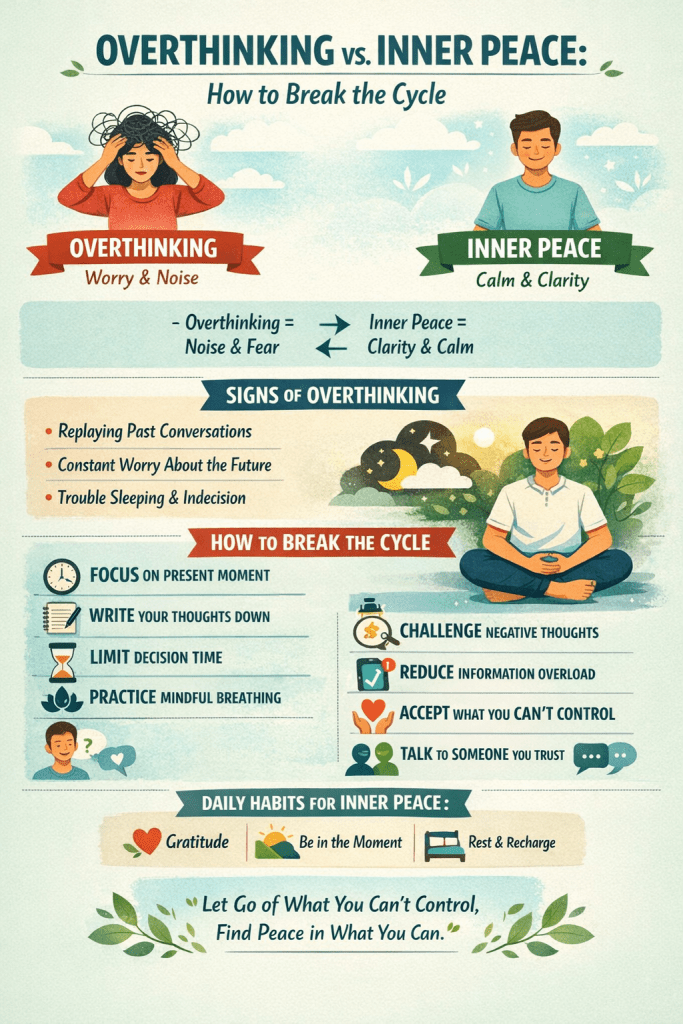
🧠 Overthinking vs. Inner Peace: How to Break the Cycle

🌪️ What is Overthinking?

  • Overthinking means constantly analyzing, worrying, or replaying situations in your mind
  • It often focuses on “what if” and worst-case scenarios
  • Instead of solving problems, it creates more stress and confusion

🕊️ What is Inner Peace?

  • Inner peace is a state of mental calm and emotional balance
  • It means accepting things you cannot control
  • A peaceful mind stays present, steady, and less reactive

⚖️ Overthinking vs. Inner Peace

  • Overthinking = Noise, doubt, fear
  • Inner Peace = Clarity, acceptance, calmness
  • Overthinking drains energy, while inner peace restores it

🚨 Signs You Are Overthinking

  • Replaying past conversations again and again
  • Constant worry about the future
  • Difficulty making decisions
  • Trouble sleeping due to racing thoughts
  • Feeling mentally exhausted without doing much

🌿 Why Do We Overthink?

  • Fear of failure or rejection
  • Need for control over everything
  • Lack of confidence in decisions
  • Past negative experiences
  • Trying to please everyone

🔓 How to Break the Overthinking Cycle

1. ⏳ Focus on the Present

  • Train your mind to stay in the current moment
  • Ask yourself: “Is this happening right now?”

2. ✍️ Write Your Thoughts Down

  • Journaling helps release thoughts instead of trapping them in your mind
  • It brings clarity and reduces mental pressure

3. 🎯 Limit Decision Time

  • Give yourself a time limit to think and decide
  • Avoid endless analysis—done is better than perfect

4. 🧘 Practice Mindfulness or Deep Breathing

  • Simple breathing exercises can calm your nervous system
  • Even 5 minutes daily makes a difference

5. 🚫 Challenge Negative Thoughts

  • Not every thought is true
  • Replace “What if everything goes wrong?” with
    “What if things turn out okay?”

6. 📵 Reduce Information Overload

  • Too much social media and comparison increase mental noise
  • Take breaks to protect your peace

7. 🤝 Accept What You Cannot Control

  • Peace begins when you stop trying to control everything
  • Focus only on your actions, not outcomes

8. 💬 Talk It Out

  • Sharing your thoughts with someone you trust reduces mental burden
  • You gain perspective and emotional relief

🌸 Daily Habits for Inner Peace

  • Start your day with gratitude
  • Spend time in silence or reflection
  • Keep your environment clean and calm
  • Practice self-compassion (be kind to yourself)
  • Get enough rest and take breaks

✨ Key Insight

  • Overthinking is not a sign of intelligence—it’s often a sign of unmanaged fear
  • Inner peace is not something you find outside—it’s something you build within

🌈 Conclusion

  • You don’t need to control every thought
  • You just need to choose which thoughts deserve your attention
  • The more you let go, the more peaceful your mind becomes

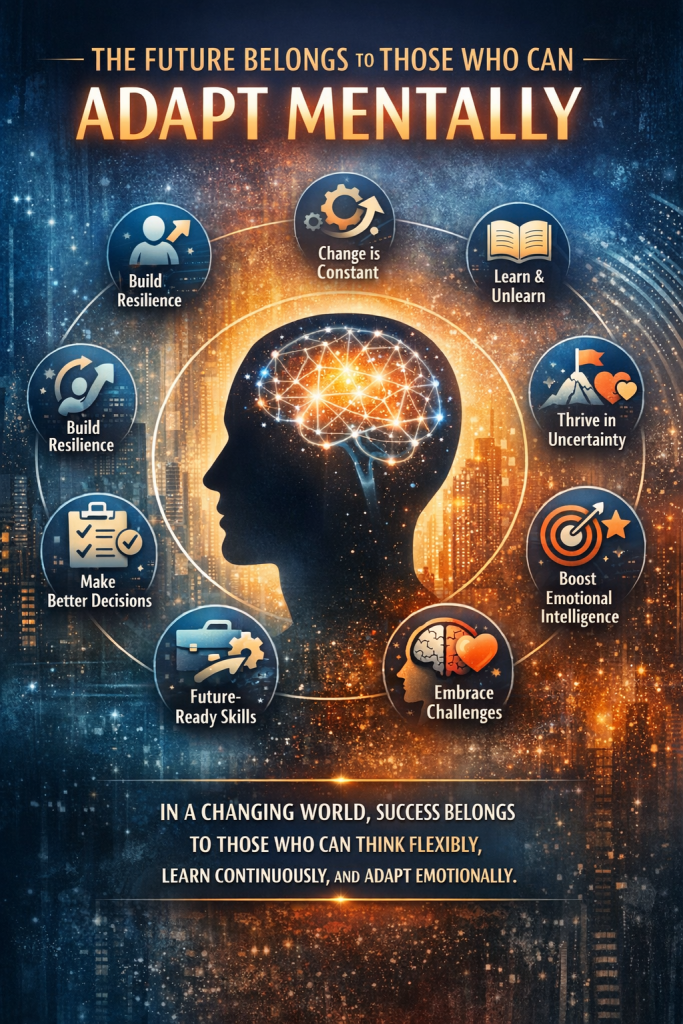
The Future Belongs to Those Who Can Adapt Mentally

In a rapidly changing world, success is no longer determined only by intelligence, talent, or experience. The ability to adapt mentally has become the most important life skill. Below are simple, clear points explaining why mental adaptability shapes the future.


1. Change Is Constant, Not Optional

Technology, workplaces, and lifestyles are evolving faster than ever. Those who mentally resist change experience stress and stagnation, while adaptable minds learn to adjust and move forward.


2. Mental Flexibility Enables Faster Learning

Adaptable individuals are open to unlearning old habits and acquiring new skills. This learning mindset allows them to stay relevant in education, careers, and personal growth.


3. Resilient Minds Handle Uncertainty Better

The future is unpredictable. Mental adaptability helps individuals remain calm during uncertainty, view challenges as temporary, and respond with problem-solving rather than panic.


4. Adaptability Strengthens Emotional Intelligence

Mentally adaptable people regulate emotions effectively, accept feedback positively, and adjust behavior based on situations. This improves relationships and leadership effectiveness.


5. Fixed Mindsets Limit Growth

A rigid mindset clings to comfort zones and fears failure. In contrast, adaptable minds see failure as feedback and change as an opportunity for improvement.


6. Mental Adaptation Supports Well-Being

Being mentally flexible reduces stress, anxiety, and burnout. Acceptance and adjustment protect mental health in high-pressure environments.


7. Future Careers Demand Cognitive Agility

Jobs of the future will require continuous upskilling. Mental adaptability enables individuals to transition across roles, industries, and technologies with confidence.


8. Adaptable Minds Make Better Decisions

Open-minded thinking allows individuals to evaluate situations objectively, consider alternatives, and make informed decisions even with limited information.


9. Growth Begins with Self-Awareness

Understanding one’s thoughts, beliefs, and emotional patterns is the first step toward mental adaptability. Awareness creates choice rather than automatic reactions.


10. Adaptability Is a Trainable Skill

Mental flexibility can be developed through reflection, lifelong learning, mindfulness, and embracing new experiences.


Conclusion

The future will not favor the strongest or the smartest, but those who can think flexibly, learn continuously, and adapt emotionally. Mental adaptability is no longer optional—it is the foundation for sustainable success and well-being in an uncertain world.

Design Your Tomorrow: Habits That Shape a Better You

✨ The life you want tomorrow is built on the choices you make today. Developing the right habits can transform your mindset, health, and future. Here are some simple habits to shape a better you:


1. Start Your Day with Intention

  • Wake up early and avoid rushing.
  • Spend a few minutes planning your day.
  • Set 1–2 top priorities instead of an overwhelming list.

2. Practice Gratitude

  • Write down 3 things you’re thankful for.
  • Gratitude shifts focus from problems to possibilities.
  • It builds positivity and emotional strength.

3. Fuel Your Body Right

  • Eat balanced meals with whole foods.
  • Stay hydrated throughout the day.
  • Avoid excess sugar and processed foods.

4. Move Your Body Daily

  • Even 20–30 minutes of walking, stretching, or yoga helps.
  • Exercise improves energy and mental clarity.
  • Consistency matters more than intensity.

5. Prioritize Learning

  • Read, listen to podcasts, or take short courses.
  • Learning keeps the brain sharp and boosts confidence.
  • Even 10 minutes a day compounds over time.

6. Declutter Your Mind

  • Journal your thoughts to reduce stress.
  • Practice mindfulness or meditation.
  • Create digital boundaries by limiting screen time.

7. Build Strong Connections

  • Spend time with people who uplift you.
  • Practice active listening and empathy.
  • Meaningful relationships improve happiness and health.

8. End Your Day with Reflection

  • Review what went well and what can improve.
  • Celebrate small wins.
  • Prepare for tomorrow with clarity.

Remember:
Small habits shape big results. You don’t need to change everything at once—just start with one habit today. Over time, your daily actions will design a tomorrow you’ll be proud of.

Reflection Without Action is a Missed Opportunity for Growth

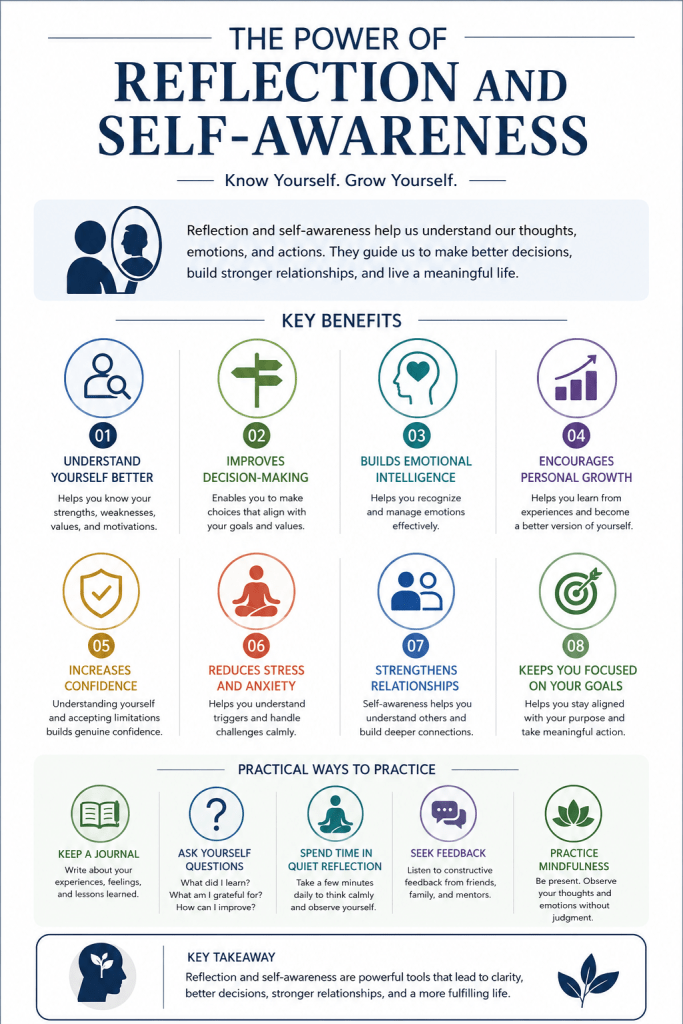
  1. Reflection Gives Clarity
    • Thinking about past experiences helps you understand what worked and what didn’t.
    • But without action, these insights won’t create real change.
    • Quote: “Knowing is not enough; we must apply.” – Johann Wolfgang von Goethe
  2. Action Brings Growth
    • Growth happens when you act on your reflections and implement changes.
    • Reflection alone leaves progress incomplete.
  3. Small Steps Matter
    • Even small actions based on reflection can lead to big improvements over time.
    • Example: If you reflect on poor fitness but start walking for 10 minutes daily, you’ll see gradual progress.
  4. Avoid Regret
    • Reflecting but not acting can lead to regrets about missed opportunities.
    • Quote: “Action is the foundational key to all success.” – Pablo Picasso
  5. Reflection + Action = Success
    • Combine reflection and action to create a cycle of learning and improvement.
    • Example: Entrepreneurs improve by acting on customer feedback after reflecting on business challenges.
  6. Learn From Mistakes
    • Reflection helps you see mistakes, but action ensures you learn from them.
    • Quote: “Success is not final, failure is not fatal: It is the courage to continue that counts.” – Winston Churchill
  7. Build Confidence Through Action
    • Acting on your thoughts builds confidence and belief in your abilities.
    • Example: Overcoming public speaking fear starts with small actions like speaking in front of friends.

Key Takeaway:
Reflection without action is like planning a journey but never starting it. Think, act, and grow—one step at a time.
Quote: “An idea is nothing without the action to back it up.” – Unknown

The Ultimate Trust: Building a Relationship with the Almighty

Have you ever felt let down or betrayed by someone you thought you could trust? You’re not alone. Human relationships can be messy and unpredictable, leaving us feeling vulnerable and unsure. But fear not, because there is one relationship that is always steadfast and trustworthy – our connection with the Almighty.

The Nature of Human Relationships

Human relationships are a beautiful and complex tapestry of emotions, but they can also be fragile and easily broken. People are flawed and imperfect, which means they can sometimes disappoint us or let us down. This can lead to feelings of mistrust and betrayal, leaving us questioning who we can truly rely on.

The Unwavering Support of the Almighty

When it comes to the Almighty, the story is different. A divine presence that offers unconditional love and unwavering support, the Almighty is always there for us, no matter what. In times of joy or sorrow, in moments of triumph or defeat, the Almighty remains a constant source of comfort and guidance.

Finding Solace in Spirituality

Turning to our faith can provide us with a sense of peace and comfort that human relationships often cannot. By deepening our spiritual connection with the Almighty, we can find solace in knowing that we are not alone in this journey of life. Through prayer, meditation, and reflection, we can strengthen our bond with the Divine and feel a sense of inner peace.

Embracing the Power of Faith

Countless individuals have found solace and strength in their relationship with the Almighty. By placing their trust in a higher power, they have been able to navigate life’s challenges with courage and resilience. The power of faith is an incredible force that can sustain us through even the darkest of times, providing us with a sense of purpose and meaning.

Remember, the Almighty is always there for you, ready to offer guidance, comfort, and love. By nurturing your relationship with the Divine, you can find a sense of peace and trust that surpasses anything the world has to offer. So, take a moment today to connect with the Almighty and feel the power of divine trust infusing your life with strength and hope.