Inner Peace vs. Happiness: What Truly Matters?

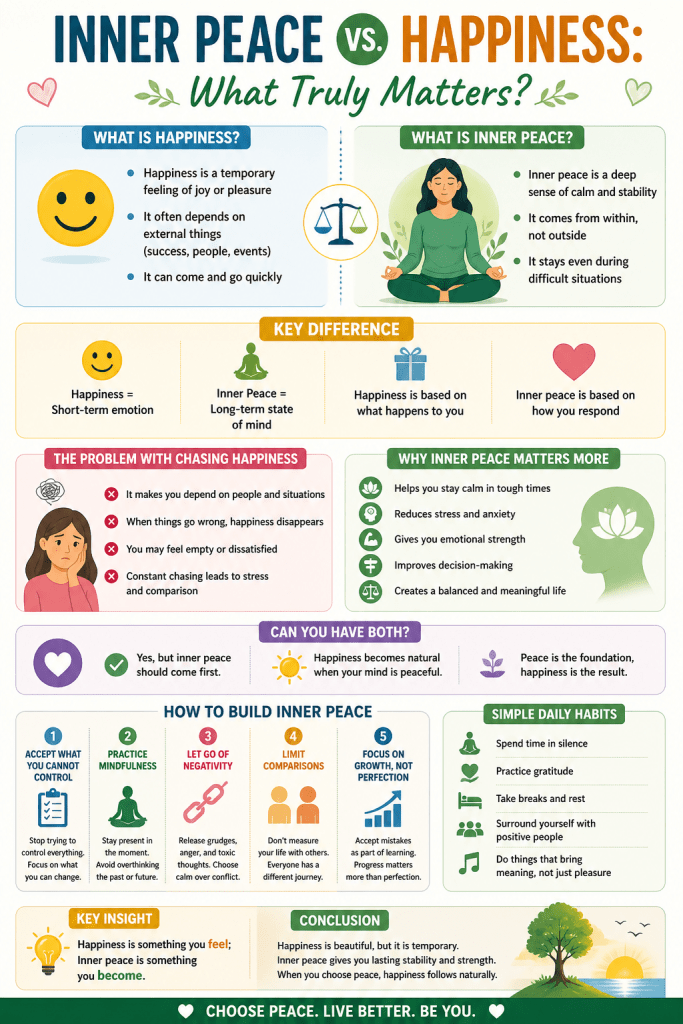
💭 What is Happiness?

  • Happiness is a temporary feeling of joy or pleasure
  • It often depends on external things (success, people, events)
  • It can come and go quickly

🧘 What is Inner Peace?

  • Inner peace is a deep sense of calm and stability
  • It comes from within, not outside
  • It stays even during difficult situations

⚖️ Key Difference

  • Happiness = Short-term emotion
  • Inner Peace = Long-term state of mind
  • Happiness is based on what happens to you
  • Inner peace is based on how you respond

🌪️ The Problem with Chasing Happiness

  • It makes you depend on people and situations
  • When things go wrong, happiness disappears
  • You may feel empty or dissatisfied
  • Constant chasing leads to stress and comparison

🌸 Why Inner Peace Matters More

  • Helps you stay calm in tough times
  • Reduces stress and anxiety
  • Gives you emotional strength
  • Improves decision-making
  • Creates a balanced and meaningful life

🔄 Can You Have Both?

  • Yes, but inner peace should come first
  • Happiness becomes natural when your mind is peaceful
  • Peace is the foundation, happiness is the result

🔓 How to Build Inner Peace

1. 🧠 Accept What You Cannot Control

  • Stop trying to control everything
  • Focus on what you can change

2. 🧘 Practice Mindfulness

  • Stay present in the moment
  • Avoid overthinking the past or future

3. ❤️ Let Go of Negativity

  • Release grudges, anger, and toxic thoughts
  • Choose calm over conflict

4. 🚫 Limit Comparisons

  • Don’t measure your life with others
  • Everyone has a different journey

5. 🌱 Focus on Growth, Not Perfection

  • Accept mistakes as part of learning
  • Progress matters more than perfection

🌼 Simple Daily Habits

  • Spend time in silence
  • Practice gratitude
  • Take breaks and rest
  • Surround yourself with positive people
  • Do things that bring meaning, not just pleasure

✨ Key Insight

  • Happiness is something you feel
  • Inner peace is something you become

🌈 Conclusion

  • Happiness is beautiful, but it is temporary
  • Inner peace gives you lasting stability and strength
  • When you choose peace, happiness follows naturally

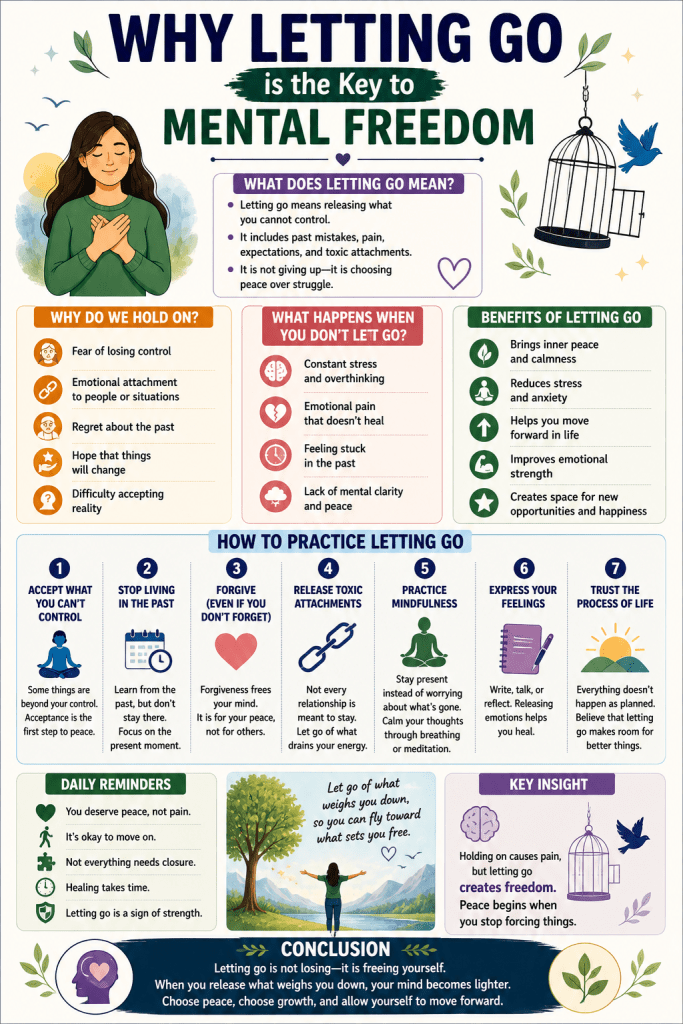
🌿 Why Letting Go is the Key to Mental Freedom

💭 What Does Letting Go Mean?

  • Letting go means releasing what you cannot control
  • It includes past mistakes, pain, expectations, and toxic attachments
  • It is not giving up—it is choosing peace over struggle

🧠 Why Do We Hold On?

  • Fear of losing control
  • Emotional attachment to people or situations
  • Regret about the past
  • Hope that things will change
  • Difficulty accepting reality

🌪️ What Happens When You Don’t Let Go?

  • Constant stress and overthinking
  • Emotional pain that doesn’t heal
  • Feeling stuck in the past
  • Lack of mental clarity and peace

🔓 Benefits of Letting Go

  • Brings inner peace and calmness
  • Reduces stress and anxiety
  • Helps you move forward in life
  • Improves emotional strength
  • Creates space for new opportunities and happiness

🔐 How to Practice Letting Go

1. स्वीकार Accept What You Can’t Control

  • Some things are beyond your control
  • Acceptance is the first step to peace

2. 🪞 Stop Living in the Past

  • Learn from the past, but don’t stay there
  • Focus on the present moment

3. ❤️ Forgive (Even If You Don’t Forget)

  • Forgiveness frees your mind
  • It is for your peace, not for others

4. 🚫 Release Toxic Attachments

  • Not every relationship is meant to stay
  • Let go of what drains your energy

5. 🧘 Practice Mindfulness

  • Stay present instead of worrying about what’s gone
  • Calm your thoughts through breathing or meditation

6. ✍️ Express Your Feelings

  • Write, talk, or reflect
  • Releasing emotions helps you heal

7. 🌱 Trust the Process of Life

  • Everything doesn’t happen as planned
  • Believe that letting go makes room for better things

🌸 Daily Reminders

  • You deserve peace, not pain
  • It’s okay to move on
  • Not everything needs closure
  • Healing takes time
  • Letting go is a sign of strength

✨ Key Insight

  • Holding on causes pain, but letting go creates freedom
  • Peace begins when you stop forcing things

🌈 Conclusion

  • Letting go is not losing—it is freeing yourself
  • When you release what weighs you down, your mind becomes lighter
  • Choose peace, choose growth, and allow yourself to move forward

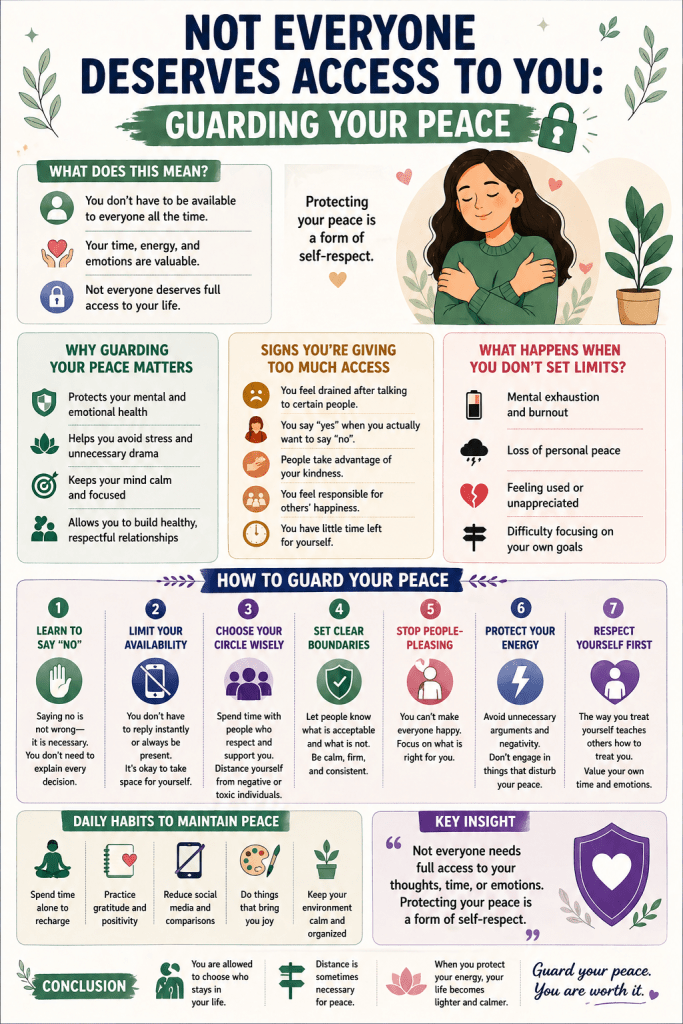
🌿 Not Everyone Deserves Access to You: Guarding Your Peace

💭 What Does This Mean?

  • You don’t have to be available to everyone all the time
  • Your time, energy, and emotions are valuable
  • Not everyone deserves full access to your life

🧠 Why Guarding Your Peace Matters

  • Protects your mental and emotional health
  • Helps you avoid stress and unnecessary drama
  • Keeps your mind calm and focused
  • Allows you to build healthy, respectful relationships

🚨 Signs You’re Giving Too Much Access

  • You feel drained after talking to certain people
  • You say “yes” when you actually want to say “no”
  • People take advantage of your kindness
  • You feel responsible for others’ happiness
  • You have little time left for yourself

🌪️ What Happens When You Don’t Set Limits?

  • Mental exhaustion and burnout
  • Loss of personal peace
  • Feeling used or unappreciated
  • Difficulty focusing on your own goals

🔐 How to Guard Your Peace

1. 🚫 Learn to Say “No”

  • Saying no is not wrong—it is necessary
  • You don’t need to explain every decision

2. ⏳ Limit Your Availability

  • You don’t have to reply instantly or always be present
  • It’s okay to take space for yourself

3. 🧍‍♀️ Choose Your Circle Wisely

  • Spend time with people who respect and support you
  • Distance yourself from negative or toxic individuals

4. 🗣️ Set Clear Boundaries

  • Let people know what is acceptable and what is not
  • Be calm, firm, and consistent

5. ❤️ Stop People-Pleasing

  • You can’t make everyone happy
  • Focus on what is right for you

6. 🧘 Protect Your Energy

  • Avoid unnecessary arguments and negativity
  • Don’t engage in things that disturb your peace

7. 🪞 Respect Yourself First

  • The way you treat yourself teaches others how to treat you
  • Value your own time and emotions

🌸 Daily Habits to Maintain Peace

  • Spend time alone to recharge
  • Practice gratitude and positivity
  • Reduce social media and comparisons
  • Do things that bring you joy
  • Keep your environment calm and organized

✨ Key Insight

  • Not everyone needs full access to your thoughts, time, or emotions
  • Protecting your peace is a form of self-respect

🌈 Conclusion

  • You are allowed to choose who stays in your life
  • Distance is sometimes necessary for peace
  • When you protect your energy, your life becomes lighter and calmer

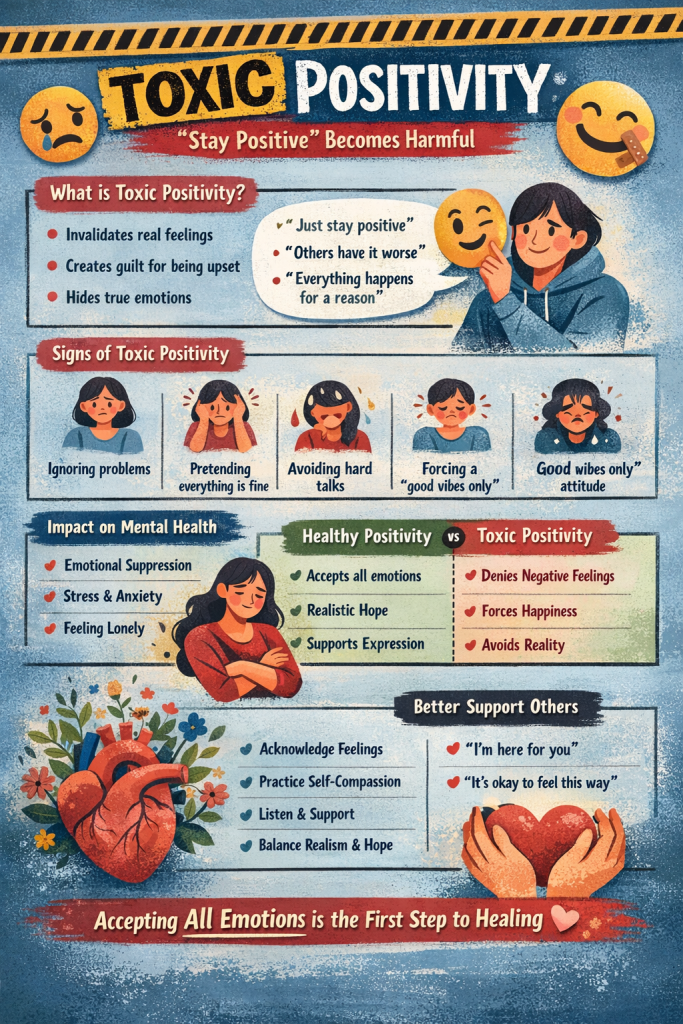
🌿 Toxic Positivity: When “Stay Positive” Becomes Harmful

💭 What is Toxic Positivity?

  • Toxic positivity is the belief that you should always stay positive, no matter how difficult the situation is
  • It rejects or ignores negative emotions like sadness, anger, or stress
  • Common phrases include:
    • “Just stay positive”
    • “Others have it worse”
    • “Everything happens for a reason”

⚠️ Why It Can Be Harmful

  • It invalidates real feelings
  • Makes people feel guilty for being upset
  • Creates pressure to hide true emotions
  • Prevents emotional healing and growth

😔 Signs of Toxic Positivity

  • Ignoring problems instead of facing them
  • Pretending everything is okay when it’s not
  • Avoiding difficult conversations
  • Feeling uncomfortable when others express sadness
  • Forcing positivity in every situation

🧠 Impact on Mental Health

  • Builds emotional suppression
  • Increases stress and anxiety
  • Leads to feeling lonely or misunderstood
  • Stops people from seeking help
  • Can cause emotional burnout over time

💡 Healthy Positivity vs Toxic Positivity

Healthy Positivity

  • Accepts both good and bad emotions
  • Encourages realistic hope
  • Supports emotional expression

Toxic Positivity

  • Denies negative feelings
  • Forces happiness
  • Avoids reality

🌱 What to Do Instead

  • Acknowledge your feelings – It’s okay to feel sad or stressed
  • Practice self-compassion – Be kind to yourself
  • Listen without judgment – For yourself and others
  • Express emotions – Talk, write, or reflect
  • Focus on balance – Accept pain and still find hope

🤝 How to Support Others Better

Instead of saying:

  • “Just stay positive”

Try saying:

  • “I’m here for you”
  • “It’s okay to feel this way”
  • “Take your time, you’ll get through this”

🌸 Conclusion

  • Positivity is powerful, but forced positivity is not healthy
  • True mental well-being comes from accepting all emotions
  • Healing begins when we allow ourselves to feel, not hide

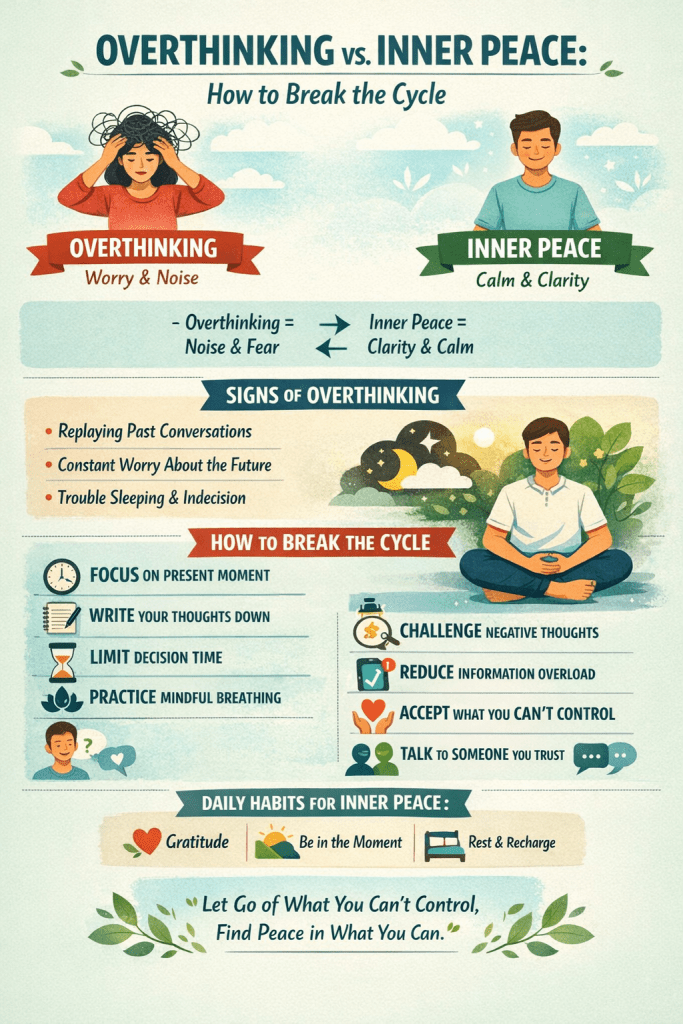
🧠 Overthinking vs. Inner Peace: How to Break the Cycle

🌪️ What is Overthinking?

  • Overthinking means constantly analyzing, worrying, or replaying situations in your mind
  • It often focuses on “what if” and worst-case scenarios
  • Instead of solving problems, it creates more stress and confusion

🕊️ What is Inner Peace?

  • Inner peace is a state of mental calm and emotional balance
  • It means accepting things you cannot control
  • A peaceful mind stays present, steady, and less reactive

⚖️ Overthinking vs. Inner Peace

  • Overthinking = Noise, doubt, fear
  • Inner Peace = Clarity, acceptance, calmness
  • Overthinking drains energy, while inner peace restores it

🚨 Signs You Are Overthinking

  • Replaying past conversations again and again
  • Constant worry about the future
  • Difficulty making decisions
  • Trouble sleeping due to racing thoughts
  • Feeling mentally exhausted without doing much

🌿 Why Do We Overthink?

  • Fear of failure or rejection
  • Need for control over everything
  • Lack of confidence in decisions
  • Past negative experiences
  • Trying to please everyone

🔓 How to Break the Overthinking Cycle

1. ⏳ Focus on the Present

  • Train your mind to stay in the current moment
  • Ask yourself: “Is this happening right now?”

2. ✍️ Write Your Thoughts Down

  • Journaling helps release thoughts instead of trapping them in your mind
  • It brings clarity and reduces mental pressure

3. 🎯 Limit Decision Time

  • Give yourself a time limit to think and decide
  • Avoid endless analysis—done is better than perfect

4. 🧘 Practice Mindfulness or Deep Breathing

  • Simple breathing exercises can calm your nervous system
  • Even 5 minutes daily makes a difference

5. 🚫 Challenge Negative Thoughts

  • Not every thought is true
  • Replace “What if everything goes wrong?” with
    “What if things turn out okay?”

6. 📵 Reduce Information Overload

  • Too much social media and comparison increase mental noise
  • Take breaks to protect your peace

7. 🤝 Accept What You Cannot Control

  • Peace begins when you stop trying to control everything
  • Focus only on your actions, not outcomes

8. 💬 Talk It Out

  • Sharing your thoughts with someone you trust reduces mental burden
  • You gain perspective and emotional relief

🌸 Daily Habits for Inner Peace

  • Start your day with gratitude
  • Spend time in silence or reflection
  • Keep your environment clean and calm
  • Practice self-compassion (be kind to yourself)
  • Get enough rest and take breaks

✨ Key Insight

  • Overthinking is not a sign of intelligence—it’s often a sign of unmanaged fear
  • Inner peace is not something you find outside—it’s something you build within

🌈 Conclusion

  • You don’t need to control every thought
  • You just need to choose which thoughts deserve your attention
  • The more you let go, the more peaceful your mind becomes

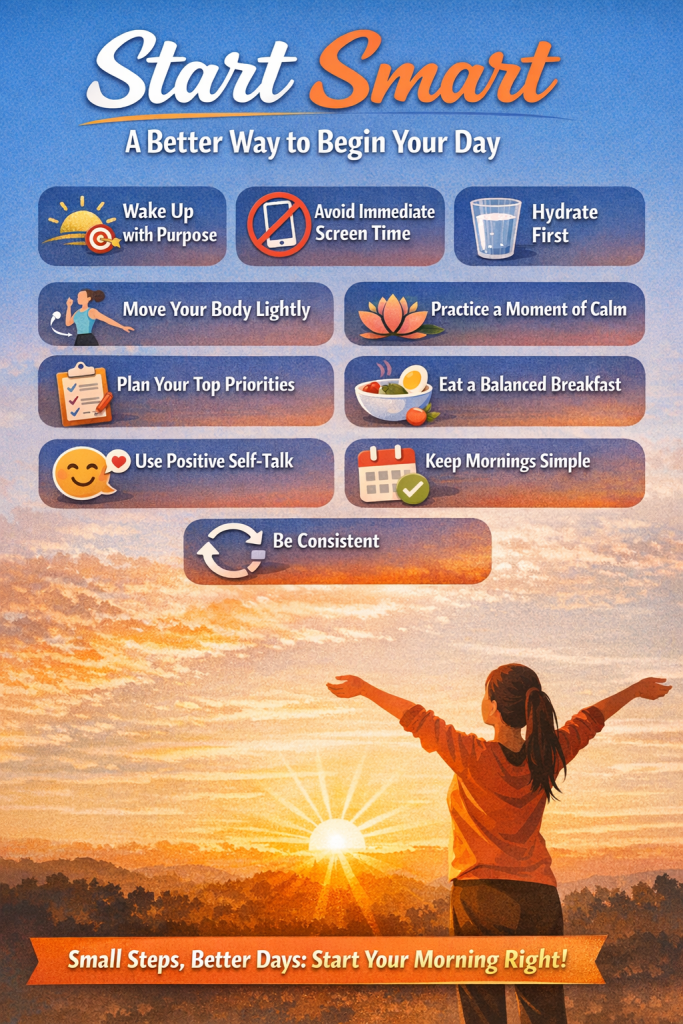
Start Smart: A Better Way to Begin Your Day

How you begin your morning often determines how effective, calm, and focused the rest of your day will be. A smart start does not require drastic changes. Small, intentional actions can create clarity, energy, and direction. Below are simple, practical points to help you start your day better.


1. Wake Up with Purpose

Avoid rushing out of bed. Take a moment to remind yourself of one important task or goal for the day. This creates direction and reduces mental clutter.


2. Avoid Immediate Screen Time

Checking your phone immediately can increase stress and distraction. Give your mind at least 15–20 minutes before engaging with messages or social media.


3. Hydrate First

Drinking water soon after waking up helps activate your body, improves concentration, and supports overall health.


4. Move Your Body Lightly

Simple stretching, a short walk, or light exercise boosts blood circulation and helps you feel more alert and positive.


5. Practice a Moment of Calm

Spend a few minutes in silence, deep breathing, or prayer/meditation. This improves emotional balance and mental clarity.


6. Plan Your Top Priorities

List two or three important tasks for the day. Clear priorities reduce overwhelm and improve productivity.


7. Eat a Balanced Breakfast

A healthy breakfast supports energy levels and concentration. Avoid skipping meals or relying only on caffeine.


8. Use Positive Self-Talk

Begin your day with encouraging thoughts. Confidence in the morning strengthens resilience throughout the day.


9. Keep Mornings Simple

Avoid overloading your schedule early in the day. A calm morning sets the tone for better decision-making.


10. Be Consistent

A smart start works best when practiced daily. Consistency turns good habits into lasting routines.


Conclusion

Starting smart is about being intentional, not perfect. A few mindful steps each morning can lead to improved focus, reduced stress, and better outcomes—both personally and professionally. When you begin your day with clarity, the rest of the day follows naturally.

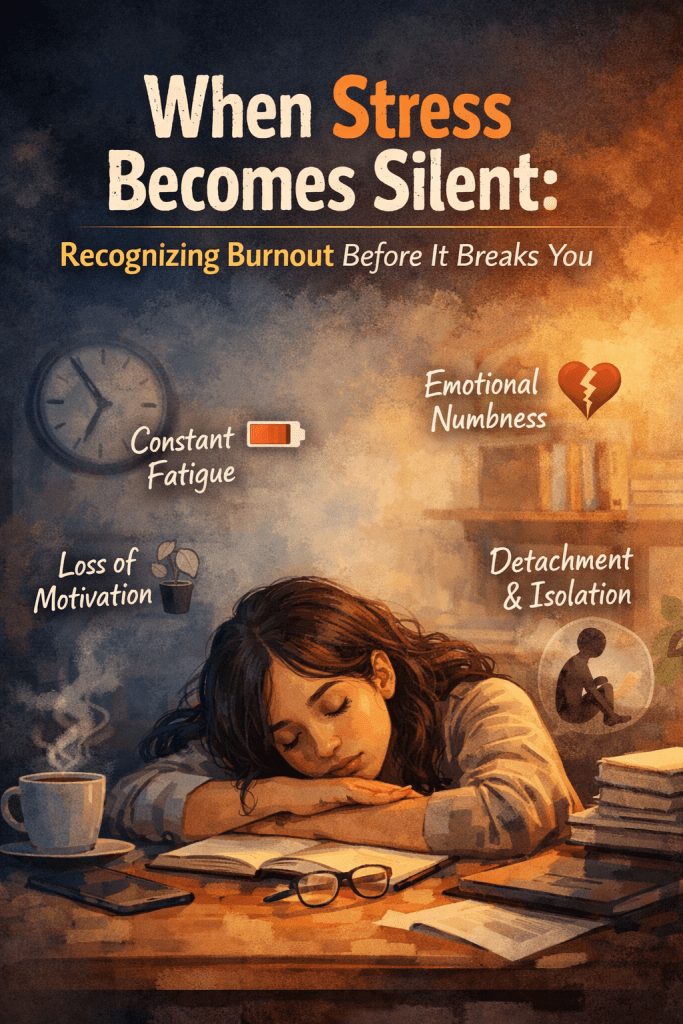
When Stress Becomes Silent: Recognizing Burnout Before It Breaks You

Introduction

Stress is often visible. We feel tired, worried, or overwhelmed and we talk about it.
Burnout, however, is different. It grows quietly. Many people do not realize they are burned out until their health, motivation, or relationships begin to suffer. Understanding early signs of burnout can help us take action before it becomes serious.


What Is Silent Burnout?

Silent burnout happens when prolonged stress is ignored or normalized. A person may continue working, meeting responsibilities, and appearing “fine” while internally feeling drained and disconnected.

It is not sudden. It develops slowly due to continuous pressure without enough rest, emotional support, or recovery.


Early Signs You Should Not Ignore

  • Constant tiredness even after rest
  • Loss of interest in work or daily activities
  • Feeling emotionally numb or detached
  • Irritability over small issues
  • Difficulty concentrating or making decisions
  • Frequent headaches, body pain, or sleep problems
  • Feeling unappreciated or hopeless

These signs are often dismissed as “just stress,” but they may indicate burnout.


Why Burnout Goes Unnoticed

  • We get used to being busy all the time
  • We believe taking rest is a weakness
  • We prioritize work over health
  • We feel guilty for slowing down
  • Others praise us for “handling everything”

Over time, this mindset makes burnout invisible.


Difference Between Stress and Burnout

  • Stress: Too many demands, but you still care
  • Burnout: Emotional exhaustion, loss of motivation, and feeling empty

Stress makes you feel overloaded. Burnout makes you feel drained and disconnected.


How to Prevent Burnout Early

  • Take regular breaks without guilt
  • Set realistic limits on work and responsibilities
  • Learn to say no when needed
  • Talk openly about how you feel
  • Prioritize sleep, nutrition, and physical activity
  • Do at least one activity daily that brings calm or joy

Small changes practiced consistently make a big difference.


When to Seek Support

If exhaustion, sadness, or detachment lasts for weeks, professional help is important. Speaking to a counselor, mentor, or healthcare professional is a sign of strength, not weakness.


Final Thoughts

Burnout does not announce itself loudly. It whispers through fatigue, silence, and loss of joy. Listening early can protect your mental and physical well-being.

Taking care of yourself is not optional. It is essential for long-term success and a healthy life.

✨ The Quantum Leap: Small Changes That Create Big Shifts in Life

Life doesn’t always change through big decisions or dramatic moments.
Sometimes, it changes through tiny actions—small steps that create powerful results over time.
In quantum physics, a “quantum leap” is a small jump of energy that leads to a big transformation.
The same idea applies to our lives.

Here’s how small changes can create big shifts, just like a quantum leap.


🌟 1. Small Changes Create New Possibilities

In quantum theory, even a tiny shift in energy can move a particle to a completely new state.
In life, a small habit change can move you to a new version of yourself.

Example:

  • Reading for 10 minutes a day can slowly turn you into a knowledgeable, confident person.
  • Drinking one extra glass of water daily can improve your energy level.

🌟 2. Every Action Raises Your “Energy Level”

Quantum leaps happen when energy increases.
Similarly, when you make small improvements, your mindset, confidence, and lifestyle rise to a higher level.

Example:

  • Waking up just 15 minutes earlier each day may give you extra time to plan your day calmly.
  • Writing three things you’re grateful for shifts your emotional energy instantly.

🌟 3. You Don’t Need Big Motivation — Just Tiny Momentum

Quantum jumps don’t require huge force; they happen instantly when enough small energy builds up.
Tiny efforts create steady momentum.

Example:

  • Walking only 2,000 steps more each day leads to better health over months.
  • Learning one new English word daily improves communication without pressure.

🌟 4. Small Decisions Change Your Direction

Even the slightest shift in angle can change your destination completely—just like how a particle’s path changes with a tiny impulse.
Small decisions today create a new future.

Example:

  • Choosing to save ₹20 a day becomes ₹600 a month and ₹7,200 a year.
  • Choosing to reduce screen time by 10 minutes daily improves focus and sleep.

🌟 5. The Power of Changing Your Environment Slightly

In quantum physics, particles change behavior depending on their environment.
Similarly, your surroundings influence your habits and mindset.

Example:

  • Keeping fruits on your table helps you eat healthier.
  • Placing books near your bed encourages reading.

🌟 6. Small Mindset Shifts Lead to Big Emotional Growth

A slight shift in thinking can transform how you feel, behave, and respond.

Example:

  • Changing the thought “I can’t do this” to “I will try” opens new opportunities.
  • Replacing negative self-talk with kinder words reduces stress.

🌟 7. Small Daily Improvements Compound Over Time

Just like small energy additions create a quantum jump, small daily efforts compound into major life progress.

Example:

  • Practicing a skill for just 5 minutes a day leads to mastery over months.
  • Saving small amounts regularly builds financial stability.

✨ Final Thought

A quantum leap is not magic.
It is the result of consistent small steps that slowly build enough energy to create a big transformation.

You don’t need huge changes.
You just need to begin—with one small step today.

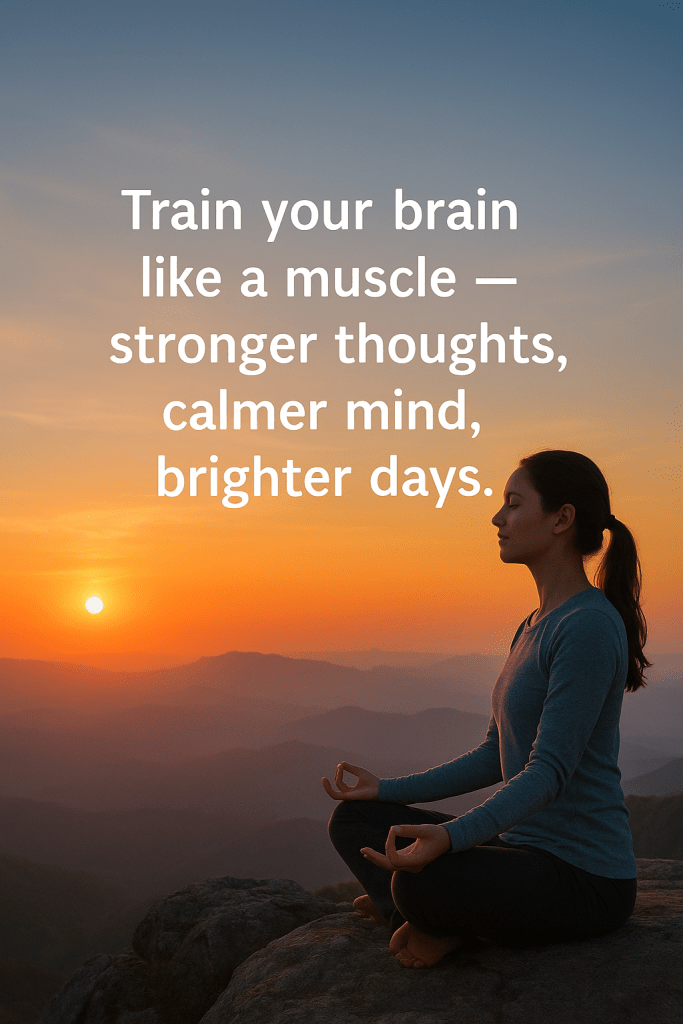
🧠 Mental Fitness: Treating Your Brain Like a Muscle

🌟 Introduction

Just like your body needs exercise to stay strong, your mind also needs regular training to stay healthy, calm, and focused.
Mental fitness isn’t about fixing problems — it’s about building strength, clarity, and emotional balance every day.

💬 “The mind is just like a muscle — the more you exercise it, the stronger it gets.”


💪 1. Train Your Brain Daily

  • Think of your brain as a muscle that grows stronger with use.
  • Do puzzles, read, learn new things, or try something different every day.
  • Challenge your routine to wake up new areas of your mind.

💬 “Great things never come from comfort zones.”


🧘‍♀️ 2. Practice Mindfulness and Meditation

  • Spend at least 10 minutes daily in silence or deep breathing.
  • It reduces stress, increases focus, and helps you stay grounded.
  • Mindfulness teaches you to live in the now, not in the noise.

💬 “Quiet the mind, and the soul will speak.” – Ma Jaya Sati Bhagavati


❤️ 3. Strengthen Emotional Resilience

  • Learn to manage emotions instead of running from them.
  • Focus on what you can control and let go of what you can’t.
  • Positive thinking is mental strength training in disguise.

💬 “You cannot control the waves, but you can learn to surf.”


🧩 4. Keep Learning and Growing

  • Pick up a new hobby, language, or creative skill.
  • Growth keeps your mind flexible and curious.
  • Every new experience builds fresh neural connections.

💬 “Once you stop learning, you start declining.” – Albert Einstein


🥗 5. Fuel Your Brain Right

  • Eat foods rich in omega-3, fruits, vegetables, and nuts.
  • Drink plenty of water and sleep well.
  • A healthy body supports a sharp, peaceful mind.

💬 “Take care of your body — it’s the only place you have to live.” – Jim Rohn


🤝 6. Build Social Connections

  • Talk, share, and connect with positive people.
  • Meaningful conversations boost happiness and mental stability.
  • Laughter and empathy are powerful mental vitamins.

💬 “Connection is the energy that exists between people when they feel seen, heard, and valued.” – Brené Brown


🏃‍♀️ 7. Move Your Body for Mental Strength

  • Walk, dance, or stretch — movement releases happy hormones.
  • Exercise improves focus, memory, and confidence.
  • A fit body supports a fit mind.

💬 “A healthy outside starts from the inside.” – Robert Urich


✍️ 8. Journal and Reflect

  • Write your thoughts to understand your emotions.
  • Journaling helps release mental clutter and find clarity.
  • It’s your daily talk with your inner self.

💬 “Writing is the painting of the voice.” – Voltaire


🌈 9. Rest and Recharge

  • Strength also means knowing when to pause.
  • Sleep, relax, and let your mind recover.
  • Rest is part of progress — not the absence of it.

💬 “Rest and self-care are not wasteful. They are acts of survival.”


🌻 Conclusion

Mental fitness is not about avoiding life’s challenges — it’s about training your mind to stay calm, confident, and creative through them.
Like your body, your brain becomes stronger with consistent care and attention.
Start small, stay steady, and your mental strength will grow — one thought at a time.

💬 “The mind is everything. What you think, you become.” – Buddha

Peaceful Eternal Life

🌸 Introduction

Everyone seeks peace — not just in moments, but in life itself. A peaceful eternal life is about living with calmness, clarity, and contentment that lasts beyond temporary highs and lows. It’s not about how long we live, but how peacefully we live.


☀️ 1. Peace Begins Within

  • True peace starts from the mind and heart, not from the outside world.
  • Calm thoughts create calm actions.
  • When you learn to quiet your inner noise, life automatically feels lighter.

“Peace comes from within. Do not seek it without.” – Buddha


🌊 2. Let Go of What You Can’t Control

  • Life becomes peaceful when we stop fighting every situation.
  • Acceptance is the first step to inner harmony.
  • Control your reactions, not the world around you.

“The greatest weapon against stress is our ability to choose one thought over another.” – William James


🌿 3. Live with Kindness and Compassion

  • A peaceful heart is a kind heart.
  • Helping others, forgiving mistakes, and spreading love bring eternal satisfaction.
  • Compassion connects us to something divine and everlasting.

🌤 4. Stay Grateful Every Day

  • Gratitude transforms ordinary days into blessings.
  • Appreciate simple joys — sunrise, laughter, loved ones, good health.
  • Gratitude invites peace and pushes away negativity.

“Gratitude turns what we have into enough.” – Anonymous


🌙 5. Connect with the Spiritual Side

  • Meditation, prayer, or quiet reflection can calm your soul.
  • Believe that life has a higher purpose beyond material success.
  • Spiritual awareness helps you feel eternal peace, beyond fear or loss.

🌻 6. Live in Harmony with Nature

  • Nature teaches balance and serenity.
  • Spend time under the sky, near trees or water — it heals silently.
  • When you live close to nature, you live close to peace.

🌈 7. Simplicity is the Secret

  • The less you chase, the more you rest.
  • Simplify your wants, declutter your mind, and value peace over possessions.
  • Eternal peace comes when you stop competing and start living mindfully.

🌟 Conclusion

Peaceful eternal life isn’t a faraway dream — it’s a state of being we can nurture every day.
It’s in our thoughts, choices, and the love we share.
When you live with peace in your heart, you live eternally — even in moments.

“Peace is not the destination, it is the way.” – Thich Nhat Hanh