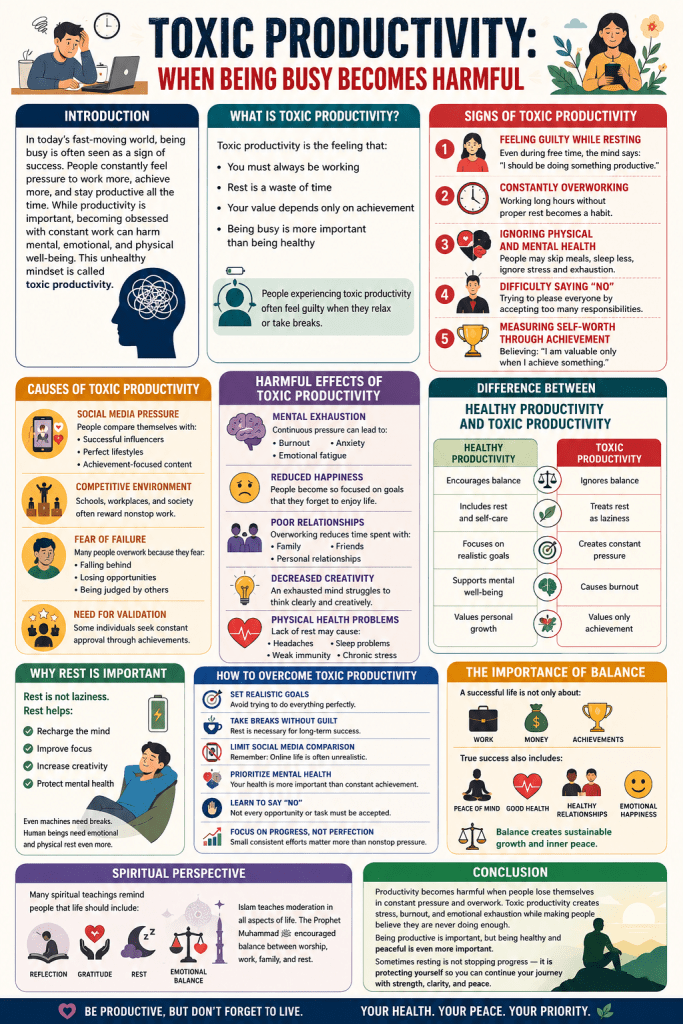
Toxic Productivity: When Being Busy Becomes Harmful

Introduction

In today’s fast-moving world, being busy is often seen as a sign of success. People constantly feel pressure to work more, achieve more, and stay productive all the time. While productivity is important, becoming obsessed with constant work can harm mental, emotional, and physical well-being. This unhealthy mindset is called toxic productivity.


What is Toxic Productivity?

Toxic productivity is the feeling that:

  • You must always be working
  • Rest is a waste of time
  • Your value depends only on achievement
  • Being busy is more important than being healthy

People experiencing toxic productivity often feel guilty when they relax or take breaks.


Signs of Toxic Productivity

1. Feeling Guilty While Resting

Even during free time, the mind says:

  • “I should be doing something productive.”

2. Constantly Overworking

Working long hours without proper rest becomes a habit.

3. Ignoring Physical and Mental Health

People may:

  • Skip meals
  • Sleep less
  • Ignore stress and exhaustion

4. Difficulty Saying “No”

Trying to please everyone by accepting too many responsibilities.

5. Measuring Self-Worth Through Achievement

Believing:

  • “I am valuable only when I achieve something.”

Causes of Toxic Productivity

Social Media Pressure

People compare themselves with:

  • Successful influencers
  • Perfect lifestyles
  • Achievement-focused content

Competitive Environment

Schools, workplaces, and society often reward nonstop work.

Fear of Failure

Many people overwork because they fear:

  • Falling behind
  • Losing opportunities
  • Being judged by others

Need for Validation

Some individuals seek constant approval through achievements.


Harmful Effects of Toxic Productivity

Mental Exhaustion

Continuous pressure can lead to:

  • Burnout
  • Anxiety
  • Emotional fatigue

Reduced Happiness

People become so focused on goals that they forget to enjoy life.

Poor Relationships

Overworking reduces time spent with:

  • Family
  • Friends
  • Personal relationships

Decreased Creativity

An exhausted mind struggles to think clearly and creatively.

Physical Health Problems

Lack of rest may cause:

  • Headaches
  • Sleep problems
  • Weak immunity
  • Chronic stress

Difference Between Healthy Productivity and Toxic Productivity

Healthy ProductivityToxic Productivity
Encourages balanceIgnores balance
Includes rest and self-careTreats rest as laziness
Focuses on realistic goalsCreates constant pressure
Supports mental well-beingCauses burnout
Values personal growthValues only achievement

Why Rest is Important

Rest is not laziness.
Rest helps:

  • Recharge the mind
  • Improve focus
  • Increase creativity
  • Protect mental health

Even machines need breaks. Human beings need emotional and physical rest even more.


How to Overcome Toxic Productivity

Set Realistic Goals

Avoid trying to do everything perfectly.

Take Breaks Without Guilt

Rest is necessary for long-term success.

Limit Social Media Comparison

Remember:

  • Online life is often unrealistic.

Prioritize Mental Health

Your health is more important than constant achievement.

Learn to Say “No”

Not every opportunity or task must be accepted.

Focus on Progress, Not Perfection

Small consistent efforts matter more than nonstop pressure.


The Importance of Balance

A successful life is not only about:

  • Work
  • Money
  • Achievements

True success also includes:

  • Peace of mind
  • Good health
  • Healthy relationships
  • Emotional happiness

Balance creates sustainable growth and inner peace.


Spiritual Perspective

Many spiritual teachings remind people that life should include:

  • Reflection
  • Gratitude
  • Rest
  • Emotional balance

Islam teaches moderation in all aspects of life. The Prophet Muhammad ﷺ encouraged balance between worship, work, family, and rest.


Conclusion

Productivity becomes harmful when people lose themselves in constant pressure and overwork. Toxic productivity creates stress, burnout, and emotional exhaustion while making people believe they are never doing enough.

Being productive is important, but being healthy and peaceful is even more important.

Sometimes resting is not stopping progress — it is protecting yourself so you can continue your journey with strength, clarity, and peace.

💔You Are Your Own Strength

1. Tough Times Are Real, and So Is Loneliness

  • When life gets difficult, you may feel isolated—even when people are around.
  • Friends and family may care, but they can’t always feel what you’re feeling.
  • It’s during these moments that you truly understand: the strongest support comes from within.

2. Don’t Expect Others to Save You

  • People may promise support, but they have their own struggles too.
  • Some will disappear when things get dark—don’t take it personally.
  • Learn to rely on yourself emotionally and mentally.

3. You Are Your Own Constant

  • Life changes, people change, situations change—but you stay.
  • You live with your thoughts, your feelings, and your healing.
  • Become your own best friend and safe space.

4. Tough Times Teach Self-Reliance

  • Pain teaches you strength.
  • You learn to cope, adapt, and rise—because you have to.
  • You start discovering inner power you never knew you had.

5. It’s Okay to Ask for Help, But Don’t Depend on It

  • Reaching out is healthy—but don’t expect anyone to carry your burden fully.
  • People can guide or listen, but only you can walk your path.

6. Grow Through the Pain, Don’t Just Go Through It

  • Every tough time is a chance to evolve.
  • Learn from the silence, the rejections, and the heartaches.
  • Use pain as fuel for personal transformation.

7. Celebrate Yourself for Surviving

  • Even if no one noticed your silent battles, you won them.
  • Give yourself credit for showing up, even when it was hard.
  • You are enough. You are strong. You are healing.

Final Thought:

“At the end of the day, the one who stands by you through every breakdown and breakthrough—is YOU.”

The Loneliness Epidemic: How to Build Meaningful Connections

In today’s fast-paced world, loneliness has become an epidemic, affecting people of all ages. Despite living in an increasingly connected world, many feel isolated and disconnected.

1. Understanding the Loneliness Epidemic

  • Growing Problem: Loneliness is no longer just about being physically alone—it’s about feeling emotionally disconnected from others.
  • Impact on Health: Studies show that loneliness can have serious effects on mental and physical health, contributing to issues like depression, anxiety, and even cardiovascular problems.

2. The Role of Technology in Loneliness

  • Social Media Paradox: While technology connects us online, it often creates a sense of superficiality. Online interactions can sometimes leave us feeling more alone than before.
  • The Need for Real Conversations: Text messages and likes are not a substitute for genuine, face-to-face connections. Real conversations foster deeper bonds.

3. Quality Over Quantity in Friendships

  • Deep Connections Matter: It’s not about having hundreds of friends, but about building meaningful, authentic relationships with a few people.
  • Emotional Support: True connections provide a source of emotional support, understanding, and mutual care.

4. Steps to Build Meaningful Connections

  • Be Present: Take the time to listen, really listen, when someone is speaking. Showing genuine interest in others builds trust and rapport.
  • Vulnerability: Don’t be afraid to open up about your feelings, struggles, and thoughts. Vulnerability fosters deeper connections and shows that you’re approachable.
  • Engage in Activities: Join clubs, take up hobbies, or volunteer. Being part of a group with shared interests increases the chances of meeting like-minded individuals.
  • Quality Time: Spend time with people you care about without distractions. Put away your phone and focus on the moment.

5. Combatting the Stigma of Loneliness

  • It’s Okay to Feel Lonely: Many people experience loneliness, but it’s not something to be ashamed of. Acknowledging it is the first step toward overcoming it.
  • Seeking Help: If loneliness feels overwhelming, don’t hesitate to seek professional help. Therapy can be a great way to process feelings and develop strategies for connection.

6. Building Stronger Communities

  • Support Systems: Communities, whether physical or virtual, play a crucial role in combating loneliness. Strengthening these networks helps individuals feel seen and valued.
  • Reach Out: If you notice someone is struggling with loneliness, reach out. Small acts of kindness, like inviting someone for coffee or a walk, can make a huge difference.

7. Conclusion

Loneliness is a complex issue, but it’s one that can be addressed with intention and effort. By prioritizing meaningful connections, being vulnerable, and taking active steps to engage with others, we can create a support system that combats isolation and fosters a sense of belonging. Together, we can break the cycle of loneliness and build stronger, more connected communities.

Finding Comfort with Solitude

Introduction

  • Embracing solitude can be enriching and empowering.
  • Solitude provides an opportunity for self-discovery and personal growth.
  • It helps in understanding oneself better and can lead to a more fulfilling life.

Benefits of Solitude

Self-Reflection

  • Allows you to introspect and understand your thoughts and feelings.
  • Helps in identifying personal goals and aspirations.
  • Encourages deep thinking and self-analysis.
  • Provides clarity on life’s priorities.

“In solitude, the mind gains strength and learns to lean upon itself.” – Laurence Sterne

Stress Reduction

  • Quiet time can reduce stress and anxiety.
  • Provides a break from the constant hustle and bustle of life.
  • Creates a calm environment to recharge.
  • Helps in managing emotions better.

“The greatest thing in the world is to know how to belong to oneself.” – Michel de Montaigne

Boosts Creativity

  • Alone time can spark creativity.
  • Helps in generating new ideas and solutions.
  • Encourages thinking outside the box.
  • Provides space for artistic and creative expression.

“Without great solitude, no serious work is possible.” – Pablo Picasso

Enhances Relationships

  • Improves your relationship with yourself, making you more self-sufficient.
  • Allows you to appreciate the time spent with others.
  • Teaches you to value and nurture relationships.
  • Helps in setting healthy boundaries.

“Solitude is the place of purification.” – Martin Buber

Increases Productivity

  • Fewer distractions mean more focus and efficiency.
  • Provides the opportunity to work on personal projects and goals.
  • Enhances concentration and dedication.
  • Leads to higher quality of work.

“The monotony and solitude of a quiet life stimulates the creative mind.” – Albert Einstein

Promotes Independence

  • Encourages self-reliance and confidence.
  • Helps in developing problem-solving skills and resilience.
  • Fosters a sense of independence.
  • Strengthens your ability to handle challenges alone.

“The best thinking has been done in solitude. The worst has been done in turmoil.” – Thomas A. Edison

Improves Mental Health

  • Provides time to recharge and rejuvenate.
  • Can lead to better emotional regulation and mental clarity.
  • Reduces feelings of overwhelm and burnout.
  • Supports overall mental well-being.

“Solitude is where I place my chaos to rest and awaken my inner peace.” – Nikki Rowe

How to Embrace Solitude

Create a Comfortable Space

  • Designate a cozy and peaceful area in your home for alone time.
  • Ensure it’s free from distractions.
  • Personalize it with items that bring you joy and comfort.
  • Keep it clean and organized.

Engage in Solo Activities

  • Pick up hobbies like reading, writing, or painting.
  • Enjoy solo walks or hikes in nature.
  • Explore cooking, gardening, or crafting.
  • Indulge in activities that bring you peace and happiness.

Practice Mindfulness and Meditation

  • Spend time meditating to clear your mind.
  • Practice mindfulness to stay present and enjoy the moment.
  • Engage in breathing exercises to calm the mind.
  • Use guided meditations or mindfulness apps.

“In the silence of the heart, God speaks.” – Mother Teresa

Set Boundaries

  • Let others know you need some alone time.
  • Schedule regular periods of solitude in your routine.
  • Learn to say no to unnecessary commitments.
  • Protect your personal time and space.

Journal Your Thoughts

  • Writing down your thoughts can be therapeutic and insightful.
  • Helps in processing emotions and tracking personal growth.
  • Encourages self-expression and clarity.
  • Provides a record of your journey and progress.

“Writing is utter solitude, the descent into the cold abyss of oneself.” – Franz Kafka

Pursue Learning

  • Use alone time to learn something new, like a language or a skill.
  • Engages your mind and keeps it active.
  • Enhances personal growth and knowledge.
  • Provides a sense of accomplishment.

Enjoy Leisure Activities

  • Watch movies, listen to music, or engage in any leisure activities you enjoy.
  • Provides relaxation and enjoyment.
  • Helps in unwinding and recharging.
  • Offers a break from routine.

Connect with Nature

  • Spend time outdoors in parks, gardens, or natural settings.
  • Nature can be calming and grounding.
  • Encourages physical activity and fresh air.
  • Enhances mental and emotional well-being.

“Look deep into nature, and then you will understand everything better.” – Albert Einstein

Overcoming the Fear of Solitude

Start Small

  • Begin with short periods of alone time and gradually increase.
  • Use this time for activities you enjoy.
  • Build comfort and confidence gradually.
  • Celebrate small victories.

Focus on the Positive

  • Remind yourself of the benefits of solitude.
  • Use affirmations to embrace your own company.
  • Reframe solitude as an opportunity, not a punishment.
  • Keep a gratitude journal to focus on positive aspects.

Stay Connected

  • Balance solitude with social interactions.
  • Stay in touch with friends and family through calls or messages.
  • Engage in social activities when needed.
  • Build a support system.

Develop a Routine

  • Incorporate solitude into your daily routine.
  • Regularity can help in getting comfortable with being alone.
  • Establish rituals that you look forward to.
  • Maintain a balance between solitude and social life.

Seek Professional Help if Needed

  • If the fear of solitude is overwhelming, consider talking to a therapist.
  • Professional guidance can provide valuable coping strategies.
  • Therapy can help in addressing underlying issues.
  • Don’t hesitate to seek support when needed.

“Solitude is fine, but you need someone to tell that solitude is fine.” – Honoré de Balzac

Conclusion

  • Solitude is a valuable part of life that can lead to personal growth and well-being.
  • Embrace and enjoy your own company to enhance your overall quality of life.
  • Remember, solitude is not loneliness; it’s an opportunity for self-care and enrichment.
  • Take small steps to incorporate solitude into your life and reap its numerous benefits.