Ikran Makto vs. Toruk Makto

The Difference Between Surviving and Becoming Someone’s Strength
Introduction

In Avatar, becoming an Ikran Makto is a personal victory. It means you have faced fear and earned the trust of your Ikran. Becoming a Toruk Makto is something much greater. It is not just about courage—it is about becoming the person others look to when they have lost hope.

Psychologically, these two titles reflect two stages of life.

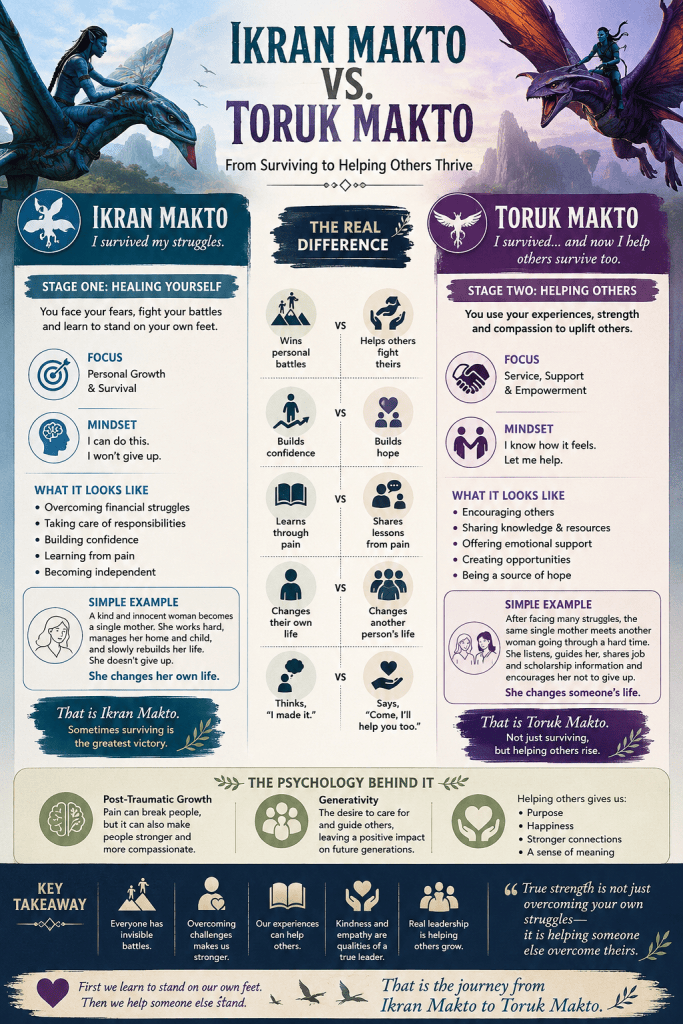
🪽 Ikran Makto“I survived my struggles.”

👑 Toruk Makto“I survived… and now I help others survive too.”

That is the real difference.


Stage One: Ikran Makto – Healing Yourself

Everyone carries a battle that the world cannot see.

Some fight…

  • Financial struggles.
  • Family problems.
  • Loneliness.
  • Failure.
  • Anxiety.
  • Self-doubt.

The first victory is not becoming rich.

The first victory is refusing to give up.

A Simple Story

She was once a cheerful and trusting young woman. Life changed suddenly. She became a single mother. She had to work, raise her child, pay bills, and face every challenge alone. There were nights she cried after her child had fallen asleep. But every morning… She woke up. She went to work. She smiled. She kept moving. Nobody applauded her. Nobody knew her silent battles. Yet she continued. That is Ikran Makto.

Sometimes surviving is the greatest victory.


👑 Stage Two: Toruk Makto – Becoming Someone’s Hope

Years passed. Life became a little easier. One day she met another single mother. The woman looked exactly how she once looked— confused… scared… and ready to give up. Instead of walking away…She sat beside her. She listened. She shared her own story. She told her, “Today is difficult. But it won’t always be like this.” Those few words gave the other woman hope. She didn’t change the whole world. She changed one person’s world. That is Toruk Makto.


🧠 The Psychology Behind It

Psychologists call this Post-Traumatic Growth. Sometimes pain breaks people. Sometimes…

Pain teaches people.

The people who have suffered often become the most compassionate because they understand what pain feels like. They don’t help because they are perfect. They help because they remember.


🌱 Success Changes You… Purpose Changes Others

Many people dream of becoming successful. Very few dream of becoming useful.

Getting a job is success. Helping someone believe in themselves again is purpose.

Owning a house is success. Making another person feel safe is purpose.

Earning money is success. Giving hope is purpose.


❤️ The Real Difference

Ikran MaktoToruk Makto
Wins personal battlesHelps others fight theirs
Builds confidenceBuilds hope
Learns through painShares lessons from pain
Changes their own lifeChanges another person’s life
Thinks, “I made it.”Says, “Come, I’ll help you too.”

🌿 A Simple Truth

The strongest people are not those who have never suffered.

They are the ones who suffered…

and still chose kindness.

Because they know exactly what it feels like to need someone.


Conclusion

Life gives everyone an opportunity to become an Ikran Makto.

But only a few become a Toruk Makto.

The world already has enough successful people.

What it needs more are people who remember where they came from, extend a helping hand, and remind others that they are not alone.

Because…

“The strongest person is not the one who climbs the mountain alone, but the one who reaches the top and comes back to help others climb.” 🌿

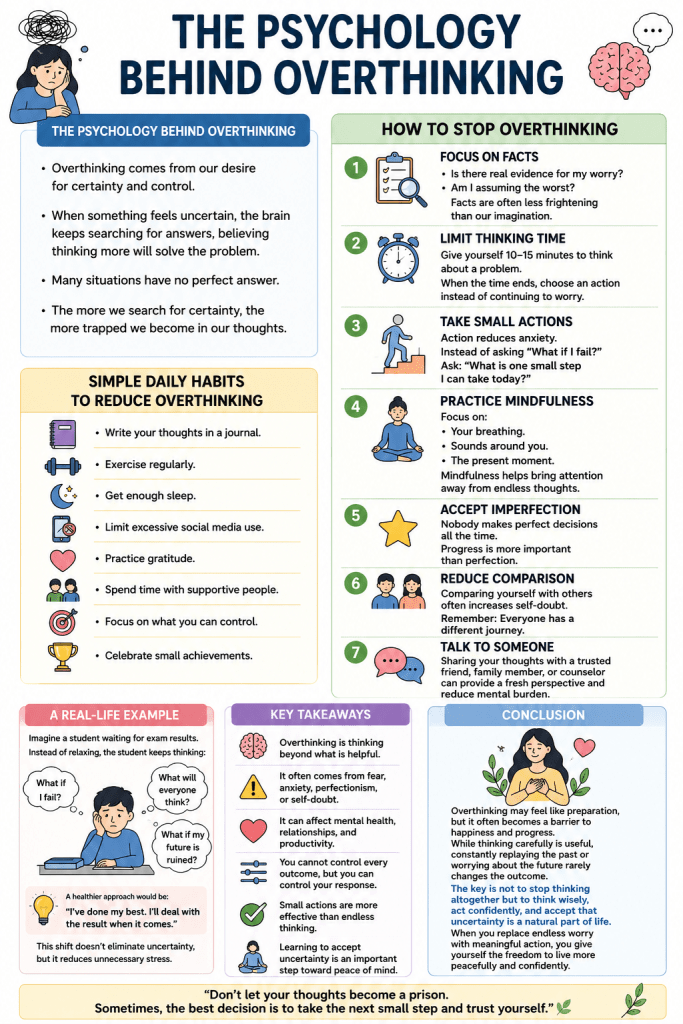
The Hidden Psychology Behind Overthinking 🧠💭

Introduction

Have you ever replayed a conversation over and over in your mind? Or spent hours worrying about something that hasn’t even happened yet? If yes, you’re not alone.

Overthinking is a common experience. While thinking carefully before making decisions is helpful, overthinking happens when our thoughts become repetitive, negative, and unproductive. Instead of solving problems, it often creates more stress and confusion.

Let’s explore why we overthink and how we can overcome it.


What Is Overthinking?

Overthinking means spending too much time analyzing situations, worrying about the future, or dwelling on the past.

It often includes:

  • Replaying conversations repeatedly.
  • Worrying about “what if” situations.
  • Constantly questioning your decisions.
  • Imagining the worst possible outcomes.
  • Feeling mentally exhausted without finding solutions.

Why Do We Overthink?

Our brain is designed to protect us from danger. Sometimes, it mistakes everyday challenges as serious threats, causing us to think excessively.

Common reasons include:

1. Fear of Making Mistakes

Many people worry that one wrong decision will lead to failure.

Example:
“I hope I didn’t say something wrong during the meeting.”


2. Perfectionism

People who want everything to be perfect often spend too much time thinking before taking action.

They may believe:

  • “I must never make mistakes.”
  • “Everything has to be perfect.”

3. Anxiety About the Future

Uncertainty makes many people uncomfortable.

Questions like:

  • “What if I fail?”
  • “What if something goes wrong?”

can keep the mind trapped in endless worry.


4. Low Self-Confidence

When people doubt themselves, they often seek certainty before making even simple decisions.


5. Past Experiences

Negative experiences, criticism, or failures can make people more cautious and lead to repeated thinking.


Signs That You’re Overthinking

You may be overthinking if you:

  • Replay conversations repeatedly.
  • Struggle to make simple decisions.
  • Lose sleep because of constant thoughts.
  • Imagine worst-case scenarios.
  • Feel mentally tired most of the time.
  • Find it difficult to enjoy the present moment.

How Overthinking Affects Your Life

Mental Health

  • Increases stress.
  • Raises anxiety levels.
  • Reduces peace of mind.

Physical Health

  • Poor sleep.
  • Headaches.
  • Muscle tension.
  • Fatigue.

Relationships

  • Misunderstandings.
  • Constant need for reassurance.
  • Difficulty trusting others.

Work and Studies

  • Delayed decisions.
  • Reduced productivity.
  • Missed opportunities.
  • Difficulty concentrating.

The Psychology Behind Overthinking

Psychologists explain that overthinking often comes from our desire for certainty and control.

When something feels uncertain, the brain keeps searching for answers, believing that thinking more will solve the problem.

Unfortunately, many situations in life have no perfect answer.

The more we search for certainty, the more trapped we become in our thoughts.


How to Stop Overthinking

1. Focus on Facts

Ask yourself:

  • Is there real evidence for my worry?
  • Am I assuming the worst?

Facts are often less frightening than our imagination.


2. Limit Thinking Time

Give yourself 10–15 minutes to think about a problem.

When the time ends, choose an action instead of continuing to worry.


3. Take Small Actions

Action reduces anxiety.

Instead of asking:
“What if I fail?”

Ask:
“What is one small step I can take today?”


4. Practice Mindfulness

Focus on:

  • Your breathing.
  • Sounds around you.
  • The present moment.

Mindfulness helps bring attention away from endless thoughts.


5. Accept Imperfection

Nobody makes perfect decisions all the time.

Progress is more important than perfection.


6. Reduce Comparison

Comparing yourself with others often increases self-doubt.

Remember:
Everyone has a different journey.


7. Talk to Someone

Sharing your thoughts with a trusted friend, family member, or counselor can provide a fresh perspective and reduce mental burden.


Simple Daily Habits to Reduce Overthinking

✔ Write your thoughts in a journal.

✔ Exercise regularly.

✔ Get enough sleep.

✔ Limit excessive social media use.

✔ Practice gratitude.

✔ Spend time with supportive people.

✔ Focus on what you can control.

✔ Celebrate small achievements.


A Real-Life Example

Imagine a student waiting for exam results.

Instead of relaxing, the student keeps thinking:

  • “What if I fail?”
  • “What will everyone think?”
  • “What if my future is ruined?”

The result hasn’t even arrived, but the mind has already created many stressful stories.

A healthier approach would be:

“I’ve done my best. I’ll deal with the result when it comes.”

This shift doesn’t eliminate uncertainty, but it reduces unnecessary stress.


Key Takeaways

  • Overthinking is thinking beyond what is helpful.
  • It often comes from fear, anxiety, perfectionism, or self-doubt.
  • It can affect mental health, relationships, and productivity.
  • You cannot control every outcome, but you can control your response.
  • Small actions are more effective than endless thinking.
  • Learning to accept uncertainty is an important step toward peace of mind.

Conclusion

Overthinking may feel like preparation, but it often becomes a barrier to happiness and progress. While thinking carefully is useful, constantly replaying the past or worrying about the future rarely changes the outcome.

The key is not to stop thinking altogether but to think wisely, act confidently, and accept that uncertainty is a natural part of life.

When you replace endless worry with meaningful action, you give yourself the freedom to live more peacefully and confidently.

“Don’t let your thoughts become a prison. Sometimes, the best decision is to take the next small step and trust yourself.” 🌿

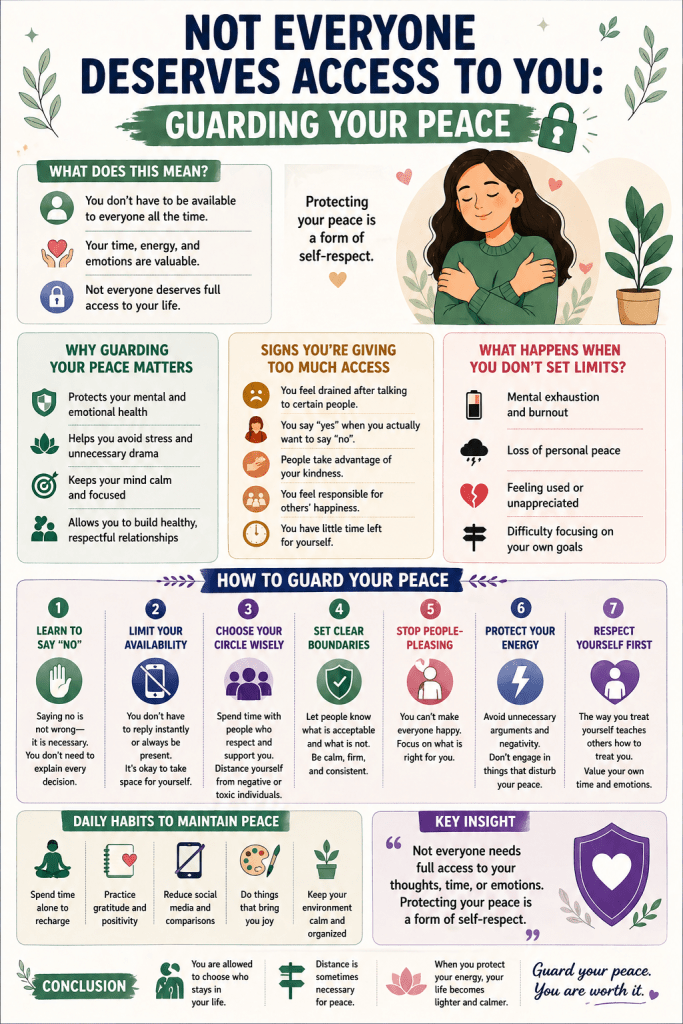
🌿 Not Everyone Deserves Access to You: Guarding Your Peace

💭 What Does This Mean?

  • You don’t have to be available to everyone all the time
  • Your time, energy, and emotions are valuable
  • Not everyone deserves full access to your life

🧠 Why Guarding Your Peace Matters

  • Protects your mental and emotional health
  • Helps you avoid stress and unnecessary drama
  • Keeps your mind calm and focused
  • Allows you to build healthy, respectful relationships

🚨 Signs You’re Giving Too Much Access

  • You feel drained after talking to certain people
  • You say “yes” when you actually want to say “no”
  • People take advantage of your kindness
  • You feel responsible for others’ happiness
  • You have little time left for yourself

🌪️ What Happens When You Don’t Set Limits?

  • Mental exhaustion and burnout
  • Loss of personal peace
  • Feeling used or unappreciated
  • Difficulty focusing on your own goals

🔐 How to Guard Your Peace

1. 🚫 Learn to Say “No”

  • Saying no is not wrong—it is necessary
  • You don’t need to explain every decision

2. ⏳ Limit Your Availability

  • You don’t have to reply instantly or always be present
  • It’s okay to take space for yourself

3. 🧍‍♀️ Choose Your Circle Wisely

  • Spend time with people who respect and support you
  • Distance yourself from negative or toxic individuals

4. 🗣️ Set Clear Boundaries

  • Let people know what is acceptable and what is not
  • Be calm, firm, and consistent

5. ❤️ Stop People-Pleasing

  • You can’t make everyone happy
  • Focus on what is right for you

6. 🧘 Protect Your Energy

  • Avoid unnecessary arguments and negativity
  • Don’t engage in things that disturb your peace

7. 🪞 Respect Yourself First

  • The way you treat yourself teaches others how to treat you
  • Value your own time and emotions

🌸 Daily Habits to Maintain Peace

  • Spend time alone to recharge
  • Practice gratitude and positivity
  • Reduce social media and comparisons
  • Do things that bring you joy
  • Keep your environment calm and organized

✨ Key Insight

  • Not everyone needs full access to your thoughts, time, or emotions
  • Protecting your peace is a form of self-respect

🌈 Conclusion

  • You are allowed to choose who stays in your life
  • Distance is sometimes necessary for peace
  • When you protect your energy, your life becomes lighter and calmer

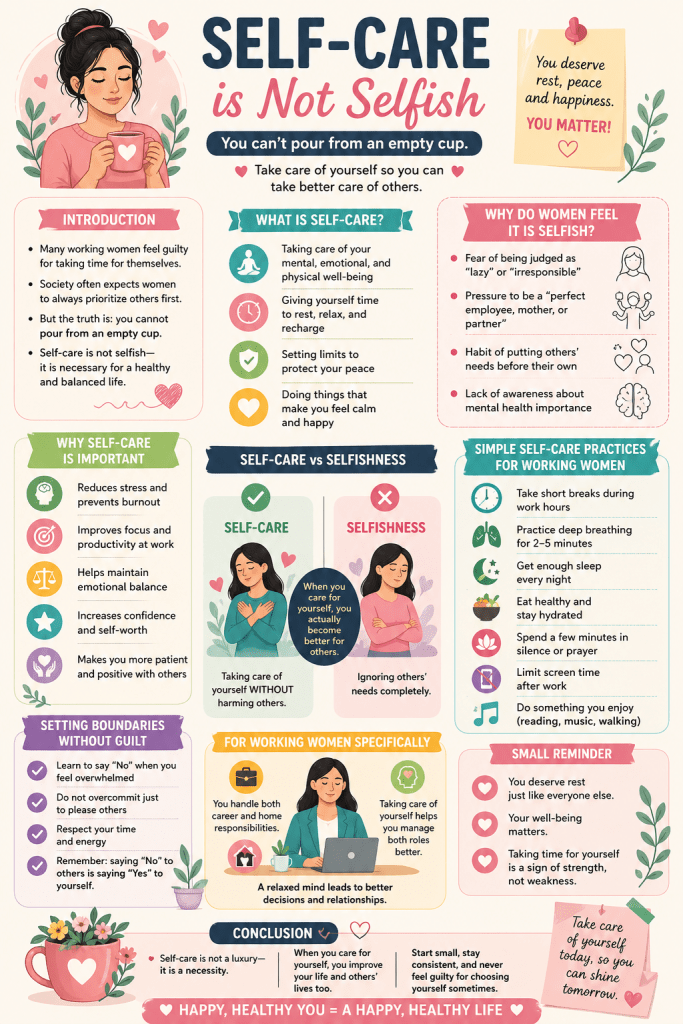
Self-Care is Not Selfish – A Simple Guide for Working Women

🌸 Introduction

  • Many working women feel guilty for taking time for themselves.
  • Society often expects women to always prioritize others first.
  • But the truth is: you cannot pour from an empty cup.
  • Self-care is not selfish—it is necessary for a healthy and balanced life.

💡 What is Self-Care?

  • Taking care of your mental, emotional, and physical well-being
  • Giving yourself time to rest, relax, and recharge
  • Setting limits to protect your peace
  • Doing things that make you feel calm and happy

🚫 Why Do Women Feel It is Selfish?

  • Fear of being judged as “lazy” or “irresponsible”
  • Pressure to be a “perfect employee, mother, or partner”
  • Habit of putting others’ needs before their own
  • Lack of awareness about mental health importance

🌿 Why Self-Care is Important

  • Reduces stress and prevents burnout
  • Improves focus and productivity at work
  • Helps maintain emotional balance
  • Increases confidence and self-worth
  • Makes you more patient and positive with others

⚖️ Self-Care vs Selfishness

  • Self-care → Taking care of yourself without harming others
  • Selfishness → Ignoring others’ needs completely
  • When you care for yourself, you actually become better for others

Simple Self-Care Practices for Working Women

  • Take short breaks during work hours
  • Practice deep breathing for 2–5 minutes
  • Get enough sleep every night
  • Eat healthy and stay hydrated
  • Spend a few minutes in silence or prayer
  • Limit screen time after work
  • Do something you enjoy (reading, music, walking)

🧠 Setting Boundaries Without Guilt

  • Learn to say “No” when you feel overwhelmed
  • Do not overcommit just to please others
  • Respect your time and energy
  • Remember: saying “No” to others is saying “Yes” to yourself

💼 For Working Women Specifically

  • You handle both career and home responsibilities
  • Taking care of yourself helps you manage both roles better
  • A relaxed mind leads to better decisions and relationships

🌙 Small Reminder

  • You deserve rest just like everyone else
  • Your well-being matters
  • Taking time for yourself is a sign of strength, not weakness

Conclusion

  • Self-care is not a luxury—it is a necessity
  • When you care for yourself, you improve your life and others’ lives too
  • Start small, stay consistent, and never feel guilty for choosing yourself sometimes

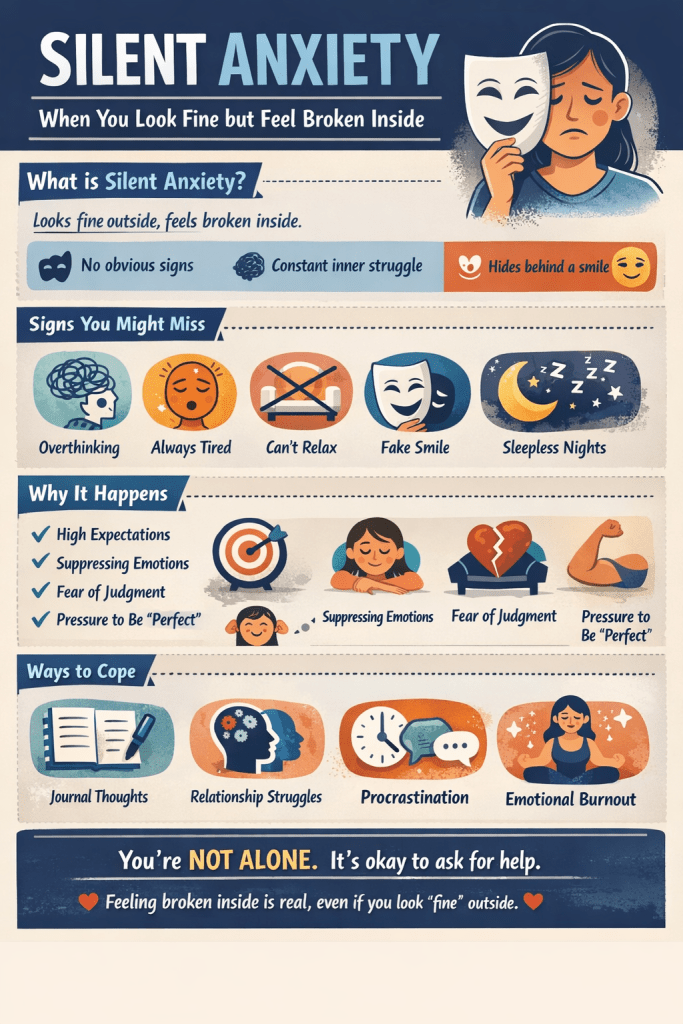
Silent Anxiety: When You Look Fine but Feel Broken Inside

Silent anxiety is one of the most misunderstood psychological experiences today. Unlike visible stress or panic, it operates beneath the surface—making a person appear calm while internally struggling.


🧠 What is Silent Anxiety?

  • A form of anxiety that is hidden and internalized
  • No obvious symptoms like panic attacks or breakdowns
  • People seem “normal” or even successful, but feel overwhelmed inside
  • Often ignored because it doesn’t “look serious”

⚠️ Common Signs You Might Miss

  • Constant overthinking and replaying conversations
  • Feeling tired without physical effort
  • Difficulty relaxing even during free time
  • Smiling outside but feeling empty or restless inside
  • Trouble sleeping due to racing thoughts
  • Fear of “something going wrong” without clear reason

🔍 Why Does Silent Anxiety Happen?

  • High expectations from self or society
  • Habit of suppressing emotions instead of expressing them
  • Fear of being judged as “weak”
  • Growing up in environments where feelings were ignored
  • Pressure to always appear “strong” or “perfect”

💭 What It Feels Like Internally

  • A constant mental noise that never fully stops
  • Feeling stuck between control and chaos
  • Emotional exhaustion without knowing why
  • Wanting help, but not knowing how to explain the problem
  • Feeling disconnected—even around people

🧩 How It Affects Daily Life

  • Reduced focus and productivity
  • Struggles in relationships (misunderstandings, withdrawal)
  • Increased procrastination
  • Loss of interest in things once enjoyed
  • Risk of long-term mental burnout

🌱 Simple Ways to Manage Silent Anxiety

  • Acknowledge your feelings instead of ignoring them
  • Practice journaling to release thoughts
  • Set small, realistic goals instead of chasing perfection
  • Take short digital breaks to calm the mind
  • Talk to someone you trust (friend, mentor, counselor)
  • Try basic breathing or mindfulness exercises

❤️ Important Reminder

  • Just because it’s invisible doesn’t mean it’s not real
  • You don’t have to “prove” your struggle to deserve support
  • It’s okay to not feel okay—even if everything looks fine outside

Conclusion

Silent anxiety is a quiet battle many people face daily. Recognizing it is the first step toward healing. When we start being honest with ourselves and allow space for our emotions, we slowly move from just “surviving” to truly living.

🌌 Is Luck a Quantum Phenomenon?

We often say, “She’s so lucky!” or “Luck was on his side!” But have you ever wondered—what if luck isn’t just random? What if it’s connected to something deeper, something at the quantum level of reality?

Let’s explore this fascinating idea step by step.


💫 1. What Is Quantum Phenomenon?

Quantum physics studies how the smallest particles—like electrons and photons—behave.
But here’s the twist:

  • These particles don’t always follow fixed rules.
  • They exist in many possible states at once (this is called superposition).
  • What happens seems to depend on observation—when we look, the result changes!

In short, quantum physics says reality isn’t fully predictable.


🍀 2. What Do We Mean by “Luck”?

Luck is often described as getting a positive outcome without clear control—like winning a lottery or meeting the right person by chance.
But if everything in life follows cause and effect, where does luck fit in?
That’s where the quantum connection begins to sound interesting.


⚛️ 3. The Quantum View: Reality Is Not Fixed

At the quantum level, events don’t have definite outcomes until they are observed.
This means:

  • The universe holds multiple possibilities.
  • The one that becomes “real” might depend on attention, energy, or even intention.

Some thinkers believe our thoughts and focus might subtly influence which reality we experience—just like observation affects quantum particles.


🧠 4. Mind, Intention, and Energy

Have you noticed how positive people seem to “attract” better situations?
Quantum theories (though not fully proven in this way) suggest that our consciousness may have an impact on probability.
It’s not magic—it’s about:

  • Focused attention.
  • Emotional energy.
  • Expectation that things can go right.

These can “tune” our behavior and decisions in ways that increase the chances of success—what we often call luck.


🔮 5. Luck = Preparation Meets Possibility

Even if we bring quantum physics into the conversation, one truth remains:

“Luck favors the prepared mind.” – Louis Pasteur

Quantum or not, opportunities exist all around.
When you’re prepared, open-minded, and positive, you’re more likely to observe and act on the right ones—turning randomness into luck.


🌠 6. So, Is Luck Really Quantum?

Science hasn’t proven that luck operates through quantum mechanics.
But the parallels are fascinating:

Quantum ConceptLife Connection
Multiple possibilitiesMany potential outcomes in life
Observation affects resultFocus and intention affect success
Uncertainty and probabilityUnpredictability of life events

So maybe luck isn’t pure chance—it’s the way our mindset, awareness, and timing align with the flow of possibilities in the universe.


🌈 7. The Takeaway

Luck might not be something “mystical.”
It could be:

  • Part physics, part psychology, and part preparation.
  • The meeting point of chance and consciousness.

When we act with clarity, faith, and focus, we may just be collapsing the quantum possibilities into a fortunate outcome.


✨ Final Thought

“You don’t find luck; you create the conditions for it to appear.”

Learn Their Game, Don’t Play It

Introduction

In life, we often meet people who are competitive, manipulative, or cunning. They play “games” to control situations or take advantage of others. Instead of falling into their traps, the smartest move is to understand their game without becoming part of it.

Here’s how you can practice this mindset:

1. Awareness Is Your First Shield

  • Know that not everyone has pure intentions.
  • Observe patterns in people’s words and actions.
  • Awareness protects you from surprise moves.

2. Understand the Rules They Follow

  • Manipulators thrive on lies, gossip, or emotional control.
  • Watch how they operate — their strengths and weaknesses.
  • Once you know their rules, they can’t use them against you.

3. Don’t Mirror Their Behavior

  • Fighting fire with fire only burns you too.
  • Stay true to your values, even if others play dirty.
  • Rise above instead of sinking to their level.

4. Protect Your Energy

  • Don’t waste energy competing in useless battles.
  • Walk away when the “game” has no real value.
  • Sometimes silence is the strongest response.

5. Stay Strategic, Not Emotional

  • People who play games often target emotions.
  • Respond with calm logic, not anger or impulse.
  • Self-control keeps you stronger than any trick.

6. Use Knowledge as Power

  • Once you know how the game works, you gain the advantage.
  • You can predict moves, set boundaries, and protect yourself.
  • But remember: knowledge is for defense, not manipulation.

Conclusion:
Life will always have people who try to play games with you. The key is simple — learn their game, but don’t play it. Understanding makes you wise, and restraint makes you powerful. Your dignity and peace are worth more than winning a dirty battle.

Boundaries = Peace: Protecting Your Energy

🌸 Introduction

Peace of mind is not about having a quiet life—it’s about protecting your energy. Many times, we lose our inner calm because we don’t set clear boundaries with people, work, or even ourselves. Setting boundaries is not selfish—it’s self-care.


🌿 Why Boundaries Are Important

  • Boundaries help you say yes to what matters and no to what drains you.
  • They create space for your own growth and happiness.
  • Without boundaries, people may take your time and energy for granted.
  • Protecting your energy helps you stay emotionally balanced.

🌼 Signs You Need Better Boundaries

  • You feel tired and drained after meeting certain people.
  • You often say “yes” when you want to say “no.”
  • You feel guilty for putting yourself first.
  • You don’t have time for things that bring you joy.

🌻 How to Set Healthy Boundaries

  1. Know Your Limits – Be clear about what feels right and what doesn’t.
  2. Learn to Say No – Respectfully decline things that exhaust you.
  3. Communicate Clearly – Express your needs without fear.
  4. Protect Your Time – Avoid overcommitting yourself.
  5. Let Go of Guilt – Remember, self-care is not being rude.

🌷 Benefits of Boundaries

  • More mental peace and less stress.
  • Healthier and more respectful relationships.
  • More time for self-care and passions.
  • Stronger confidence and self-respect.

🌸 Conclusion

Boundaries are not walls—they are doors that let peace in and keep negativity out. When you protect your energy, you create space for joy, balance, and growth. Remember: Boundaries = Peace.

When the Future is Foggy, Find Peace in the Present

Life often feels uncertain. The future can seem unclear, and that uncertainty may cause stress or anxiety. The best way to deal with it is to bring your attention back to the present moment.


🌿 Why the Future Feels “Foggy”

  • We cannot control everything that lies ahead.
  • Overthinking future outcomes creates fear.
  • Expectations and “what-ifs” make the mind restless.

🧘 How to Find Peace in the Present

  1. Focus on Your Breath – Breathing deeply calms the mind instantly.
  2. Practice Gratitude – Note down 2–3 things you’re thankful for each day.
  3. Do One Task at a Time – Multitasking creates stress, single-tasking brings focus.
  4. Spend Time in Nature – Walks, fresh air, and greenery help you stay grounded.
  5. Limit Future Worry – Replace “What if?” with “What now?”

🌞 Benefits of Living in the Now

  • Reduces stress and anxiety.
  • Improves focus and productivity.
  • Builds emotional resilience.
  • Increases happiness and inner peace.

✨ Final Thought

The fog of the future will always exist. But when you choose to live in the present, you create clarity within yourself. Peace doesn’t come from knowing the future—it comes from embracing the moment you have right now.

Work-Life Balance Is a Myth

1. Why Work-Life Balance Feels Impossible

  • The idea of perfectly splitting work and personal life is unrealistic.
  • Life and work often overlap, especially in demanding jobs like nursing, teaching, or entrepreneurship.
  • Example: A nurse working night shifts may have to attend family needs during the day, making “balance” tricky.

2. Work-Life Integration: A More Realistic Goal

  • Instead of strict separation, aim to blend work and life in a way that fits your unique situation.
  • This means adjusting priorities as needed rather than forcing equal time on both.
  • Example: Working from home some days to care for children, then fully focusing on work on other days.

3. Set Boundaries That Work for You

  • Boundaries don’t mean 50/50 time but protecting what’s important.
  • It could be “no work emails after 8 PM” or dedicating certain hours to family or hobbies.
  • Example: A teacher might decide weekends are for family only, even if some grading spills over.

4. Focus on Quality, Not Quantity

  • Spending “quality” focused time with family or on hobbies is better than counting hours.
  • Deeply engaging with what matters can recharge you more than a balanced schedule.
  • Example: A nurse might have only a few hours with family but makes it meaningful by fully unplugging.

5. Flexibility Is Key

  • Life is unpredictable—sometimes work demands more, sometimes personal life does.
  • Being flexible helps reduce stress and guilt over “not balancing perfectly.”
  • Example: During a hospital emergency, a nurse may work extra hours but then take a few days off.

6. Use Small Daily Rituals to Recharge

  • Simple habits like meditation, short walks, or journaling can boost mental health daily.
  • These little breaks help keep you balanced inside, even when life is hectic.
  • Example: A busy professional might take 10 minutes every morning to plan their day mindfully.

7. Ask for Support When Needed

  • Don’t hesitate to seek help from family, friends, or colleagues to manage demands.
  • Sharing responsibilities lightens your load and creates a support network.
  • Example: A working mom might ask a partner to handle dinner on work-heavy days.

8. Celebrate Small Wins

  • Recognize your achievements in both work and life to stay motivated.
  • Balance isn’t perfect—small successes matter and keep you moving forward.
  • Example: Finishing a tough project at work and attending a child’s school event in the same week.

Conclusion: Aim for Harmony, Not Balance

  • Instead of chasing an unrealistic perfect balance, focus on harmony between your work and personal life.
  • Be kind to yourself, stay flexible, and prioritize what truly matters.
  • This mindset shift can reduce stress and help you thrive both professionally and personally.