
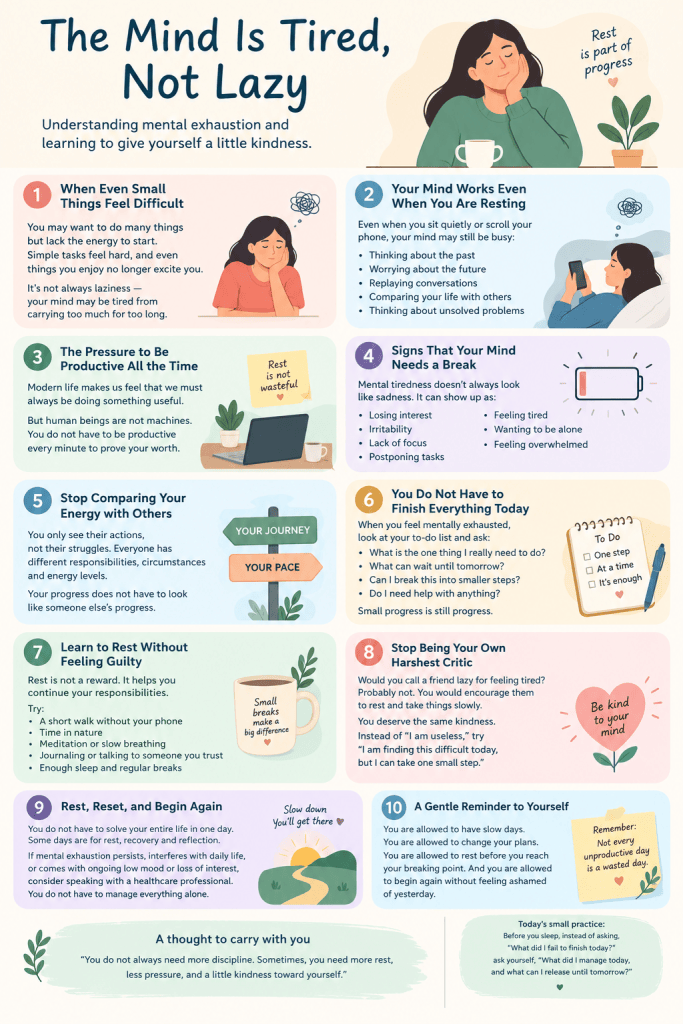
Understanding mental exhaustion and learning to give yourself a little kindness
1. When Even Small Things Feel Difficult
Have you ever had a day when you wanted to do many things but could not find the energy to start?
Simple tasks feel difficult. Replying to a message seems exhausting. Even things you usually enjoy no longer excite you.
You may start blaming yourself: “Why am I so lazy? Why can’t I do things like before?”
But sometimes, the problem is not laziness. Your mind may be tired from carrying too much for too long.
2. Your Mind Works Even When You Are Resting
You may sit quietly, scroll through your phone, or lie on your bed, but your mind may still be busy.
- Thinking about yesterday’s mistakes.
- Worrying about tomorrow’s responsibilities.
- Replaying conversations in your head.
- Comparing your life with others.
- Thinking about problems you cannot solve right now.
Your body may be resting, but your mind may not be getting the rest it needs.
3. The Pressure to Be Productive All the Time
Modern life often makes people feel that they must always be doing something useful.
There is work to complete, messages to answer, responsibilities to manage, and goals to achieve. Even during free time, people may feel guilty for not being productive.
Rest begins to feel like a waste of time.
But human beings are not machines. You do not have to be productive every minute to prove that you are valuable.
4. Signs That Your Mind Needs a Break
Mental tiredness does not always look like sadness. Sometimes, it appears in small everyday behaviours.
- Losing interest in activities you once enjoyed.
- Feeling irritated over little things.
- Finding it difficult to concentrate.
- Postponing even simple tasks.
- Feeling tired despite getting some rest.
- Wanting to be alone more often.
- Feeling overwhelmed by ordinary responsibilities.
These signs can have different causes, including stress, poor sleep, or health concerns. They are not proof of laziness.
5. Stop Comparing Your Energy with Others
Some people seem to manage their work, family, friendships, and personal goals effortlessly. Seeing them may make you question yourself.
But you see their actions, not their entire struggles.
Everyone has different responsibilities, circumstances, energy levels, and emotional challenges. What feels easy for one person may feel difficult for another.
Your progress does not have to look like someone else’s progress.
6. You Do Not Have to Finish Everything Today
When you feel mentally exhausted, looking at your entire to-do list can make you feel even more overwhelmed.
Instead of thinking, “I have so much to do,” try asking:
- What is the one thing I really need to do today?
- What can wait until tomorrow?
- Can I break this task into smaller steps?
- Do I need help with anything?
Completing one small task is better than spending the entire day blaming yourself for not completing everything.
Small progress is still progress.
7. Learn to Rest Without Feeling Guilty
Rest is not a reward that you receive only after completing every responsibility.
Sometimes, rest is what helps you continue your responsibilities.
You can give your mind a break by:
- Taking a short walk without looking at your phone.
- Sitting quietly for a few minutes.
- Spending time in nature.
- Praying, meditating, or practising slow breathing.
- Writing down the thoughts that keep repeating in your mind.
- Talking to someone who makes you feel understood.
- Getting enough sleep and taking regular breaks.
You do not need an expensive holiday or an entire free day to begin. Sometimes, a few peaceful minutes can be a good starting point.
8. Stop Being Your Own Harshest Critic
Imagine a friend telling you, “I am tired. I cannot manage everything today.”
Would you immediately call that person lazy? Probably not. You might tell them to rest, take things slowly, and try again tomorrow.
You deserve the same understanding that you offer others.
Instead of saying, “I am useless because I cannot do this,” try saying, “I am finding this difficult today, but I can take one small step.”
Self-kindness does not mean avoiding responsibility. It means approaching responsibility without unnecessary self-punishment.
9. Rest, Reset, and Begin Again
You do not have to solve your entire life in one day.
Some days are meant for achievement. Other days may require patience, recovery, and reflection.
If you have been pushing yourself too hard, give yourself permission to slow down. Review your priorities, set reasonable boundaries, and allow yourself time to recover.
If mental exhaustion persists, interferes with everyday life, or comes with ongoing low mood or loss of interest, consider speaking with a healthcare professional. You do not have to manage everything alone.
10. A Gentle Reminder to Yourself
You are allowed to have slow days.
You are allowed to change your plans.
You are allowed to rest before you reach your breaking point.
And you are allowed to begin again without feeling ashamed of yesterday.
Remember: Not every unproductive day is a wasted day. Sometimes, it is a reminder that you have been expecting too much from yourself for too long.
A thought to carry with you
“You do not always need more discipline. Sometimes, you need more rest, less pressure, and a little kindness toward yourself.”
Today’s small practice: Before going to bed, instead of asking, “What did I fail to finish today?” ask yourself, “What did I manage today, and what can I release until tomorrow?”
Your mind deserves care, too. 🌿

