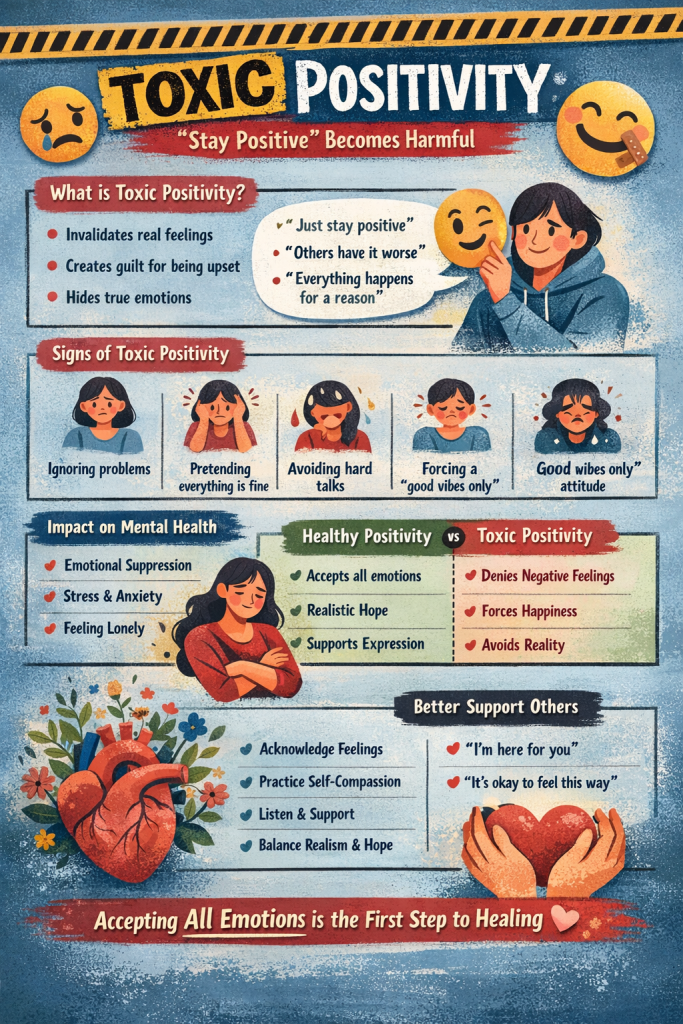
🌿 Toxic Positivity: When “Stay Positive” Becomes Harmful

💭 What is Toxic Positivity?

  • Toxic positivity is the belief that you should always stay positive, no matter how difficult the situation is
  • It rejects or ignores negative emotions like sadness, anger, or stress
  • Common phrases include:
    • “Just stay positive”
    • “Others have it worse”
    • “Everything happens for a reason”

⚠️ Why It Can Be Harmful

  • It invalidates real feelings
  • Makes people feel guilty for being upset
  • Creates pressure to hide true emotions
  • Prevents emotional healing and growth

😔 Signs of Toxic Positivity

  • Ignoring problems instead of facing them
  • Pretending everything is okay when it’s not
  • Avoiding difficult conversations
  • Feeling uncomfortable when others express sadness
  • Forcing positivity in every situation

🧠 Impact on Mental Health

  • Builds emotional suppression
  • Increases stress and anxiety
  • Leads to feeling lonely or misunderstood
  • Stops people from seeking help
  • Can cause emotional burnout over time

💡 Healthy Positivity vs Toxic Positivity

Healthy Positivity

  • Accepts both good and bad emotions
  • Encourages realistic hope
  • Supports emotional expression

Toxic Positivity

  • Denies negative feelings
  • Forces happiness
  • Avoids reality

🌱 What to Do Instead

  • Acknowledge your feelings – It’s okay to feel sad or stressed
  • Practice self-compassion – Be kind to yourself
  • Listen without judgment – For yourself and others
  • Express emotions – Talk, write, or reflect
  • Focus on balance – Accept pain and still find hope

🤝 How to Support Others Better

Instead of saying:

  • “Just stay positive”

Try saying:

  • “I’m here for you”
  • “It’s okay to feel this way”
  • “Take your time, you’ll get through this”

🌸 Conclusion

  • Positivity is powerful, but forced positivity is not healthy
  • True mental well-being comes from accepting all emotions
  • Healing begins when we allow ourselves to feel, not hide

From Self-Doubt to Self-Worth: A Journey Toward Confidence

Everyone feels self-doubt sometimes. But with the right mindset and steps, you can move from questioning yourself to believing in your worth. Here’s how:


🌱 1. Understand That Self-Doubt Is Normal

  • Everyone experiences it, even successful people.
  • It means you’re growing and challenging yourself.

💭 2. Identify the Voice of Doubt

  • Pay attention to negative thoughts like “I’m not good enough” or “I can’t do this.”
  • These thoughts are often based on fear, not facts.

✨ 3. List Your Strengths

  • Write down things you’re good at or proud of.
  • It could be as small as being a good listener or as big as completing a degree.
  • Review this list often to remind yourself of your worth.

🧠 4. Replace Negative Thoughts with Positive Ones

  • Instead of saying “I always fail,” say “I’m learning and improving.”
  • Practice daily affirmations like “I am capable” or “I deserve success.”

🧩 5. Set Small, Achievable Goals

  • Confidence grows with progress.
  • Start with simple tasks you can succeed at, then move on to bigger ones.

🧍‍♀️ 6. Surround Yourself with Supportive People

  • Spend time with those who lift you up, not those who bring you down.
  • Talk to friends, mentors, or family when you feel low.

📚 7. Learn and Improve

  • Take courses, read, or practice skills you want to get better at.
  • Knowledge builds confidence.

🎯 8. Celebrate Every Win

  • Give yourself credit for progress, no matter how small.
  • Each step forward adds to your self-worth.

🧘‍♀️ 9. Practice Self-Compassion

  • Be kind to yourself when you make mistakes.
  • Nobody is perfect – mistakes are part of learning.

🌟 10. Believe in Your Potential

  • You have unique talents and strengths.
  • Trust that you are capable of achieving great things.

💬 Final Thoughts:

Moving from self-doubt to self-worth is a journey, not a race. Take it one step at a time. With patience, practice, and positivity, you’ll find your confidence growing each day.

Cognitive Behavioral Therapy (CBT) Techniques for Everyday Anxiety

Anxiety can be overwhelming, but Cognitive Behavioral Therapy (CBT) offers practical techniques to manage and reduce it. Here are some simple and effective CBT techniques you can use in your daily life:

1. Identify and Challenge Negative Thoughts

  • What to Do: Pay attention to negative thoughts that arise during anxious moments. Ask yourself if these thoughts are based on facts or assumptions.
  • How It Helps: By challenging and reframing negative thoughts, you can reduce their impact on your emotions and behaviors.

2. Practice Mindfulness

  • What to Do: Engage in mindfulness exercises, such as deep breathing or guided meditation, to stay focused on the present moment.
  • How It Helps: Mindfulness can help you manage anxiety by reducing rumination and increasing your awareness of current experiences.

3. Use Cognitive Restructuring

  • What to Do: Replace irrational or distorted thoughts with more balanced and realistic ones. For example, if you think, “I’m going to fail this test,” reframe it to, “I’m prepared, and I can handle this.”
  • How It Helps: Cognitive restructuring helps you develop a more positive and realistic perspective, which can alleviate anxiety.

4. Develop Problem-Solving Skills

  • What to Do: Break down stressful problems into smaller, manageable steps and create a plan to address them.
  • How It Helps: Effective problem-solving can reduce anxiety by giving you a sense of control and a clear path forward.

5. Engage in Behavioral Activation

  • What to Do: Set small, achievable goals for yourself, and engage in activities that you enjoy or that provide a sense of accomplishment.
  • How It Helps: Increasing your activity level and engaging in pleasurable activities can help improve your mood and reduce anxiety.

6. Practice Relaxation Techniques

  • What to Do: Incorporate relaxation exercises such as progressive muscle relaxation, deep breathing, or yoga into your routine.
  • How It Helps: These techniques can help lower physical tension and promote a sense of calm, which can alleviate anxiety.

7. Set Realistic Goals

  • What to Do: Set small, achievable goals for yourself rather than overwhelming, unrealistic ones. Break tasks into smaller steps and celebrate progress.
  • How It Helps: Setting and achieving realistic goals can build confidence and reduce feelings of being overwhelmed.

8. Use Exposure Therapy

  • What to Do: Gradually face and expose yourself to the situations or objects that trigger your anxiety in a controlled manner.
  • How It Helps: Gradual exposure can help desensitize you to anxiety-provoking stimuli, making them less intimidating over time.

9. Keep a Thought Record

  • What to Do: Maintain a journal where you record anxious thoughts, associated feelings, and alternative, more balanced thoughts.
  • How It Helps: Keeping a thought record allows you to track patterns in your thinking and helps you work on challenging negative thought patterns.

10. Seek Support

  • What to Do: Don’t hesitate to reach out to friends, family, or a mental health professional for support and guidance.
  • How It Helps: Talking about your anxiety with others can provide relief, offer new perspectives, and help you feel less isolated.