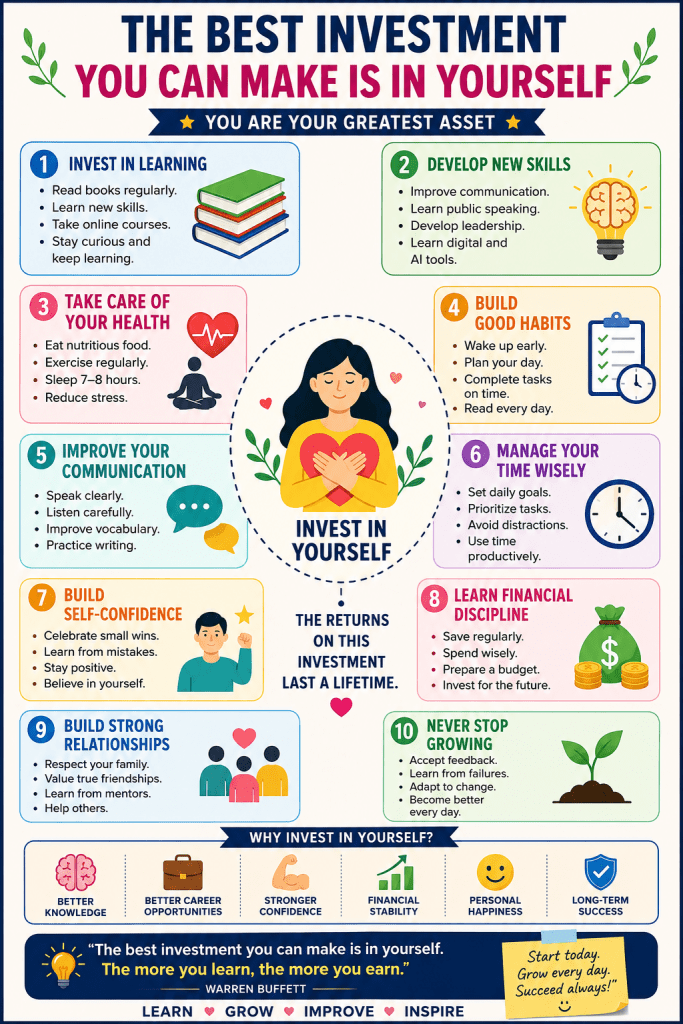
The Best Investment You Can Make Is in Yourself

“The greatest asset you will ever own is not your money—it’s you.”

Introduction

Many people dream of becoming successful, wealthy, and happy. They often invest money in land, gold, stocks, or businesses. While these are valuable investments, the best investment you can ever make is investing in yourself. When you improve your knowledge, skills, health, and character, you create opportunities that no one can take away.


1. Invest in Learning 📚

Knowledge is one of the few things that grows when you share it.

  • Read books regularly.
  • Learn new skills.
  • Attend workshops and seminars.
  • Take free online courses.
  • Stay curious and keep learning.

Simple Example:
A student who learns Excel, Power BI, or AI tools has better career opportunities than someone who only depends on classroom learning.


2. Develop New Skills 💡

Skills increase your confidence and employability.

  • Improve communication skills.
  • Learn public speaking.
  • Develop leadership qualities.
  • Improve problem-solving ability.
  • Learn digital and AI tools.

Remember:
A degree gets you an interview, but skills help you build a successful career.


3. Take Care of Your Health ❤️

Your health is your greatest wealth.

  • Eat nutritious food.
  • Exercise regularly.
  • Sleep for 7–8 hours.
  • Drink enough water.
  • Reduce stress through relaxation or meditation.

Healthy body + Healthy mind = Better performance.


4. Build Good Habits 🌱

Small daily habits create big success over time.

  • Wake up early.
  • Plan your day.
  • Complete tasks on time.
  • Read every day.
  • Avoid procrastination.

“Successful people are simply people with successful habits.”


5. Improve Your Communication 🗣️

Good communication opens many doors.

  • Speak clearly and confidently.
  • Listen carefully.
  • Improve your vocabulary.
  • Practice writing professionally.
  • Respect others’ opinions.

Communication is one of the most valuable skills in every profession.


6. Manage Your Time Wisely ⏰

Time is more valuable than money because it cannot be replaced.

  • Set daily goals.
  • Prioritize important tasks.
  • Avoid unnecessary distractions.
  • Limit excessive social media use.
  • Use your free time productively.

Every minute invested wisely brings long-term benefits.


7. Build Self-Confidence 🌟

Believe in your abilities.

  • Celebrate small achievements.
  • Learn from mistakes.
  • Stay positive.
  • Face challenges with courage.
  • Never compare yourself with others.

Confidence grows through continuous learning and practice.


8. Learn Financial Discipline 💰

Managing money wisely is an important life skill.

  • Save regularly.
  • Avoid unnecessary spending.
  • Prepare a simple budget.
  • Learn basic financial planning.
  • Invest wisely for the future.

Financial discipline provides security and peace of mind.


9. Build Strong Relationships 🤝

Success becomes more meaningful when shared with others.

  • Respect your family.
  • Value true friendships.
  • Learn from mentors.
  • Help others whenever possible.
  • Build a positive professional network.

Strong relationships create lifelong support and opportunities.


10. Never Stop Growing 🚀

Personal growth is a lifelong journey.

  • Accept feedback positively.
  • Learn from failures.
  • Adapt to change.
  • Keep improving every day.
  • Believe that every day is a new opportunity to become better.

Growth begins when you step outside your comfort zone.


Why Investing in Yourself Matters

When you invest in yourself, you gain:

  • Better knowledge
  • Stronger skills
  • Good health
  • Higher confidence
  • Better career opportunities
  • Financial stability
  • Personal happiness
  • Long-term success

These are lifelong returns that continue to grow over time.


Conclusion

Money can be lost, opportunities may come and go, but the knowledge, skills, values, and experiences you gain by investing in yourself remain with you forever. Every book you read, every new skill you learn, every healthy habit you build, and every challenge you overcome helps shape a brighter future. Start investing in yourself today because you are your greatest asset, and the returns on this investment will benefit you for a lifetime.

Remember: “Invest in yourself today, and your future self will thank you tomorrow.”

✨ The Quantum Leap: Small Changes That Create Big Shifts in Life

Life doesn’t always change through big decisions or dramatic moments.
Sometimes, it changes through tiny actions—small steps that create powerful results over time.
In quantum physics, a “quantum leap” is a small jump of energy that leads to a big transformation.
The same idea applies to our lives.

Here’s how small changes can create big shifts, just like a quantum leap.


🌟 1. Small Changes Create New Possibilities

In quantum theory, even a tiny shift in energy can move a particle to a completely new state.
In life, a small habit change can move you to a new version of yourself.

Example:

  • Reading for 10 minutes a day can slowly turn you into a knowledgeable, confident person.
  • Drinking one extra glass of water daily can improve your energy level.

🌟 2. Every Action Raises Your “Energy Level”

Quantum leaps happen when energy increases.
Similarly, when you make small improvements, your mindset, confidence, and lifestyle rise to a higher level.

Example:

  • Waking up just 15 minutes earlier each day may give you extra time to plan your day calmly.
  • Writing three things you’re grateful for shifts your emotional energy instantly.

🌟 3. You Don’t Need Big Motivation — Just Tiny Momentum

Quantum jumps don’t require huge force; they happen instantly when enough small energy builds up.
Tiny efforts create steady momentum.

Example:

  • Walking only 2,000 steps more each day leads to better health over months.
  • Learning one new English word daily improves communication without pressure.

🌟 4. Small Decisions Change Your Direction

Even the slightest shift in angle can change your destination completely—just like how a particle’s path changes with a tiny impulse.
Small decisions today create a new future.

Example:

  • Choosing to save ₹20 a day becomes ₹600 a month and ₹7,200 a year.
  • Choosing to reduce screen time by 10 minutes daily improves focus and sleep.

🌟 5. The Power of Changing Your Environment Slightly

In quantum physics, particles change behavior depending on their environment.
Similarly, your surroundings influence your habits and mindset.

Example:

  • Keeping fruits on your table helps you eat healthier.
  • Placing books near your bed encourages reading.

🌟 6. Small Mindset Shifts Lead to Big Emotional Growth

A slight shift in thinking can transform how you feel, behave, and respond.

Example:

  • Changing the thought “I can’t do this” to “I will try” opens new opportunities.
  • Replacing negative self-talk with kinder words reduces stress.

🌟 7. Small Daily Improvements Compound Over Time

Just like small energy additions create a quantum jump, small daily efforts compound into major life progress.

Example:

  • Practicing a skill for just 5 minutes a day leads to mastery over months.
  • Saving small amounts regularly builds financial stability.

✨ Final Thought

A quantum leap is not magic.
It is the result of consistent small steps that slowly build enough energy to create a big transformation.

You don’t need huge changes.
You just need to begin—with one small step today.

For Whom Are You Working? Understanding Your Work Purpose

In our busy lives, it’s easy to get caught up in daily tasks and forget to reflect on the bigger picture. One essential question to ask yourself is: “For whom am I working?” Understanding this can bring clarity and motivation to your professional life. Here are some key points to consider:

1. Yourself

  • Personal Growth: Every job or career move should contribute to your personal and professional development. Whether it’s gaining new skills, expanding your knowledge, or achieving personal goals, remember that you are investing in yourself.
  • Financial Stability: Your work provides the means to support your lifestyle and achieve financial security. This stability is crucial for your peace of mind and future planning.

2. Your Family

  • Support System: Many people work to provide for their families. This includes ensuring that your loved ones have what they need for a comfortable and secure life.
  • Role Model: By working hard and pursuing your goals, you set a positive example for your children and other family members. Your dedication can inspire them to pursue their own dreams and work hard.

3. Your Employer

  • Company Success: Your efforts contribute to the overall success and profitability of your company. When you perform well, it helps the business grow, which can lead to more opportunities for you and your colleagues.
  • Team Collaboration: Working for your employer also means supporting your team. Your contributions help create a productive and positive work environment.

4. Your Community

  • Economic Contribution: Your work helps stimulate the local economy by providing services, creating jobs, and paying taxes. This, in turn, supports public services and infrastructure.
  • Social Impact: Depending on your profession, your work may directly benefit the community. For example, teachers, healthcare workers, and public servants all play vital roles in improving society.

5. Your Future Self

  • Long-Term Goals: Think about where you want to be in the next five, ten, or twenty years. Your current work should align with your long-term goals and aspirations.
  • Retirement: Consider how your current work impacts your retirement plans. Contributing to a retirement fund and ensuring you have a sustainable career path is crucial for your future well-being.

Reflect and Reevaluate

Periodically taking the time to reflect on “for whom you are working” can help ensure that your efforts are aligned with your values and goals. It can also provide a renewed sense of purpose and motivation in your professional life.

By understanding the impact of your work on yourself, your family, your employer, your community, and your future, you can make more informed decisions and find greater satisfaction in your career.

50/30/20 Rule: A Blueprint for Financial Success

Introduction: In the intricate tapestry of personal finance, finding a roadmap that’s both practical and effective is crucial. Enter the 50/30/20 rule, a tried-and-true principle that simplifies budgeting and empowers individuals to take control of their financial destinies. Let’s delve into this comprehensive guide to understand the 50/30/20 rule and how it can transform your approach to managing money.

Decoding the 50/30/20 Rule: A Blueprint for Financial Success

1. Needs (50%): Nurturing Financial Stability

  • The foundation of the 50/30/20 rule lies in allocating 50% of your after-tax income to essential needs. This includes:
    • Rent or Mortgage
    • Utilities (Water, Electricity, Gas)
    • Groceries
    • Health Insurance
    • Transportation
    • Minimum Debt Payments
  • This category ensures that your fundamental requirements are met, providing stability and security.

2. Wants (30%): Balancing Enjoyment and Responsibility

  • The “Wants” category, accounting for 30% of your budget, encompasses discretionary spending that enhances your lifestyle. This includes:
    • Dining out and Entertainment
    • Subscription Services
    • Hobbies and Leisure Activities
    • Fashion and Non-essential Shopping
  • Allocating 30% to wants allows you to enjoy life without jeopardizing your financial health, striking a balance between enjoyment and responsibility.

3. Savings/Debt Repayment (20%): Building for the Future

  • The final piece of the puzzle is dedicating 20% of your income to savings and debt repayment. This includes:
    • Emergency Fund Savings
    • Retirement Contributions
    • Additional Debt Repayment
  • Devoting 20% to savings ensures you are building a financial safety net and working towards long-term goals.

Benefits of the 50/30/20 Rule: A Holistic Approach to Money Management

  1. Simplicity and Clarity:
    • The rule simplifies budgeting by offering clear categories, making it easy to understand and implement.
  2. Financial Balance:
    • It encourages a balanced approach, ensuring you cover your needs, indulge in wants, and prioritize savings and debt repayment.
  3. Flexibility:
    • The rule is adaptable to different income levels, providing a flexible framework for various financial situations.

Implementing the 50/30/20 Rule: Practical Tips for Success

  1. Track Your Spending:
    • Understand where your money is going to effectively allocate it to the 50/30/20 categories.
  2. Review and Adjust:
    • Regularly review your budget and make adjustments as needed to stay on track.
  3. Emergency Fund Priority:
    • Build and maintain an emergency fund as a top priority within the 20% savings category.

Conclusion: The 50/30/20 rule is not just a budgeting guideline; it’s a philosophy that empowers you to take charge of your financial destiny. By adhering to this rule, you can achieve financial balance, cultivate good money habits, and work towards both short-term and long-term financial goals. So, embark on this journey with the 50/30/20 rule as your compass, guiding you towards a future of financial stability and success.