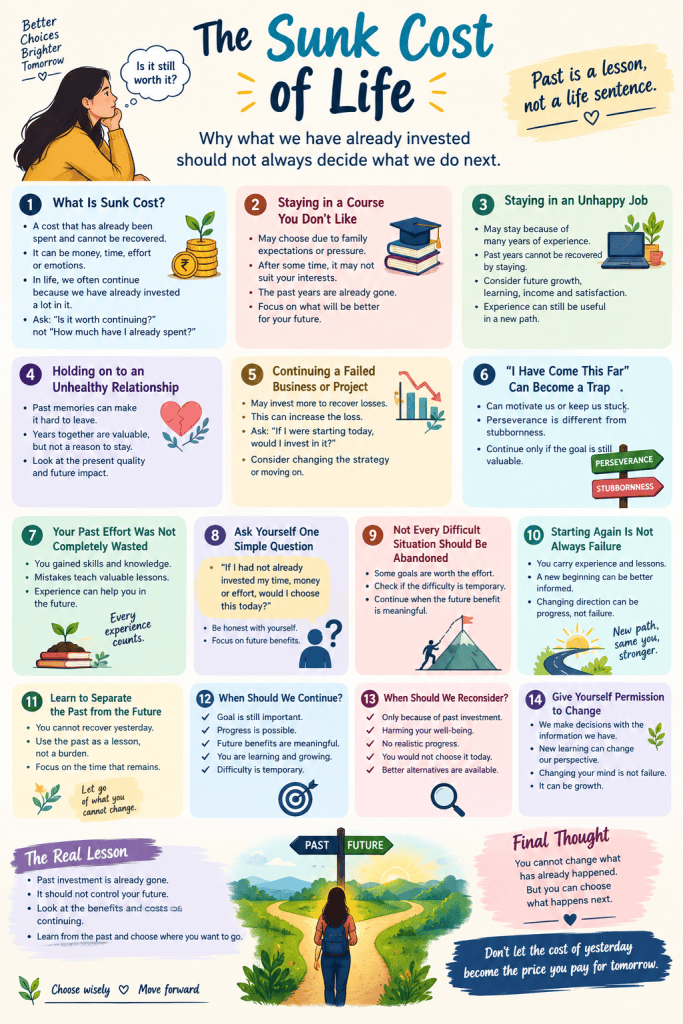
Why what we have already invested should not always decide what we do next
1. What Is Sunk Cost?
- Sunk cost means a cost that has already been spent and cannot be recovered.
- It may be money, time, effort or emotional energy.
- In economics, sunk costs should not influence future decisions.
- In life, we often continue something simply because we have already invested a lot in it.
- The important question is not “How much have I already spent?”, but “Is it worth continuing?”
2. Staying in a Course You Don’t Like
- A student may choose a course because of family expectations or personal circumstances.
- After some time, she may realise that the course does not match her interests.
- She may think, “I have already spent two years, so I cannot change.”
- But the two years have already passed.
- The better question is: “What will be the best choice for my future?”
- Changing direction does not mean that the previous years were completely wasted.
3. Staying in an Unhappy Job
- Some people remain in an uncomfortable job because they have worked there for many years.
- They may feel that leaving means wasting their previous experience.
- But past years cannot be recovered by staying in the same situation.
- Consider future salary, growth, learning opportunities and job satisfaction.
- Experience gained from the old job can still be useful in a new career.
- Sometimes moving forward requires accepting that a change is necessary.
4. Holding on to an Unhealthy Relationship
- People may stay in difficult relationships because of the years they have already invested.
- They may think, “We have been together for so long.”
- Shared memories and emotions can make decisions difficult.
- However, past time should not automatically determine the future.
- Consider the present quality of the relationship and its impact on both people.
- A meaningful past can be respected without being forced to continue forever.
5. Continuing a Failed Business or Project
- An entrepreneur may continue investing money in a business that is not performing well.
- The reason may be: “I have already invested so much.”
- Continuing to invest only to recover previous losses can make the situation worse.
- Analyse the future potential of the business objectively.
- Ask: “If I were starting this today, would I invest in it?”
- Sometimes changing the strategy or stopping the project is the wiser decision.
6. “I Have Come This Far” Can Become a Trap
- “I have come this far” can sometimes motivate us.
- But it can also prevent us from making a necessary change.
- Perseverance means continuing because the goal is still valuable.
- Sunk-cost thinking means continuing mainly because of past investment.
- Difficult does not always mean wrong.
- But continuing something only because of the past may not be a wise decision.
7. Your Past Effort Was Not Completely Wasted
- Leaving something does not mean that everything you did was useless.
- Every experience can provide knowledge.
- Mistakes can teach valuable lessons.
- Difficult situations can develop patience and confidence.
- A failed business can teach you what not to do next time.
- A difficult job can give you skills that are useful elsewhere.
- The experience remains, even when the original plan changes.
8. Ask Yourself One Simple Question
When you feel stuck, ask:
“If I were starting today, would I choose this again?”
- If the answer is yes, continuing may be worthwhile.
- If the answer is no, understand why.
- Think about future benefits rather than only past investment.
- Separate your current decision from your previous decision.
- This simple question can help you make a more objective choice.
9. Not Every Difficult Situation Should Be Abandoned
- Sunk-cost thinking should not become an excuse for quitting everything.
- Some valuable goals require time and patience.
- Education, career development and business growth may involve temporary difficulties.
- Ask whether the difficulty is temporary or permanent.
- Consider whether meaningful progress is still possible.
- Continue when the future benefit is worth the effort.
10. Starting Again Is Not Always Failure
- Changing direction can feel like starting from zero.
- But you are not actually starting from zero.
- You already have experience, knowledge and lessons from the past.
- A new beginning can be based on better understanding.
- Changing your decision after learning new information can be a sign of maturity.
- Starting again can sometimes be a smarter form of moving forward.
11. Learn to Separate the Past from the Future
- We cannot change yesterday.
- We cannot recover every hour, rupee or opportunity we have already spent.
- But we can decide how to use our future.
- Past mistakes should become lessons, not permanent burdens.
- Do not spend more of your future simply to justify a past decision.
- Focus on the choices that can improve your present and future.
12. When Should We Continue?
Continue when:
- The goal is still important to you.
- Progress is possible.
- The future benefits are meaningful.
- You are learning and improving.
- The difficulties are temporary.
- The effort is still reasonable compared with the expected result.
13. When Should We Reconsider?
Reconsider when:
- You are continuing only because of your past investment.
- The situation is repeatedly harming you.
- There is no realistic progress.
- You would not choose the same path if you were starting today.
- Better alternatives are available.
- Fear of change is the main reason you are staying.
14. Give Yourself Permission to Change
- We make decisions based on the information available at that time.
- New experiences can change our understanding.
- A decision that was right five years ago may not be right today.
- Changing your mind does not always mean you failed.
- It can mean that you have learned something new.
- Growth sometimes requires changing direction.
15. The Real Lesson of Sunk Cost
- Past investment is already gone.
- It should not automatically determine future choices.
- Look at the expected benefits and costs of continuing.
- Learn from the past without becoming trapped by it.
- Make decisions based on where you want to go, not only on where you have been.
- Your future deserves a fresh evaluation.
🌱 Final Thought
- You cannot change the time you have already spent.
- You cannot recover every failed opportunity.
- But you can decide what you do with your remaining time.
- You can change your course.
- You can try again.
- You can choose differently.
Your past is a lesson, not a life sentence.
“Don’t let the cost of yesterday become the price you pay for tomorrow.”