What does True Happiness means?

Introduction

In today’s fast-paced world, many people chase happiness through money, success, possessions, or social status. However, true happiness goes beyond temporary pleasures. It is a deeper sense of contentment, peace, and satisfaction with life.


What is True Happiness?

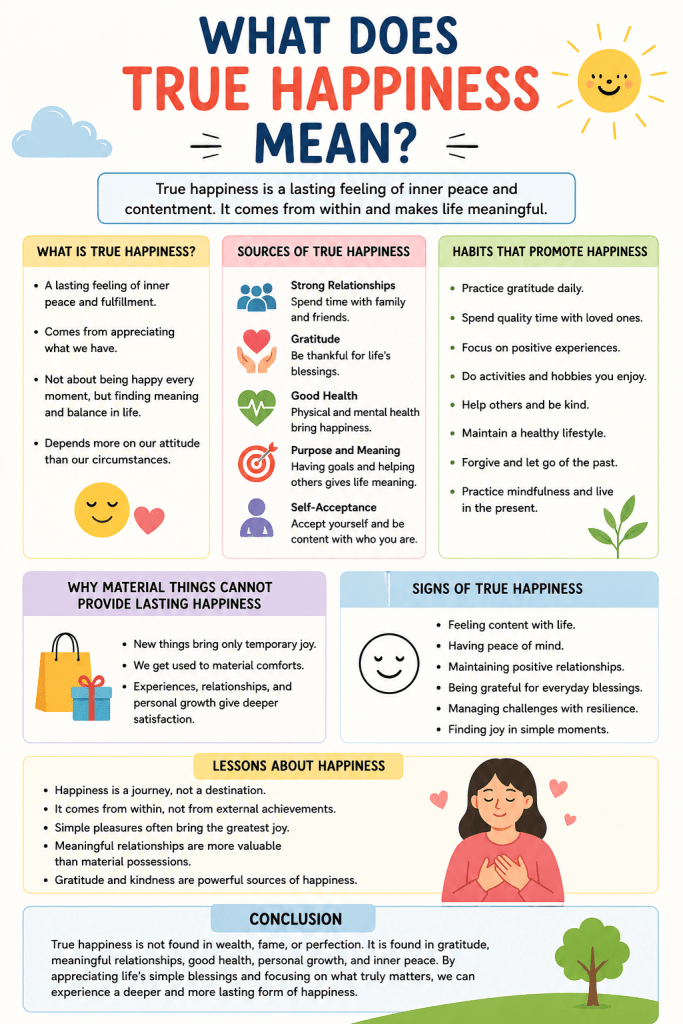
  • True happiness is a lasting feeling of inner peace and fulfillment.
  • It comes from appreciating what we have rather than constantly wanting more.
  • It is not about being happy every moment but about finding meaning and balance in life.
  • Happiness is a state of mind that depends more on our attitude than our circumstances.

Common Misconceptions About Happiness

1. Happiness Means Being Rich

  • Money can provide comfort and security.
  • However, wealth alone does not guarantee happiness.
  • Many wealthy individuals still experience stress and dissatisfaction.

2. Happiness Means Having Everything

  • No one has a perfect life.
  • True happiness comes from accepting imperfections and making the best of situations.

3. Happiness is Permanent

  • Life includes both joyful and difficult moments.
  • Experiencing sadness does not mean a person is unhappy overall.

Sources of True Happiness

1. Strong Relationships

  • Spending time with family and friends creates emotional support.
  • Meaningful connections improve overall well-being.

2. Gratitude

  • Being thankful for life’s blessings increases satisfaction.
  • Gratitude helps people focus on what they have rather than what they lack.

3. Good Health

  • Physical and mental well-being contribute greatly to happiness.
  • Regular exercise, healthy eating, and sufficient sleep improve mood.

4. Purpose and Meaning

  • Having goals and a sense of purpose makes life more fulfilling.
  • Helping others and contributing to society can create lasting happiness.

5. Self-Acceptance

  • Accepting oneself, including strengths and weaknesses, builds inner peace.
  • Comparing ourselves with others often reduces happiness.

Habits That Promote Happiness

  • Practice gratitude daily.
  • Spend quality time with loved ones.
  • Focus on positive experiences.
  • Engage in hobbies and activities you enjoy.
  • Help others through acts of kindness.
  • Maintain a healthy lifestyle.
  • Learn to forgive and let go of past mistakes.
  • Practice mindfulness and live in the present moment.

Why Material Things Cannot Provide Lasting Happiness

  • New possessions often bring temporary excitement.
  • Over time, people become accustomed to material comforts.
  • Experiences, relationships, and personal growth usually provide deeper satisfaction than material goods.

Signs of True Happiness

  • Feeling content with life.
  • Having peace of mind.
  • Maintaining positive relationships.
  • Being grateful for everyday blessings.
  • Managing challenges with resilience.
  • Finding joy in simple moments.

Lessons About Happiness

  • Happiness is a journey, not a destination.
  • It comes from within rather than external achievements.
  • Simple pleasures often bring the greatest joy.
  • Meaningful relationships are more valuable than material possessions.
  • Gratitude and kindness are powerful sources of happiness.

Conclusion

True happiness is not found in wealth, fame, or perfection. It is found in gratitude, meaningful relationships, good health, personal growth, and inner peace. By appreciating life’s simple blessings and focusing on what truly matters, we can experience a deeper and more lasting form of happiness. True happiness is not about having the best of everything—it is about making the best of everything we have. 🌸✨


Embracing JOMO: Finding Joy and Balance in Missing Out

Embracing JOMO: The Joy of Missing Out

In today’s fast-paced world, the fear of missing out (FOMO) often dominates our lives, pushing us to constantly stay connected and engaged. However, there’s a refreshing and liberating concept known as JOMO – the Joy of Missing Out. Embracing JOMO involves finding happiness in opting out of social activities or online engagements in favor of personal time and activities that bring genuine joy.

1. Understanding JOMO

  • Definition: JOMO is the pleasure derived from choosing personal well-being over the need for social validation.
  • Mindful Choice: It’s about making conscious decisions that prioritize true happiness and peace of mind.

2. Benefits of JOMO

  • Increased Well-being: Embracing JOMO can reduce stress and anxiety, leading to a calmer and more centered life.
  • Quality Time: It allows for deeper connections with oneself and loved ones, rather than superficial interactions.
  • Creativity and Productivity: With fewer distractions, we can focus on activities that nourish our creativity and productivity.
  • Imam Al-Ghazali: “Desires make slaves out of kings and patience makes kings out of slaves.”

3. Mindfulness and Presence

  • Living in the Moment: JOMO encourages us to be present and fully engaged in whatever we are doing, fostering a sense of mindfulness.
  • Ibn Qayyim Al-Jawziyya: “A slave stands a better chance of attaining Allah’s pleasure if he sticks to the limits and keeps far away from what He has prohibited, even if this means missing out on some good things.”

4. Personal Growth

  • Self-Discovery: Missing out on social engagements provides the space needed for self-reflection and personal growth.
  • Introspection: Time alone can lead to greater self-awareness and clarity about one’s goals and values.
  • Rumi: “The quieter you become, the more you are able to hear.”

5. Building Meaningful Relationships

  • Depth Over Breadth: JOMO allows us to focus on building deeper, more meaningful relationships rather than spreading ourselves too thin.
  • Authenticity: Choosing quality interactions over quantity helps foster genuine connections.
  • Ibn Arabi: “Beware of confining yourself to a particular belief and denying all else, for much good would elude you – indeed, the knowledge of reality would elude you.”

6. Enhancing Productivity

  • Focused Attention: With fewer distractions, we can concentrate better on tasks and projects that matter.
  • Flow State: JOMO helps us enter a state of flow where we can perform at our best.

7. Rediscovering Joy in Simple Pleasures

  • Appreciating Simplicity: Embracing JOMO helps us find joy in simple, everyday pleasures that are often overlooked.
  • Nature and Solitude: Activities like reading, walking in nature, or simply enjoying quiet time become more fulfilling.
  • Abu Hamid Al-Ghazali: “Do not allow your heart to take pleasure with the praises of people, nor be saddened by their condemnation.”

Practical Tips for Embracing JOMO

  1. Set Boundaries: Learn to say no to activities that don’t align with your values or bring you joy.
  2. Digital Detox: Take regular breaks from social media and digital devices to reconnect with yourself and your surroundings.
  3. Prioritize Self-Care: Engage in activities that nourish your mind, body, and soul.
  4. Be Selective: Choose to spend time with people and activities that truly matter to you.
  5. Practice Gratitude: Focus on appreciating the present moment and the things you already have.

Conclusion

Embracing JOMO is about finding contentment in solitude and joy in simplicity. It’s a shift from the constant hustle and bustle to a more intentional and fulfilling way of living. As you navigate through life, remember to savor the moments you choose to miss out on, for they often hold the key to your inner peace and happiness. As Al-Farabi wisely said, “Happiness is to be found in the state of tranquility which is achieved through the exercise of virtue.”

Simplicity Speaks Louder: Why Less is Truly More

Sometimes, Simple is More

  • Less Mess, Clear Mind:
  • Simplicity is the ultimate sophistication.” – Leonardo da Vinci
    • When we tidy up our stuff, it’s easier to think clearly.
    • Having fewer things around us helps us feel calm and focused.
    • It feels good to only keep what we really need.
  • Simple Design Looks Great:
  • “Beauty of style and harmony and grace and good rhythm depend on simplicity.” – Plato
    • Simple things like clean lines and plain colors always look nice.
    • If we don’t clutter up a design, it stands out and looks cool.
    • Simple designs can make buildings, clothes, and pictures look awesome.
  • Happiness in Little Things:
  • “Happiness is not in the mere possession of money; it lies in the joy of achievement, in the thrill of creative effort.” – Franklin D. Roosevelt
    • It’s the small stuff that makes us happiest.
    • Like a quiet moment, a walk outside, or a chat with a friend.
    • We don’t need fancy things to feel happy; the simple stuff works just fine.
  • Making Life Easier:
  • “Simplicity is about subtracting the obvious and adding the meaningful.” – John Maeda
    • Keeping our daily routines simple helps us get more done.
    • If we focus on the important stuff and ignore the distractions, we have more time and energy.
    • Doing things in a simple way can help us reach our goals faster.
  • Finding Peace Inside:
  • “Simplicity is the nature of great souls”
    • Simplifying our lives means not worrying about too much stuff.
    • When we stop trying to do everything and impress everyone, we feel more peaceful inside.
    • Being happy with what we have now is better than always wanting more.

In a world that often says we need lots of fancy things to be happy, it’s good to remember that sometimes, simple is better. When we keep things simple, life feels clearer, happier, and more peaceful. So let’s take a step back, simplify, and enjoy the beauty of a simple life.