From Resistance to Release: Learning to Trust Life’s Flow

🌸 Introduction

Life often feels like a river — sometimes calm, sometimes stormy. Yet, instead of floating, we often resist the current, trying to control everything. This resistance creates stress and exhaustion. True peace begins when we release control and learn to trust life’s natural flow.


💧 1. Resistance Creates Tension

  • When we cling too tightly to expectations, we struggle.
  • Resistance is like swimming against the current — tiring and frustrating.
  • Life is not meant to be forced; it is meant to be lived.

“What you resist, persists. What you accept, transforms.”


💧 2. The Power of Release

  • Release is not giving up; it is letting go of unnecessary struggle.
  • It means surrendering what you cannot control.
  • Trust that every setback is a redirection toward growth.

“Surrender is not weakness; it is strength aligned with wisdom.”


💧 3. Trusting the Flow

  • Life has its own rhythm — just like seasons, tides, and sunrise.
  • Trusting the flow means believing that life carries lessons, opportunities, and healing.
  • Sometimes, what looks like an ending is actually a beginning.

“Trust the process, even when the path is unclear.”


💧 4. Practical Ways to Flow with Life

  • Practice mindfulness – be present instead of worrying about tomorrow.
  • Breathe deeply – calm your mind when overwhelmed.
  • Write a gratitude journal – focus on what’s working.
  • Release control – accept that not everything is in your hands.

🌸 Conclusion

Moving from resistance to release is a journey. When we stop fighting life and start trusting its flow, we discover inner peace. Life is not about controlling the current but learning to float gracefully with it.

“Flow with life, and life will flow through you with peace.”

Energy First: Prioritize What Truly Matters

Introduction:
Our energy is our most valuable resource. Unlike time, which is fixed, energy determines how effectively we live, work, and grow. Focusing on what truly matters allows us to achieve more, reduce stress, and create a meaningful life. By putting Energy First, we can make conscious choices about where to invest our effort and attention.

1. Understand Your Energy, Not Just Time

  • Time is fixed; energy is what powers your actions.
  • Notice when you feel most alert and focused.
  • Plan your most important tasks during high-energy periods.

2. Identify What Truly Matters

  • List tasks, goals, and relationships that impact your growth and happiness.
  • Ask yourself: “Does this matter in the long run?”
  • Say no to distractions and low-value activities.

3. Protect Your Energy

  • Avoid unnecessary stress and negative people.
  • Take breaks, rest, and recharge regularly.
  • Use mindfulness or short meditation to reset your energy.

4. Focus on One Thing at a Time

  • Multitasking drains energy and reduces effectiveness.
  • Complete high-priority tasks before moving to others.
  • Use the “Energy First” principle: high energy → high impact tasks.

5. Create Energy-Boosting Habits

  • Exercise, healthy eating, and quality sleep boost your energy.
  • Start your day with tasks that give satisfaction or momentum.
  • Limit social media and other energy-draining activities.

6. Align Energy with Goals

  • Spend energy on actions that bring you closer to your goals.
  • Regularly review priorities and adjust where your energy goes.
  • Celebrate small wins to maintain motivation and energy.

Conclusion:
Your energy is your most valuable resource. Prioritizing what truly matters helps you achieve more, feel better, and live a meaningful life. Always put Energy First and let it guide your daily choices.

Time is the Greatest Currency

Introduction

People often believe that money is the most powerful resource, but in reality, time is the greatest currency we have. Unlike money, time cannot be saved in a bank, borrowed, or replaced. Once it’s gone, it’s gone forever. The way we spend our time shapes our happiness, relationships, and success in life.


Why Time is More Valuable than Money

  • Money can be earned, lost, and earned again, but time can never return.
  • Everyone, no matter how rich or poor, gets the same 24 hours a day.
  • Time is the foundation on which all achievements are built.

How Time Works Like Currency

  • Every day, we spend time on different activities, just like we spend money.
  • Using time on growth, learning, or meaningful relationships is like making a smart investment.
  • Wasting time on unimportant things is like losing money on a bad deal.

Using Time Wisely

  • Prioritize what truly matters: health, family, and personal growth.
  • Learn to say no to distractions and unnecessary commitments.
  • Manage time effectively by setting goals and avoiding procrastination.
  • Remember: spending quality time with loved ones creates memories that money can’t buy.

The Real Wealth

  • True wealth isn’t measured by how much money you have, but how wisely you use your time.
  • At the end of life, people don’t wish for more money—they wish for more time with the people they love.
  • Balancing work, rest, and joy makes life meaningful.

Conclusion

Time is life’s greatest currency. Use it with care, spend it on things that bring happiness and growth, and never waste it on what doesn’t matter. Once time is gone, it never comes back—so value every moment.

Boundaries = Peace: Protecting Your Energy

🌸 Introduction

Peace of mind is not about having a quiet life—it’s about protecting your energy. Many times, we lose our inner calm because we don’t set clear boundaries with people, work, or even ourselves. Setting boundaries is not selfish—it’s self-care.


🌿 Why Boundaries Are Important

  • Boundaries help you say yes to what matters and no to what drains you.
  • They create space for your own growth and happiness.
  • Without boundaries, people may take your time and energy for granted.
  • Protecting your energy helps you stay emotionally balanced.

🌼 Signs You Need Better Boundaries

  • You feel tired and drained after meeting certain people.
  • You often say “yes” when you want to say “no.”
  • You feel guilty for putting yourself first.
  • You don’t have time for things that bring you joy.

🌻 How to Set Healthy Boundaries

  1. Know Your Limits – Be clear about what feels right and what doesn’t.
  2. Learn to Say No – Respectfully decline things that exhaust you.
  3. Communicate Clearly – Express your needs without fear.
  4. Protect Your Time – Avoid overcommitting yourself.
  5. Let Go of Guilt – Remember, self-care is not being rude.

🌷 Benefits of Boundaries

  • More mental peace and less stress.
  • Healthier and more respectful relationships.
  • More time for self-care and passions.
  • Stronger confidence and self-respect.

🌸 Conclusion

Boundaries are not walls—they are doors that let peace in and keep negativity out. When you protect your energy, you create space for joy, balance, and growth. Remember: Boundaries = Peace.

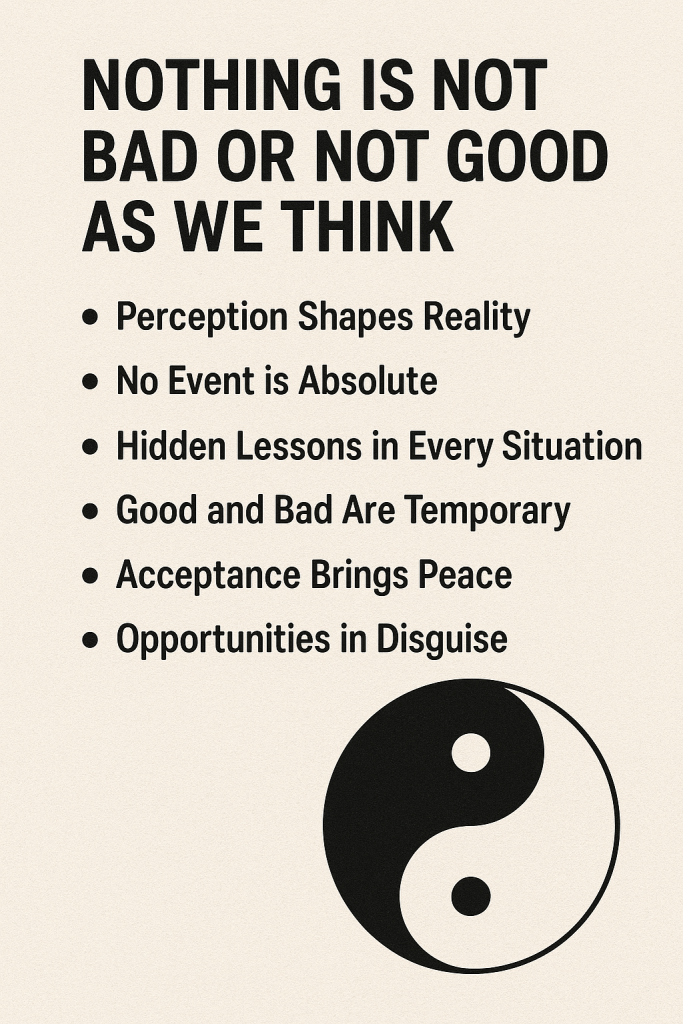
Nothing is Not Bad or Not Good as We Think

Introduction

Life often surprises us with situations that we quickly label as good or bad. But in reality, many things are neither completely good nor completely bad—it is our perception that shapes how we feel about them.


Key Points

  • Perception Shapes Reality
    • What feels like a setback today may turn into a blessing tomorrow.
    • Example: Losing a job can seem bad, but it may lead to better opportunities.
  • No Event is Absolute
    • Life events are neutral; it is we who add the meaning.
    • Something that feels painful to one person might feel like growth to another.
  • Hidden Lessons in Every Situation
    • Even challenges carry lessons, strength, and wisdom.
    • What seems “bad” can make us stronger and more resilient.
  • Good and Bad Are Temporary
    • Joy and sorrow are like waves—they come and go.
    • Nothing remains permanent; every phase changes with time.
  • Acceptance Brings Peace
    • Instead of labeling things as good or bad, accepting them as experiences brings calmness.
    • This mindset helps us handle stress with balance.
  • Opportunities in Disguise
    • Difficulties often open doors we would never notice otherwise.
    • The key is to stay open-minded and patient.

Conclusion

Nothing in life is completely good or bad—it is our thoughts and judgments that create those labels. When we look at situations with an open and neutral mind, we find peace, growth, and unexpected opportunities. Life is a teacher, and every moment—whether pleasant or painful—has a purpose.

Accept, Don’t Suppress

Life often gives us emotions we don’t want—sadness, anger, disappointment, or fear. Many people try to hide these feelings or push them away, but doing so only makes the pain heavier. True strength lies in accepting your emotions, not suppressing them.

✨ Simple Points to Remember

  • Acceptance is the first step to healing – When you allow yourself to feel, you give space for recovery to begin.
  • Suppression creates stress – Bottled-up emotions don’t disappear; they show up as anxiety, irritability, or even health issues.
  • Feeling is not weakness – It takes courage to admit when you’re hurt or struggling.
  • Expression brings clarity – Talking, journaling, or creative outlets help you understand your emotions better.
  • Acceptance leads to growth – Once you face your feelings, you can learn from them and move forward stronger.
  • Peace comes with honesty – Pretending drains energy; being truthful with yourself brings inner calm.
  • You’re not alone – Everyone experiences pain, and sharing it can connect you with others who understand.

🌸 Final Thought

Remember, acceptance is not about giving up—it’s about letting go of denial. When you accept what you feel, you open the door to healing, growth, and peace.

Why Every Ending is a New Beginning: Embracing Change in 2025

The end of one chapter often marks the start of something new. As we step into 2025, it’s the perfect time to embrace change and welcome fresh opportunities. Here’s why every ending can be seen as a new beginning:

1. A Chance to Reflect and Learn

“Life can only be understood backwards, but it must be lived forwards.” – Søren Kierkegaard

  • Endings give us a moment to pause and reflect on what worked and what didn’t.
  • Lessons learned from past experiences can guide better decisions in the future.

2. Room for Growth

“Every next level of your life will demand a different you.” – Leonardo DiCaprio

  • Closing old chapters creates space for personal and professional growth.
  • It’s an opportunity to step out of your comfort zone and explore new possibilities.

3. The Power of Fresh Starts

“It’s never too late to be what you might have been.” – George Eliot

  • A new year like 2025 symbolizes renewal and hope.
  • Starting fresh allows us to set goals and intentions with clarity.

4. Letting Go of the Past

“Some of us think holding on makes us strong, but sometimes it is letting go.” – Hermann Hesse

  • Holding onto the past can weigh us down.
  • Embracing change means letting go of what no longer serves us, be it habits, relationships, or mindsets.

5. Building Resilience

“The oak fought the wind and was broken, the willow bent when it must and survived.” – Robert Jordan

  • Every ending teaches us resilience and the ability to adapt to change.
  • This adaptability is crucial for navigating life’s uncertainties.

6. Opportunities to Redefine Ourselves

“It’s not what we have, but what we do with what we have, that defines who we are.” – J.K. Rowling

  • Each ending offers a chance to redefine who we are and what we stand for.
  • Use 2025 to align your actions with your values and aspirations.

7. The Excitement of the Unknown

“Go confidently in the direction of your dreams. Live the life you have imagined.” – Henry David Thoreau

  • The unknown can be daunting but also exciting.
  • New beginnings come with endless possibilities and the thrill of discovery.

8. Strengthening Relationships

“In the middle of every difficulty lies opportunity.” – Albert Einstein

  • Changes often bring new people into our lives and strengthen existing bonds.
  • Embrace the chance to connect, network, and grow alongside others.

9. A Reminder of Life’s Cycles

Life is a series of endings and beginnings, much like the seasons.

  • Accepting this natural cycle helps us move forward with grace and optimism.

10. Empowering Yourself for 2025

“The best way to predict the future is to create it.” – Peter Drucker

  • View 2025 as a blank canvas to design the life you want.
  • Take small, consistent steps toward your goals, and celebrate every milestone.

Final Thoughts

“Every sunset brings the promise of a new dawn.” – Ralph Waldo Emerson
Every ending holds the seed of a new beginning. Embracing change with an open heart and mind can turn challenges into stepping stones for growth. In 2025, let go of fear and welcome the opportunities that come your way.

Reflection Without Action is a Missed Opportunity for Growth

  1. Reflection Gives Clarity
    • Thinking about past experiences helps you understand what worked and what didn’t.
    • But without action, these insights won’t create real change.
    • Quote: “Knowing is not enough; we must apply.” – Johann Wolfgang von Goethe
  2. Action Brings Growth
    • Growth happens when you act on your reflections and implement changes.
    • Reflection alone leaves progress incomplete.
  3. Small Steps Matter
    • Even small actions based on reflection can lead to big improvements over time.
    • Example: If you reflect on poor fitness but start walking for 10 minutes daily, you’ll see gradual progress.
  4. Avoid Regret
    • Reflecting but not acting can lead to regrets about missed opportunities.
    • Quote: “Action is the foundational key to all success.” – Pablo Picasso
  5. Reflection + Action = Success
    • Combine reflection and action to create a cycle of learning and improvement.
    • Example: Entrepreneurs improve by acting on customer feedback after reflecting on business challenges.
  6. Learn From Mistakes
    • Reflection helps you see mistakes, but action ensures you learn from them.
    • Quote: “Success is not final, failure is not fatal: It is the courage to continue that counts.” – Winston Churchill
  7. Build Confidence Through Action
    • Acting on your thoughts builds confidence and belief in your abilities.
    • Example: Overcoming public speaking fear starts with small actions like speaking in front of friends.

Key Takeaway:
Reflection without action is like planning a journey but never starting it. Think, act, and grow—one step at a time.
Quote: “An idea is nothing without the action to back it up.” – Unknown

Do One Thing Every Day That Scares You

Introduction:

  • Embrace the idea of stepping out of your comfort zone daily.
  • Facing fears can lead to personal growth and self-discovery.

1. Why Face Your Fears?

  • Build Confidence: Overcoming fears boosts self-esteem.
  • Enhance Resilience: Regularly challenging yourself makes you more adaptable to life’s uncertainties.
  • Discover New Opportunities: Fear often holds us back from opportunities for growth and success.

2. Start Small

  • Identify Minor Fears: Begin with small challenges, like speaking up in a meeting or trying a new hobby.
  • Take Baby Steps: Gradually build up to more significant challenges.

3. Daily Challenges

  • Try Something New: Whether it’s a new food, a new route to work, or a new activity, variety can break the monotony.
  • Connect with Others: Strike up a conversation with a stranger or reach out to someone you haven’t spoken to in a while.
  • Speak Up: Share your thoughts or opinions in situations where you would typically stay silent.

4. Reflect on Your Progress

  • Keep a Journal: Document your daily challenges and how you felt before and after facing them.
  • Celebrate Small Wins: Acknowledge and celebrate each victory, no matter how small.

5. Learn from Failures

  • Accept Imperfection: Understand that not every attempt will be successful, and that’s okay.
  • Analyze and Adapt: Reflect on what didn’t work and think about how you can improve next time.

6. Benefits of Facing Your Fears

  • Personal Growth: Each challenge conquered makes you stronger and more self-aware.
  • Increased Creativity: New experiences can spark creativity and innovation.
  • Better Stress Management: Regularly facing fears can reduce overall anxiety and stress levels.

7. Inspirational Examples

  • Public Speaking: Many successful people, like Warren Buffet, overcame their fear of public speaking through practice.
  • New Skills: Learning a new language or instrument can be daunting but rewarding.

8. Encouraging Quotes

  • Eleanor Roosevelt: “Do one thing every day that scares you.”
  • Nelson Mandela: “I learned that courage was not the absence of fear, but the triumph over it.”

Conclusion:

  • Embracing daily challenges can transform your life.
  • Start small, stay consistent, and watch as you grow braver and more confident over time.

Call to Action:

  • Challenge yourself today to do one thing that scares you. Share your experiences and inspire others to do the same!

Self-Awareness: Understanding Yourself for Personal Growth

What Is Self-Awareness?

  • Quote: “Knowing yourself is the beginning of all wisdom.” – Aristotle
  • Self-awareness is the ability to recognize and understand your own thoughts, emotions, and behaviors.
  • It helps you identify how you react to different situations and how others perceive you.

Why Self-Awareness Is Important

  • Quote: “When I discover who I am, I’ll be free.” – Ralph Ellison
  • It helps you make better decisions, build healthier relationships, and manage emotions effectively.
  • Example: If you realize that stress makes you impatient, you can take steps to manage stress before it affects your behavior.

Types of Self-Awareness

  • Quote: “What we perceive about ourselves is greatly a reflection of how we will end up living our lives.” – Stephen Richards
  • Internal Self-Awareness: Understanding your emotions, values, and goals.
    • Example: Knowing that you value honesty can help you avoid situations where you feel pressured to be dishonest.
  • External Self-Awareness: Understanding how others see you.
    • Example: If people see you as quiet, but you think of yourself as outgoing, you may need to align your self-perception with your actions.

Benefits of Self-Awareness

  • Quote: “Self-awareness gives you the capacity to learn from your mistakes as well as your successes.” – Lawrence Bossidy
  • Improved Emotional Control: You can respond to situations more calmly.
    • Example: When you’re aware that certain topics make you angry, you can prepare to stay calm during difficult conversations.
  • Better Relationships: Understanding your own needs and recognizing others’ emotions improves communication.
    • Example: Being aware of your need for personal space helps you set boundaries in relationships.

How to Develop Self-Awareness

  • Quote: “The unexamined life is not worth living.” – Socrates
  • Reflect on Your Feelings: Take time to think about your emotions and why you feel them.
    • Example: After a tough day, reflect on why you felt upset and how you handled it.
  • Seek Feedback: Ask trusted friends or colleagues how they perceive you.
    • Example: If a colleague says you seem stressed, it might help you realize you’re overwhelmed and need to make changes.
  • Practice Mindfulness: Stay present and observe your thoughts without judgment.
    • Example: During a stressful moment, pause and notice your thoughts instead of reacting immediately.

Common Obstacles to Self-Awareness

  • Denial: Refusing to acknowledge your flaws or emotions.
    • Example: Telling yourself you’re always right, even when faced with feedback that suggests otherwise.
  • Fear of Self-Reflection: Avoiding deeper thinking because you’re afraid of what you’ll find.
    • Example: Not wanting to admit that you may need to make uncomfortable changes in your life.

How Self-Awareness Leads to Growth

  • Quote: “Self-awareness is not just relaxation and not just meditation. It must combine relaxation with activity and dynamism. Technology can aid that.” – Deepak Chopra
  • Recognizing your strengths and weaknesses helps you set realistic goals and improve over time.
  • Example: If you’re aware that procrastination is a weakness, you can work on time management skills to overcome it.

Conclusion

  • Quote: “Your visions will become clear only when you can look into your own heart. Who looks outside, dreams; who looks inside, awakes.” – Carl Jung
  • Self-awareness is the key to personal growth and better relationships.
  • By understanding yourself, you can make positive changes in your life, handle challenges more effectively, and become the best version of yourself.