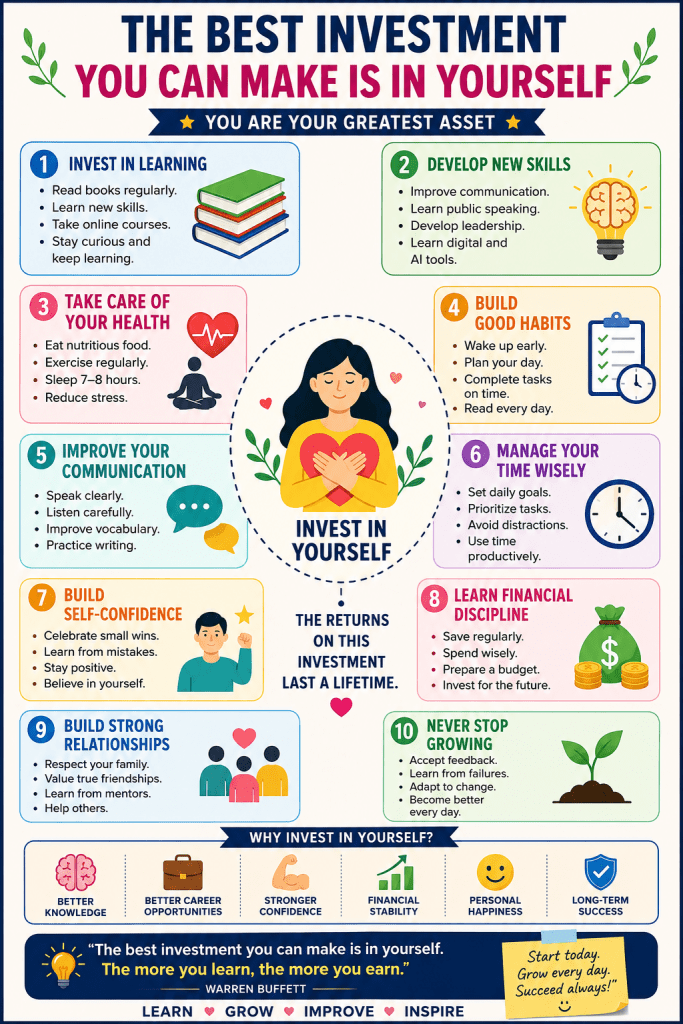
The Best Investment You Can Make Is in Yourself

“The greatest asset you will ever own is not your money—it’s you.”

Introduction

Many people dream of becoming successful, wealthy, and happy. They often invest money in land, gold, stocks, or businesses. While these are valuable investments, the best investment you can ever make is investing in yourself. When you improve your knowledge, skills, health, and character, you create opportunities that no one can take away.


1. Invest in Learning 📚

Knowledge is one of the few things that grows when you share it.

  • Read books regularly.
  • Learn new skills.
  • Attend workshops and seminars.
  • Take free online courses.
  • Stay curious and keep learning.

Simple Example:
A student who learns Excel, Power BI, or AI tools has better career opportunities than someone who only depends on classroom learning.


2. Develop New Skills 💡

Skills increase your confidence and employability.

  • Improve communication skills.
  • Learn public speaking.
  • Develop leadership qualities.
  • Improve problem-solving ability.
  • Learn digital and AI tools.

Remember:
A degree gets you an interview, but skills help you build a successful career.


3. Take Care of Your Health ❤️

Your health is your greatest wealth.

  • Eat nutritious food.
  • Exercise regularly.
  • Sleep for 7–8 hours.
  • Drink enough water.
  • Reduce stress through relaxation or meditation.

Healthy body + Healthy mind = Better performance.


4. Build Good Habits 🌱

Small daily habits create big success over time.

  • Wake up early.
  • Plan your day.
  • Complete tasks on time.
  • Read every day.
  • Avoid procrastination.

“Successful people are simply people with successful habits.”


5. Improve Your Communication 🗣️

Good communication opens many doors.

  • Speak clearly and confidently.
  • Listen carefully.
  • Improve your vocabulary.
  • Practice writing professionally.
  • Respect others’ opinions.

Communication is one of the most valuable skills in every profession.


6. Manage Your Time Wisely ⏰

Time is more valuable than money because it cannot be replaced.

  • Set daily goals.
  • Prioritize important tasks.
  • Avoid unnecessary distractions.
  • Limit excessive social media use.
  • Use your free time productively.

Every minute invested wisely brings long-term benefits.


7. Build Self-Confidence 🌟

Believe in your abilities.

  • Celebrate small achievements.
  • Learn from mistakes.
  • Stay positive.
  • Face challenges with courage.
  • Never compare yourself with others.

Confidence grows through continuous learning and practice.


8. Learn Financial Discipline 💰

Managing money wisely is an important life skill.

  • Save regularly.
  • Avoid unnecessary spending.
  • Prepare a simple budget.
  • Learn basic financial planning.
  • Invest wisely for the future.

Financial discipline provides security and peace of mind.


9. Build Strong Relationships 🤝

Success becomes more meaningful when shared with others.

  • Respect your family.
  • Value true friendships.
  • Learn from mentors.
  • Help others whenever possible.
  • Build a positive professional network.

Strong relationships create lifelong support and opportunities.


10. Never Stop Growing 🚀

Personal growth is a lifelong journey.

  • Accept feedback positively.
  • Learn from failures.
  • Adapt to change.
  • Keep improving every day.
  • Believe that every day is a new opportunity to become better.

Growth begins when you step outside your comfort zone.


Why Investing in Yourself Matters

When you invest in yourself, you gain:

  • Better knowledge
  • Stronger skills
  • Good health
  • Higher confidence
  • Better career opportunities
  • Financial stability
  • Personal happiness
  • Long-term success

These are lifelong returns that continue to grow over time.


Conclusion

Money can be lost, opportunities may come and go, but the knowledge, skills, values, and experiences you gain by investing in yourself remain with you forever. Every book you read, every new skill you learn, every healthy habit you build, and every challenge you overcome helps shape a brighter future. Start investing in yourself today because you are your greatest asset, and the returns on this investment will benefit you for a lifetime.

Remember: “Invest in yourself today, and your future self will thank you tomorrow.”

Self-Awareness: Understanding Yourself for Personal Growth

What Is Self-Awareness?

  • Quote: “Knowing yourself is the beginning of all wisdom.” – Aristotle
  • Self-awareness is the ability to recognize and understand your own thoughts, emotions, and behaviors.
  • It helps you identify how you react to different situations and how others perceive you.

Why Self-Awareness Is Important

  • Quote: “When I discover who I am, I’ll be free.” – Ralph Ellison
  • It helps you make better decisions, build healthier relationships, and manage emotions effectively.
  • Example: If you realize that stress makes you impatient, you can take steps to manage stress before it affects your behavior.

Types of Self-Awareness

  • Quote: “What we perceive about ourselves is greatly a reflection of how we will end up living our lives.” – Stephen Richards
  • Internal Self-Awareness: Understanding your emotions, values, and goals.
    • Example: Knowing that you value honesty can help you avoid situations where you feel pressured to be dishonest.
  • External Self-Awareness: Understanding how others see you.
    • Example: If people see you as quiet, but you think of yourself as outgoing, you may need to align your self-perception with your actions.

Benefits of Self-Awareness

  • Quote: “Self-awareness gives you the capacity to learn from your mistakes as well as your successes.” – Lawrence Bossidy
  • Improved Emotional Control: You can respond to situations more calmly.
    • Example: When you’re aware that certain topics make you angry, you can prepare to stay calm during difficult conversations.
  • Better Relationships: Understanding your own needs and recognizing others’ emotions improves communication.
    • Example: Being aware of your need for personal space helps you set boundaries in relationships.

How to Develop Self-Awareness

  • Quote: “The unexamined life is not worth living.” – Socrates
  • Reflect on Your Feelings: Take time to think about your emotions and why you feel them.
    • Example: After a tough day, reflect on why you felt upset and how you handled it.
  • Seek Feedback: Ask trusted friends or colleagues how they perceive you.
    • Example: If a colleague says you seem stressed, it might help you realize you’re overwhelmed and need to make changes.
  • Practice Mindfulness: Stay present and observe your thoughts without judgment.
    • Example: During a stressful moment, pause and notice your thoughts instead of reacting immediately.

Common Obstacles to Self-Awareness

  • Denial: Refusing to acknowledge your flaws or emotions.
    • Example: Telling yourself you’re always right, even when faced with feedback that suggests otherwise.
  • Fear of Self-Reflection: Avoiding deeper thinking because you’re afraid of what you’ll find.
    • Example: Not wanting to admit that you may need to make uncomfortable changes in your life.

How Self-Awareness Leads to Growth

  • Quote: “Self-awareness is not just relaxation and not just meditation. It must combine relaxation with activity and dynamism. Technology can aid that.” – Deepak Chopra
  • Recognizing your strengths and weaknesses helps you set realistic goals and improve over time.
  • Example: If you’re aware that procrastination is a weakness, you can work on time management skills to overcome it.

Conclusion

  • Quote: “Your visions will become clear only when you can look into your own heart. Who looks outside, dreams; who looks inside, awakes.” – Carl Jung
  • Self-awareness is the key to personal growth and better relationships.
  • By understanding yourself, you can make positive changes in your life, handle challenges more effectively, and become the best version of yourself.

The Role of Self-Compassion in Achieving Emotional Well-being and Peace

1. What is Self-Compassion?

  • Self-compassion means being kind and forgiving toward yourself, especially during tough times.
  • Example: If you made a mistake at work, instead of harsh self-criticism, you support yourself by saying, “Everyone makes mistakes.”

2. Why is Self-Compassion Important?

  • It reduces self-criticism, stress, and mental pressure.
  • Example: If you fail an exam, instead of thinking “I’m not good enough,” self-compassion helps you say, “This was tough, but I can improve.”

3. Three Elements of Self-Compassion

  • Self-Kindness: Be gentle with yourself instead of harsh and judgmental.
    • Example: Missing a deadline at work—tell yourself, “It’s okay to make mistakes sometimes.”
  • Common Humanity: Recognize that everyone experiences setbacks.
    • Example: Struggling with weight loss? Remember, many people face the same challenge, and you’re not alone.
  • Mindfulness: Acknowledge your emotions without letting them overwhelm you.
    • Example: After a job rejection, mindfulness helps you accept the disappointment without overthinking it.

4. How Self-Compassion Promotes Mental Peace

  • Reduces Anxiety and Stress: Self-kindness relieves inner turmoil and leads to a calmer mind.
    • Example: After a stressful day, letting yourself rest without guilt reduces stress.
  • Improves Emotional Well-being: Helps you process criticism constructively without internalizing negativity.
    • Example: After receiving feedback at work, focus on learning from it instead of thinking you’re terrible at your job.
  • Boosts Resilience: Enables you to bounce back from challenges without getting discouraged.
    • Example: An athlete who loses a competition views it as a learning experience rather than a personal failure.

5. Practical Ways to Cultivate Self-Compassion

  • Positive Self-Talk: Replace negative thoughts with positive affirmations.
    • Example: Instead of “I’m not good at anything,” say, “I’m learning and improving.”
  • Forgive Yourself: Let go of mistakes and move forward.
    • Example: If you forget a friend’s birthday, forgive yourself and make amends instead of dwelling on guilt.
  • Take Breaks: Allow yourself rest when needed.
    • Example: After completing a big project, take time to relax without feeling guilty.
  • Practice Mindfulness: Stay aware of your emotions without judgment.
    • Example: When overwhelmed, pause and acknowledge your feelings without reacting negatively.

6. Benefits of Self-Compassion for Daily Life

  • Improved Relationships: Self-compassion makes you more understanding and patient with others.
    • Example: Being kind to yourself after a stressful day helps you treat your family with patience.
  • Greater Happiness: Encourages a positive outlook and reduces feelings of inadequacy.
    • Example: Missing a personal goal like exercising becomes an opportunity to adjust your approach rather than feeling like a failure.
  • Inner Balance: Helps you stay calm and focused in tough situations.
    • Example: During financial stress, self-compassion allows you to calmly assess and plan without panic.

7. Final Thoughts

  • Practicing self-compassion leads to mental peace and balance.
  • It helps you stay resilient in the face of challenges, and by treating yourself with kindness, you can handle life’s ups and downs with a peaceful mind.

Fake It Until You Make It: A Path to Confidence and Success

Understanding the Concept:

“Fake it until you make it” is a popular saying encouraging individuals to act as if they already possess the qualities or achievements they desire, in order to actually attain them.

Key Points

  1. Boosts Confidence
    • “Act as if what you do makes a difference. It does.” – William James
    • Pretending to be confident can help you develop actual confidence over time.
  2. Encourages Positive Thinking
    • “Whether you think you can, or you think you can’t – you’re right.” – Henry Ford
    • Adopting a positive mindset can influence your actions and outcomes.
  3. Helps Overcome Fear
    • “Do one thing every day that scares you.” – Eleanor Roosevelt
    • Acting confidently, even when you’re scared, can help you face and overcome fears.
  4. Facilitates Skill Development
    • “Practice isn’t the thing you do once you’re good. It’s the thing you do that makes you good.” – Malcolm Gladwell
    • By acting as if you’re skilled, you put in the necessary practice to actually become skilled.
  5. Improves Interpersonal Relationships
    • “You miss 100% of the shots you don’t take.” – Wayne Gretzky
    • Acting confidently in social situations can help you form better relationships and networks.
  6. Promotes Professional Growth
    • “Success is not the key to happiness. Happiness is the key to success. If you love what you are doing, you will be successful.” – Albert Schweitzer
    • Embracing a confident persona at work can lead to more opportunities and professional advancement.
  7. Supports Mental Resilience
    • “It’s not whether you get knocked down, it’s whether you get up.” – Vince Lombardi
    • Faking confidence helps build mental toughness, enabling you to recover from setbacks more effectively.

Practical Tips

  • Dress the Part: Your appearance can significantly influence how you feel about yourself.
  • Positive Body Language: Stand tall, make eye contact, and smile.
  • Set Small Goals: Achieve small successes to build genuine confidence over time.
  • Learn Continuously: Keep improving your skills and knowledge.
  • Seek Feedback: Constructive criticism can help you improve and grow.

Conclusion

  • “Fake it until you make it” is not about deception; it’s about harnessing the power of positive thinking and acting to transform your reality. By embracing this mindset, you can build the confidence and skills needed to achieve your goals and succeed in various aspects of life.

Unmasking Bias: Seeing Through the Blind Spot

We often believe we see the world clearly, making judgments based on facts and logic. However, the reality is far more complex. Our minds are susceptible to biases that can cloud our judgment and distort our perception of reality. One of the most insidious of these biases is the “biased blind spot,” where we fail to recognize our own biases while readily identifying them in others.

  1. The Nature of Bias:
    • Bias refers to the inclination or prejudice for or against something or someone, often based on factors like race, gender, or personal experiences.
    • Biases can be implicit (unconscious) or explicit (conscious) and influence our thoughts, feelings, and behaviors in subtle ways.
  2. The Blind Spot Effect:
    • The biased blind spot, also known as the “bias blind spot,” describes our tendency to recognize biases in others while failing to acknowledge our own.
    • This blind spot can lead us to believe that we are objective and impartial, despite evidence to the contrary.
  3. Types of Bias:
    • Confirmation Bias: We seek out information that confirms our existing beliefs and ignore evidence that contradicts them.
    • Attribution Bias: We attribute our successes to internal factors (skill, talent) and our failures to external factors (luck, circumstances).
    • In-group Bias: We favor members of our own group over those outside it, leading to favoritism and prejudice.
    • Implicit Bias: Unconscious attitudes or stereotypes that influence our understanding, actions, and decisions.
  4. Impacts on Decision-Making:
    • The biased blind spot can distort our decision-making processes, leading to flawed judgments and missed opportunities.
    • In professional settings, biases can affect hiring, promotions, and performance evaluations, perpetuating inequalities and hindering diversity and inclusion efforts.
  5. Overcoming the Blind Spot:
    • Recognizing and acknowledging our biases is the first step toward overcoming the biased blind spot.
    • Engaging in self-reflection, seeking feedback from others, and considering alternative perspectives can help mitigate the influence of biases.
  6. Cultivating Awareness:
    • Education and training programs can raise awareness of biases and their impact on decision-making.
    • Creating environments that encourage open dialogue and constructive criticism can foster a culture of inclusivity and accountability.
  7. Embracing Diversity:
    • Embracing diversity and inclusion fosters innovation, creativity, and resilience within organizations and communities.
    • By valuing diverse perspectives and experiences, we can challenge our own biases and broaden our understanding of the world.
  8. Conclusion:
    • The biased blind spot reminds us that none of us are immune to biases, no matter how rational or well-intentioned we may be.
    • By acknowledging our biases and actively working to counteract them, we can strive for fairness, equality, and empathy in our interactions and decision-making processes.
    • Let’s embrace the journey of self-awareness and continuous learning, recognizing that overcoming biases is a collective effort that benefits us all.