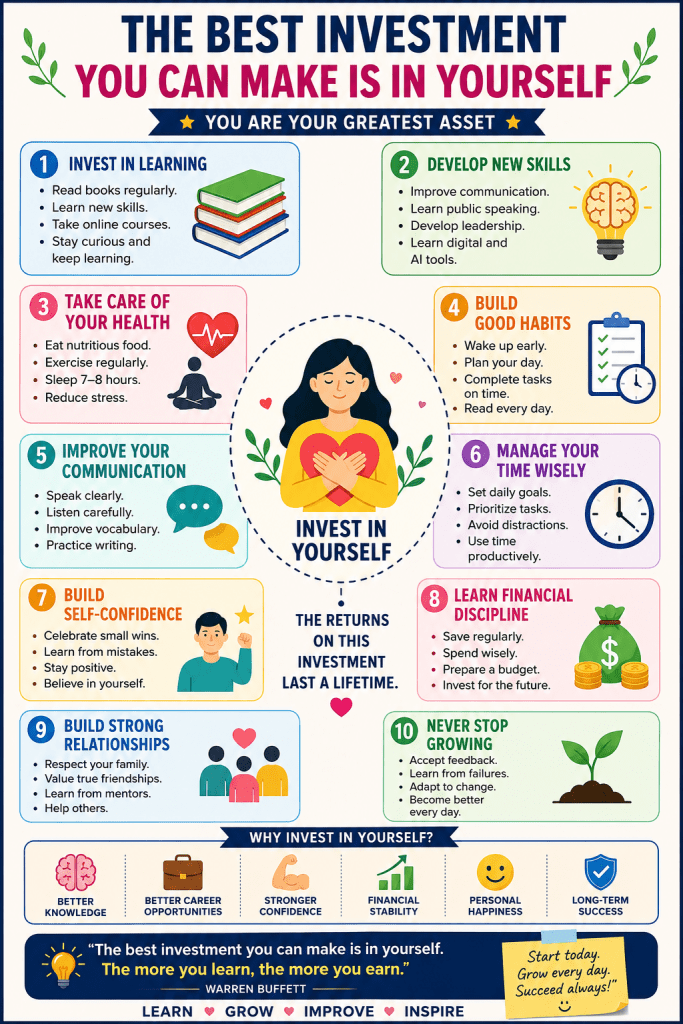
The Best Investment You Can Make Is in Yourself

“The greatest asset you will ever own is not your money—it’s you.”

Introduction

Many people dream of becoming successful, wealthy, and happy. They often invest money in land, gold, stocks, or businesses. While these are valuable investments, the best investment you can ever make is investing in yourself. When you improve your knowledge, skills, health, and character, you create opportunities that no one can take away.


1. Invest in Learning 📚

Knowledge is one of the few things that grows when you share it.

  • Read books regularly.
  • Learn new skills.
  • Attend workshops and seminars.
  • Take free online courses.
  • Stay curious and keep learning.

Simple Example:
A student who learns Excel, Power BI, or AI tools has better career opportunities than someone who only depends on classroom learning.


2. Develop New Skills 💡

Skills increase your confidence and employability.

  • Improve communication skills.
  • Learn public speaking.
  • Develop leadership qualities.
  • Improve problem-solving ability.
  • Learn digital and AI tools.

Remember:
A degree gets you an interview, but skills help you build a successful career.


3. Take Care of Your Health ❤️

Your health is your greatest wealth.

  • Eat nutritious food.
  • Exercise regularly.
  • Sleep for 7–8 hours.
  • Drink enough water.
  • Reduce stress through relaxation or meditation.

Healthy body + Healthy mind = Better performance.


4. Build Good Habits 🌱

Small daily habits create big success over time.

  • Wake up early.
  • Plan your day.
  • Complete tasks on time.
  • Read every day.
  • Avoid procrastination.

“Successful people are simply people with successful habits.”


5. Improve Your Communication 🗣️

Good communication opens many doors.

  • Speak clearly and confidently.
  • Listen carefully.
  • Improve your vocabulary.
  • Practice writing professionally.
  • Respect others’ opinions.

Communication is one of the most valuable skills in every profession.


6. Manage Your Time Wisely ⏰

Time is more valuable than money because it cannot be replaced.

  • Set daily goals.
  • Prioritize important tasks.
  • Avoid unnecessary distractions.
  • Limit excessive social media use.
  • Use your free time productively.

Every minute invested wisely brings long-term benefits.


7. Build Self-Confidence 🌟

Believe in your abilities.

  • Celebrate small achievements.
  • Learn from mistakes.
  • Stay positive.
  • Face challenges with courage.
  • Never compare yourself with others.

Confidence grows through continuous learning and practice.


8. Learn Financial Discipline 💰

Managing money wisely is an important life skill.

  • Save regularly.
  • Avoid unnecessary spending.
  • Prepare a simple budget.
  • Learn basic financial planning.
  • Invest wisely for the future.

Financial discipline provides security and peace of mind.


9. Build Strong Relationships 🤝

Success becomes more meaningful when shared with others.

  • Respect your family.
  • Value true friendships.
  • Learn from mentors.
  • Help others whenever possible.
  • Build a positive professional network.

Strong relationships create lifelong support and opportunities.


10. Never Stop Growing 🚀

Personal growth is a lifelong journey.

  • Accept feedback positively.
  • Learn from failures.
  • Adapt to change.
  • Keep improving every day.
  • Believe that every day is a new opportunity to become better.

Growth begins when you step outside your comfort zone.


Why Investing in Yourself Matters

When you invest in yourself, you gain:

  • Better knowledge
  • Stronger skills
  • Good health
  • Higher confidence
  • Better career opportunities
  • Financial stability
  • Personal happiness
  • Long-term success

These are lifelong returns that continue to grow over time.


Conclusion

Money can be lost, opportunities may come and go, but the knowledge, skills, values, and experiences you gain by investing in yourself remain with you forever. Every book you read, every new skill you learn, every healthy habit you build, and every challenge you overcome helps shape a brighter future. Start investing in yourself today because you are your greatest asset, and the returns on this investment will benefit you for a lifetime.

Remember: “Invest in yourself today, and your future self will thank you tomorrow.”

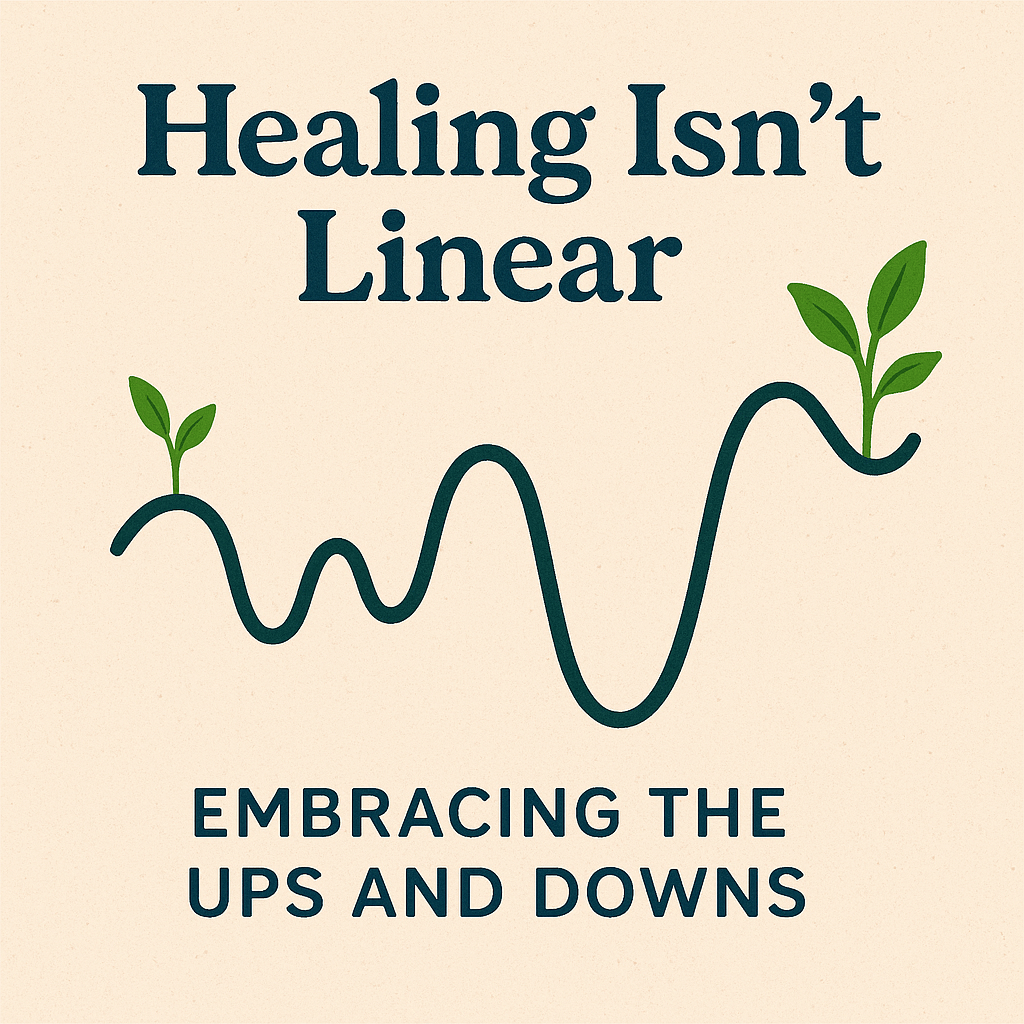
🌱 Healing Isn’t Linear: Embracing the Ups and Downs

Healing—whether emotional, mental, or physical—is not a straight path. It’s a journey filled with progress, setbacks, and moments that may feel like you’re going in circles. And that’s okay.


1. Healing Takes Time

  • Recovery doesn’t happen overnight.
  • It’s okay to take days, weeks, or even years.
  • Be patient with yourself.

2. It’s Normal to Have Good and Bad Days

  • Some days you’ll feel strong, other days you won’t.
  • Bad days don’t erase your progress.
  • Every step, even backward, is part of the journey.

3. Progress Isn’t Always Visible

  • Just because you can’t see improvement doesn’t mean it’s not happening.
  • Inner changes often take time to show on the outside.

4. Setbacks Are Not Failures

  • Falling back into old patterns is common.
  • It’s not a failure—it’s part of learning and growing.
  • Use it as a lesson, not a reason to give up.

5. Celebrate Small Wins

  • Even small steps matter—like getting out of bed, saying “no,” or smiling again.
  • Every tiny win adds up to big change.

6. Your Journey Is Unique

  • Don’t compare your healing to others.
  • Everyone heals at their own pace and in their own way.
  • What works for someone else may not work for you—and that’s okay.

7. Allow Yourself to Feel

  • Don’t hide your emotions—feel them.
  • Crying, anger, or sadness are not signs of weakness.
  • Emotions are part of processing and healing.

8. Ask for Help When You Need It

  • You don’t have to do it alone.
  • Talk to a friend, therapist, or support group.
  • Asking for help is a strength, not a weakness.

9. Be Kind to Yourself

  • Talk to yourself with love and compassion.
  • You’re doing your best, and that’s enough.
  • Replace self-criticism with encouragement.

10. Healing Is Ongoing

  • Healing doesn’t mean you’ll never feel pain again.
  • It means you learn to carry it with more strength and less fear.
  • It’s about growing through what you go through.

🌼 Final Thought:

Healing isn’t a straight line—it’s a journey of twists, turns, detours, and growth. Embrace the process, honor your progress, and trust that every step—even the tough ones—is leading you toward a stronger you.

Do One Thing Every Day That Scares You

Introduction:

  • Embrace the idea of stepping out of your comfort zone daily.
  • Facing fears can lead to personal growth and self-discovery.

1. Why Face Your Fears?

  • Build Confidence: Overcoming fears boosts self-esteem.
  • Enhance Resilience: Regularly challenging yourself makes you more adaptable to life’s uncertainties.
  • Discover New Opportunities: Fear often holds us back from opportunities for growth and success.

2. Start Small

  • Identify Minor Fears: Begin with small challenges, like speaking up in a meeting or trying a new hobby.
  • Take Baby Steps: Gradually build up to more significant challenges.

3. Daily Challenges

  • Try Something New: Whether it’s a new food, a new route to work, or a new activity, variety can break the monotony.
  • Connect with Others: Strike up a conversation with a stranger or reach out to someone you haven’t spoken to in a while.
  • Speak Up: Share your thoughts or opinions in situations where you would typically stay silent.

4. Reflect on Your Progress

  • Keep a Journal: Document your daily challenges and how you felt before and after facing them.
  • Celebrate Small Wins: Acknowledge and celebrate each victory, no matter how small.

5. Learn from Failures

  • Accept Imperfection: Understand that not every attempt will be successful, and that’s okay.
  • Analyze and Adapt: Reflect on what didn’t work and think about how you can improve next time.

6. Benefits of Facing Your Fears

  • Personal Growth: Each challenge conquered makes you stronger and more self-aware.
  • Increased Creativity: New experiences can spark creativity and innovation.
  • Better Stress Management: Regularly facing fears can reduce overall anxiety and stress levels.

7. Inspirational Examples

  • Public Speaking: Many successful people, like Warren Buffet, overcame their fear of public speaking through practice.
  • New Skills: Learning a new language or instrument can be daunting but rewarding.

8. Encouraging Quotes

  • Eleanor Roosevelt: “Do one thing every day that scares you.”
  • Nelson Mandela: “I learned that courage was not the absence of fear, but the triumph over it.”

Conclusion:

  • Embracing daily challenges can transform your life.
  • Start small, stay consistent, and watch as you grow braver and more confident over time.

Call to Action:

  • Challenge yourself today to do one thing that scares you. Share your experiences and inspire others to do the same!

Focus: The Key to Success in a Distracted World

1. Clear Goals Beat Confusion

“I may not be the smartest, but I stick with it longer.” – Albert Einstein

  • Focused folks know what they want and go after it.
  • Being clear about your goals is more important than having a million ideas.

2. Doing Trumps Overthinking

“The most successful people are regular folks with a strong focus.” – Bruce Lee

  • Instead of overthinking, focused people take action.
  • It’s better to do something, even if it’s not perfect, than to do nothing at all.

3. Small Steps Lead to Big Wins

“Success comes from doing small things well, every single day.” – Robert Collier

  • Consistent effort pays off more than occasional brilliance.
  • Doing a little bit every day adds up to big achievements over time.

4. Bouncing Back Beats Being Perfect

“It’s not about how smart you are; it’s about how tough you are.” – Mark Twain

  • Resilience is more important than talent.
  • Focused people bounce back from failures and keep going.

5. Getting Stuff Done > Seeking Approval

“Success is about making a difference, not getting praise.” – Confucius

  • Results matter more than recognition.
  • Making an impact is better than seeking approval from others.

In summary, while being super smart is cool, being focused is even better. By staying clear on goals, taking action, staying consistent, bouncing back from failures, and focusing on results, anyone can achieve amazing things. So, next time you’re tempted to chase brilliance, remember: it’s better to stay on track like a focused champ than to get lost in your own genius.

Living with Purpose: Embracing Slow Living, Minimalism, and Intentional Living

  • Introduction:
    • In our modern, fast-paced world, there’s a growing desire to slow down and live more intentionally.
    • Slow living encompasses mindfulness, simplicity, and intentionality as core principles.
  • Understanding Slow Living:
    • “The essence of life is not in the great victories and grand failures, but in the simple joys of everyday living.” – Mahatma Gandhi
    • Slow living encourages us to resist the urge to constantly rush through life and instead focus on being present and mindful in each moment.
    • It involves savoring experiences, cultivating gratitude, and prioritizing meaningful connections over material possessions or external achievements.
  • The Essence of Minimalism:
    • “Simplicity is the ultimate sophistication.” – N. R. Narayana Murthy
    • Minimalism is a lifestyle choice that advocates for intentional living with fewer material possessions and distractions.
    • By decluttering our physical and mental spaces, we create room for clarity, creativity, and peace of mind.
  • Benefits of Intentional Living:
    • “The mind is everything. What you think, you become.” – Swami Vivekananda
    • Intentional living involves aligning our actions with our values and priorities to live a more purposeful life.
    • It empowers us to make conscious choices, set meaningful goals, and cultivate habits that support our well-being and personal growth.
  • Practical Tips for Embracing Slow Living:
    • “Take rest; a field that has rested gives a bountiful crop.” – Osho
    • Prioritize self-care by incorporating practices like meditation, journaling, or spending time in nature.
    • Simplify your surroundings by decluttering your home, digital devices, and schedule to reduce overwhelm and create space for what truly matters.
    • Cultivate mindfulness by being fully present in each moment, practicing gratitude, and embracing the beauty of simplicity.
    • Set boundaries to protect your time and energy, saying no to activities or commitments that don’t align with your values or priorities.
  • Embracing slow living, minimalism, and intentional living offers a transformative path to a more fulfilling and meaningful life. By adopting these principles and practices, we can cultivate greater happiness, contentment, and inner peace amidst the chaos of modern life.