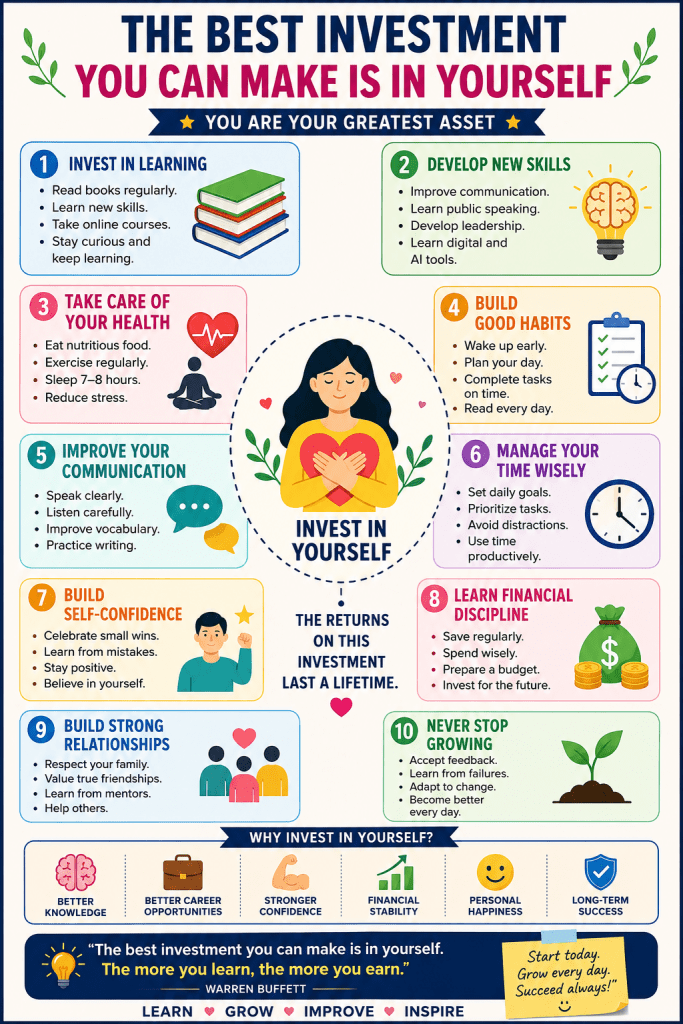
The Best Investment You Can Make Is in Yourself

“The greatest asset you will ever own is not your money—it’s you.”

Introduction

Many people dream of becoming successful, wealthy, and happy. They often invest money in land, gold, stocks, or businesses. While these are valuable investments, the best investment you can ever make is investing in yourself. When you improve your knowledge, skills, health, and character, you create opportunities that no one can take away.


1. Invest in Learning 📚

Knowledge is one of the few things that grows when you share it.

  • Read books regularly.
  • Learn new skills.
  • Attend workshops and seminars.
  • Take free online courses.
  • Stay curious and keep learning.

Simple Example:
A student who learns Excel, Power BI, or AI tools has better career opportunities than someone who only depends on classroom learning.


2. Develop New Skills 💡

Skills increase your confidence and employability.

  • Improve communication skills.
  • Learn public speaking.
  • Develop leadership qualities.
  • Improve problem-solving ability.
  • Learn digital and AI tools.

Remember:
A degree gets you an interview, but skills help you build a successful career.


3. Take Care of Your Health ❤️

Your health is your greatest wealth.

  • Eat nutritious food.
  • Exercise regularly.
  • Sleep for 7–8 hours.
  • Drink enough water.
  • Reduce stress through relaxation or meditation.

Healthy body + Healthy mind = Better performance.


4. Build Good Habits 🌱

Small daily habits create big success over time.

  • Wake up early.
  • Plan your day.
  • Complete tasks on time.
  • Read every day.
  • Avoid procrastination.

“Successful people are simply people with successful habits.”


5. Improve Your Communication 🗣️

Good communication opens many doors.

  • Speak clearly and confidently.
  • Listen carefully.
  • Improve your vocabulary.
  • Practice writing professionally.
  • Respect others’ opinions.

Communication is one of the most valuable skills in every profession.


6. Manage Your Time Wisely ⏰

Time is more valuable than money because it cannot be replaced.

  • Set daily goals.
  • Prioritize important tasks.
  • Avoid unnecessary distractions.
  • Limit excessive social media use.
  • Use your free time productively.

Every minute invested wisely brings long-term benefits.


7. Build Self-Confidence 🌟

Believe in your abilities.

  • Celebrate small achievements.
  • Learn from mistakes.
  • Stay positive.
  • Face challenges with courage.
  • Never compare yourself with others.

Confidence grows through continuous learning and practice.


8. Learn Financial Discipline 💰

Managing money wisely is an important life skill.

  • Save regularly.
  • Avoid unnecessary spending.
  • Prepare a simple budget.
  • Learn basic financial planning.
  • Invest wisely for the future.

Financial discipline provides security and peace of mind.


9. Build Strong Relationships 🤝

Success becomes more meaningful when shared with others.

  • Respect your family.
  • Value true friendships.
  • Learn from mentors.
  • Help others whenever possible.
  • Build a positive professional network.

Strong relationships create lifelong support and opportunities.


10. Never Stop Growing 🚀

Personal growth is a lifelong journey.

  • Accept feedback positively.
  • Learn from failures.
  • Adapt to change.
  • Keep improving every day.
  • Believe that every day is a new opportunity to become better.

Growth begins when you step outside your comfort zone.


Why Investing in Yourself Matters

When you invest in yourself, you gain:

  • Better knowledge
  • Stronger skills
  • Good health
  • Higher confidence
  • Better career opportunities
  • Financial stability
  • Personal happiness
  • Long-term success

These are lifelong returns that continue to grow over time.


Conclusion

Money can be lost, opportunities may come and go, but the knowledge, skills, values, and experiences you gain by investing in yourself remain with you forever. Every book you read, every new skill you learn, every healthy habit you build, and every challenge you overcome helps shape a brighter future. Start investing in yourself today because you are your greatest asset, and the returns on this investment will benefit you for a lifetime.

Remember: “Invest in yourself today, and your future self will thank you tomorrow.”

Time is the Greatest Currency

Introduction

People often believe that money is the most powerful resource, but in reality, time is the greatest currency we have. Unlike money, time cannot be saved in a bank, borrowed, or replaced. Once it’s gone, it’s gone forever. The way we spend our time shapes our happiness, relationships, and success in life.


Why Time is More Valuable than Money

  • Money can be earned, lost, and earned again, but time can never return.
  • Everyone, no matter how rich or poor, gets the same 24 hours a day.
  • Time is the foundation on which all achievements are built.

How Time Works Like Currency

  • Every day, we spend time on different activities, just like we spend money.
  • Using time on growth, learning, or meaningful relationships is like making a smart investment.
  • Wasting time on unimportant things is like losing money on a bad deal.

Using Time Wisely

  • Prioritize what truly matters: health, family, and personal growth.
  • Learn to say no to distractions and unnecessary commitments.
  • Manage time effectively by setting goals and avoiding procrastination.
  • Remember: spending quality time with loved ones creates memories that money can’t buy.

The Real Wealth

  • True wealth isn’t measured by how much money you have, but how wisely you use your time.
  • At the end of life, people don’t wish for more money—they wish for more time with the people they love.
  • Balancing work, rest, and joy makes life meaningful.

Conclusion

Time is life’s greatest currency. Use it with care, spend it on things that bring happiness and growth, and never waste it on what doesn’t matter. Once time is gone, it never comes back—so value every moment.

Nothing In Life Is Free

Introduction

In life, we often come across things that seem free—opportunities, favors, or even knowledge. But if we look closely, nothing is truly free. Behind every blessing lies someone’s effort, time, or sacrifice. Understanding this truth helps us value what we receive and inspires us to work harder for what we desire.

Key Points

  1. Every Blessing Has a Price
    • Life may offer you opportunities, knowledge, or support, but each comes with a price—hard work, patience, or sacrifice.
  2. Time Is the Greatest Currency
    • The hours you invest in learning, relationships, or dreams are far more valuable than money. Nothing grows without your time.
  3. Behind Every Gift Lies Effort
    • The love of parents, guidance of teachers, or kindness of friends may seem free, but they carry countless sacrifices and selfless efforts.
  4. Success Demands Investment
    • No shortcut, no magic formula. Success requires sweat, discipline, and resilience. What looks “free” often hides years of struggle.
  5. Gratitude Opens Your Eyes
    • When you receive something without paying, pause and reflect. Someone else has already paid the price. Respect it.
  6. Life’s Silent Rule
    • The universe whispers a simple truth: You get what you work for, not what you wish for. Nothing is truly free.

Conclusion

The truth is simple: nothing in life is free. Every achievement, every gift, and every opportunity has a cost—whether paid in time, effort, or sacrifice. When we embrace this reality, we stop taking things for granted and start valuing both our own efforts and the sacrifices of others. Success, love, and growth are never free, but they are always worth the price we pay.

Navigating Stocks: A Beginner’s Guide with Insights from Financial Icons

Introduction: Diving into the stock market may feel complex, especially for beginners. However, with guidance, even newcomers can sail these financial waters confidently. This guide breaks down stock market basics, drawing inspiration from financial legends who carved their success stories through smart investing.

Decoding the Stock Market: The stock market is where shares of companies are bought and sold. Investors aim to profit by buying stocks and hoping their value rises. Let’s demystify this world, learning from the experiences of financial icons.

1. Warren Buffett: The Wise Investor Warren Buffett, known as the “Oracle of Omaha,” earned wealth through long-term value investing. He stresses researching companies, understanding fundamentals, and holding onto investments patiently.

2. Benjamin Graham: Father of Value Investing Benjamin Graham, the pioneer, advocated for scrutinizing a stock’s intrinsic value, seeking companies with solid fundamentals, and investing with a margin of safety.

3. Peter Lynch: Common-Sense Guru Peter Lynch’s simple strategy encourages focusing on industries and companies you know well, making confident investment decisions.

4. Ray Dalio: Diversification Visionary Ray Dalio, founder of Bridgewater Associates, underscores the importance of diversification and adapting to economic conditions.

5. Jesse Livermore: Trading Legend Jesse Livermore’s life teaches lessons in risk management and emotional discipline for successful trading.

Practical Guidelines for Novices: Now, let’s simplify the practical steps for beginners:

1. Learn the Basics:

Immerse yourself in beginner-friendly resources to understand stock market fundamentals.

2. Set Clear Goals:

Define specific financial objectives, whether it’s saving for a goal or building wealth over time.

3. Create a Budget:

Assess your finances, allocate a portion for investing after covering essential expenses.

4. Diversify Investments:

Spread your investments across different stocks and sectors to minimize risk.

5. Start Small:

Begin with a modest investment to learn the ropes without significant financial exposure.

6. Stay Informed:

Regularly read news, follow market trends, and stay informed about your investments.

7. Use Online Platforms:

Explore user-friendly online platforms for easy stock trading and monitoring.

8. Seek Advice:

Consult reputable financial advisors or mentors to gain insights and guidance.

9. Monitor and Adjust:

Regularly review your portfolio, evaluate performance, and adjust your strategy as needed.

10. Embrace Long-Term Vision:

Adopt a patient approach, focusing on long-term growth rather than short-term fluctuations.

11. Stay Emotionally Resilient:

Keep emotions in check during market ups and downs, making informed decisions.

12. Learn from Mistakes:

Treat mistakes as learning opportunities, adjusting your strategy based on experience.

Conclusion: Embarking on the stock market journey as a beginner is achievable with simplified insights and practical steps. Patience, continuous learning, and a sensible approach form the pillars of a successful investing journey. As you navigate this financial landscape, let the wisdom of financial legends guide you toward making informed and confident decisions for your financial future.

50/30/20 Rule: A Blueprint for Financial Success

Introduction: In the intricate tapestry of personal finance, finding a roadmap that’s both practical and effective is crucial. Enter the 50/30/20 rule, a tried-and-true principle that simplifies budgeting and empowers individuals to take control of their financial destinies. Let’s delve into this comprehensive guide to understand the 50/30/20 rule and how it can transform your approach to managing money.

Decoding the 50/30/20 Rule: A Blueprint for Financial Success

1. Needs (50%): Nurturing Financial Stability

  • The foundation of the 50/30/20 rule lies in allocating 50% of your after-tax income to essential needs. This includes:
    • Rent or Mortgage
    • Utilities (Water, Electricity, Gas)
    • Groceries
    • Health Insurance
    • Transportation
    • Minimum Debt Payments
  • This category ensures that your fundamental requirements are met, providing stability and security.

2. Wants (30%): Balancing Enjoyment and Responsibility

  • The “Wants” category, accounting for 30% of your budget, encompasses discretionary spending that enhances your lifestyle. This includes:
    • Dining out and Entertainment
    • Subscription Services
    • Hobbies and Leisure Activities
    • Fashion and Non-essential Shopping
  • Allocating 30% to wants allows you to enjoy life without jeopardizing your financial health, striking a balance between enjoyment and responsibility.

3. Savings/Debt Repayment (20%): Building for the Future

  • The final piece of the puzzle is dedicating 20% of your income to savings and debt repayment. This includes:
    • Emergency Fund Savings
    • Retirement Contributions
    • Additional Debt Repayment
  • Devoting 20% to savings ensures you are building a financial safety net and working towards long-term goals.

Benefits of the 50/30/20 Rule: A Holistic Approach to Money Management

  1. Simplicity and Clarity:
    • The rule simplifies budgeting by offering clear categories, making it easy to understand and implement.
  2. Financial Balance:
    • It encourages a balanced approach, ensuring you cover your needs, indulge in wants, and prioritize savings and debt repayment.
  3. Flexibility:
    • The rule is adaptable to different income levels, providing a flexible framework for various financial situations.

Implementing the 50/30/20 Rule: Practical Tips for Success

  1. Track Your Spending:
    • Understand where your money is going to effectively allocate it to the 50/30/20 categories.
  2. Review and Adjust:
    • Regularly review your budget and make adjustments as needed to stay on track.
  3. Emergency Fund Priority:
    • Build and maintain an emergency fund as a top priority within the 20% savings category.

Conclusion: The 50/30/20 rule is not just a budgeting guideline; it’s a philosophy that empowers you to take charge of your financial destiny. By adhering to this rule, you can achieve financial balance, cultivate good money habits, and work towards both short-term and long-term financial goals. So, embark on this journey with the 50/30/20 rule as your compass, guiding you towards a future of financial stability and success.