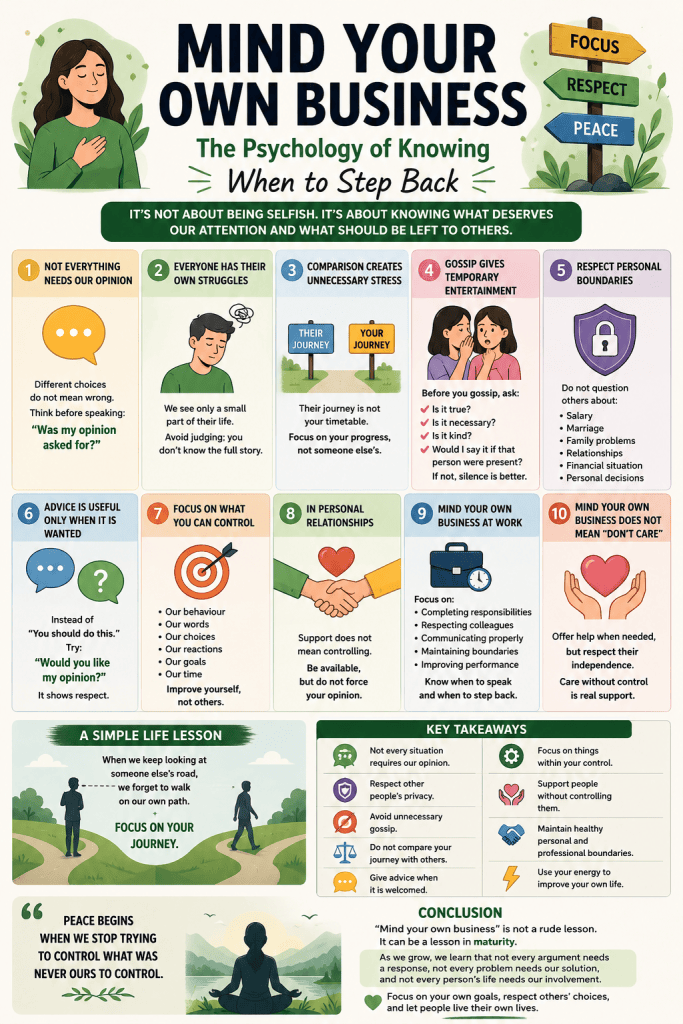
Mind Your Own Business: The Psychology of Knowing When to Step Back

In everyday life, we often become interested in other people’s choices, problems, relationships, careers, and personal matters. Sometimes we give advice because we care. But sometimes, without realizing it, we cross personal boundaries. “Mind your own business” is not about being selfish or uncaring. It is about knowing what deserves our attention and what should be left to others.

1. Not Everything Needs Our Opinion

We do not need to have an opinion about everything.

A person’s career choice, lifestyle, appearance, relationship, or personal decision may be different from ours. Different does not always mean wrong.

Think before speaking:
“Was my opinion asked for?”

2. Everyone Has Their Own Struggles

We often see only a small part of someone’s life.

A person who looks happy may be dealing with problems privately. A person who seems successful may have faced many failures before reaching that position.

Therefore, judging someone based on what we see can be unfair.

3. Comparison Creates Unnecessary Stress

Constantly watching what others are doing can make us feel that we are behind.

Someone may get a job before us.
Someone may get married earlier.
Someone may earn more.
Someone may appear more successful.

Their journey is not our timetable.

Focus on your progress instead of measuring your life against someone else’s.

4. Gossip Gives Temporary Entertainment

Talking about other people’s personal matters may feel interesting, but gossip can damage relationships and trust.

Before sharing something about another person, ask:

  • Is it true?
  • Is it necessary?
  • Is it kind?
  • Would I say it if that person were present?

If not, silence is often the better choice.

5. Respect Personal Boundaries

Everyone has a right to privacy.

We should not unnecessarily question someone about:

  • Their salary
  • Marriage
  • Family problems
  • Personal relationships
  • Financial situation
  • Personal decisions

Caring about someone does not mean having access to every part of their life.

6. Advice Is Useful Only When It Is Wanted

Good advice can help, but unwanted advice can feel like criticism.

Instead of saying:

“You should do this.”

Try:

“Would you like my opinion?”

This simple question shows respect.

7. Focus on What You Can Control

We cannot control other people’s decisions.

We can control:

  • Our behaviour
  • Our words
  • Our choices
  • Our reactions
  • Our goals
  • Our time

Life becomes easier when we spend more energy improving ourselves than correcting everyone else.

8. In Personal Relationships

Sometimes we become too involved in the lives of friends or relatives.

For example, a friend may choose to stay in a difficult relationship. We can express concern, but repeatedly forcing our opinion may push the person away.

Support does not always mean controlling. Sometimes it means being available when they need us.

9. Mind Your Own Business at Work

In the workplace, unnecessary involvement in colleagues’ personal matters can create conflict.

A professional person focuses on:

  • Completing responsibilities
  • Respecting colleagues
  • Communicating properly
  • Maintaining boundaries
  • Improving performance

Professionalism means knowing when to speak and when to step back.

10. Mind Your Own Business Does Not Mean “Don’t Care”

There is an important difference between indifference and healthy boundaries.

If someone genuinely needs help, we should offer support.

But if someone is capable of making their own decision, we should respect their independence.

Care without control is a healthy form of support.

We lose focus on our own journey.

Key Takeaways

  • Not every situation requires our opinion.
  • Respect other people’s privacy.
  • Avoid unnecessary gossip.
  • Do not compare your journey with others.
  • Give advice when it is welcomed.
  • Focus on things within your control.
  • Support people without controlling them.
  • Maintain healthy personal and professional boundaries.
  • Use your energy to improve your own life.

Conclusion

“Mind your own business” is not a rude lesson. It can be a lesson in maturity.

As we grow, we learn that not every argument needs a response, not every problem needs our solution, and not every person’s life needs our involvement.

Sometimes, the healthiest thing we can do is simply focus on our own goals, respect other people’s choices, and let people live their own lives.

“Peace begins when we stop trying to control what was never ours to control.” 🌿

Digital Burnout and Cognitive Overload

Introduction

In today’s digital world, technology has become an inseparable part of our daily lives. From work and education to communication and entertainment, screens dominate almost every moment. While digital tools improve efficiency and connectivity, excessive and continuous exposure to them puts heavy pressure on the human mind. This growing mental strain leads to digital burnout and cognitive overload, affecting focus, emotional balance, productivity, and overall well-being. Understanding this issue is essential to creating healthier digital habits and protecting mental health in the modern age.

1. What is Digital Burnout?

  • Digital burnout happens when we feel mentally tired due to excessive screen time.
  • It is caused by constant use of phones, laptops, and digital platforms.

2. What is Cognitive Overload?

  • Cognitive overload occurs when the brain receives more information than it can process.
  • Notifications, emails, messages, and multitasking overload our thinking capacity.

3. Why is it Increasing Today?

  • Continuous online work and virtual meetings
  • Social media scrolling without breaks
  • Pressure to stay available and respond instantly
  • Information overload from news and digital content

4. Common Signs and Symptoms

  • Difficulty concentrating and remembering things
  • Mental fatigue and constant tiredness
  • Irritability and mood swings
  • Headaches and sleep problems
  • Loss of motivation and productivity

5. Impact on Mental Health

  • Increased stress and anxiety
  • Reduced attention span
  • Emotional exhaustion
  • Feeling overwhelmed even with simple tasks

6. Impact on Work and Studies

  • Lower efficiency and creativity
  • Increased errors and poor decision-making
  • Reduced learning capacity
  • Declining engagement and interest

7. How Digital Burnout Affects Daily Life

  • Less face-to-face interaction
  • Reduced quality time with family
  • Constant mental distraction
  • Difficulty enjoying offline moments

8. Simple Ways to Reduce Digital Burnout

  • Take regular screen breaks
  • Limit unnecessary notifications
  • Follow single-tasking instead of multitasking
  • Set boundaries for work and personal time
  • Practice digital detox regularly

9. Role of Mindfulness and Rest

  • Short breathing exercises calm the mind
  • Adequate sleep restores cognitive capacity
  • Mindful usage of technology improves focus

10. Conclusion

  • Digital tools are helpful, but overuse harms mental well-being.
  • Managing screen time and information flow is essential for a healthy mind.
  • Balance, awareness, and conscious digital habits can prevent burnout.

Closing Quote:
“Resting the mind is not a luxury—it is a necessity in a digital world.”

🌅 Morning Routines for the Emotionally Intelligent

✨ Introduction

  • Emotionally intelligent people are self-aware, empathetic, and manage emotions wisely.
  • A strong morning routine sets the emotional tone for the entire day.

☀️ 1. Wake Up Without Rushing

  • Emotionally intelligent people give themselves time in the morning.
  • No snoozing 10 times or jumping straight into stress.
  • They wake up with intention, not panic.

🧘‍♀️ 2. Check In With Yourself First

  • They start by asking: How do I feel today?
  • Quick self-awareness check helps manage emotions early.
  • Journaling or just a 2-minute thought pause helps.

🌬 3. Deep Breathing or Meditation

  • Even 5 minutes of breathing deeply calms the mind.
  • Helps in gaining control over emotional reactions.
  • Builds emotional resilience before facing the world.

📝 4. Set a Positive Intention

  • Emotionally intelligent people don’t just plan the day, they set the mood.
  • They might say: “Today I will stay calm no matter what.”
  • This creates emotional focus and positivity.

📵 5. No Immediate Phone Use

  • They avoid social media or news first thing.
  • Emotional intelligence means choosing what enters your mind.
  • Instead, they connect with themselves before connecting with the world.

✍️ 6. Gratitude Practice

  • They list 2–3 things they’re grateful for.
  • Shifts focus from stress to contentment.
  • Gratitude rewires the brain for emotional stability.

🏃‍♂️ 7. Move the Body

  • A short walk, stretches, or workout boosts mood.
  • Physical movement releases endorphins – feel-good hormones.
  • Emotionally intelligent people know body and mind are connected.

🍵 8. Mindful Breakfast

  • No multitasking — they eat with attention and care.
  • Emotionally intelligent people honor their body with nutrition and presence.
  • A peaceful meal reduces cortisol (stress hormone).

💡 9. Review the Day with Clarity

  • They mentally walk through their day.
  • Prioritize key tasks and potential emotional triggers.
  • This pre-planning helps avoid emotional overwhelm later.

🌟 Conclusion

  • A calm, centered morning is the secret behind emotionally intelligent behavior.
  • You don’t need hours — just a few mindful habits done daily.
  • “Win the morning, win the day.” — Start with emotional awareness, and the rest will follow.

🌟 Focus Only on You: A Guide to Self-Growth & Inner Peace 🌟

  1. You Are Your First Priority
    • Stop trying to please everyone.
    • Your peace, health, and happiness matter most.
  2. Comparison Steals Joy
    • Everyone has their own timeline.
    • Focus on your path, not someone else’s.
  3. Protect Your Energy
    • Not every fight is worth your time.
    • Walk away from negativity and drama.
  4. Set Boundaries Without Guilt
    • Saying “no” is an act of self-respect.
    • People who care will understand.
  5. Celebrate Small Wins
    • Growth is not always loud or fast.
    • Progress is progress, no matter how small.
  6. Silence the Noise
    • Disconnect from social media often.
    • Give your mind the space to breathe.
  7. Listen to Your Inner Voice
    • Your intuition is your best guide.
    • Trust yourself more than outside opinions.
  8. Invest in Yourself
    • Read, rest, learn, travel, heal.
    • The more you grow, the better your life becomes.
  9. Let Go of What You Can’t Control
    • Focus only on your actions and reactions.
    • Leave the rest to life or the divine.
  10. Be Patient With Yourself
  • Healing and growth take time.
  • Don’t rush your journey—respect it.

💬 Final Thought:
When you truly focus on you, life becomes simpler, clearer, and more fulfilling. The best version of your life starts with the best version of you.

🔍 How to Focus and Avoid Distractions

Distractions are everywhere, from buzzing phones to random thoughts. Here’s how to stay focused and productive:


✅ 1. Set Clear Goals

  • Know what you need to achieve.
  • Break big tasks into smaller, manageable steps.
  • Write down your to-do list daily.

✅ 2. Create a Distraction-Free Zone

  • Turn off notifications.
  • Keep your phone out of reach.
  • Use noise-canceling headphones or calming background music.

✅ 3. Use Time Blocks

  • Try the Pomodoro Technique (25 mins work, 5 mins break).
  • Schedule breaks to avoid burnout.
  • Focus on one task per block.

✅ 4. Declutter Your Workspace

  • Keep only the essentials on your desk.
  • A clean space helps you think clearly.
  • Organize digitally too — clear your desktop!

✅ 5. Avoid Multitasking

  • Focus on one thing at a time.
  • Multitasking reduces accuracy and slows you down.

✅ 6. Train Your Brain

  • Practice mindfulness or meditation.
  • Try brain games or puzzles to improve attention span.

✅ 7. Get Enough Sleep

  • Poor sleep = poor focus.
  • Aim for 7–8 hours of quality rest each night.

✅ 8. Fuel Your Body

  • Stay hydrated.
  • Eat brain-friendly snacks like nuts, fruits, and dark chocolate.

✅ 9. Review and Reflect

  • At the end of the day, review what you did.
  • Celebrate progress and adjust goals if needed.

Becoming Your Own Role Model: Why It Starts with You

We all look up to someone — a celebrity, a teacher, a parent, or a leader. But what if you could become the person you admire the most? Here’s why and how becoming your own role model is powerful:


🔹 1. You Know Yourself Best

  • You understand your strengths and struggles.
  • You know your journey, your efforts, and your pain.
  • Others may inspire you, but they haven’t walked in your shoes.

🔹 2. External Role Models Can Disappoint

  • People are human — they make mistakes.
  • Depending too much on others for motivation can be risky.
  • When you become your own role model, you control the standard.

🔹 3. You Become Accountable

  • You stop blaming others and take ownership of your growth.
  • You start asking: What would the best version of me do?
  • This mindset keeps you grounded and focused.

🔹 4. It Builds Self-Respect and Confidence

  • Every time you show up for yourself, your belief grows.
  • You realize you don’t need outside validation to feel worthy.
  • Confidence isn’t given — it’s built.

🔹 5. You Set the Standard for Others

  • When you lead yourself well, others notice.
  • You inspire friends, siblings, and even strangers without trying.
  • True leadership begins with self-leadership.

🔹 6. Progress Over Perfection

  • You don’t need to be perfect to be your own role model.
  • Keep learning, keep improving — that’s what matters.
  • Growth is what makes you admirable.

Simple Ways to Start

  • Set small goals and stick to them.
  • Talk kindly to yourself.
  • Celebrate progress, no matter how small.
  • Reflect often: Am I becoming the person I’d look up to?

💡 Final Thought:

You don’t need to chase someone else’s path. Build your own. Be someone you’d be proud to look up to — because it truly starts with you.

How to Stay Strong When Life Gets Tough

Mental toughness is the ability to stay strong, focused, and calm—even when life gets difficult. It doesn’t mean you’re emotionless, but that you don’t give up easily. Here’s how you can build it step by step:


1. Start Your Day with Purpose

  • Wake up with a plan or goal in mind.
  • Avoid immediately checking your phone.
  • Take 5 minutes to reflect or set your intention for the day.

2. Do Difficult Things First

  • Tackle your most challenging task early.
  • This builds confidence and discipline.
  • It also reduces stress for the rest of the day.

3. Practice Self-Control

  • Learn to say “no” when needed.
  • Avoid emotional outbursts—pause and breathe.
  • Respond, don’t react.

4. Accept What You Can’t Control

  • Don’t waste energy on things outside your control (like traffic or other people’s opinions).
  • Focus on your actions and attitude.

5. Stay Positive, But Realistic

  • Positive thinking helps—but don’t ignore problems.
  • Learn to say: “This is hard, but I can handle it.”

6. Learn from Mistakes

  • Don’t fear failure; use it as a teacher.
  • Ask yourself: What can I learn from this?
  • Keep moving forward, even after a setback.

7. Keep Promises to Yourself

  • Do what you say you’ll do, even when it’s hard.
  • This builds self-respect and inner strength.

8. Take Care of Your Body

  • Eat well, sleep enough, and exercise regularly.
  • A strong body supports a strong mind.

9. Surround Yourself with Positive People

  • Be around those who uplift and challenge you.
  • Limit time with negative or toxic influences.

10. Practice Gratitude Daily

  • Write down 3 things you’re thankful for.
  • Gratitude builds resilience and peace of mind.

Final Thought:

Mental toughness isn’t about being perfect—it’s about staying steady during ups and downs. Build it slowly, one small action at a time. Over time, you’ll notice you’re stronger, calmer, and more confident in whatever life throws at you.

Not Everything Is in Our Control: Learning to Let Go

Life doesn’t always go the way we plan. Sometimes, no matter how hard we try, things happen beyond our control. Learning to accept this truth can bring peace and strength.


1. Plans May Change — And That’s Okay

  • We may plan every detail, but life often surprises us.
  • Flexibility helps us handle sudden changes better.

2. We Can’t Control Other People

  • We can’t control how others think, feel, or act.
  • What we can control is our own response to them.

3. Unexpected Problems Will Arise

  • Health issues, weather changes, job losses—some things happen without warning.
  • Worrying doesn’t prevent problems; calm thinking helps us face them.

4. Letting Go Reduces Stress

  • Trying to control everything only makes us anxious.
  • Letting go gives us mental freedom and inner peace.

5. Focus on What You Can Control

  • Your attitude, choices, words, and actions are always in your hands.
  • Shifting focus here builds confidence and clarity.

6. Mistakes Happen – Learn, Don’t Blame

  • Blaming yourself for everything that goes wrong is unfair.
  • Learn the lesson, then move forward with kindness toward yourself.

7. Life Isn’t Always Fair

  • Not all efforts give the result we expect.
  • But showing up with honesty and effort still builds strength of character.

8. Accepting Uncertainty Brings Freedom

  • Life is uncertain, but that’s also what makes it interesting.
  • Accepting the unknown helps you live in the present.

9. Trust the Process

  • Sometimes delays or detours lead to better outcomes.
  • Have faith that things unfold for a reason, even if you don’t see it yet.

10. Peace Comes from Within

  • Control doesn’t create peace—acceptance does.
  • True peace comes when we stop fighting what we cannot change.

Final Thought:

You don’t have to control everything. You just need to manage your mindset, do your best, and let life flow. The rest will take care of itself.

Deep Work vs. Multitasking: What’s More Effective?

In today’s fast-paced world, everyone wants to get more done in less time. But should you focus on one task at a time or juggle multiple things at once? Let’s explore the difference between deep work and multitasking to see which one is more effective.

What is Deep Work?

Deep work is when you focus entirely on one task without distractions. It requires complete concentration and helps you produce high-quality results. When you engage in deep work, you enter a state of flow where you can solve complex problems, think creatively, and complete work efficiently.

Benefits of Deep Work:

  • Better Quality – Since you are fully focused, your work is more accurate and detailed.
  • Increased Productivity – You finish tasks faster because you are not switching between different activities.
  • Stronger Memory and Learning – Focusing deeply improves your ability to learn and retain information.
  • More Creativity – Your brain has more space to think deeply and come up with new ideas.

What is Multitasking?

Multitasking means doing multiple tasks at the same time. It sounds like a great way to be more productive, but in reality, it divides your attention and makes it harder to concentrate.

Why Multitasking Doesn’t Work Well:

  • Lower Quality of Work – You make more mistakes because your brain is constantly switching between tasks.
  • Slower Progress – It takes longer to complete each task when your attention is divided.
  • Higher Stress Levels – Your brain has to work harder, leading to mental fatigue and stress.
  • Reduced Focus and Memory – Constantly shifting attention weakens your ability to remember information.

Which is More Effective?

Research shows that deep work is far more effective than multitasking. When you focus on one thing at a time, you get better results, complete tasks faster, and feel more satisfied with your work. On the other hand, multitasking reduces efficiency and increases stress.

How to Develop Deep Work Habits:

  1. Set Specific Time Blocks – Dedicate fixed hours to deep work without interruptions.
  2. Eliminate Distractions – Turn off notifications, close unnecessary tabs, and find a quiet place to work.
  3. Use the Pomodoro Technique – Work for 25-50 minutes, take a short break, and repeat.
  4. Train Your Focus – Start with short deep work sessions and gradually increase the time.
  5. Prioritize Important Tasks – Identify tasks that need deep concentration and schedule them first.

Conclusion

While multitasking may seem productive, it actually slows you down and lowers the quality of your work. Deep work, on the other hand, helps you stay focused, creative, and efficient. By practicing deep work, you can achieve better results and make the most of your time. So, next time you work, choose focus over multitasking, and see the difference!

Do you practice deep work or multitasking? Share your experience in the comments!

Embracing Change: Overcoming Fear and Thriving in Uncertainty

Why Do We Struggle with Change?

  1. Fear of the Unknown
    • Stepping into the unfamiliar creates anxiety and fear.
    • Humans tend to resist situations they cannot predict or control.
  2. Comfort Zone Attachment
    • We prefer routines that feel safe and predictable.
    • Change threatens our established comfort and forces adaptation.
  3. Emotional Resistance
    • Change often involves loss (habits, people, roles).
    • Emotional ties to the past make it harder to let go.
  4. Cognitive Bias
    • “Status quo bias” makes us prefer what we already know.
    • Overestimating risks while underestimating benefits adds to hesitation.
  5. Fear of Failure
    • Concerns about not succeeding in a new environment or role can paralyze action.
    • Self-doubt amplifies resistance to change.

How to Embrace Change Effectively

  1. Acknowledge the Discomfort
    • Understand that resistance is a natural reaction.
    • Accept your feelings without judgment.
  2. Shift Your Perspective
    • View change as an opportunity for growth rather than a threat.
    • Focus on potential benefits and new experiences.
  3. Break It Down
    • Tackle change in smaller, manageable steps.
    • Celebrate progress to build momentum.
  4. Reframe Fear as Excitement
    • Recognize that fear and excitement can feel similar.
    • Shift your mindset to focus on positive anticipation.
  5. Practice Self-Compassion
    • Be kind to yourself during the adjustment period.
    • Remember, it’s okay to struggle while adapting.
  6. Stay Curious and Open
    • Approach change with a mindset of learning.
    • Ask, “What can this teach me?” rather than resisting outright.
  7. Seek Support
    • Share your feelings with friends, family, or mentors.
    • Community and guidance can ease the transition.
  8. Visualize Success
    • Imagine yourself thriving in the new scenario.
    • Positive visualization helps reduce anxiety and motivates action.
  9. Build Resilience
    • Use challenges as an opportunity to strengthen adaptability.
    • Regularly step out of your comfort zone in small ways to prepare for bigger changes.
  10. Focus on What You Can Control
    • Identify aspects of the change you can influence.
    • Taking action where possible reduces helplessness.

Conclusion

Change is inevitable, and while it may be uncomfortable, it is also essential for growth and progress. By understanding why we resist it and adopting strategies to embrace it, we can navigate life’s transitions with confidence and optimism.