
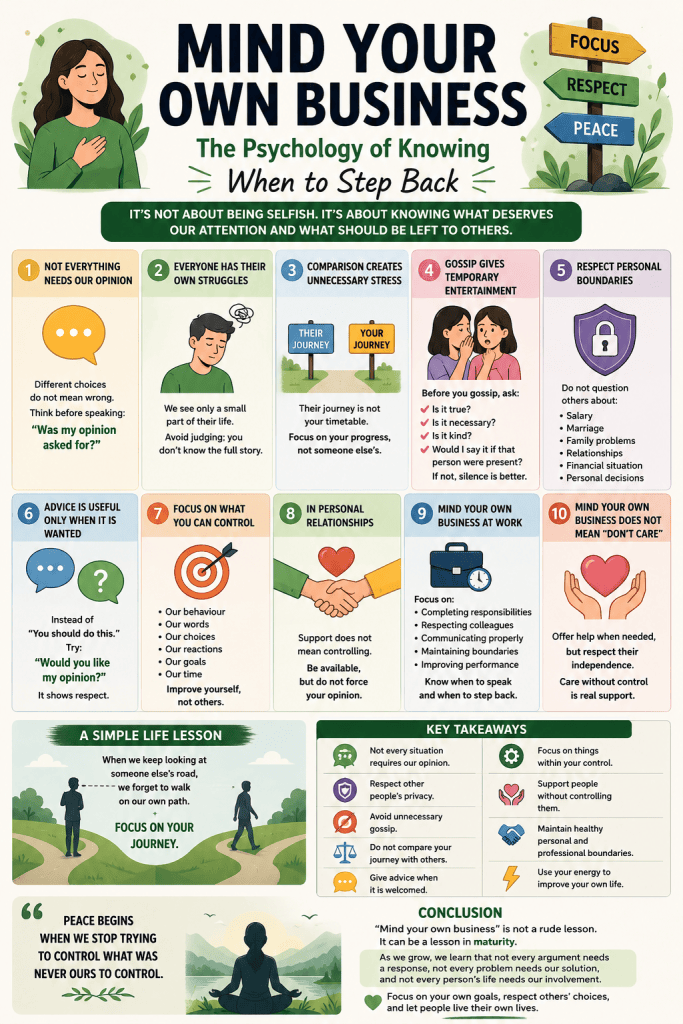
In everyday life, we often become interested in other people’s choices, problems, relationships, careers, and personal matters. Sometimes we give advice because we care. But sometimes, without realizing it, we cross personal boundaries. “Mind your own business” is not about being selfish or uncaring. It is about knowing what deserves our attention and what should be left to others.
1. Not Everything Needs Our Opinion
We do not need to have an opinion about everything.
A person’s career choice, lifestyle, appearance, relationship, or personal decision may be different from ours. Different does not always mean wrong.
Think before speaking:
“Was my opinion asked for?”
2. Everyone Has Their Own Struggles
We often see only a small part of someone’s life.
A person who looks happy may be dealing with problems privately. A person who seems successful may have faced many failures before reaching that position.
Therefore, judging someone based on what we see can be unfair.
3. Comparison Creates Unnecessary Stress
Constantly watching what others are doing can make us feel that we are behind.
Someone may get a job before us.
Someone may get married earlier.
Someone may earn more.
Someone may appear more successful.
Their journey is not our timetable.
Focus on your progress instead of measuring your life against someone else’s.
4. Gossip Gives Temporary Entertainment
Talking about other people’s personal matters may feel interesting, but gossip can damage relationships and trust.
Before sharing something about another person, ask:
- Is it true?
- Is it necessary?
- Is it kind?
- Would I say it if that person were present?
If not, silence is often the better choice.
5. Respect Personal Boundaries
Everyone has a right to privacy.
We should not unnecessarily question someone about:
- Their salary
- Marriage
- Family problems
- Personal relationships
- Financial situation
- Personal decisions
Caring about someone does not mean having access to every part of their life.
6. Advice Is Useful Only When It Is Wanted
Good advice can help, but unwanted advice can feel like criticism.
Instead of saying:
“You should do this.”
Try:
“Would you like my opinion?”
This simple question shows respect.
7. Focus on What You Can Control
We cannot control other people’s decisions.
We can control:
- Our behaviour
- Our words
- Our choices
- Our reactions
- Our goals
- Our time
Life becomes easier when we spend more energy improving ourselves than correcting everyone else.
8. In Personal Relationships
Sometimes we become too involved in the lives of friends or relatives.
For example, a friend may choose to stay in a difficult relationship. We can express concern, but repeatedly forcing our opinion may push the person away.
Support does not always mean controlling. Sometimes it means being available when they need us.
9. Mind Your Own Business at Work
In the workplace, unnecessary involvement in colleagues’ personal matters can create conflict.
A professional person focuses on:
- Completing responsibilities
- Respecting colleagues
- Communicating properly
- Maintaining boundaries
- Improving performance
Professionalism means knowing when to speak and when to step back.
10. Mind Your Own Business Does Not Mean “Don’t Care”
There is an important difference between indifference and healthy boundaries.
If someone genuinely needs help, we should offer support.
But if someone is capable of making their own decision, we should respect their independence.
Care without control is a healthy form of support.
We lose focus on our own journey.
Key Takeaways
- Not every situation requires our opinion.
- Respect other people’s privacy.
- Avoid unnecessary gossip.
- Do not compare your journey with others.
- Give advice when it is welcomed.
- Focus on things within your control.
- Support people without controlling them.
- Maintain healthy personal and professional boundaries.
- Use your energy to improve your own life.
Conclusion
“Mind your own business” is not a rude lesson. It can be a lesson in maturity.
As we grow, we learn that not every argument needs a response, not every problem needs our solution, and not every person’s life needs our involvement.
Sometimes, the healthiest thing we can do is simply focus on our own goals, respect other people’s choices, and let people live their own lives.
“Peace begins when we stop trying to control what was never ours to control.” 🌿


 Pioneer Edge