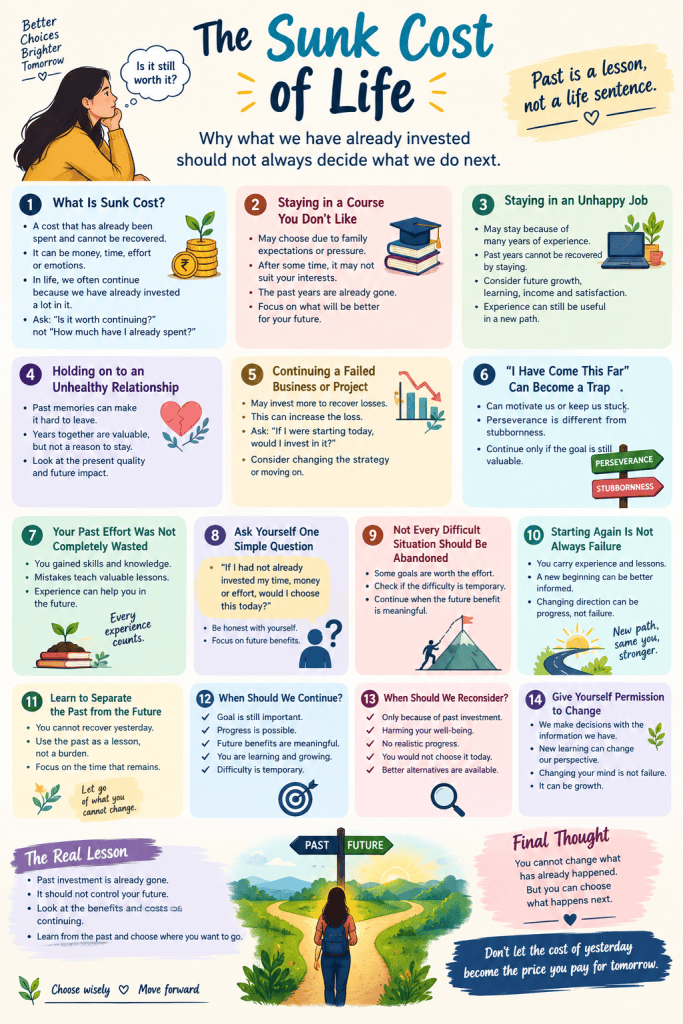
The Sunk Cost of Life

Why what we have already invested should not always decide what we do next

1. What Is Sunk Cost?

  • Sunk cost means a cost that has already been spent and cannot be recovered.
  • It may be money, time, effort or emotional energy.
  • In economics, sunk costs should not influence future decisions.
  • In life, we often continue something simply because we have already invested a lot in it.
  • The important question is not “How much have I already spent?”, but “Is it worth continuing?”

2. Staying in a Course You Don’t Like

  • A student may choose a course because of family expectations or personal circumstances.
  • After some time, she may realise that the course does not match her interests.
  • She may think, “I have already spent two years, so I cannot change.”
  • But the two years have already passed.
  • The better question is: “What will be the best choice for my future?”
  • Changing direction does not mean that the previous years were completely wasted.

3. Staying in an Unhappy Job

  • Some people remain in an uncomfortable job because they have worked there for many years.
  • They may feel that leaving means wasting their previous experience.
  • But past years cannot be recovered by staying in the same situation.
  • Consider future salary, growth, learning opportunities and job satisfaction.
  • Experience gained from the old job can still be useful in a new career.
  • Sometimes moving forward requires accepting that a change is necessary.

4. Holding on to an Unhealthy Relationship

  • People may stay in difficult relationships because of the years they have already invested.
  • They may think, “We have been together for so long.”
  • Shared memories and emotions can make decisions difficult.
  • However, past time should not automatically determine the future.
  • Consider the present quality of the relationship and its impact on both people.
  • A meaningful past can be respected without being forced to continue forever.

5. Continuing a Failed Business or Project

  • An entrepreneur may continue investing money in a business that is not performing well.
  • The reason may be: “I have already invested so much.”
  • Continuing to invest only to recover previous losses can make the situation worse.
  • Analyse the future potential of the business objectively.
  • Ask: “If I were starting this today, would I invest in it?”
  • Sometimes changing the strategy or stopping the project is the wiser decision.

6. “I Have Come This Far” Can Become a Trap

  • “I have come this far” can sometimes motivate us.
  • But it can also prevent us from making a necessary change.
  • Perseverance means continuing because the goal is still valuable.
  • Sunk-cost thinking means continuing mainly because of past investment.
  • Difficult does not always mean wrong.
  • But continuing something only because of the past may not be a wise decision.

7. Your Past Effort Was Not Completely Wasted

  • Leaving something does not mean that everything you did was useless.
  • Every experience can provide knowledge.
  • Mistakes can teach valuable lessons.
  • Difficult situations can develop patience and confidence.
  • A failed business can teach you what not to do next time.
  • A difficult job can give you skills that are useful elsewhere.
  • The experience remains, even when the original plan changes.

8. Ask Yourself One Simple Question

When you feel stuck, ask:

“If I were starting today, would I choose this again?”

  • If the answer is yes, continuing may be worthwhile.
  • If the answer is no, understand why.
  • Think about future benefits rather than only past investment.
  • Separate your current decision from your previous decision.
  • This simple question can help you make a more objective choice.

9. Not Every Difficult Situation Should Be Abandoned

  • Sunk-cost thinking should not become an excuse for quitting everything.
  • Some valuable goals require time and patience.
  • Education, career development and business growth may involve temporary difficulties.
  • Ask whether the difficulty is temporary or permanent.
  • Consider whether meaningful progress is still possible.
  • Continue when the future benefit is worth the effort.

10. Starting Again Is Not Always Failure

  • Changing direction can feel like starting from zero.
  • But you are not actually starting from zero.
  • You already have experience, knowledge and lessons from the past.
  • A new beginning can be based on better understanding.
  • Changing your decision after learning new information can be a sign of maturity.
  • Starting again can sometimes be a smarter form of moving forward.

11. Learn to Separate the Past from the Future

  • We cannot change yesterday.
  • We cannot recover every hour, rupee or opportunity we have already spent.
  • But we can decide how to use our future.
  • Past mistakes should become lessons, not permanent burdens.
  • Do not spend more of your future simply to justify a past decision.
  • Focus on the choices that can improve your present and future.

12. When Should We Continue?

Continue when:

  • The goal is still important to you.
  • Progress is possible.
  • The future benefits are meaningful.
  • You are learning and improving.
  • The difficulties are temporary.
  • The effort is still reasonable compared with the expected result.

13. When Should We Reconsider?

Reconsider when:

  • You are continuing only because of your past investment.
  • The situation is repeatedly harming you.
  • There is no realistic progress.
  • You would not choose the same path if you were starting today.
  • Better alternatives are available.
  • Fear of change is the main reason you are staying.

14. Give Yourself Permission to Change

  • We make decisions based on the information available at that time.
  • New experiences can change our understanding.
  • A decision that was right five years ago may not be right today.
  • Changing your mind does not always mean you failed.
  • It can mean that you have learned something new.
  • Growth sometimes requires changing direction.

15. The Real Lesson of Sunk Cost

  • Past investment is already gone.
  • It should not automatically determine future choices.
  • Look at the expected benefits and costs of continuing.
  • Learn from the past without becoming trapped by it.
  • Make decisions based on where you want to go, not only on where you have been.
  • Your future deserves a fresh evaluation.

🌱 Final Thought

  • You cannot change the time you have already spent.
  • You cannot recover every failed opportunity.
  • But you can decide what you do with your remaining time.
  • You can change your course.
  • You can try again.
  • You can choose differently.

Your past is a lesson, not a life sentence.

“Don’t let the cost of yesterday become the price you pay for tomorrow.”

Trust the Process: Finding Strength in the Journey

Trusting the process means having faith in the journey, even when the outcome isn’t immediately clear. It’s about believing that every step has a purpose and that growth comes with time.

1. Understand the Concept

  • Trusting the process is about patience and perseverance.
  • It acknowledges that progress isn’t always linear but is still meaningful.

2. Focus on the Present

  • Concentrate on the steps you can take today rather than worrying about the future.
  • Mindfulness can help you stay grounded in the moment.

3. Set Small, Achievable Goals

  • Break your journey into smaller milestones.
  • Celebrate small wins to stay motivated and positive.

4. Let Go of Perfection

  • Accept that mistakes are part of the process.
  • View setbacks as learning opportunities rather than failures.

5. Trust in Your Efforts

  • Believe that consistent action will lead to results over time.
  • Remind yourself that hard work pays off, even if it’s not immediately visible.

6. Seek Inspiration

  • Learn from stories of others who succeeded by trusting the process.
  • Their journeys can remind you that patience leads to rewards.

7. Be Open to Growth

  • Recognize that challenges and changes help you grow stronger and wiser.
  • Embrace the lessons that come along the way.

8. Practice Patience

  • Understand that good things take time.
  • Resist the urge to rush the outcome and trust that it will happen at the right time.

9. Stay Positive

  • Surround yourself with encouraging people, books, and content.
  • Focus on the progress you’ve made instead of dwelling on what’s left to achieve.

10. Believe in the Bigger Picture

  • Trust that everything is working together for your good, even if it’s not apparent now.
  • Have faith in the process, knowing that it’s leading you to where you’re meant to be.

11. Keep Moving Forward

  • Take consistent action, no matter how small.
  • Progress, even at a slow pace, is still progress.

12. Reflect and Adjust

  • Regularly reflect on your journey to appreciate how far you’ve come.
  • Be open to adjusting your approach while staying committed to your goals.

Trusting the process requires patience, effort, and faith. By adopting this mindset, you can navigate life’s challenges with resilience and confidence, knowing that every step contributes to your growth and success.

Make It or Break It: Achieve It or Accept It

  1. What Does “Make It or Break It” Mean?
    • A mindset where you either succeed through effort or face the consequences of failure.
    • Encourages determination and perseverance in high-stakes situations.
  2. The Drive to “Make It”
    • Success comes from pushing past challenges.
    • Focus on solutions, learning from mistakes, and adapting to reach your goals.
  3. The Concept of “Achieve It or Accept It”
    • After giving your best, sometimes outcomes are beyond your control.
    • Learn to either achieve your goals or accept the situation gracefully.
  4. Why Acceptance is Important
    • Acceptance is not giving up; it’s understanding when to let go.
    • Helps shift focus to new opportunities or better approaches.
  5. Balancing the Two Mindsets
    • Use “Make It or Break It” to strive for success.
    • Apply “Achieve It or Accept It” to stay resilient when things don’t go as planned.
  6. Lessons for Life
    • Life isn’t always about winning; it’s about learning and growing.
    • Failure is a stepping stone, and acceptance leads to new possibilities.

Conclusion

  • Combine determination and acceptance for a balanced approach to challenges.
  • Strive for success, but know when to adapt and move forward.
  • Life’s journey is about persistence, resilience, and learning from every experience.

Consistency and Perseverance: Keys to Success

Success is not always about talent or luck; it’s about staying committed to your goals, even when things get tough. Two key qualities that play a significant role in achieving success are consistency and perseverance. Here’s why they matter:

1. What is Consistency?

  • Consistency means doing something regularly and reliably, without getting distracted.
  • It’s about showing up every day and putting in the effort, whether you feel motivated or not.

2. What is Perseverance?

  • Perseverance is the ability to keep going despite challenges, setbacks, or failures.
  • It’s about not giving up when things get difficult and continuing to work toward your goal with determination.

3. Why Are They Important?

  • Consistency builds habits. Small, repeated actions over time lead to bigger results.
  • Perseverance helps you overcome obstacles. It gives you the strength to push through even when success seems far away.

4. How Do They Work Together?

  • Consistency and perseverance go hand in hand. While consistency keeps you on track, perseverance helps you bounce back when faced with difficulties.
  • If you are consistent, your efforts compound over time. If you persevere, you keep going until you reach your goal, regardless of the hurdles.

5. Examples in Everyday Life:

  • Learning a new skill: Whether it’s playing a musical instrument or learning a new language, consistent practice combined with perseverance is the secret to mastering it.
  • Fitness journey: Results are often seen through consistent workouts and perseverance, especially when progress is slow.
  • Starting a business: Entrepreneurs who stay consistent in their efforts and persevere through challenges tend to succeed in the long run.

6. How to Cultivate Consistency and Perseverance?

  • Set small, achievable goals: Breaking down your goal into manageable tasks can help you stay consistent.
  • Track your progress: Keep a record of your achievements, no matter how small. This will keep you motivated.
  • Stay patient: Results take time. Trust the process and keep going, even when immediate outcomes are not visible.
  • Surround yourself with support: Find people who encourage your growth and help you stay on track.

7. Final Thoughts:

  • Achieving anything worthwhile requires consistent effort and the willingness to keep going, even when things get tough.
  • Remember, success is not about doing everything perfectly, but about consistently showing up and persevering, no matter the obstacles.

By embracing consistency and perseverance, you can transform your dreams into reality and achieve long-term success.

Why Facing Challenges Makes Us Stronger

Introduction: Life is full of ups and downs, and we all experience struggles at some point. Whether it’s personal, professional, or emotional, these challenges can be difficult to face. However, struggles play a crucial role in shaping who we are and building our character. While we may want to avoid them, it is often through overcoming challenges that we grow stronger, wiser, and more resilient.

1. Strengthens Resilience:

  • Struggles teach us to bounce back from failures and setbacks. The more we face challenges, the stronger our ability to keep going despite difficulties.
  • Example: Every time we get through a tough situation, we become more confident in our ability to handle future challenges.

2. Develops Patience:

  • Struggle often requires time to overcome. During this process, we learn to be patient and trust that things will improve with effort and persistence.
  • Example: Working through a difficult project or overcoming a personal setback teaches us the value of waiting for positive outcomes.

3. Enhances Problem-Solving Skills:

  • Facing struggles forces us to think creatively and find solutions. It sharpens our ability to look at problems from different perspectives and come up with effective strategies.
  • Example: When you face obstacles, you learn to brainstorm alternatives and think outside the box to solve problems.

4. Builds Confidence:

  • Overcoming challenges boosts self-esteem. Each struggle we conquer reminds us of our capabilities and strengthens our belief in ourselves.
  • Example: Achieving a goal after hard work or getting through a difficult time makes us more confident in handling future challenges.

5. Encourages Self-Reflection:

  • Struggles often lead to personal growth by making us reflect on our strengths and weaknesses. Through self-reflection, we gain better self-awareness and understanding.
  • Example: After facing a tough time, we often take a step back and think about what we’ve learned about ourselves.

6. Cultivates Empathy and Compassion:

  • Going through struggles helps us understand the challenges others may face. This makes us more empathetic and compassionate towards others who are going through hard times.
  • Example: People who have faced financial struggles or health issues are often more understanding and supportive of others in similar situations.

7. Strengthens Mental Toughness:

  • Struggles build mental toughness, teaching us to stay calm under pressure and keep our emotions in check when things get difficult.
  • Example: Athletes, soldiers, and entrepreneurs all develop mental toughness by pushing through their struggles and staying focused on their goals.

8. Fuels Personal Growth:

  • Every challenge we face is an opportunity to grow. Struggles push us to step out of our comfort zones, learn new things, and develop as individuals.
  • Example: A difficult job, a failed relationship, or any setback can make us more mature and capable.

9. Teaches Gratitude:

  • Struggles help us appreciate the good things in life. Once we’ve been through tough times, we tend to be more grateful for the positive moments and the progress we’ve made.
  • Example: After overcoming illness or financial hardship, we appreciate our health and stability even more.

10. Builds Perseverance:

  • Struggles teach us not to give up. The more we persevere through difficulties, the more we learn to keep going, even when success seems far away.
  • Example: Inventors, scientists, and successful entrepreneurs often face repeated failures before they succeed, but their perseverance keeps them moving forward.

Conclusion:

Struggles are a necessary part of life, shaping who we are and helping us grow. Instead of fearing challenges, we should embrace them as opportunities to build character, strength, and resilience. Through struggle, we discover our true potential.

The Only Way to Do Great Work is to Love What You Do

Steve Jobs once said, “The only way to do great work is to love what you do.” This profound statement underscores the importance of passion in achieving excellence. When you genuinely love what you do, work ceases to be a mere obligation and transforms into a source of fulfillment and joy.

  1. Passion Fuels Excellence
    • Intrinsic Motivation: When you love what you do, you are naturally motivated to put in the effort and strive for greatness.
    • Quality Over Quantity: Passion drives you to focus on the quality of your work, aiming for perfection and innovation.
  2. Resilience and Perseverance
    • Overcoming Challenges: Loving your work helps you persevere through challenges and setbacks.
    • Quote: “Success is not the key to happiness. Happiness is the key to success. If you love what you are doing, you will be successful.” – Albert Schweitzer
  3. Creativity and Innovation
    • Thinking Outside the Box: Passionate individuals are more likely to think creatively and come up with innovative solutions.
    • Quote: “Do what you love, and the necessary resources will follow.” – Peter McWilliams
  4. Fulfillment and Satisfaction
    • Personal Happiness: Loving your work contributes to overall happiness and satisfaction in life.
    • Meaningful Work: When you enjoy what you do, your work becomes meaningful and fulfilling.
  5. Inspiration and Influence
    • Inspiring Others: Passionate work inspires and influences others around you, creating a positive impact.
    • Leadership: Leaders who love their work inspire their teams to strive for excellence.
  6. Continual Improvement
    • Lifelong Learning: Passion drives you to continuously learn and improve in your field.
    • Quote: “Choose a job you love, and you will never have to work a day in your life.” – Confucius

How to Find and Cultivate Your Passion

  1. Self-Reflection
    • Identify what you enjoy and what makes you feel fulfilled.
    • Consider your hobbies, interests, and what you are naturally good at.
  2. Experimentation
    • Try different roles and projects to discover what you truly enjoy.
    • Don’t be afraid to step out of your comfort zone and explore new opportunities.
  3. Set Goals
    • Define clear, achievable goals that align with your passions.
    • Regularly review and adjust your goals to stay aligned with your evolving interests.
  4. Seek Inspiration
    • Surround yourself with passionate and motivated individuals.
    • Learn from mentors and role models who love what they do.
  5. Balance and Well-being
    • Ensure a healthy work-life balance to maintain your passion.
    • Take care of your physical and mental well-being to stay motivated and energized.

Conclusion

Loving what you do is not just a luxury; it is a necessity for achieving greatness. Passion fuels your motivation, creativity, and resilience, leading to excellence in your work. By finding and cultivating your passion, you can transform your career into a source of joy and fulfillment. Embrace the journey of discovering what you love, and let it drive you to reach new heights in your personal and professional life. Remember, the only way to do great work is to love what you do.

Today’s Common People are Tomorrow’s Achievers: Embracing Potential and Dreams

Success stories often begin with ordinary people who dared to dream big. Their journeys from humble beginnings to great achievements show that greatness is within reach for everyone. Here are some key points illustrating how common people can transform into tomorrow’s achievers, complemented by quotes from famous personalities.

1. Humble Beginnings

  • Example: J.K. Rowling, once a struggling single mother, wrote the Harry Potter series while facing numerous rejections from publishers. Her perseverance led to one of the most successful literary franchises in history.
  • Key Insight: Many successful individuals start from modest origins. They use their challenges as fuel for their ambitions.

2. Power of Perseverance

  • Quote: Oprah Winfrey – “The greatest discovery of all time is that a person can change his future by merely changing his attitude.”
  • Explanation: Success is defined not by the absence of challenges but by how one responds to them. Perseverance turns obstacles into stepping stones.

3. Believing in Dreams

  • Quote: Walt Disney – “All our dreams can come true if we have the courage to pursue them.”
  • Explanation: Dreams fuel ambition and set the stage for greatness. Belief in one’s dreams propels individuals forward despite adversities.

4. Continuous Learning and Growth

  • Quote: Albert Einstein – “Life is like riding a bicycle. To keep your balance, you must keep moving.”
  • Explanation: Personal growth is a lifelong journey of learning and adapting. Continuous self-improvement is essential for achieving and sustaining success.

5. Impact of Positivity

  • Quote: Steve Jobs – “The only way to do great work is to love what you do.”
  • Explanation: A positive mindset can turn obstacles into opportunities. Passion and positivity drive innovation and excellence.

6. Taking Action

  • Quote: Confucius – “The journey of a thousand miles begins with a single step.”
  • Explanation: Every great achievement starts with a single step. Taking action, no matter how small, is crucial for progress.

7. Inspiring Change

  • Quote: Malala Yousafzai – “One child, one teacher, one book, one pen can change the world.”
  • Explanation: Achievers often inspire others to follow their paths. Their stories of success can motivate entire communities to strive for better futures.

8. Belief in Potential

  • Quote: Henry Ford – “Whether you think you can or you think you can’t, you’re right.”
  • Explanation: Believing in oneself is crucial to achieving success. Self-confidence and a strong sense of potential can turn dreams into reality.

9. Innovative Thinking

  • Quote: Thomas Edison – “Genius is one percent inspiration and ninety-nine percent perspiration.”
  • Explanation: Innovation requires hard work and persistence. Creative thinking coupled with relentless effort can lead to breakthrough achievements.

10. Seizing Opportunities

  • Quote: Richard Branson – “Business opportunities are like buses, there’s always another one coming.”
  • Explanation: Successful individuals seize opportunities and are not deterred by setbacks. They understand that persistence and readiness are key to capitalizing on new chances.

Conclusion

Today’s common people have the potential to become tomorrow’s achievers. By embracing their dreams, maintaining a positive mindset, persevering through challenges, and continuously learning, they can overcome any obstacle. The stories and wisdom of successful individuals remind us that greatness is within everyone’s reach. Start your journey today, believe in your potential, and take the first step toward achieving your dreams.

Overcoming Distraction: Strategies for Sharpening Focus in a Busy World

Introduction:

In today’s lightning-speed world, honing our focus is the key to success, with constant notifications and multitasking often serving as adversaries.

Understanding the Distraction Dilemma:

  • Distractions aren’t just productivity roadblocks; they contribute to stress. As Nobel laureate Albert Einstein once said, “Out of clutter, find simplicity.”
  • Technology, a double-edged sword, can lead to distraction. Apple co-founder Steve Jobs emphasized, “Focus is about saying no.”

Techniques for Uninterrupted Focus:

  1. Mindful Awareness:
    • Mindfulness, championed by Oprah Winfrey, involves practices like meditation. Oprah asserts, “Your life is fueled by passion and purpose when you engage in activities that you love.”
  2. Set Clear Goals:
    • The late Stephen Covey, author of “The 7 Habits of Highly Effective People,” stressed the importance of clear goals: “Begin with the end in mind.”
  3. Prioritize Tasks:
    • Former U.S. President Dwight D. Eisenhower’s Urgent-Important matrix helps prioritize tasks. He said, “What is important is seldom urgent, and what is urgent is seldom important.”
  4. Create a Distraction-Free Environment:
    • Elon Musk, CEO of Tesla and SpaceX, emphasizes the need for focus: “Don’t confuse education with schooling. I didn’t go to Harvard, but people who work for me did.”
  5. Time Blocking:
    • Barbara Corcoran, entrepreneur and “Shark Tank” star, swears by time blocking: “I spend the first 10 minutes of every day organizing my time.”
  6. Digital Detox:
    • Bill Gates, co-founder of Microsoft, is known for taking tech breaks: “I’m a great believer that any tool that enhances communication has profound effects in terms of how people can learn from each other.”
  7. Utilize Productivity Tools:
    • The Pomodoro Technique, endorsed by Twitter co-founder Biz Stone, involves focused work intervals. Stone notes, “Timing yourself makes you race against the clock.”
  8. Establish Boundaries:
    • Warren Buffett, renowned investor, sets boundaries: “The difference between successful people and very successful people is that very successful people say ‘no’ to almost everything.”

Conclusion:

  • The journey to overcome distraction is ongoing, yet as Marie Curie said, “Life is not easy for any of us. But what of that? We must have perseverance and above all confidence in ourselves.”
  • By incorporating these techniques and insights from influential figures, one can navigate the bustling world with renewed focus and purpose.