
Introduction
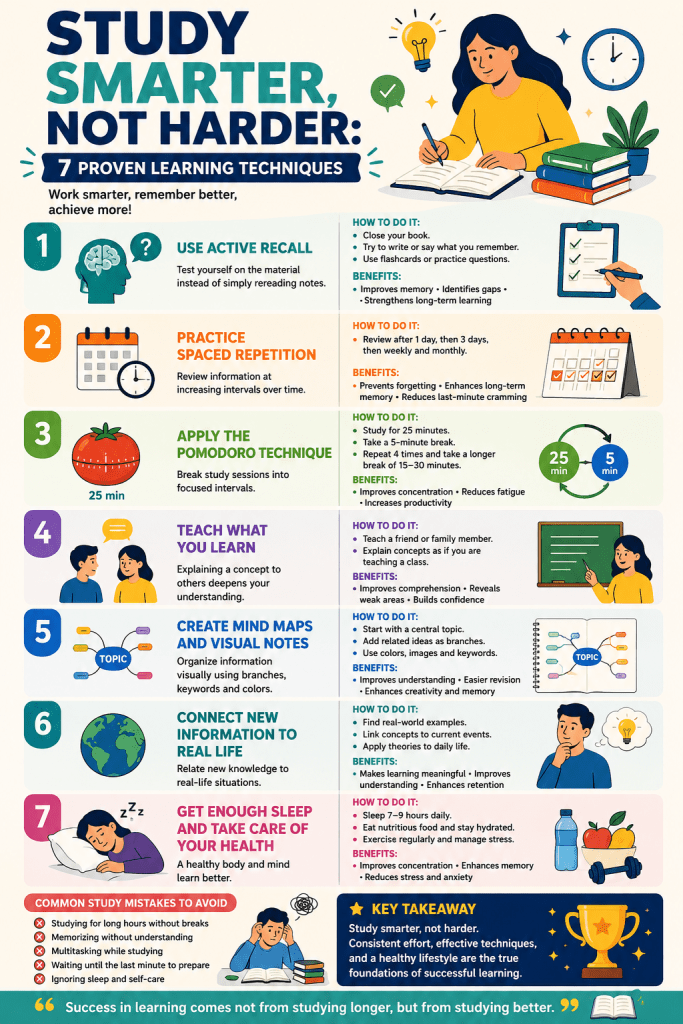
Many students spend long hours studying but still struggle to remember what they have learned. The secret to academic success is not studying harder—it’s studying smarter. By using effective learning techniques, students can improve understanding, retain information longer, and reduce stress.
Here are seven proven learning techniques that can help you learn more efficiently and achieve better results.
1. Use Active Recall
What is it?
Active recall involves testing yourself on the material instead of simply rereading notes.
How to do it:
- Close your book after studying a topic.
- Try to write down or explain what you remember.
- Use flashcards or practice questions.
Benefits:
- Improves memory retention.
- Identifies knowledge gaps.
- Strengthens long-term learning.
Tip: The more you retrieve information from memory, the stronger your understanding becomes.
2. Practice Spaced Repetition
What is it?
Spaced repetition means reviewing information at increasing intervals over time.
How to do it:
- Review notes after one day.
- Review again after three days.
- Continue reviewing weekly and monthly.
Benefits:
- Prevents forgetting.
- Enhances long-term memory.
- Reduces last-minute cramming.
Tip: Small, regular reviews are more effective than one long study session.
3. Apply the Pomodoro Technique
What is it?
A time-management method that breaks study sessions into focused intervals.
How to do it:
- Study for 25 minutes.
- Take a 5-minute break.
- Repeat four times.
- Take a longer break of 15–30 minutes.
Benefits:
- Improves concentration.
- Reduces mental fatigue.
- Increases productivity.
Tip: During study periods, avoid checking your phone or social media.
4. Teach What You Learn
What is it?
Explaining a concept to someone else helps deepen understanding.
How to do it:
- Teach a friend.
- Explain concepts to family members.
- Pretend you are teaching a class.
Benefits:
- Improves comprehension.
- Reveals areas that need more study.
- Builds confidence.
Tip: If you cannot explain it simply, you may need to review it again.
5. Create Mind Maps and Visual Notes
What is it?
Mind maps organize information visually using branches, colors, and keywords.
How to do it:
- Start with a central topic.
- Add related ideas as branches.
- Use symbols and colors.
Benefits:
- Improves understanding.
- Makes revision easier.
- Enhances creativity and memory.
Tip: Visual learners often remember diagrams better than paragraphs.
6. Connect New Information to Real Life
What is it?
Relating new knowledge to personal experiences or practical situations.
How to do it:
- Find real-world examples.
- Link concepts to current events.
- Apply theories to everyday situations.
Benefits:
- Makes learning meaningful.
- Improves understanding.
- Enhances memory retention.
Tip: The brain remembers information better when it has personal relevance.
7. Get Enough Sleep and Take Care of Your Health
What is it?
Learning is not just about studying; it also depends on physical and mental well-being.
How to do it:
- Sleep 7–9 hours daily.
- Eat nutritious food.
- Stay hydrated.
- Exercise regularly.
Benefits:
- Improves concentration.
- Enhances memory formation.
- Reduces stress and anxiety.
Tip: A well-rested brain learns faster and performs better.
Common Study Mistakes to Avoid
❌ Studying for long hours without breaks
❌ Memorizing without understanding
❌ Multitasking while studying
❌ Waiting until the last minute to prepare
❌ Ignoring sleep and self-care
Conclusion
Academic success is not determined by how many hours you study but by how effectively you learn. Techniques such as active recall, spaced repetition, teaching others, and using visual tools can significantly improve learning outcomes. By adopting these smart study strategies, students can enhance their performance, reduce stress, and enjoy the learning process.
Key Takeaway
Study smarter, not harder. Consistent effort, effective techniques, and a healthy lifestyle are the true foundations of successful learning. 📚✨
“Success in learning comes not from studying longer, but from studying better.”

