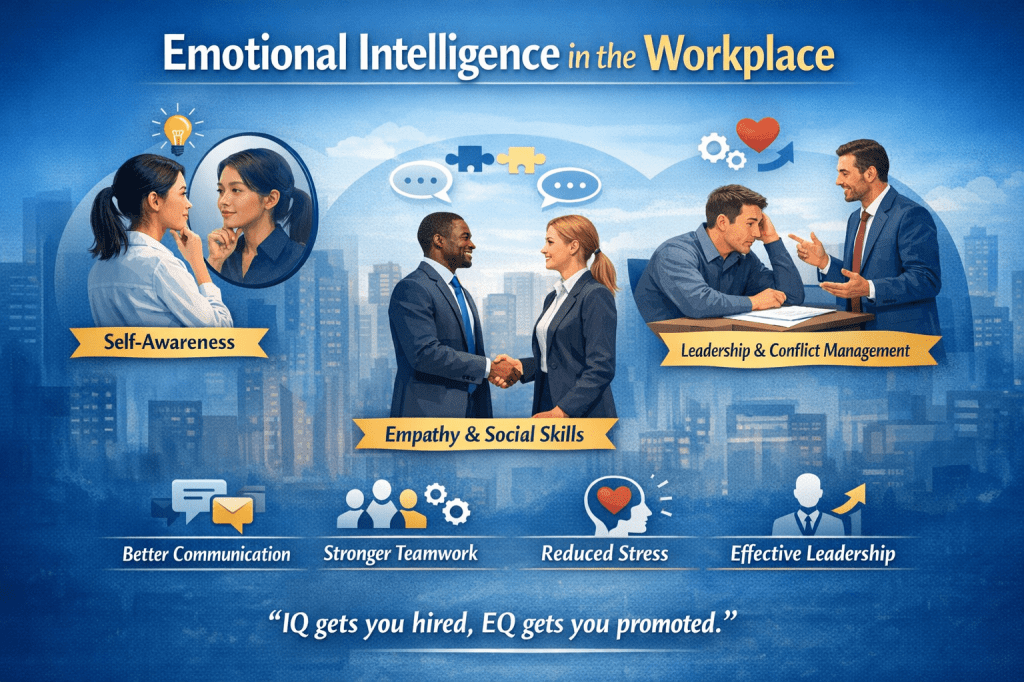
Emotional Intelligence in the Workplace

Emotional Intelligence (EI) is the ability to understand, manage, and use emotions effectively — both your own and others’.
In today’s workplace, technical skills alone are not enough. Emotional intelligence determines how well we lead, communicate, and collaborate.


🔹 1. What is Emotional Intelligence?

Emotional Intelligence includes:

  • Self-awareness – Understanding your own emotions
  • Self-regulation – Controlling impulsive reactions
  • Motivation – Staying driven toward goals
  • Empathy – Understanding others’ feelings
  • Social skills – Building healthy relationships

“IQ may get you hired, but EQ gets you promoted.”


🔹 2. Why Emotional Intelligence Matters at Work

  • Improves communication
  • Reduces workplace conflicts
  • Builds stronger teamwork
  • Enhances leadership effectiveness
  • Increases job satisfaction

Employees with high EI create a positive and respectful work culture.

“People may forget what you said, but they will never forget how you made them feel.”


🔹 3. Emotional Intelligence in Leadership

A leader with emotional intelligence:

  • Listens actively
  • Handles criticism calmly
  • Encourages team members
  • Resolves conflicts fairly
  • Inspires trust

Such leaders create psychological safety within teams.

“Leadership is not about control, it is about connection.”


🔹 4. Emotional Intelligence and Teamwork

Teams function better when members:

  • Respect different opinions
  • Manage disagreements maturely
  • Support each other during stress
  • Communicate clearly

High EI reduces misunderstandings and strengthens cooperation.

“Strong teams are built on understanding, not just skill.”


🔹 5. How to Improve Emotional Intelligence

  • Practice self-reflection daily
  • Pause before reacting
  • Develop active listening skills
  • Seek constructive feedback
  • Show empathy in conversations

Small behavioral changes can create a big professional impact.

“Emotional intelligence is not about being emotional; it is about being emotionally smart.”


🔹 Conclusion

In modern workplaces, success depends not only on knowledge but also on emotional maturity. Emotional intelligence builds trust, strengthens relationships, and drives long-term performance.

“Your attitude and emotional control define your professional success more than your technical ability.”

🛠️ Debug My Life: Simple Fixes for a Smoother Mindset

Just like software, life too can get messy with bugs — stress, confusion, bad habits, or procrastination. It’s time to debug your life and upgrade your system!

🔍 1. Identify the Bugs

  • Notice what’s draining your energy — toxic habits, overthinking, negative people, or clutter.
  • Keep a journal or note what triggers stress or low moods.

🧹 2. Clear the Cache (Declutter)

  • Clean your space — a tidy environment boosts mental clarity.
  • Let go of emotional baggage: forgive, release, reset.

🔄 3. Restart Often

  • Take short breaks, walk in nature, or meditate.
  • Sleep well — it’s the best reset button for your brain.

🧭 4. Update Your Mindset

  • Replace “I can’t” with “How can I?”
  • Feed your mind with positive content — books, podcasts, or uplifting people.

⌛ 5. Fix Procrastination Bugs

  • Use the 5-minute rule: “I’ll do this just for 5 minutes.”
  • Break big tasks into tiny steps.

🔐 6. Strengthen Your Firewall (Boundaries)

  • Learn to say “no” without guilt.
  • Protect your time and peace like your passwords.

⚙️ 7. Install Healthy Habits

  • Eat well, move daily, and stay hydrated.
  • Start small — one habit at a time is enough to change your life.

🌐 8. Connect to Good Networks

  • Surround yourself with people who lift you up, not pull you down.
  • Share your progress, and ask for help when needed.

🧑‍💻 9. Run Daily Diagnostics

  • End each day with reflection: What went well? What can improve?
  • Appreciate small wins and keep learning.

🚀 10. Keep Debugging

  • Life won’t be perfect, but you can keep improving.
  • Debugging is not a one-time task — it’s a habit of self-awareness and self-care.

💡 Final Thought:

You don’t need to be perfect — just better than yesterday.
Keep debugging. Keep evolving.

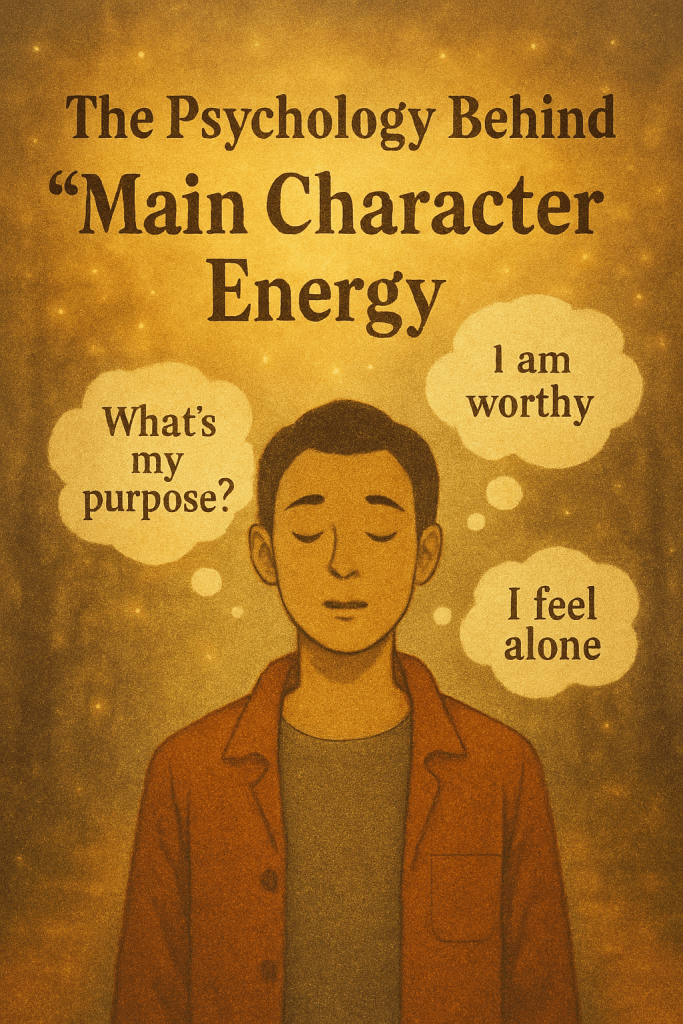
The Psychology Behind “Main Character Energy”

In recent years, you might have heard phrases like “I’m in my main character era” or “Live like the main character.” But what does it really mean? And why is it trending?

Let’s break it down simply.


🌟 What Is “Main Character Energy”?

Main Character Energy (MCE) is a mindset where a person sees themselves as the lead in their own life story. It’s about confidence, self-awareness, and making choices that align with your values, not just blending into the background.

“You are the author of your own story. Don’t hand the pen to someone else.”


🧠 Why It Feels So Good (Psychological Reasons)

  1. Boosts Self-Esteem
    • When you feel like the ‘main character,’ you value yourself more.
    • Example: Dressing up just for a walk because it makes you feel good.
  2. Encourages Mindfulness
    • You become more aware of your surroundings and actions.
    • Example: Drinking coffee slowly while enjoying the moment, like you’re in a movie scene.
  3. Helps Create a Strong Identity
    • You start asking: What kind of person do I want to be?
    • This leads to intentional decisions, not just going with the crowd.
  4. Inspires Personal Growth
    • Main characters overcome challenges.
    • Example: You treat a bad day not as the end—but as the middle of your character arc.
    “You either walk inside your story and own it, or you stand outside and hustle for your worthiness.” — Brené Brown

🎬 Main Character Energy vs. Narcissism

It’s important to note that MCE is not about being self-obsessed or thinking others are less important.
It’s about:

✅ Confidence — not arrogance
✅ Self-love — not selfishness
✅ Growth — not perfection

“You can be the main character of your life without needing to be the center of everyone else’s.”

✨ Practical Ways to Step into Your Main Character Energy

  1. Create Your “Main Character” Morning Routine
    • Start your day with intention. Stretch, journal, listen to music that motivates you.
    • Example: Brew your coffee slowly, stand by the window, and soak in the moment — like the intro scene of a movie.
  2. Dress for the Mood You Want to Create
    • Wear outfits that make you feel confident, even if you’re not going anywhere fancy.
    • Example: Wear that bold shirt or lipstick just because it feels you.
  3. Narrate Your Day (Internally or Out Loud!)
    • Turn simple moments into powerful scenes.
    • Example: Walking to the bus stop? Imagine you’re the hero heading to an important mission.
  4. Celebrate Small Wins Like Big Victories
    • Whether it’s finishing a to-do list or making it through a hard day, clap for yourself.
    • Example: Treat yourself to a solo coffee date after a productive week.
  5. Set a Soundtrack for Your Life
    • Make playlists that match your vibe — “Confidence Mode,” “Healing Era,” or “Rising Strong.”
    • Music/podcast makes every moment feel cinematic and empowering.
  6. Say Yes to Solo Moments
    • Take yourself out for a nature walk, or bookstore visit. You don’t need company to enjoy your life.
    • Example: A quiet Sunday spent journaling and reflecting can feel like a self-love scene.

📖 Final Thought

You don’t need to wait for someone to give you permission. You are already the main character.
Every small act of self-care, courage, and intention writes a better version of your life story.

“The moment you start acting like life is a movie, everything changes. The mood, the energy, the plot—it’s all in your hands.”

The Synergy of Mind and Body: Self-Care Practices for Total Health

The mind and body are deeply connected, and taking care of both is essential for overall well-being. Understanding and nurturing this connection is key to effective self-care.

  1. Understanding the Mind-Body Link
    • The mind and body are not separate; they influence each other constantly. Our thoughts, emotions, and mental states can affect our physical health, and vice versa.
  2. Mental Health Impacts Physical Health
    • Stress, anxiety, and depression can manifest as physical symptoms like headaches, fatigue, muscle tension, or digestive issues.
    • Positive mental states like happiness and calm can promote better immune function, improve sleep, and boost energy levels.
  3. Physical Health Influences Mental Health
    • Regular physical activity boosts mood by releasing endorphins, which reduce stress and improve mental clarity.
    • A healthy diet rich in nutrients also supports brain function, reducing feelings of anxiety or depression.
  4. Self-Care Practices that Strengthen the Mind-Body Connection
    • Exercise: Whether it’s yoga, walking, or strength training, physical activity helps release pent-up tension, reduces anxiety, and improves mood.
    • Mindfulness and Meditation: These practices center the mind, reduce stress, and help you tune in to both physical and emotional needs.
    • Adequate Sleep: A good night’s sleep recharges the body and mind, enhancing emotional stability and cognitive function.
    • Healthy Eating: A balanced diet filled with fruits, vegetables, and whole grains can improve both mood and energy levels, making it easier to manage stress.
    • Deep Breathing: Simple breathing exercises can calm the nervous system, reduce heart rate, and help in moments of stress.
  5. The Power of Positive Thinking
    • Cultivating a positive mindset can reduce the physical effects of stress, such as high blood pressure and muscle tension. Positive thoughts promote relaxation and well-being.
  6. Stress Management and Relaxation
    • Chronic stress can lead to various health issues, including digestive problems and high blood pressure. Practicing relaxation techniques like progressive muscle relaxation or guided imagery can relieve tension and improve both mental and physical health.
  7. Emotional Expression
    • Suppressing emotions can negatively affect physical health. Self-care through emotional expression, such as talking with loved ones or journaling, can release built-up emotional tension and prevent it from manifesting as physical ailments.
  8. The Importance of Self-Awareness
    • Being aware of your body’s signals—such as fatigue, tension, or pain—allows you to address your needs before they escalate into more serious issues.
  9. Self-Care for Balance
    • The key to effective self-care lies in balancing both mental and physical health. Taking time for activities that nurture your body and mind will help you achieve a holistic sense of well-being.

    Self-Awareness: Understanding Yourself for Personal Growth

    What Is Self-Awareness?

    • Quote: “Knowing yourself is the beginning of all wisdom.” – Aristotle
    • Self-awareness is the ability to recognize and understand your own thoughts, emotions, and behaviors.
    • It helps you identify how you react to different situations and how others perceive you.

    Why Self-Awareness Is Important

    • Quote: “When I discover who I am, I’ll be free.” – Ralph Ellison
    • It helps you make better decisions, build healthier relationships, and manage emotions effectively.
    • Example: If you realize that stress makes you impatient, you can take steps to manage stress before it affects your behavior.

    Types of Self-Awareness

    • Quote: “What we perceive about ourselves is greatly a reflection of how we will end up living our lives.” – Stephen Richards
    • Internal Self-Awareness: Understanding your emotions, values, and goals.
      • Example: Knowing that you value honesty can help you avoid situations where you feel pressured to be dishonest.
    • External Self-Awareness: Understanding how others see you.
      • Example: If people see you as quiet, but you think of yourself as outgoing, you may need to align your self-perception with your actions.

    Benefits of Self-Awareness

    • Quote: “Self-awareness gives you the capacity to learn from your mistakes as well as your successes.” – Lawrence Bossidy
    • Improved Emotional Control: You can respond to situations more calmly.
      • Example: When you’re aware that certain topics make you angry, you can prepare to stay calm during difficult conversations.
    • Better Relationships: Understanding your own needs and recognizing others’ emotions improves communication.
      • Example: Being aware of your need for personal space helps you set boundaries in relationships.

    How to Develop Self-Awareness

    • Quote: “The unexamined life is not worth living.” – Socrates
    • Reflect on Your Feelings: Take time to think about your emotions and why you feel them.
      • Example: After a tough day, reflect on why you felt upset and how you handled it.
    • Seek Feedback: Ask trusted friends or colleagues how they perceive you.
      • Example: If a colleague says you seem stressed, it might help you realize you’re overwhelmed and need to make changes.
    • Practice Mindfulness: Stay present and observe your thoughts without judgment.
      • Example: During a stressful moment, pause and notice your thoughts instead of reacting immediately.

    Common Obstacles to Self-Awareness

    • Denial: Refusing to acknowledge your flaws or emotions.
      • Example: Telling yourself you’re always right, even when faced with feedback that suggests otherwise.
    • Fear of Self-Reflection: Avoiding deeper thinking because you’re afraid of what you’ll find.
      • Example: Not wanting to admit that you may need to make uncomfortable changes in your life.

    How Self-Awareness Leads to Growth

    • Quote: “Self-awareness is not just relaxation and not just meditation. It must combine relaxation with activity and dynamism. Technology can aid that.” – Deepak Chopra
    • Recognizing your strengths and weaknesses helps you set realistic goals and improve over time.
    • Example: If you’re aware that procrastination is a weakness, you can work on time management skills to overcome it.

    Conclusion

    • Quote: “Your visions will become clear only when you can look into your own heart. Who looks outside, dreams; who looks inside, awakes.” – Carl Jung
    • Self-awareness is the key to personal growth and better relationships.
    • By understanding yourself, you can make positive changes in your life, handle challenges more effectively, and become the best version of yourself.

    Boost Your Emotional Intelligence: Strategies for Personal and Professional Growth

    Emotional Intelligence: Why It Matters and How to Improve It

    Emotional Intelligence (EI) is the ability to understand and manage your own emotions, as well as recognize and influence the emotions of others. Here’s why it matters and how you can improve it:

    Why Emotional Intelligence Matters

    1. Better Relationships
      • Quote: “The greatest ability in business is to get along with others and to influence their actions.” – John Hancock
      • Understanding emotions helps you connect with others, fostering strong personal and professional relationships.
    2. Improved Communication
      • Quote: “Effective communication is 20% what you know and 80% how you feel about what you know.” – Jim Rohn
      • High EI enables clearer and more empathetic communication, reducing misunderstandings and conflicts.
    3. Enhanced Decision-Making
      • Quote: “Emotions can get in the way or get you on the way.” – Mavis Mazhura
      • Being aware of your emotions can help you make more balanced and thoughtful decisions.
    4. Increased Self-Awareness
      • Quote: “Knowing yourself is the beginning of all wisdom.” – Aristotle
      • Understanding your emotions and their impact helps you grow and improve in both personal and professional areas.
    5. Better Stress Management
      • Quote: “It’s not stress that kills us, it is our reaction to it.” – Hans Selye
      • High EI helps you manage stress better by recognizing and addressing your emotional responses.

    How to Improve Emotional Intelligence

    1. Practice Self-Awareness
      • Reflect on your emotions and how they influence your thoughts and actions.
      • Tip: Keep a journal to track your emotional responses and identify patterns.
    2. Develop Self-Regulation
      • Learn to control your emotional impulses and think before acting.
      • Tip: Practice deep breathing or meditation to stay calm in stressful situations.
    3. Enhance Empathy
      • Try to understand and share the feelings of others.
      • Tip: Listen actively and ask open-ended questions to better understand others’ perspectives.
    4. Improve Social Skills
      • Work on building and maintaining healthy relationships.
      • Tip: Practice effective communication, show appreciation, and resolve conflicts calmly.
    5. Cultivate Motivation
      • Find internal motivation to pursue your goals with passion and persistence.
      • Tip: Set personal goals and celebrate small achievements to keep yourself motivated.
    6. Seek Feedback
      • Ask for constructive feedback from trusted friends or colleagues to gain insights into your emotional behavior.
      • Tip: Be open to criticism and use it as an opportunity for growth.

    Quote to Remember: “Emotional intelligence is the key to both personal and professional success.” – Daniel Goleman

    By focusing on these areas, you can enhance your emotional intelligence and reap the benefits in all aspects of your life. Remember, improving EI is a continuous journey that requires practice and dedication.

    Discovering Real Happiness: A Journey Within

    Understanding Real Happiness

    • Intrinsic vs. Extrinsic: Real happiness often stems from intrinsic sources, rather than extrinsic. Intrinsic sources include personal growth, relationships, and self-fulfillment, while extrinsic sources are typically material possessions or external validation.

    Key Sources of True Happiness

    1. Meaningful Relationships
      • Connection: Building strong, positive relationships with family, friends, and community.
      • Support: Having a support system to share joys and challenges.
      • Love and Affection: Experiencing love, compassion, and affection from others.
    2. Personal Growth
      • Self-Awareness: Understanding your values, strengths, and weaknesses.
      • Continuous Learning: Engaging in lifelong learning and skill development.
      • Achieving Goals: Setting and achieving personal goals and milestones.
    3. Gratitude
      • Appreciation: Regularly acknowledging and appreciating the good things in life.
      • Positive Mindset: Fostering a mindset of abundance rather than scarcity.
    4. Acts of Kindness
      • Helping Others: Engaging in acts of kindness and helping others without expecting anything in return.
      • Volunteering: Participating in community service or volunteer work.
    5. Mindfulness and Presence
      • Being Present: Focusing on the present moment and fully engaging with it.
      • Meditation: Practicing mindfulness or meditation to reduce stress and increase self-awareness.
    6. Health and Well-being
      • Physical Health: Maintaining good physical health through exercise, nutrition, and rest.
      • Mental Health: Prioritizing mental well-being, managing stress, and seeking help when needed.
    7. Sense of Purpose
      • Life Purpose: Finding and pursuing a sense of purpose or a cause that you are passionate about.
      • Meaningful Work: Engaging in work or activities that provide a sense of accomplishment and purpose.
    8. Balance
      • Work-Life Balance: Maintaining a healthy balance between work, personal life, and leisure.
      • Time Management: Effectively managing time to reduce stress and increase productivity.

    Practices to Cultivate True Happiness

    • Daily Reflection: Take time each day to reflect on what you are grateful for and what brought you joy.
    • Journaling: Keep a journal to document positive experiences and personal growth.
    • Mindful Breathing: Practice mindful breathing exercises to stay centered and calm.
    • Quality Time: Spend quality time with loved ones and engage in meaningful conversations.
    • Pursue Hobbies: Engage in hobbies and activities that you are passionate about and that bring you joy.

    Conclusion

    True happiness lies within and is cultivated through meaningful connections, personal growth, gratitude, acts of kindness, mindfulness, well-being, purpose, and balance. By focusing on these intrinsic sources, you can nurture a lasting sense of happiness and fulfillment.

    Exploring Self-Awareness: Unlocking Your Inner Potential

    In our journey of personal growth and fulfillment, self-awareness acts as a guiding light. It empowers us to understand our thoughts, emotions, strengths, weaknesses, and aspirations, allowing us to navigate life’s twists and turns with clarity and purpose. However, developing self-awareness requires practice and commitment.

    Understanding Self-Awareness:

    Self-awareness is the ability to observe and understand our own thoughts, feelings, and behaviors without judgment. It involves tuning into our inner world, recognizing patterns, and gaining insights into what drives us. When we are self-aware, we can make conscious choices, manage our emotions effectively, and live in alignment with our values and goals.

    The Significance of Self-Awareness:

    1. Enhanced Decision Making: Self-aware individuals can make decisions that are in line with their values, preferences, and long-term goals. By understanding their motivations and thought processes, they can weigh options more effectively and choose the path that resonates with them.
    2. Improved Relationships: Self-awareness fosters empathy, communication, and understanding in relationships. When we are aware of our own emotions and behaviors, we can relate to others more authentically, cultivate deeper connections, and resolve conflicts more constructively.
    3. Effective Stress Management: Self-awareness enables us to recognize stress triggers and coping mechanisms, allowing us to respond to stressful situations with greater resilience and composure. By understanding our emotional responses, we can navigate challenges with grace and poise.
    4. Personal Growth: Self-awareness is the cornerstone of personal growth and development. By continuously reflecting on our experiences, strengths, and areas for improvement, we can evolve into the best versions of ourselves and lead more fulfilling lives.

    Practical Exercises to Cultivate Self-Awareness:

    1. Journaling: Set aside time each day to journal about your thoughts, feelings, and experiences. Write freely without censorship, exploring your innermost thoughts and emotions. Reflect on patterns, triggers, and insights that emerge from your writing.
    2. Mindfulness Meditation: Practice mindfulness meditation to cultivate present-moment awareness and non-judgmental observation of your thoughts and sensations. Start with a few minutes of focused breathing, gradually increasing the duration as you become more comfortable.
    3. Self-Reflection Questions: Set aside time for self-reflection by asking yourself probing questions about your values, goals, fears, and aspirations. Examples include: “What brings me joy?” “What are my greatest strengths?” “What limiting beliefs hold me back?”
    4. Feedback Seeking: Solicit feedback from trusted friends, mentors, or colleagues about your strengths, weaknesses, and blind spots. Listen openly to their perspectives, embracing constructive criticism as an opportunity for growth and self-discovery.
    5. Values Clarification: Identify your core values—principles that guide your decisions and actions. Create a list of your top values and reflect on why they are important to you. Aligning your actions with your values can enhance your sense of fulfillment and purpose.
    6. Goal Setting: Set SMART (Specific, Measurable, Achievable, Relevant, Time-bound) goals for different areas of your life, such as career, relationships, health, and personal growth. Break down larger goals into smaller, actionable steps, and track your progress regularly.

    Conclusion:

    Self-awareness is a transformative skill that empowers us to live authentically, purposefully, and joyfully. By incorporating simple yet effective exercises into our daily routine, we can deepen our understanding of ourselves, unlock our inner potential, and cultivate a life of meaning and fulfillment. Embrace the journey of self-discovery with curiosity and compassion, and watch as the seeds of self-awareness blossom into profound personal growth and transformation.

    Decoding Emotional Intelligence: Fresh Insights from Science and Notable Personalities

    Neuroscience of Emotional Intelligence:

      • “Emotional intelligence is not just a buzzword; it’s backed by science. Studies show that the brain regions associated with empathy, self-awareness, and emotional regulation are keys to understand emotional intelligence.” – Daniel Goleman
      • “The mind is everything. What you think, you become.” – Buddha
      1. Emotional Intelligence and Mental Health:
      • “Our emotional intelligence impacts our mental health profoundly. Developing resilience and self-awareness can help us navigate life’s challenges with greater ease and grace.” – Deepak Chopra
      • “You, yourself, as much as anybody in the entire universe, deserve your love and affection.” – Buddha
      1. EI in Leadership and Work Performance:
      • “Leadership is not about being in charge. It’s about taking care of those in your charge. Emotional intelligence is the key to effective leadership and high-performing teams.” – Simon Sinek
      • “The only way to do great work is to love what you do.” – Steve Jobs
      1. Cultivating Emotional Intelligence:
      • “Mindfulness meditation and empathy training are powerful tools for cultivating emotional intelligence. By practicing self-awareness and empathy, we can enhance our relationships and well-being.” – Brené Brown
      • “The greatest glory in living lies not in never falling, but in rising every time we fall.” – Nelson Mandela

      Conclusion:
      As these quotes from influential figures demonstrate, emotional intelligence is not only supported by science but also embodies timeless wisdom. By embracing the principles of emotional intelligence and incorporating them into our lives, we can enhance our mental health, leadership abilities, and overall success. Let us remember that the journey to unlocking the power of emotional intelligence begins with self-awareness, empathy, and a commitment to continuous growth and development.

      Unleashing Success: The Power of Emotional Intelligence

      Introduction: In our intricate and interconnected world, success extends beyond traditional intelligence. Emotional Intelligence (EI), a concept gaining increasing recognition, has become a pivotal factor in personal and professional triumph. Let’s embark on a journey to understand the essence of emotional intelligence and how it serves as a catalyst for positive change and achievement.

      Defining Emotional Intelligence: Emotional Intelligence refers to the ability to recognize, understand, manage, and effectively use our own emotions, as well as being attuned to the emotions of others. It encompasses several key components:

      1. Self-awareness: Understanding one’s emotions, strengths, weaknesses, and their impact on others.
      2. Self-regulation: Managing and controlling one’s emotions, avoiding impulsive reactions.
      3. Empathy: Understanding and sharing the feelings of others, fostering deeper connections.
      4. Motivation: Being driven by personal passion and having the ability to motivate oneself and others.
      5. Social skills: Navigating social situations with finesse, building and maintaining positive relationships.

      The Impact of Emotional Intelligence: EI goes beyond simply managing emotions. It is a dynamic force that influences various aspects of life, including:

      1. Personal Well-being:
        • Individuals with high EI tend to have better mental health, cope effectively with stress, and enjoy overall well-being.
      2. Effective Communication:
        • High EI enables individuals to express themselves clearly, listen actively, and navigate conflicts with finesse.
      3. Leadership Excellence:
        • Successful leaders often possess high emotional intelligence, leading to better team collaboration, employee satisfaction, and organizational success.
      4. Healthy Relationships:
        • EI enhances the quality of relationships by fostering empathy, understanding, and effective communication.
      5. Adaptability:
        • Individuals with high EI adapt more easily to change, demonstrating resilience and a positive approach to challenges.

      Real-World Examples: Let’s delve into some real-world examples that illuminate the transformative impact of emotional intelligence:

      1. Leadership Success: Satya Nadella’s empathetic leadership at Microsoft has transformed the company culture, leading to increased innovation and employee satisfaction.
      2. Global Impact: Nelson Mandela’s ability to empathize and reconcile played a crucial role in dismantling apartheid, showcasing the global impact of emotional intelligence.
      3. Athletic Excellence: Serena Williams’s resilience on the tennis court demonstrates how emotional intelligence contributes to high-performance under pressure.

      Cultivating Emotional Intelligence: Now, let’s explore practical ways to enhance and cultivate emotional intelligence:

      1. Practice Self-awareness: Regularly reflect on your emotions, strengths, and areas for improvement.
      2. Develop Empathy:Actively listen to others, seek to understand different perspectives, and cultivate compassion.
      3. Manage Stress Effectively: Adopt healthy coping mechanisms, such as mindfulness and exercise, to manage stress.
      4. Continuous Learning: Read books, attend workshops, and engage in activities that enhance emotional intelligence.
      5. Seek Feedback: Solicit constructive feedback from others to gain insights into your emotional strengths and areas for development.

      Conclusion: In a world where success is increasingly intertwined with interpersonal skills and adaptability, emotional intelligence emerges as a potent force. By understanding, cultivating, and applying the principles of EI, individuals can not only navigate the complexities of their own emotions but also foster positive change in their relationships, workplaces, and communities. As we embrace the profound impact of emotional intelligence, we unlock a pathway to personal growth, enhanced well-being, and enduring success.