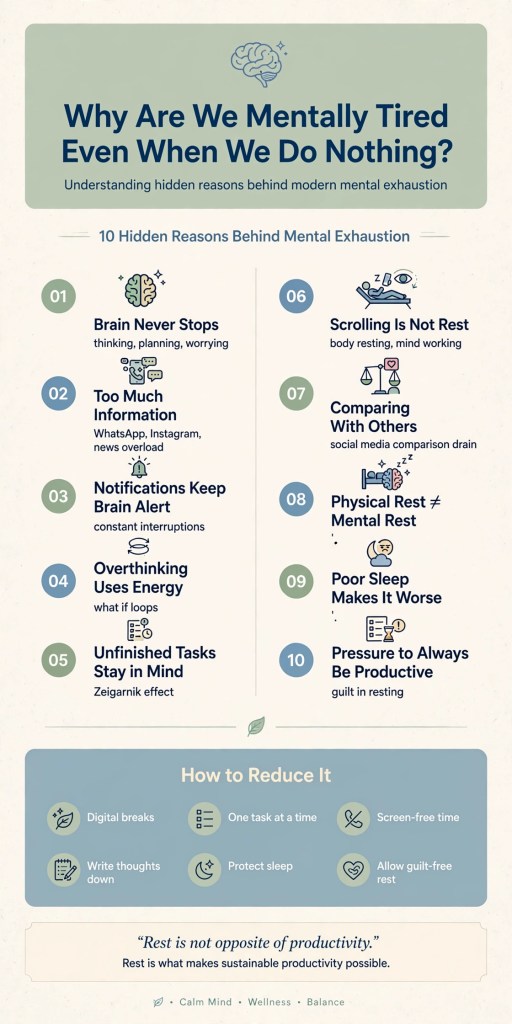
Why Are We Mentally Tired Even When We Do Nothing?

Understanding the hidden reasons behind modern mental exhaustion

Have you ever spent an entire day doing “nothing” and still felt completely exhausted?

You may not have attended meetings, travelled, studied for hours, or done heavy physical work. Yet, by the end of the day, your mind feels tired.

Why does this happen?

Mental tiredness is not always caused by physical activity. Sometimes, our brain is working continuously in the background—even when our body is resting.


🧠 1. Your Brain Never Really Stops

Even when you are sitting quietly, your brain may be:

  • Thinking about yesterday
  • Planning tomorrow
  • Remembering unfinished tasks
  • Worrying about problems
  • Imagining different situations
  • Processing conversations

So, “doing nothing” does not necessarily mean “thinking nothing.”


📱 2. Too Much Information

Every day, we receive an enormous amount of information through:

  • WhatsApp messages
  • Instagram and YouTube
  • News
  • Emails
  • Advertisements
  • College or workplace notifications
  • Online conversations

Our brain constantly decides:

“Is this important?”

“Should I respond?”

“Should I remember this?”

This continuous processing can create mental overload.


🔔 3. Notifications Keep Our Brain Alert

A simple notification may take only a few seconds to check.

But every notification interrupts our attention.

Even when we do not open it, our mind may wonder:

“Who messaged me?”

“What happened?”

“Do I need to reply?”

Constant interruptions prevent the mind from experiencing genuine rest.


🤔 4. Overthinking Uses Mental Energy

Sometimes the biggest source of tiredness is not work—it is thinking about work.

We may repeatedly think:

  • “What if something goes wrong?”
  • “Did I say the wrong thing?”
  • “What will others think?”
  • “Should I have done something differently?”
  • “What should I do next?”

The problem may be small, but repeated thinking makes it feel much bigger.


⏳ 5. Unfinished Tasks Stay in the Mind

An incomplete assignment, unanswered message or pending decision can remain in our thoughts.

Even when we are relaxing, our brain may keep reminding us:

“You still have something to do.”

This creates a feeling of being mentally busy without actually being productive.


📲 6. Scrolling Is Not Always Rest

Many people think:

“I’ll relax by scrolling through my phone.”

But social media requires constant attention.

We move quickly from:

Video → Message → Post → Advertisement → News → Video

The brain keeps receiving new information.

So, the body may be resting while the mind is still working.


🪞 7. Comparing Ourselves With Others

Social media often shows us carefully selected versions of other people’s lives.

We may see:

  • Someone’s new job
  • Someone’s vacation
  • Someone’s achievement
  • Someone’s beautiful home
  • Someone’s success

Then we compare it with our own life.

This can create thoughts such as:

“Am I doing enough?”

“Why am I behind?”

“Should I be more successful?”

Constant comparison can quietly drain mental energy.


😴 8. Physical Rest Is Not Always Mental Rest

Sleeping or lying down gives the body rest.

But mental rest requires something more.

You may be physically comfortable while your mind is still:

  • Planning
  • Worrying
  • Analysing
  • Remembering
  • Comparing
  • Predicting

Therefore:

Resting your body and resting your mind are not always the same thing.


🌙 9. Poor Sleep Makes Mental Tiredness Worse

Sleep is essential for the brain to recover.

Late-night:

  • Scrolling
  • Studying
  • Working
  • Gaming
  • Watching videos

can reduce the quality of rest.

The next day, even simple activities may feel difficult.


🌿 How Can We Reduce Mental Tiredness?

We don’t always need a complete break from life.

Small changes can help.

1. Take Short Digital Breaks

Keep your phone away for a few minutes and allow your mind to experience silence.

2. Do One Thing at a Time

Constant multitasking increases mental load.

Focus on one task before moving to another.

3. Spend Time Without a Screen

Try:

  • Walking
  • Gardening
  • Reading
  • Drawing
  • Sitting outdoors
  • Talking with someone

4. Write Down Your Thoughts

If your mind is crowded with unfinished tasks, write them down.

A simple list can tell your brain:

“I don’t have to remember everything.”

5. Protect Your Sleep

Create a regular sleep routine and reduce unnecessary screen use before bedtime.

6. Learn to Do Nothing Without Guilt

Sometimes, doing nothing is not laziness.

It is recovery.


🌱 The Importance of Mental Rest

We charge our phones when their battery becomes low.

But we often continue using our minds even when our mental battery is almost empty.

Mental rest gives us space to:

  • Think clearly
  • Control emotions
  • Make better decisions
  • Concentrate better
  • Become more creative
  • Handle stress more effectively

💡 Remember This

You don’t have to be physically busy to become mentally tired.

Sometimes, the exhaustion comes from:

Too much information + too many decisions + too much thinking + too little mental rest.

So, the next time you feel tired after “doing nothing,” don’t immediately call yourself lazy.

Ask yourself:

“Was my body resting, or was my mind actually resting too?”

🌿 Rest is not the opposite of productivity.

Rest is what makes sustainable productivity possible.

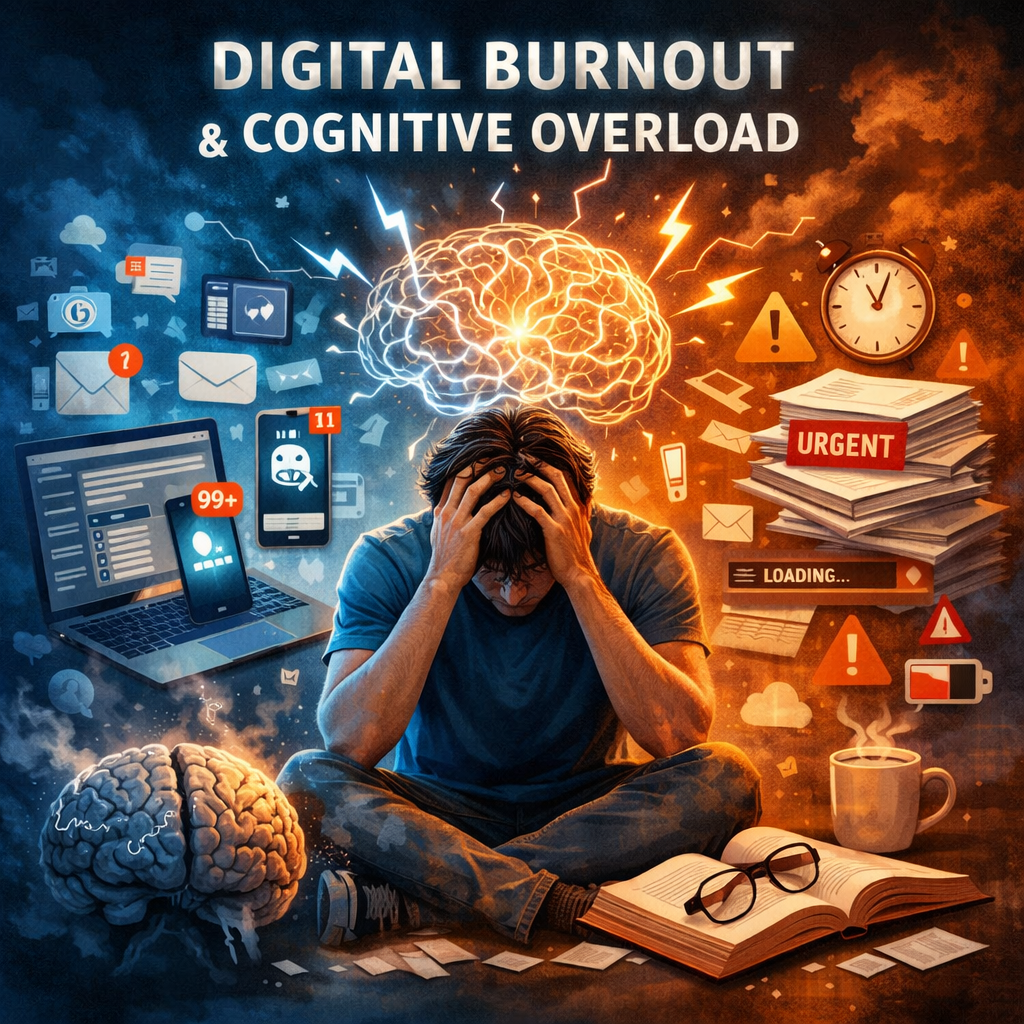
Digital Burnout and Cognitive Overload

Introduction

In today’s digital world, technology has become an inseparable part of our daily lives. From work and education to communication and entertainment, screens dominate almost every moment. While digital tools improve efficiency and connectivity, excessive and continuous exposure to them puts heavy pressure on the human mind. This growing mental strain leads to digital burnout and cognitive overload, affecting focus, emotional balance, productivity, and overall well-being. Understanding this issue is essential to creating healthier digital habits and protecting mental health in the modern age.

1. What is Digital Burnout?

  • Digital burnout happens when we feel mentally tired due to excessive screen time.
  • It is caused by constant use of phones, laptops, and digital platforms.

2. What is Cognitive Overload?

  • Cognitive overload occurs when the brain receives more information than it can process.
  • Notifications, emails, messages, and multitasking overload our thinking capacity.

3. Why is it Increasing Today?

  • Continuous online work and virtual meetings
  • Social media scrolling without breaks
  • Pressure to stay available and respond instantly
  • Information overload from news and digital content

4. Common Signs and Symptoms

  • Difficulty concentrating and remembering things
  • Mental fatigue and constant tiredness
  • Irritability and mood swings
  • Headaches and sleep problems
  • Loss of motivation and productivity

5. Impact on Mental Health

  • Increased stress and anxiety
  • Reduced attention span
  • Emotional exhaustion
  • Feeling overwhelmed even with simple tasks

6. Impact on Work and Studies

  • Lower efficiency and creativity
  • Increased errors and poor decision-making
  • Reduced learning capacity
  • Declining engagement and interest

7. How Digital Burnout Affects Daily Life

  • Less face-to-face interaction
  • Reduced quality time with family
  • Constant mental distraction
  • Difficulty enjoying offline moments

8. Simple Ways to Reduce Digital Burnout

  • Take regular screen breaks
  • Limit unnecessary notifications
  • Follow single-tasking instead of multitasking
  • Set boundaries for work and personal time
  • Practice digital detox regularly

9. Role of Mindfulness and Rest

  • Short breathing exercises calm the mind
  • Adequate sleep restores cognitive capacity
  • Mindful usage of technology improves focus

10. Conclusion

  • Digital tools are helpful, but overuse harms mental well-being.
  • Managing screen time and information flow is essential for a healthy mind.
  • Balance, awareness, and conscious digital habits can prevent burnout.

Closing Quote:
“Resting the mind is not a luxury—it is a necessity in a digital world.”

Daily Stress vs. Chronic Stress: Knowing the Difference

Introduction

Stress is a part of everyday life. Deadlines, responsibilities, and unexpected situations often create pressure. However, not all stress is the same. Understanding the difference between daily stress and chronic stress helps us manage our mental health better and prevent long-term harm.


What Is Daily Stress?

Daily stress is short-term and usually linked to routine activities or temporary challenges.

Common causes:

  • Tight schedules or deadlines
  • Exams, meetings, or presentations
  • Traffic, minor conflicts, or small setbacks

Key characteristics:

  • Lasts for a short period
  • Reduces once the situation is resolved
  • Can sometimes improve focus and motivation

Example:
Feeling nervous before an exam but relaxed once it is over.


What Is Chronic Stress?

Chronic stress is long-lasting and occurs when stressful situations continue without relief.

Common causes:

  • Ongoing financial problems
  • Long-term work pressure
  • Family conflicts or caregiving responsibilities
  • Unresolved emotional issues

Key characteristics:

  • Persists for weeks or months
  • Feels constant and overwhelming
  • Affects both mental and physical health

Example:
Feeling anxious and exhausted every day due to prolonged work pressure.


Key Differences Between Daily and Chronic Stress

  • Duration:
    Daily stress is temporary; chronic stress is continuous.
  • Impact:
    Daily stress is manageable; chronic stress is harmful.
  • Recovery:
    Daily stress fades with rest; chronic stress does not easily go away.
  • Health effects:
    Chronic stress may lead to anxiety, depression, sleep issues, and fatigue.

Why Knowing the Difference Matters

  • Helps you recognize when stress becomes unhealthy
  • Encourages timely self-care and support
  • Prevents burnout and long-term mental health issues

Ignoring chronic stress can slowly affect emotional well-being, relationships, and overall quality of life.


Simple Ways to Manage Stress

  • Practice deep breathing or mindfulness
  • Maintain a healthy daily routine
  • Take short breaks and rest adequately
  • Share concerns with trusted people
  • Seek professional help when stress feels constant

Final Thoughts

Stress is unavoidable, but suffering is not. While daily stress is a normal part of life, chronic stress is a warning sign that should not be ignored. By understanding the difference, we can take better care of our minds and lead healthier, more balanced lives.

🌱 Hard Times Don’t Last Forever

Life is not a straight road—it’s a journey filled with twists, turns, ups, and downs. When we go through tough times, it feels as if the pain will never end. But here’s the truth: hard times are temporary. They come to test us, to teach us, and most importantly, to prepare us for something better.

🌤️ Why Hard Times Don’t Last Forever

  1. Every Storm Eventually Ends
    No matter how heavy the rain, the clouds always clear. Similarly, every challenge you face has an expiry date. What seems unbearable today will one day just be a memory.
  2. Struggles Build Strength
    Muscles grow when they are tested by resistance. In the same way, life’s struggles make you stronger, braver, and wiser. Without difficulties, we would never discover our true strength.
  3. Time is a Great Healer
    Wounds, whether emotional or physical, need time. As days pass, pain lessens, and perspective grows. What breaks you today may build you tomorrow.
  4. Mindset Shapes the Outcome
    If you see a problem as a dead end, it becomes one. But if you see it as a lesson, it becomes a stepping stone. Choosing hope over despair changes the way you experience tough times.
  5. You’re Not Alone
    Hardships feel lighter when shared. Leaning on family, friends, or faith can provide the comfort and support you need to move forward.
  6. Growth Happens in Darkness
    Seeds grow in the dark soil before they bloom in sunlight. Likewise, your struggles may be preparing you for opportunities you cannot yet see.
  7. Hope is the Lifeline
    One of the most powerful reminders during hard times is: “This too shall pass.” Hope is not just a feeling—it is the fuel that keeps you moving forward.

🌟 A Short Story to Remember

There’s a saying: “Diamonds are made under pressure.”
A young man once complained to his grandmother about all his struggles. She boiled carrots, eggs, and coffee beans in three pots of water. After a while, she asked him what he saw.

  • The carrots became soft.
  • The eggs turned hard inside.
  • The coffee beans transformed the water itself.

She explained: “Life’s difficulties affect us differently. Some become weak, some become tough, and some use hardships to create something new and beautiful.”

The young man realized that challenges don’t define us—our response does.


💡 Final Thought

Hard times are like passing clouds—dark for a while, but they never block the sun forever. Stay patient, stay strong, and believe that brighter days are ahead. Every struggle you face today is preparing you for a stronger, wiser, and more hopeful tomorrow.

Your comeback will always be stronger than your setback. 🌈