Quantum Superposition: You Can Be More Than One Version of Yourself

Introduction

In quantum physics, superposition means a particle can exist in multiple states at the same time until someone observes it. This mind-bending idea isn’t just for scientists. It mirrors our personal journey. In life, we often forget that we too carry many possible versions of ourselves waiting to unfold.


1. You carry many possibilities within you

In superposition, a particle can be here and there.
In life, you can be strong and scared. Brave and unsure. Learning and leading.
You don’t have to fit into one fixed label.

Your identity is a wide horizon, not a locked room.


2. You don’t have to decide who you are immediately

Superposition teaches that reality settles only when observed.
Similarly, you don’t need to rush your life decisions.
Career, relationships, dreams — these don’t always need instant clarity.
Give yourself permission to explore before choosing.


3. You can reinvent yourself anytime

Just like a particle collapses into a specific state when observed, you can choose which version of yourself to activate today.
Want to be more confident? More disciplined? More patient?
You can select that version and let it grow.

The choice becomes the turning point.


4. Your circumstances do not define your potential

Superposition reminds us that there is always more happening beneath the surface.
Your potential isn’t limited by your past or present situation.
There are countless paths hidden inside you, waiting to be chosen.


5. You are allowed to grow in different directions

People often feel pressure to be consistent, predictable, or a “single type” of person.
But you can be a creative thinker and a practical planner.
A dreamer and a doer.
A calm person and a bold decision-maker.

Life becomes richer when you embrace your complexity instead of hiding it.


6. Your future is a collection of possibilities

Superposition shows that reality isn’t fixed.
Your future isn’t fixed either.
Small shifts in choice, mindset, and habits can unlock entirely new paths.

Every day, you decide which version of yourself steps forward.


Final Thoughts

Quantum superposition gently reminds us that we are not stuck. We are not one-dimensional. We are not limited to a single identity or destiny. Within each of us lives a constellation of possibilities, waiting to be chosen at the right moment.

You are allowed to evolve.
You are allowed to change.

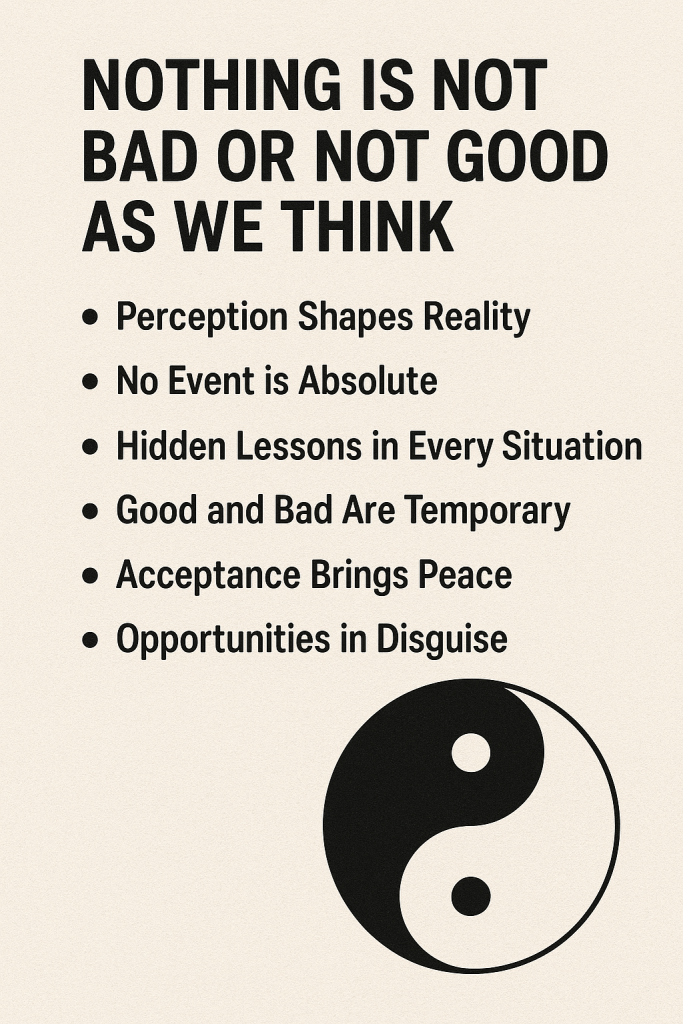
Nothing is Not Bad or Not Good as We Think

Introduction

Life often surprises us with situations that we quickly label as good or bad. But in reality, many things are neither completely good nor completely bad—it is our perception that shapes how we feel about them.


Key Points

  • Perception Shapes Reality
    • What feels like a setback today may turn into a blessing tomorrow.
    • Example: Losing a job can seem bad, but it may lead to better opportunities.
  • No Event is Absolute
    • Life events are neutral; it is we who add the meaning.
    • Something that feels painful to one person might feel like growth to another.
  • Hidden Lessons in Every Situation
    • Even challenges carry lessons, strength, and wisdom.
    • What seems “bad” can make us stronger and more resilient.
  • Good and Bad Are Temporary
    • Joy and sorrow are like waves—they come and go.
    • Nothing remains permanent; every phase changes with time.
  • Acceptance Brings Peace
    • Instead of labeling things as good or bad, accepting them as experiences brings calmness.
    • This mindset helps us handle stress with balance.
  • Opportunities in Disguise
    • Difficulties often open doors we would never notice otherwise.
    • The key is to stay open-minded and patient.

Conclusion

Nothing in life is completely good or bad—it is our thoughts and judgments that create those labels. When we look at situations with an open and neutral mind, we find peace, growth, and unexpected opportunities. Life is a teacher, and every moment—whether pleasant or painful—has a purpose.

Nothing In Life Is Free

Introduction

In life, we often come across things that seem free—opportunities, favors, or even knowledge. But if we look closely, nothing is truly free. Behind every blessing lies someone’s effort, time, or sacrifice. Understanding this truth helps us value what we receive and inspires us to work harder for what we desire.

Key Points

  1. Every Blessing Has a Price
    • Life may offer you opportunities, knowledge, or support, but each comes with a price—hard work, patience, or sacrifice.
  2. Time Is the Greatest Currency
    • The hours you invest in learning, relationships, or dreams are far more valuable than money. Nothing grows without your time.
  3. Behind Every Gift Lies Effort
    • The love of parents, guidance of teachers, or kindness of friends may seem free, but they carry countless sacrifices and selfless efforts.
  4. Success Demands Investment
    • No shortcut, no magic formula. Success requires sweat, discipline, and resilience. What looks “free” often hides years of struggle.
  5. Gratitude Opens Your Eyes
    • When you receive something without paying, pause and reflect. Someone else has already paid the price. Respect it.
  6. Life’s Silent Rule
    • The universe whispers a simple truth: You get what you work for, not what you wish for. Nothing is truly free.

Conclusion

The truth is simple: nothing in life is free. Every achievement, every gift, and every opportunity has a cost—whether paid in time, effort, or sacrifice. When we embrace this reality, we stop taking things for granted and start valuing both our own efforts and the sacrifices of others. Success, love, and growth are never free, but they are always worth the price we pay.

🌟 Perception Is Everything: The Way You See Life Shapes Your Life

🔍 What Is Perception?

  • Perception is how you see, understand, and interpret the world around you.
  • It’s based on your thoughts, beliefs, experiences, and emotions.
  • Two people can go through the same situation but feel completely different—because of perception.

🌈 Why Perception Matters in Life

  • Your thoughts shape your reality.
    If you see problems, you feel stuck. If you see opportunities, you feel hopeful.
  • Perception affects your emotions.
    How you feel is often based on how you see what’s happening, not the event itself.
  • It guides your decisions.
    The way you view people, situations, or even yourself affects the choices you make.
  • It impacts your relationships.
    Misunderstandings often arise not from facts but from different perceptions.
  • It builds or breaks confidence.
    If you perceive yourself as capable, you’ll take action. If you don’t, you’ll hold back.

💡 Real-Life Examples

  • A rainy day:
    One person sees it as gloomy, another sees it as cozy and peaceful.
  • Criticism:
    One sees it as an attack, another sees it as a chance to grow.
  • Failure:
    Some see it as the end, others see it as feedback.

🔁 How to Shift Your Perception

  • Pause and reflect before reacting.
  • Ask yourself: “Is there another way to see this?”
  • Practice gratitude – it changes your focus from lack to abundance.
  • Surround yourself with positive influences – they shape your lens.
  • Challenge negative thoughts and replace them with balanced thinking.

🧠 Final Thought

“We don’t see things as they are, we see them as we are.”

When you change your perception, you change your life.
It’s not always the world that needs to change — sometimes it’s just how you’re looking at it.

The Science of Manifestation: Does It Really Work?

1. Understanding Manifestation

  • Manifestation is the belief that thoughts shape reality.
  • Based on the Law of Attraction, it suggests that positive thinking leads to positive outcomes, while negative thinking attracts obstacles.
  • People use manifestation techniques like visualization, affirmations, and goal-setting to attract success, love, or happiness.

2. The Brain’s Role in Manifestation

While manifestation is often linked to spirituality, science explains how it works through psychology and neuroscience:

🔹 Reticular Activating System (RAS) – The Mind’s Filter

  • The RAS in the brain filters information and directs attention to what matters.
  • If you constantly think about success, your brain notices more opportunities that align with that goal.

🔹 Neuroplasticity – Rewiring Thought Patterns

  • The brain can form new neural pathways based on repeated thoughts.
  • Positive thinking and affirmations strengthen confidence and motivation, making success more achievable.

🔹 Self-Fulfilling Prophecy – Turning Beliefs into Reality

  • If you believe in a goal, you subconsciously take actions that lead to achieving it.
  • Example: If you believe you are confident, you act confidently, which makes others perceive you that way.

🔹 Psychological Priming – Preparing for Success

  • When you visualize success, your brain creates a mental rehearsal, making the real experience feel more familiar and achievable.

3. Common Myths About Manifestation

It’s not just wishful thinking – You must take action.
It’s not an instant solution – Results take time and effort.
It doesn’t work for everything – External factors like luck, timing, and competition still play a role.


4. Practical Steps to Manifest Your Goals

Be Clear About What You Want → Define specific, realistic goals.
Visualize Success Daily → Picture yourself achieving your goal with strong emotions.
Take Consistent Action → Manifestation works when combined with real effort (e.g., learning new skills, networking).
Practice Gratitude → A positive mindset attracts more opportunities and motivation.
Replace Self-Doubt with Confidence → Shift from “I can’t” to “I will.”


5. The Truth: Does Manifestation Really Work?

  • Yes, but through mindset shifts and action.
  • Science supports that focused thinking, goal-setting, and belief in success increase the chances of achieving it.
  • Manifestation alone won’t create results—it must be paired with hard work and persistence.

6. Manifest with Action

Manifestation is a powerful tool for motivation and confidence, but it’s not magic. The best way to turn dreams into reality is to think it, believe it, take action, and stay consistent.

Your thoughts create your path, but your actions build the road!

Your Current Situation is Not Your Destination

Introduction

  • Life is a journey filled with ups and downs.
  • Current challenges do not define your future.

Understanding the Present

  • Acknowledge Your Feelings: It’s okay to feel stuck or overwhelmed.
  • Reality Check: Assess where you are without judgment.

The Power of Perspective

  • Temporary vs. Permanent: Understand that situations are often temporary.
  • Growth Mindset: Embrace challenges as opportunities for growth.

Steps to Move Forward

  1. Set Clear Goals:
    • Define what you want to achieve.
    • Break goals into manageable steps.
  2. Take Action:
    • Small, consistent actions lead to big changes.
    • Focus on what you can control.
  3. Seek Support:
    • Surround yourself with positive influences.
    • Don’t hesitate to ask for help from friends, family, or professionals.
  4. Learn from Setbacks:
    • View failures as lessons rather than obstacles.
    • Reflect on what you can do differently next time.
  5. Stay Patient:
    • Change takes time; be kind to yourself.
    • Celebrate small victories along the way.

Cultivating Resilience

  • Build Coping Strategies: Develop skills to manage stress and uncertainty.
  • Stay Flexible: Be open to new paths and possibilities.

Conclusion

  • Your current situation is just one part of your life’s journey.
  • With effort and persistence, you can shape your future.
  • Remember, the best is yet to come!

You Get What You Fight For, Not What You Wish For

Understanding the Concept:

  • The phrase emphasizes that achieving goals requires action and effort, not just hopes or dreams.
  • It’s a reminder that success is earned through hard work, not simply wished for.

The Power of Action:

  • Simply wishing for something doesn’t lead to results. You need to take deliberate steps toward your objectives.
  • Action transforms dreams into reality and creates tangible results.

Setting Clear Goals:

  • Define what you truly want in life, whether it’s a career goal, personal development, or relationships.
  • Write down specific, measurable goals to keep you focused.
  • Break larger goals into smaller, actionable steps to make them more achievable.

Embracing Challenges:

  • Understand that obstacles are part of the journey. Fighting for your dreams means facing challenges head-on.
  • Learning to navigate difficulties builds character and perseverance.

Building Resilience:

  • Develop a resilient mindset to overcome setbacks. The fight for your goals will strengthen your character and determination.
  • Adopt a growth mindset: view challenges as opportunities for learning and improvement.

Taking Responsibility:

  • Own your choices and their outcomes. Recognize that your efforts directly impact your results.
  • Avoid blaming external factors; instead, focus on what you can control.

Staying Committed:

  • Consistency is key. Regularly work towards your goals, even when motivation wanes.
  • Create a routine that incorporates daily or weekly actions toward your goals.

Celebrating Progress:

  • Acknowledge and celebrate small victories along the way. This boosts morale and keeps you motivated.
  • Reflect on how far you’ve come to maintain perspective during tough times.

Adopting a Positive Mindset:

  • Cultivate optimism. A positive attitude helps you stay focused on your goals and keeps you motivated during challenges.
  • Practice gratitude to appreciate what you have while working toward what you want.

Learning from Failure:

  • Accept that failure is often part of the process. Each setback is an opportunity to learn and grow.
  • Analyze what went wrong, adjust your strategy, and keep moving forward.

Visualizing Success:

  • Use visualization techniques to imagine yourself achieving your goals. This can increase motivation and reinforce your commitment.
  • Create a vision board to serve as a constant reminder of what you’re fighting for.

Staying Flexible:

  • Be open to adjusting your plans as needed. Sometimes, the path to your goals may change unexpectedly.
  • Adaptability allows you to stay on track, even when faced with unforeseen circumstances.

Finding Your Why:

  • Identify your deeper motivations for pursuing your goals. Understanding your “why” can drive you to fight harder.
  • Write down your reasons for wanting to achieve your goals; revisit them when your motivation dips.

Conclusion:

  • Remember, wishing alone will not bring about change. It’s the effort and determination you invest in your goals that will ultimately lead to success.
  • Fight for what you desire, and you will see results! Taking action is the key to turning dreams into reality.

Path to Progress: Setting and Reaching Your Goals

Introduction

Setting goals is a fundamental aspect of personal and professional growth. Goals provide direction, motivation, and a clear focus on what you want to achieve. However, simply having goals is not enough; you need a structured approach to turn your aspirations into reality.

1. Identify Your Goals

  • Self-reflection: Spend time thinking about what you truly want to achieve.
  • Specificity: Clearly define your goals. Instead of “I want to be fit,” try “I want to lose 10 kg in 3 months.”

2. Break Down Your Goals

  • Smaller Steps: Divide your goal into smaller, manageable tasks.
  • Milestones: Set milestones to track your progress. This keeps you motivated and helps you see how far you’ve come.

3. Make Your Goals SMART

  • Specific: Be clear about what you want to achieve.
  • Measurable: Ensure you can track your progress.
  • Achievable: Set realistic goals that are within your capabilities.
  • Relevant: Your goals should align with your broader objectives.
  • Time-bound: Set a deadline to create a sense of urgency.

4. Create a Plan of Action

  • Write it Down: Document your plan to make it more concrete.
  • Prioritize: Determine which tasks need immediate attention and which can wait.
  • Resources: Identify the resources you’ll need, such as time, money, or support from others.

5. Stay Committed and Consistent

  • Daily Habits: Integrate small tasks related to your goal into your daily routine.
  • Avoid Procrastination: Stay disciplined and avoid putting off tasks.

6. Monitor Your Progress

  • Regular Check-ins: Schedule regular intervals to review your progress.
  • Adjust as Needed: Be flexible and adjust your plan if you encounter obstacles or if circumstances change.

7. Stay Motivated

  • Celebrate Small Wins: Recognize and reward yourself for achieving milestones.
  • Stay Positive: Keep a positive mindset and remind yourself of why you set the goal in the first place.
  • Seek Support: Surround yourself with supportive people who can encourage and motivate you.

8. Learn from Setbacks

  • Reflect: Analyze what went wrong without being too harsh on yourself.
  • Adjust: Modify your plan to overcome future obstacles.
  • Persevere: Keep pushing forward, even when faced with difficulties.

9. Stay Accountable

  • Share Your Goals: Tell a friend or join a group with similar goals.
  • Track Progress Publicly: Consider blogging or using social media to share your journey.

10. Review and Celebrate

  • Evaluate: Once you reach your goal, take time to evaluate what worked and what didn’t.
  • Celebrate: Reward yourself for the hard work and effort.
  • Set New Goals: After achieving one goal, set new ones to continue growing and improving.

Conclusion

Setting and achieving goals is a process that requires careful planning, commitment, and adaptability. By following these simple steps, you can turn your aspirations into reality and continue to grow both personally and professionally.

Unmasking Bias: Seeing Through the Blind Spot

We often believe we see the world clearly, making judgments based on facts and logic. However, the reality is far more complex. Our minds are susceptible to biases that can cloud our judgment and distort our perception of reality. One of the most insidious of these biases is the “biased blind spot,” where we fail to recognize our own biases while readily identifying them in others.

  1. The Nature of Bias:
    • Bias refers to the inclination or prejudice for or against something or someone, often based on factors like race, gender, or personal experiences.
    • Biases can be implicit (unconscious) or explicit (conscious) and influence our thoughts, feelings, and behaviors in subtle ways.
  2. The Blind Spot Effect:
    • The biased blind spot, also known as the “bias blind spot,” describes our tendency to recognize biases in others while failing to acknowledge our own.
    • This blind spot can lead us to believe that we are objective and impartial, despite evidence to the contrary.
  3. Types of Bias:
    • Confirmation Bias: We seek out information that confirms our existing beliefs and ignore evidence that contradicts them.
    • Attribution Bias: We attribute our successes to internal factors (skill, talent) and our failures to external factors (luck, circumstances).
    • In-group Bias: We favor members of our own group over those outside it, leading to favoritism and prejudice.
    • Implicit Bias: Unconscious attitudes or stereotypes that influence our understanding, actions, and decisions.
  4. Impacts on Decision-Making:
    • The biased blind spot can distort our decision-making processes, leading to flawed judgments and missed opportunities.
    • In professional settings, biases can affect hiring, promotions, and performance evaluations, perpetuating inequalities and hindering diversity and inclusion efforts.
  5. Overcoming the Blind Spot:
    • Recognizing and acknowledging our biases is the first step toward overcoming the biased blind spot.
    • Engaging in self-reflection, seeking feedback from others, and considering alternative perspectives can help mitigate the influence of biases.
  6. Cultivating Awareness:
    • Education and training programs can raise awareness of biases and their impact on decision-making.
    • Creating environments that encourage open dialogue and constructive criticism can foster a culture of inclusivity and accountability.
  7. Embracing Diversity:
    • Embracing diversity and inclusion fosters innovation, creativity, and resilience within organizations and communities.
    • By valuing diverse perspectives and experiences, we can challenge our own biases and broaden our understanding of the world.
  8. Conclusion:
    • The biased blind spot reminds us that none of us are immune to biases, no matter how rational or well-intentioned we may be.
    • By acknowledging our biases and actively working to counteract them, we can strive for fairness, equality, and empathy in our interactions and decision-making processes.
    • Let’s embrace the journey of self-awareness and continuous learning, recognizing that overcoming biases is a collective effort that benefits us all.