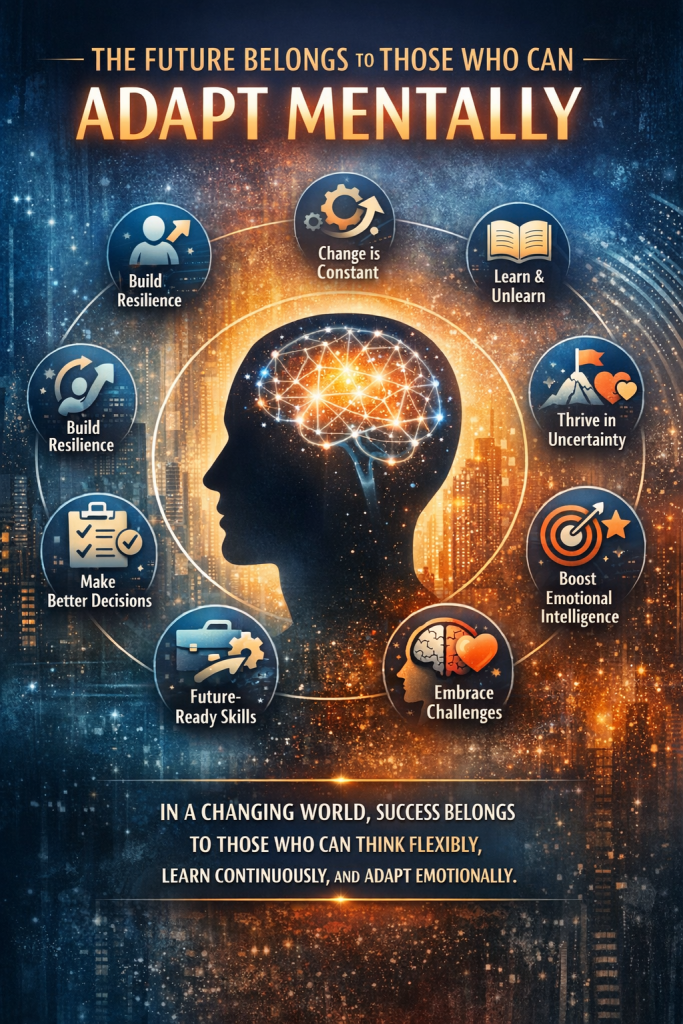
The Future Belongs to Those Who Can Adapt Mentally

In a rapidly changing world, success is no longer determined only by intelligence, talent, or experience. The ability to adapt mentally has become the most important life skill. Below are simple, clear points explaining why mental adaptability shapes the future.


1. Change Is Constant, Not Optional

Technology, workplaces, and lifestyles are evolving faster than ever. Those who mentally resist change experience stress and stagnation, while adaptable minds learn to adjust and move forward.


2. Mental Flexibility Enables Faster Learning

Adaptable individuals are open to unlearning old habits and acquiring new skills. This learning mindset allows them to stay relevant in education, careers, and personal growth.


3. Resilient Minds Handle Uncertainty Better

The future is unpredictable. Mental adaptability helps individuals remain calm during uncertainty, view challenges as temporary, and respond with problem-solving rather than panic.


4. Adaptability Strengthens Emotional Intelligence

Mentally adaptable people regulate emotions effectively, accept feedback positively, and adjust behavior based on situations. This improves relationships and leadership effectiveness.


5. Fixed Mindsets Limit Growth

A rigid mindset clings to comfort zones and fears failure. In contrast, adaptable minds see failure as feedback and change as an opportunity for improvement.


6. Mental Adaptation Supports Well-Being

Being mentally flexible reduces stress, anxiety, and burnout. Acceptance and adjustment protect mental health in high-pressure environments.


7. Future Careers Demand Cognitive Agility

Jobs of the future will require continuous upskilling. Mental adaptability enables individuals to transition across roles, industries, and technologies with confidence.


8. Adaptable Minds Make Better Decisions

Open-minded thinking allows individuals to evaluate situations objectively, consider alternatives, and make informed decisions even with limited information.


9. Growth Begins with Self-Awareness

Understanding one’s thoughts, beliefs, and emotional patterns is the first step toward mental adaptability. Awareness creates choice rather than automatic reactions.


10. Adaptability Is a Trainable Skill

Mental flexibility can be developed through reflection, lifelong learning, mindfulness, and embracing new experiences.


Conclusion

The future will not favor the strongest or the smartest, but those who can think flexibly, learn continuously, and adapt emotionally. Mental adaptability is no longer optional—it is the foundation for sustainable success and well-being in an uncertain world.

✨ The Quantum Leap: Small Changes That Create Big Shifts in Life

Life doesn’t always change through big decisions or dramatic moments.
Sometimes, it changes through tiny actions—small steps that create powerful results over time.
In quantum physics, a “quantum leap” is a small jump of energy that leads to a big transformation.
The same idea applies to our lives.

Here’s how small changes can create big shifts, just like a quantum leap.


🌟 1. Small Changes Create New Possibilities

In quantum theory, even a tiny shift in energy can move a particle to a completely new state.
In life, a small habit change can move you to a new version of yourself.

Example:

  • Reading for 10 minutes a day can slowly turn you into a knowledgeable, confident person.
  • Drinking one extra glass of water daily can improve your energy level.

🌟 2. Every Action Raises Your “Energy Level”

Quantum leaps happen when energy increases.
Similarly, when you make small improvements, your mindset, confidence, and lifestyle rise to a higher level.

Example:

  • Waking up just 15 minutes earlier each day may give you extra time to plan your day calmly.
  • Writing three things you’re grateful for shifts your emotional energy instantly.

🌟 3. You Don’t Need Big Motivation — Just Tiny Momentum

Quantum jumps don’t require huge force; they happen instantly when enough small energy builds up.
Tiny efforts create steady momentum.

Example:

  • Walking only 2,000 steps more each day leads to better health over months.
  • Learning one new English word daily improves communication without pressure.

🌟 4. Small Decisions Change Your Direction

Even the slightest shift in angle can change your destination completely—just like how a particle’s path changes with a tiny impulse.
Small decisions today create a new future.

Example:

  • Choosing to save ₹20 a day becomes ₹600 a month and ₹7,200 a year.
  • Choosing to reduce screen time by 10 minutes daily improves focus and sleep.

🌟 5. The Power of Changing Your Environment Slightly

In quantum physics, particles change behavior depending on their environment.
Similarly, your surroundings influence your habits and mindset.

Example:

  • Keeping fruits on your table helps you eat healthier.
  • Placing books near your bed encourages reading.

🌟 6. Small Mindset Shifts Lead to Big Emotional Growth

A slight shift in thinking can transform how you feel, behave, and respond.

Example:

  • Changing the thought “I can’t do this” to “I will try” opens new opportunities.
  • Replacing negative self-talk with kinder words reduces stress.

🌟 7. Small Daily Improvements Compound Over Time

Just like small energy additions create a quantum jump, small daily efforts compound into major life progress.

Example:

  • Practicing a skill for just 5 minutes a day leads to mastery over months.
  • Saving small amounts regularly builds financial stability.

✨ Final Thought

A quantum leap is not magic.
It is the result of consistent small steps that slowly build enough energy to create a big transformation.

You don’t need huge changes.
You just need to begin—with one small step today.

Push Forward, But Know When to Pivot

Success in any endeavor requires persistence, but it also demands adaptability. While pushing forward is essential for achieving goals, knowing when to pivot can be the difference between success and failure. Entrepreneurs, professionals, and even individuals in personal growth journeys must balance determination with flexibility to navigate challenges effectively.


1. What Does It Mean to “Push Forward”?

Pushing forward means staying committed to your goals despite setbacks. It involves:
✔️ Overcoming obstacles
✔️ Staying focused on long-term vision
✔️ Learning from failures and improving

🔹 Example:
Indian startup Zomato faced multiple rejections but continued refining its business model until it became a food-tech giant.


2. The Power of Persistence

Many success stories stem from unwavering persistence. People who achieve greatness often face years of struggle before breakthroughs.

✔️ Amitabh Bachchan – Rejected in Bollywood early on, but he kept pushing forward and became one of India’s biggest superstars.
✔️ KFC’s Colonel Sanders – His chicken recipe was rejected over 1,000 times before it became a global franchise.

Key Lesson: If you truly believe in your idea, keep refining and improving it instead of giving up too soon.


3. When Should You Pivot?

Pivoting means making a strategic shift in response to challenges, market changes, or new opportunities. Signs that it’s time to pivot include:
✔️ Constant failures with no measurable progress
✔️ Market demand is not aligning with your efforts
✔️ Competitors are moving ahead with better solutions

🔹 Example:
✔️ Instagram – Started as a check-in app called “Burbn,” but the founders noticed users were more interested in sharing photos, so they pivoted.
✔️ Flipkart – Initially an online bookstore, it pivoted into a full-fledged e-commerce platform to meet market demand.


4. How to Decide Whether to Push Forward or Pivot?

Here are key questions to ask:
✔️ Are you making consistent progress toward your goal?
✔️ Is there a real market need for your idea?
✔️ Can adjustments make your current strategy work, or is a major shift required?
✔️ Are you seeing incremental improvements, or is growth stagnating?

🔹 Example:
✔️ Netflix – Started as a DVD rental business but saw the rise of streaming and pivoted early. Today, it dominates the global entertainment industry.


5. The Balance Between Stubbornness and Flexibility

✔️ Be stubborn about your vision, but flexible about your strategy.
✔️ Be open to feedback, even if it means changing direction.
✔️ Embrace failure as a learning tool, not as a dead end.

🔹 Example:
✔️ OYO Rooms – Faced multiple setbacks but kept adapting its business model to meet market needs, making it one of India’s largest hospitality brands.


Final Thoughts: Adapt, Adjust, Achieve

Pushing forward is necessary for success, but knowing when to pivot is equally important. Smart leaders, entrepreneurs, and professionals recognize when to persist and when to change direction.

Stay determined, stay open to change, and success will follow.

Your Only Rival: Yesterday’s You

In a world driven by comparison and competition, it’s easy to get caught up in what others are doing. However, the most meaningful competition is the one you have with yourself. Let’s explore why focusing on personal growth rather than comparing yourself to others is the key to success and fulfillment.

1. Understanding Personal Growth

  • Personal growth is about becoming a better version of yourself.
  • It involves setting goals, overcoming challenges, and developing new skills that matter to you.

2. The Pitfalls of Comparison

  • Constantly comparing yourself to others can lead to feelings of inadequacy.
  • Everyone’s journey is different; what works for someone else might not work for you.

3. Setting Your Own Standards

  • Define what success means for you, based on your values and aspirations.
  • Focus on personal benchmarks that reflect your individual goals and progress.

4. Reflecting on Your Journey

  • Take time to reflect on where you were yesterday and how far you’ve come.
  • Keeping a journal can help track your progress and highlight areas for improvement.

5. Embracing Small Wins

  • Celebrate small achievements along the way; they contribute to your overall growth.
  • Recognizing progress, no matter how minor, fosters motivation and confidence.

6. Learning from Setbacks

  • Instead of viewing setbacks as failures, see them as opportunities to learn.
  • Each challenge faced and overcome strengthens your resilience and determination.

7. Fostering a Growth Mindset

  • Adopt a mindset that values learning and growth over perfection.
  • This perspective allows you to embrace challenges and view mistakes as part of the process.

8. Personal Accountability

  • Hold yourself accountable for your progress rather than focusing on external validation.
  • Accountability encourages you to take ownership of your growth journey.

9. Investing in Yourself

  • Prioritize self-care, education, and experiences that enrich your life.
  • Investing in yourself leads to personal fulfillment and long-term success.

10. The Journey Matters More Than the Destination

  • The path to self-improvement is ongoing; it’s about the journey, not just the end goals.
  • Embrace each step, learning and evolving along the way.

Final Thought

The only true competition is with yesterday’s you. Focus on your journey, celebrate your progress, and strive to be better every day. By competing with yourself, you unlock your potential and pave the way for a fulfilling and successful life.

You Get What You Fight For, Not What You Wish For

Understanding the Concept:

  • The phrase emphasizes that achieving goals requires action and effort, not just hopes or dreams.
  • It’s a reminder that success is earned through hard work, not simply wished for.

The Power of Action:

  • Simply wishing for something doesn’t lead to results. You need to take deliberate steps toward your objectives.
  • Action transforms dreams into reality and creates tangible results.

Setting Clear Goals:

  • Define what you truly want in life, whether it’s a career goal, personal development, or relationships.
  • Write down specific, measurable goals to keep you focused.
  • Break larger goals into smaller, actionable steps to make them more achievable.

Embracing Challenges:

  • Understand that obstacles are part of the journey. Fighting for your dreams means facing challenges head-on.
  • Learning to navigate difficulties builds character and perseverance.

Building Resilience:

  • Develop a resilient mindset to overcome setbacks. The fight for your goals will strengthen your character and determination.
  • Adopt a growth mindset: view challenges as opportunities for learning and improvement.

Taking Responsibility:

  • Own your choices and their outcomes. Recognize that your efforts directly impact your results.
  • Avoid blaming external factors; instead, focus on what you can control.

Staying Committed:

  • Consistency is key. Regularly work towards your goals, even when motivation wanes.
  • Create a routine that incorporates daily or weekly actions toward your goals.

Celebrating Progress:

  • Acknowledge and celebrate small victories along the way. This boosts morale and keeps you motivated.
  • Reflect on how far you’ve come to maintain perspective during tough times.

Adopting a Positive Mindset:

  • Cultivate optimism. A positive attitude helps you stay focused on your goals and keeps you motivated during challenges.
  • Practice gratitude to appreciate what you have while working toward what you want.

Learning from Failure:

  • Accept that failure is often part of the process. Each setback is an opportunity to learn and grow.
  • Analyze what went wrong, adjust your strategy, and keep moving forward.

Visualizing Success:

  • Use visualization techniques to imagine yourself achieving your goals. This can increase motivation and reinforce your commitment.
  • Create a vision board to serve as a constant reminder of what you’re fighting for.

Staying Flexible:

  • Be open to adjusting your plans as needed. Sometimes, the path to your goals may change unexpectedly.
  • Adaptability allows you to stay on track, even when faced with unforeseen circumstances.

Finding Your Why:

  • Identify your deeper motivations for pursuing your goals. Understanding your “why” can drive you to fight harder.
  • Write down your reasons for wanting to achieve your goals; revisit them when your motivation dips.

Conclusion:

  • Remember, wishing alone will not bring about change. It’s the effort and determination you invest in your goals that will ultimately lead to success.
  • Fight for what you desire, and you will see results! Taking action is the key to turning dreams into reality.

The Crucial Role of Rest in Enhancing Productivity

Many of us believe that the more hours we put into our work, the more productive we will be. However, this is a misconception. Rest, including sleep and regular breaks, plays a crucial role in enhancing productivity. Here’s why rest is important and how it can significantly improve your efficiency.

1. The Role of Sleep in Productivity

a. Cognitive Function

  • Memory Improvement: Sleep helps consolidate memories, making it easier to recall information.
  • Enhanced Problem-Solving: A well-rested brain is better at solving complex problems.
  • Boosted Creativity: Sleep fosters creative thinking and innovation.

b. Energy Levels

  • Sustained Energy: Sleep replenishes energy, allowing you to be active and alert throughout the day.
  • Preventing Fatigue: Adequate sleep prevents daytime sleepiness and fatigue.

c. Emotional Stability

  • Mood Regulation: Good sleep reduces mood swings and improves emotional stability.
  • Better Interpersonal Relations: Emotional stability leads to more harmonious interactions with colleagues and others.

2. The Benefits of Taking Breaks

a. Enhanced Focus

  • Improved Concentration: Short breaks help maintain focus and attention.
  • Mental Refreshment: Breaks provide a mental reset, preventing cognitive overload.

b. Stress Reduction

  • Lower Stress Levels: Regular breaks help manage and reduce stress.
  • Improved Mental Health: Taking breaks can alleviate anxiety and improve overall mental health.

c. Preventing Burnout

  • Avoiding Exhaustion: Breaks help prevent physical and mental exhaustion.
  • Sustained Performance: Regular breaks ensure long-term productivity and performance.

d. Physical Health Benefits

  • Reduced Eye Strain: Breaks from screens reduce eye strain and headaches.
  • Improved Posture: Moving around during breaks helps maintain good posture and reduces muscle tension.

3. Tips to Incorporate Rest into Your Routine

a. Prioritize Sleep

  • Consistent Sleep Schedule: Go to bed and wake up at the same time every day.
  • Relaxing Bedtime Routine: Engage in calming activities before bed, such as reading or meditation.
  • Sleep-Friendly Environment: Ensure your bedroom is dark, quiet, and cool.

b. Schedule Regular Breaks

  • Pomodoro Technique: Work for 25 minutes, then take a 5-minute break.
  • Longer Breaks: Take a 15-30 minute break every few hours for deeper rest.

c. Use Breaks Wisely

  • Physical Activity: Take a walk, stretch, or do light exercises.
  • Relaxation: Practice deep breathing, meditate, or enjoy a hobby.
  • Disconnect: Avoid checking emails or social media during breaks to fully recharge.

d. Listen to Your Body

  • Recognize Fatigue: Take breaks when you start feeling tired or unfocused.
  • Stay Hydrated and Nourished: Drink water and eat healthy snacks to maintain energy levels.

e. Micro-Breaks

  • Brief Pauses: Take short 1-2 minute breaks to stretch or close your eyes.
  • Mini-Meditations: Spend a minute practicing mindfulness or deep breathing.

Conclusion

Rest is not a luxury but a necessity for maintaining high productivity levels. Adequate sleep and regular breaks are fundamental for cognitive function, energy restoration, emotional stability, focus, stress reduction, physical health, and preventing burnout. By prioritizing rest, you can enhance your productivity, improve your overall well-being, and achieve a healthier work-life balance. Remember, sometimes the most productive thing you can do is to take a break.