Everything Happens for a Reason

In everyday life, we often hear the phrase “Everything happens for a reason.” In Islam, this idea is deeply rooted in the belief of Qadr (Divine Decree)—that Allah has a perfect plan for everything that happens in our lives. Even when we don’t understand it, there is always wisdom behind it.


🌙 1. Allah Knows What We Do Not Know

Sometimes we feel confused, hurt, or disappointed when things don’t go our way. But Islam teaches us that Allah’s knowledge is far greater than ours.

Quran Verse:

“Perhaps you dislike something and it is good for you; and perhaps you love something and it is bad for you. And Allah knows, while you do not know.”
(Surah Al-Baqarah 2:216)

Meaning:
What we think is bad may actually protect us, and what we desire may not be good for us. Allah sees the full picture—we only see a small part.


🌱 2. Every Test Has a Purpose

Difficulties are not punishments, but tests meant to strengthen our faith and character.

Quran Verse:

“Do people think they will be left alone because they say, ‘We believe,’ and will not be tested?”
(Surah Al-Ankabut 29:2)

Meaning:
Life’s challenges are part of our journey. They help us grow, become patient, and get closer to Allah.


💭 3. Hardship Comes with Ease

No pain or struggle is permanent. Allah promises relief along with difficulty.

Quran Verse:

“Indeed, with hardship comes ease.”
(Surah Ash-Sharh 94:6)

Meaning:
After every difficulty, ease will come—sometimes in ways we don’t expect.


🤲 4. Allah’s Plan is Always the Best

Even when our plans fail, it doesn’t mean life is failing. It means Allah is redirecting us to something better.

Quran Verse:

“And Allah is the best of planners.”
(Surah Aal-e-Imran 3:54)

Meaning:
We plan based on what we want, but Allah plans based on what is best for us.


🌸 5. Nothing Happens Without Allah’s Permission

Every event in our life—big or small—is part of Allah’s decree.

Quran Verse:

“No disaster strikes except by permission of Allah.”
(Surah At-Taghabun 64:11)

Meaning:
This reminds us that everything is under Allah’s control, and nothing happens randomly.


🕊️ 6. Trust (Tawakkul) Brings Peace

When we truly trust Allah, our hearts become calm even in uncertain situations.

Quran Verse:

“And whoever relies upon Allah – then He is sufficient for him.”
(Surah At-Talaq 65:3)

Meaning:
When we depend on Allah, He takes care of our needs in ways we cannot imagine.


🌟 7. Real-Life Reflection

  • You didn’t get the job → Maybe a better opportunity is coming
  • A relationship ended → Maybe Allah is protecting your heart
  • You faced failure → Maybe it is preparing you for success

What feels like a setback today may be a blessing tomorrow.

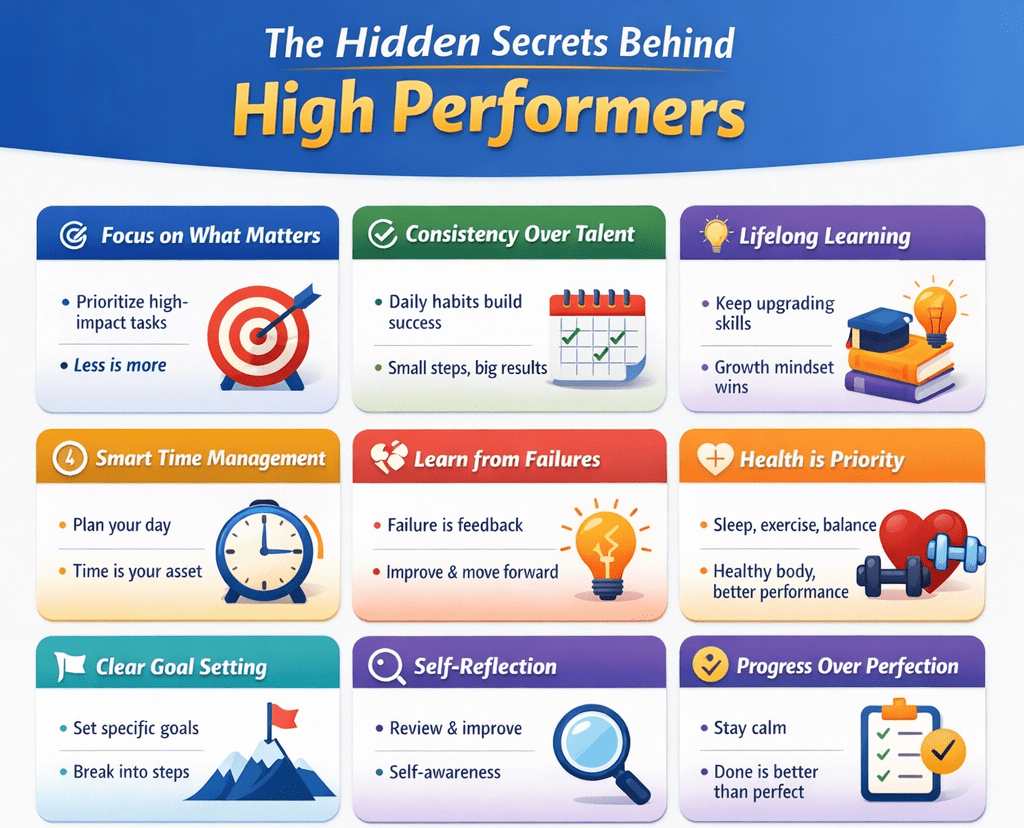
The Hidden Secrets Behind High Performers

🔹 1. They Focus on What Truly Matters

  • High performers don’t do everything — they do the right things.
  • They prioritize high-impact tasks over busy work.

👉 Secret: Saying “no” is more powerful than saying yes.


🔹 2. Consistency Beats Talent

  • They don’t rely on motivation — they build daily habits.
  • Small actions done every day create big results.

🇮🇳 Indian Insight: CBSE toppers emphasized regular study and routine, not last-minute effort.


🔹 3. They Keep Learning Always

  • High performers are lifelong learners.
  • They upgrade skills continuously to stay ahead.

👉 Secret: Growth mindset > Fixed mindset


🔹 4. They Manage Time Like Experts

  • They plan their day with clear priorities.
  • They avoid distractions and focus on deep work.

👉 Secret: Time is treated as an asset, not something to waste.


🔹 5. They Stay Strong During Failures

  • They see failure as feedback, not defeat.
  • They adapt quickly and keep moving forward.

🔹 6. They Take Care of Their Health

  • Physical and mental health are top priorities.
  • Good sleep, exercise, and balance improve performance.

🔹 7. They Set Clear Goals

  • They break big goals into smaller steps.
  • They track progress regularly.

👉 Secret: Clarity creates confidence.


🔹 8. They Reflect and Improve

  • They regularly review what worked and what didn’t.
  • This helps them improve continuously.

👉 Secret: Self-awareness is a superpower.


🔹 9. They Surround Themselves with the Right People

  • They build networks with positive and growth-oriented people.
  • Mentors and peers influence success.

👉 Secret: Your environment shapes your results.


🔹 10. They Stay Calm, Not Perfect

  • They don’t chase perfection — they focus on progress.
  • Balance and mental peace improve performance.

✅ Final Thought

👉 High performers are not “extraordinary people” —
they simply follow extraordinary habits consistently.

Success is not a secret — it’s a system.

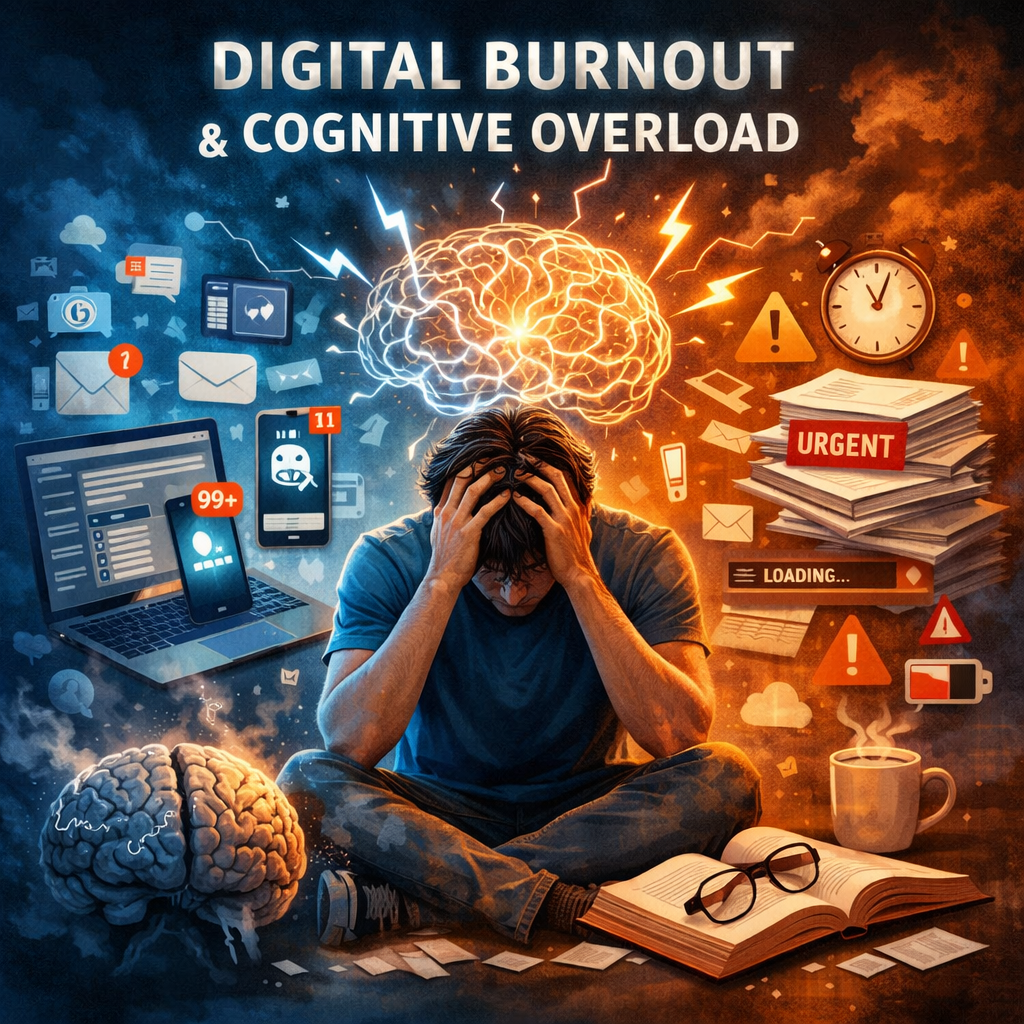
Digital Burnout and Cognitive Overload

Introduction

In today’s digital world, technology has become an inseparable part of our daily lives. From work and education to communication and entertainment, screens dominate almost every moment. While digital tools improve efficiency and connectivity, excessive and continuous exposure to them puts heavy pressure on the human mind. This growing mental strain leads to digital burnout and cognitive overload, affecting focus, emotional balance, productivity, and overall well-being. Understanding this issue is essential to creating healthier digital habits and protecting mental health in the modern age.

1. What is Digital Burnout?

  • Digital burnout happens when we feel mentally tired due to excessive screen time.
  • It is caused by constant use of phones, laptops, and digital platforms.

2. What is Cognitive Overload?

  • Cognitive overload occurs when the brain receives more information than it can process.
  • Notifications, emails, messages, and multitasking overload our thinking capacity.

3. Why is it Increasing Today?

  • Continuous online work and virtual meetings
  • Social media scrolling without breaks
  • Pressure to stay available and respond instantly
  • Information overload from news and digital content

4. Common Signs and Symptoms

  • Difficulty concentrating and remembering things
  • Mental fatigue and constant tiredness
  • Irritability and mood swings
  • Headaches and sleep problems
  • Loss of motivation and productivity

5. Impact on Mental Health

  • Increased stress and anxiety
  • Reduced attention span
  • Emotional exhaustion
  • Feeling overwhelmed even with simple tasks

6. Impact on Work and Studies

  • Lower efficiency and creativity
  • Increased errors and poor decision-making
  • Reduced learning capacity
  • Declining engagement and interest

7. How Digital Burnout Affects Daily Life

  • Less face-to-face interaction
  • Reduced quality time with family
  • Constant mental distraction
  • Difficulty enjoying offline moments

8. Simple Ways to Reduce Digital Burnout

  • Take regular screen breaks
  • Limit unnecessary notifications
  • Follow single-tasking instead of multitasking
  • Set boundaries for work and personal time
  • Practice digital detox regularly

9. Role of Mindfulness and Rest

  • Short breathing exercises calm the mind
  • Adequate sleep restores cognitive capacity
  • Mindful usage of technology improves focus

10. Conclusion

  • Digital tools are helpful, but overuse harms mental well-being.
  • Managing screen time and information flow is essential for a healthy mind.
  • Balance, awareness, and conscious digital habits can prevent burnout.

Closing Quote:
“Resting the mind is not a luxury—it is a necessity in a digital world.”

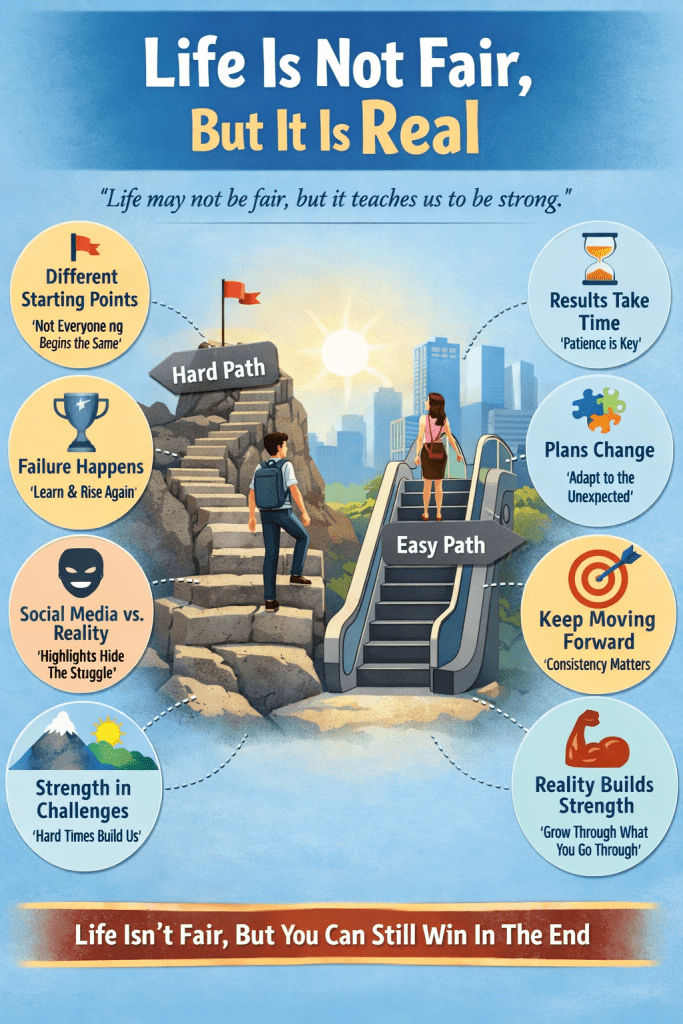
Life Is Not Fair, But It Is Real

Life often looks unfair when we compare our journey with others. Some people move ahead quickly, while others struggle despite hard work. Accepting this truth helps us grow stronger and wiser.


1. Everyone Starts From a Different Place

Not all people begin life with the same opportunities, support, or resources. Comparing paths only creates frustration.

2. Hard Work Doesn’t Always Give Instant Results

Effort is important, but results may take time. Life tests patience before giving rewards.

3. Talent Alone Is Not Enough

Skills matter, but consistency, discipline, and resilience matter more in real life.

4. Failure Is a Part of the Process

Mistakes and setbacks are not signs of weakness. They are lessons that shape character.

5. Life Doesn’t Follow Our Plans

Unexpected changes are normal. Learning to adjust is a real-life skill.

6. Comparison Steals Peace

Social media shows highlights, not struggles. Every success has an unseen story.

7. Growth Comes From Acceptance

When we accept reality instead of resisting it, we find clarity and strength.

8. Strength Is Built in Difficult Times

Challenges teach responsibility, humility, and emotional maturity.

9. Life Rewards Those Who Keep Going

Consistency and persistence matter more than perfection.

10. Reality Makes Us Stronger

Life may not be fair, but it prepares us to face the world with courage.


Closing Thought

Life is not meant to be easy—it is meant to be lived, learned from, and grown through.

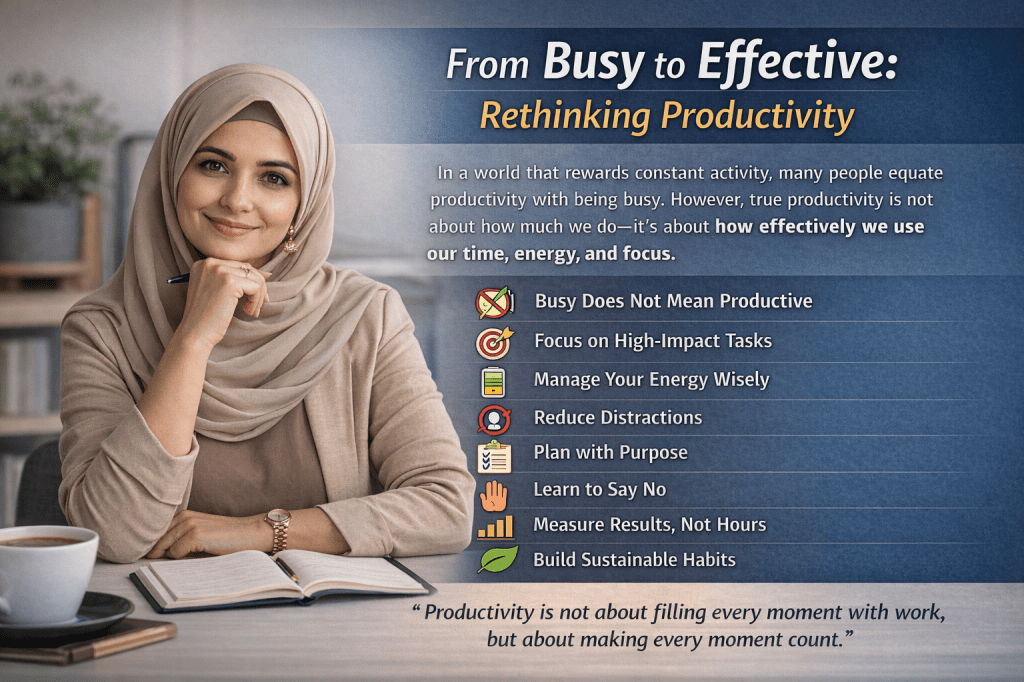
From Busy to Effective: Rethinking Productivity

Introduction

In a world that rewards constant activity, many people equate productivity with being busy. Long to-do lists, packed schedules, and endless notifications create the illusion of progress. However, true productivity is not about how much we do—it is about how effectively we use our time, energy, and focus. Moving from busyness to effectiveness requires a shift in mindset, not just better tools.


Key Ideas Explained in Simple Points

1. Being Busy Is Easy, Being Effective Is Intentional

  • Busyness fills time; effectiveness creates results
  • Effective people choose tasks deliberately
  • Outcomes matter more than effort

2. Productivity Begins in the Mind

  • Clear thinking leads to better decisions
  • Mental clutter reduces focus and efficiency
  • Calm minds work faster and better

3. Focus on What Truly Matters

  • Not all tasks deserve equal attention
  • High-impact tasks move goals forward
  • Prioritization reduces stress and overload

4. Time Alone Is Not Enough

  • Energy and attention shape performance
  • Working when mentally fresh improves quality
  • Rest is essential for sustained productivity

5. One Task at a Time

  • Multitasking reduces accuracy and speed
  • Single-tasking improves effectiveness
  • Fewer interruptions mean better results

6. Simple Planning Makes a Big Difference

  • Plan the day with clear priorities
  • Limit goals to what is realistically achievable
  • Review progress regularly

Conclusion

True productivity is not about doing more—it is about doing what matters most with clarity and purpose. When the mind is focused and priorities are clear, effectiveness replaces exhaustion, and success becomes sustainable.


Closing Quote

“Productivity is not about filling every moment with work, but about making every moment count.”

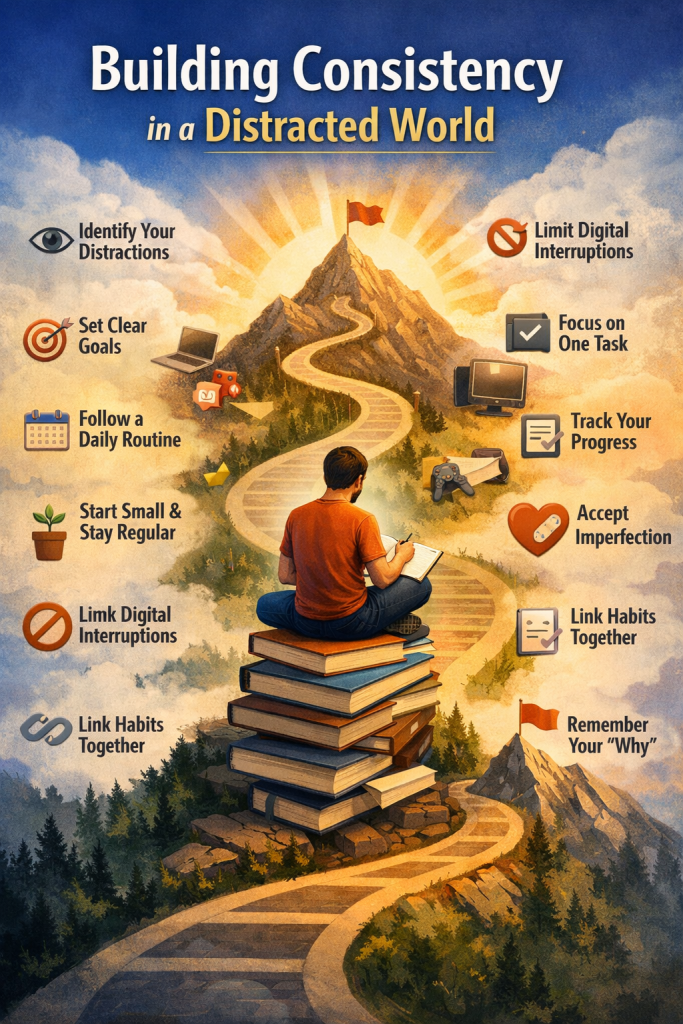
Building Consistency in a Distracted World

In today’s fast-paced digital environment, maintaining consistency has become increasingly difficult. Constant notifications, information overload, and competing priorities often disrupt focus. However, consistency remains a critical factor for personal growth, productivity, and long-term success. The following simple points explain how consistency can be built despite daily distractions.


1. Understand What Distracts You

Identify the main sources of distraction in your daily routine, such as mobile phones, social media, or multitasking. Awareness is the first step toward control.


2. Set Clear and Realistic Goals

Consistency improves when goals are specific and achievable. Break large goals into small, manageable tasks to avoid feeling overwhelmed.


3. Create a Fixed Routine

A regular schedule helps train the mind. Performing tasks at the same time each day builds habit strength and reduces decision fatigue.


4. Start Small but Stay Regular

Small actions done daily are more effective than occasional intense efforts. Even limited progress, when repeated, leads to meaningful results over time.


5. Limit Digital Interruptions

Turn off unnecessary notifications and allocate specific times for checking messages or social media. Controlled usage improves concentration.


6. Focus on One Task at a Time

Multitasking reduces efficiency and consistency. Single-tasking improves quality of work and builds discipline.


7. Track Your Progress

Maintain a simple checklist or journal to record daily efforts. Tracking creates accountability and motivates continuation.


8. Accept Imperfection and Continue

Missing a day is not failure. The key to consistency is returning to the routine without guilt or self-criticism.


9. Build Supportive Habits

Link new habits to existing ones, such as reading after dinner or planning the next day before sleeping. Habit stacking strengthens consistency.


10. Remember Your Purpose

Revisit the reason behind your goals. A clear purpose provides motivation during periods of low energy or distraction.


Conclusion

In a distracted world, consistency is not about perfection but persistence. By making small, intentional changes and staying committed, anyone can develop consistent habits that lead to long-term success and personal satisfaction.

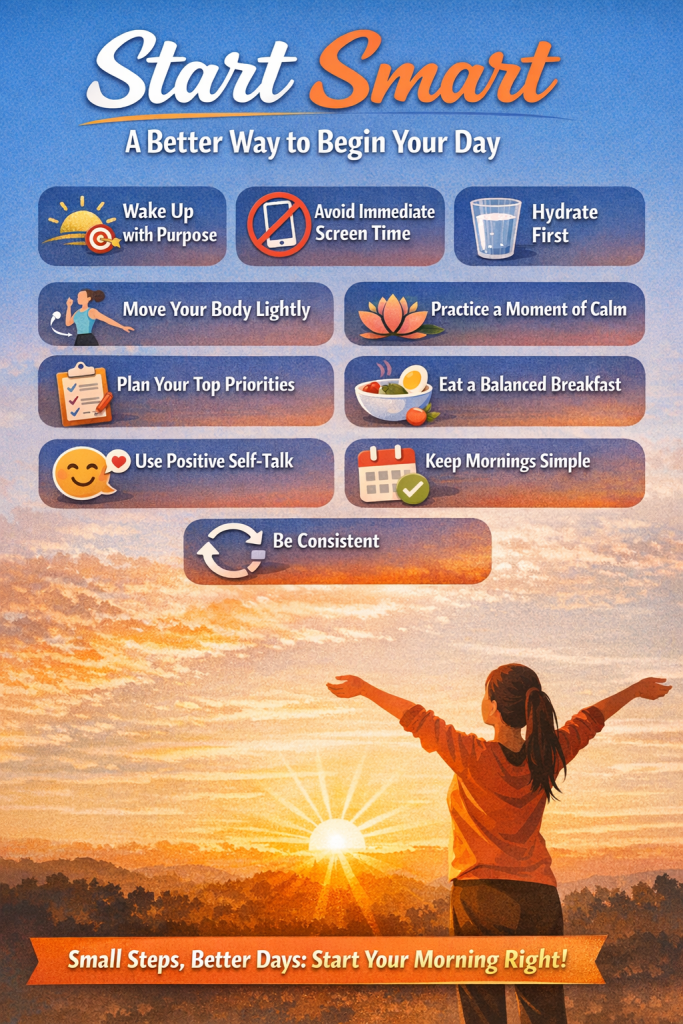
Start Smart: A Better Way to Begin Your Day

How you begin your morning often determines how effective, calm, and focused the rest of your day will be. A smart start does not require drastic changes. Small, intentional actions can create clarity, energy, and direction. Below are simple, practical points to help you start your day better.


1. Wake Up with Purpose

Avoid rushing out of bed. Take a moment to remind yourself of one important task or goal for the day. This creates direction and reduces mental clutter.


2. Avoid Immediate Screen Time

Checking your phone immediately can increase stress and distraction. Give your mind at least 15–20 minutes before engaging with messages or social media.


3. Hydrate First

Drinking water soon after waking up helps activate your body, improves concentration, and supports overall health.


4. Move Your Body Lightly

Simple stretching, a short walk, or light exercise boosts blood circulation and helps you feel more alert and positive.


5. Practice a Moment of Calm

Spend a few minutes in silence, deep breathing, or prayer/meditation. This improves emotional balance and mental clarity.


6. Plan Your Top Priorities

List two or three important tasks for the day. Clear priorities reduce overwhelm and improve productivity.


7. Eat a Balanced Breakfast

A healthy breakfast supports energy levels and concentration. Avoid skipping meals or relying only on caffeine.


8. Use Positive Self-Talk

Begin your day with encouraging thoughts. Confidence in the morning strengthens resilience throughout the day.


9. Keep Mornings Simple

Avoid overloading your schedule early in the day. A calm morning sets the tone for better decision-making.


10. Be Consistent

A smart start works best when practiced daily. Consistency turns good habits into lasting routines.


Conclusion

Starting smart is about being intentional, not perfect. A few mindful steps each morning can lead to improved focus, reduced stress, and better outcomes—both personally and professionally. When you begin your day with clarity, the rest of the day follows naturally.

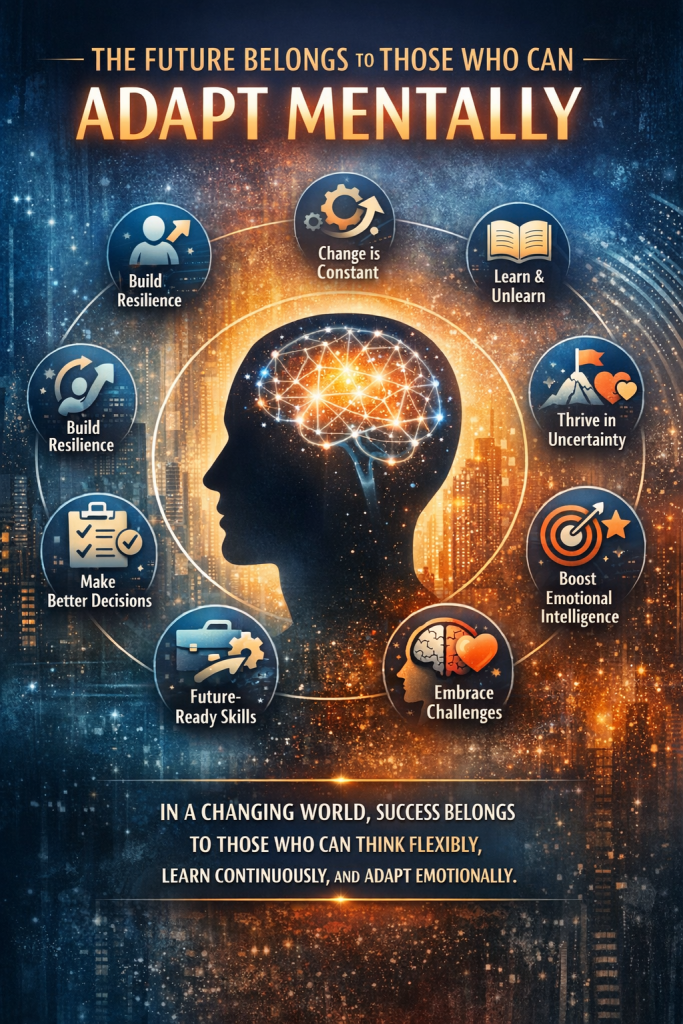
The Future Belongs to Those Who Can Adapt Mentally

In a rapidly changing world, success is no longer determined only by intelligence, talent, or experience. The ability to adapt mentally has become the most important life skill. Below are simple, clear points explaining why mental adaptability shapes the future.


1. Change Is Constant, Not Optional

Technology, workplaces, and lifestyles are evolving faster than ever. Those who mentally resist change experience stress and stagnation, while adaptable minds learn to adjust and move forward.


2. Mental Flexibility Enables Faster Learning

Adaptable individuals are open to unlearning old habits and acquiring new skills. This learning mindset allows them to stay relevant in education, careers, and personal growth.


3. Resilient Minds Handle Uncertainty Better

The future is unpredictable. Mental adaptability helps individuals remain calm during uncertainty, view challenges as temporary, and respond with problem-solving rather than panic.


4. Adaptability Strengthens Emotional Intelligence

Mentally adaptable people regulate emotions effectively, accept feedback positively, and adjust behavior based on situations. This improves relationships and leadership effectiveness.


5. Fixed Mindsets Limit Growth

A rigid mindset clings to comfort zones and fears failure. In contrast, adaptable minds see failure as feedback and change as an opportunity for improvement.


6. Mental Adaptation Supports Well-Being

Being mentally flexible reduces stress, anxiety, and burnout. Acceptance and adjustment protect mental health in high-pressure environments.


7. Future Careers Demand Cognitive Agility

Jobs of the future will require continuous upskilling. Mental adaptability enables individuals to transition across roles, industries, and technologies with confidence.


8. Adaptable Minds Make Better Decisions

Open-minded thinking allows individuals to evaluate situations objectively, consider alternatives, and make informed decisions even with limited information.


9. Growth Begins with Self-Awareness

Understanding one’s thoughts, beliefs, and emotional patterns is the first step toward mental adaptability. Awareness creates choice rather than automatic reactions.


10. Adaptability Is a Trainable Skill

Mental flexibility can be developed through reflection, lifelong learning, mindfulness, and embracing new experiences.


Conclusion

The future will not favor the strongest or the smartest, but those who can think flexibly, learn continuously, and adapt emotionally. Mental adaptability is no longer optional—it is the foundation for sustainable success and well-being in an uncertain world.

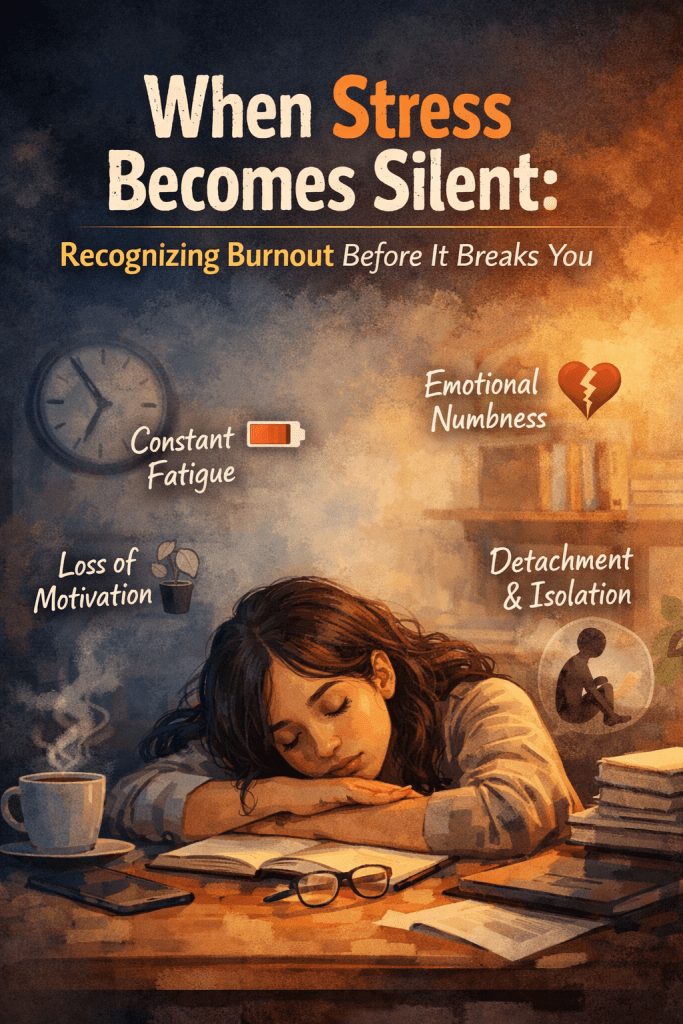
When Stress Becomes Silent: Recognizing Burnout Before It Breaks You

Introduction

Stress is often visible. We feel tired, worried, or overwhelmed and we talk about it.
Burnout, however, is different. It grows quietly. Many people do not realize they are burned out until their health, motivation, or relationships begin to suffer. Understanding early signs of burnout can help us take action before it becomes serious.


What Is Silent Burnout?

Silent burnout happens when prolonged stress is ignored or normalized. A person may continue working, meeting responsibilities, and appearing “fine” while internally feeling drained and disconnected.

It is not sudden. It develops slowly due to continuous pressure without enough rest, emotional support, or recovery.


Early Signs You Should Not Ignore

  • Constant tiredness even after rest
  • Loss of interest in work or daily activities
  • Feeling emotionally numb or detached
  • Irritability over small issues
  • Difficulty concentrating or making decisions
  • Frequent headaches, body pain, or sleep problems
  • Feeling unappreciated or hopeless

These signs are often dismissed as “just stress,” but they may indicate burnout.


Why Burnout Goes Unnoticed

  • We get used to being busy all the time
  • We believe taking rest is a weakness
  • We prioritize work over health
  • We feel guilty for slowing down
  • Others praise us for “handling everything”

Over time, this mindset makes burnout invisible.


Difference Between Stress and Burnout

  • Stress: Too many demands, but you still care
  • Burnout: Emotional exhaustion, loss of motivation, and feeling empty

Stress makes you feel overloaded. Burnout makes you feel drained and disconnected.


How to Prevent Burnout Early

  • Take regular breaks without guilt
  • Set realistic limits on work and responsibilities
  • Learn to say no when needed
  • Talk openly about how you feel
  • Prioritize sleep, nutrition, and physical activity
  • Do at least one activity daily that brings calm or joy

Small changes practiced consistently make a big difference.


When to Seek Support

If exhaustion, sadness, or detachment lasts for weeks, professional help is important. Speaking to a counselor, mentor, or healthcare professional is a sign of strength, not weakness.


Final Thoughts

Burnout does not announce itself loudly. It whispers through fatigue, silence, and loss of joy. Listening early can protect your mental and physical well-being.

Taking care of yourself is not optional. It is essential for long-term success and a healthy life.

Daily Stress vs. Chronic Stress: Knowing the Difference

Introduction

Stress is a part of everyday life. Deadlines, responsibilities, and unexpected situations often create pressure. However, not all stress is the same. Understanding the difference between daily stress and chronic stress helps us manage our mental health better and prevent long-term harm.


What Is Daily Stress?

Daily stress is short-term and usually linked to routine activities or temporary challenges.

Common causes:

  • Tight schedules or deadlines
  • Exams, meetings, or presentations
  • Traffic, minor conflicts, or small setbacks

Key characteristics:

  • Lasts for a short period
  • Reduces once the situation is resolved
  • Can sometimes improve focus and motivation

Example:
Feeling nervous before an exam but relaxed once it is over.


What Is Chronic Stress?

Chronic stress is long-lasting and occurs when stressful situations continue without relief.

Common causes:

  • Ongoing financial problems
  • Long-term work pressure
  • Family conflicts or caregiving responsibilities
  • Unresolved emotional issues

Key characteristics:

  • Persists for weeks or months
  • Feels constant and overwhelming
  • Affects both mental and physical health

Example:
Feeling anxious and exhausted every day due to prolonged work pressure.


Key Differences Between Daily and Chronic Stress

  • Duration:
    Daily stress is temporary; chronic stress is continuous.
  • Impact:
    Daily stress is manageable; chronic stress is harmful.
  • Recovery:
    Daily stress fades with rest; chronic stress does not easily go away.
  • Health effects:
    Chronic stress may lead to anxiety, depression, sleep issues, and fatigue.

Why Knowing the Difference Matters

  • Helps you recognize when stress becomes unhealthy
  • Encourages timely self-care and support
  • Prevents burnout and long-term mental health issues

Ignoring chronic stress can slowly affect emotional well-being, relationships, and overall quality of life.


Simple Ways to Manage Stress

  • Practice deep breathing or mindfulness
  • Maintain a healthy daily routine
  • Take short breaks and rest adequately
  • Share concerns with trusted people
  • Seek professional help when stress feels constant

Final Thoughts

Stress is unavoidable, but suffering is not. While daily stress is a normal part of life, chronic stress is a warning sign that should not be ignored. By understanding the difference, we can take better care of our minds and lead healthier, more balanced lives.