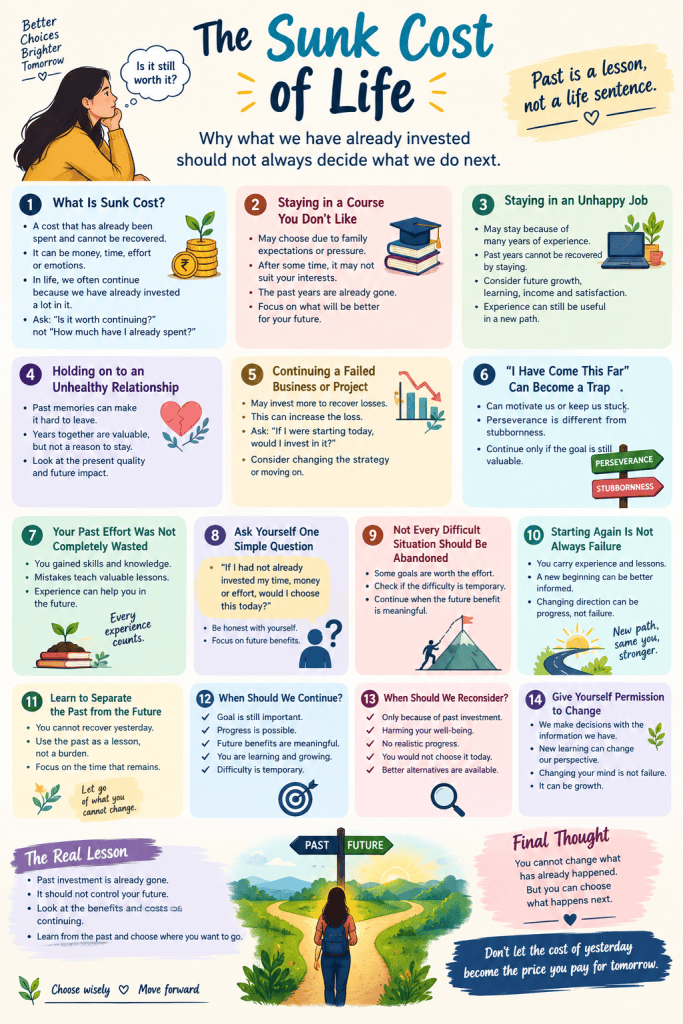
The Sunk Cost of Life

Why what we have already invested should not always decide what we do next

1. What Is Sunk Cost?

  • Sunk cost means a cost that has already been spent and cannot be recovered.
  • It may be money, time, effort or emotional energy.
  • In economics, sunk costs should not influence future decisions.
  • In life, we often continue something simply because we have already invested a lot in it.
  • The important question is not “How much have I already spent?”, but “Is it worth continuing?”

2. Staying in a Course You Don’t Like

  • A student may choose a course because of family expectations or personal circumstances.
  • After some time, she may realise that the course does not match her interests.
  • She may think, “I have already spent two years, so I cannot change.”
  • But the two years have already passed.
  • The better question is: “What will be the best choice for my future?”
  • Changing direction does not mean that the previous years were completely wasted.

3. Staying in an Unhappy Job

  • Some people remain in an uncomfortable job because they have worked there for many years.
  • They may feel that leaving means wasting their previous experience.
  • But past years cannot be recovered by staying in the same situation.
  • Consider future salary, growth, learning opportunities and job satisfaction.
  • Experience gained from the old job can still be useful in a new career.
  • Sometimes moving forward requires accepting that a change is necessary.

4. Holding on to an Unhealthy Relationship

  • People may stay in difficult relationships because of the years they have already invested.
  • They may think, “We have been together for so long.”
  • Shared memories and emotions can make decisions difficult.
  • However, past time should not automatically determine the future.
  • Consider the present quality of the relationship and its impact on both people.
  • A meaningful past can be respected without being forced to continue forever.

5. Continuing a Failed Business or Project

  • An entrepreneur may continue investing money in a business that is not performing well.
  • The reason may be: “I have already invested so much.”
  • Continuing to invest only to recover previous losses can make the situation worse.
  • Analyse the future potential of the business objectively.
  • Ask: “If I were starting this today, would I invest in it?”
  • Sometimes changing the strategy or stopping the project is the wiser decision.

6. “I Have Come This Far” Can Become a Trap

  • “I have come this far” can sometimes motivate us.
  • But it can also prevent us from making a necessary change.
  • Perseverance means continuing because the goal is still valuable.
  • Sunk-cost thinking means continuing mainly because of past investment.
  • Difficult does not always mean wrong.
  • But continuing something only because of the past may not be a wise decision.

7. Your Past Effort Was Not Completely Wasted

  • Leaving something does not mean that everything you did was useless.
  • Every experience can provide knowledge.
  • Mistakes can teach valuable lessons.
  • Difficult situations can develop patience and confidence.
  • A failed business can teach you what not to do next time.
  • A difficult job can give you skills that are useful elsewhere.
  • The experience remains, even when the original plan changes.

8. Ask Yourself One Simple Question

When you feel stuck, ask:

“If I were starting today, would I choose this again?”

  • If the answer is yes, continuing may be worthwhile.
  • If the answer is no, understand why.
  • Think about future benefits rather than only past investment.
  • Separate your current decision from your previous decision.
  • This simple question can help you make a more objective choice.

9. Not Every Difficult Situation Should Be Abandoned

  • Sunk-cost thinking should not become an excuse for quitting everything.
  • Some valuable goals require time and patience.
  • Education, career development and business growth may involve temporary difficulties.
  • Ask whether the difficulty is temporary or permanent.
  • Consider whether meaningful progress is still possible.
  • Continue when the future benefit is worth the effort.

10. Starting Again Is Not Always Failure

  • Changing direction can feel like starting from zero.
  • But you are not actually starting from zero.
  • You already have experience, knowledge and lessons from the past.
  • A new beginning can be based on better understanding.
  • Changing your decision after learning new information can be a sign of maturity.
  • Starting again can sometimes be a smarter form of moving forward.

11. Learn to Separate the Past from the Future

  • We cannot change yesterday.
  • We cannot recover every hour, rupee or opportunity we have already spent.
  • But we can decide how to use our future.
  • Past mistakes should become lessons, not permanent burdens.
  • Do not spend more of your future simply to justify a past decision.
  • Focus on the choices that can improve your present and future.

12. When Should We Continue?

Continue when:

  • The goal is still important to you.
  • Progress is possible.
  • The future benefits are meaningful.
  • You are learning and improving.
  • The difficulties are temporary.
  • The effort is still reasonable compared with the expected result.

13. When Should We Reconsider?

Reconsider when:

  • You are continuing only because of your past investment.
  • The situation is repeatedly harming you.
  • There is no realistic progress.
  • You would not choose the same path if you were starting today.
  • Better alternatives are available.
  • Fear of change is the main reason you are staying.

14. Give Yourself Permission to Change

  • We make decisions based on the information available at that time.
  • New experiences can change our understanding.
  • A decision that was right five years ago may not be right today.
  • Changing your mind does not always mean you failed.
  • It can mean that you have learned something new.
  • Growth sometimes requires changing direction.

15. The Real Lesson of Sunk Cost

  • Past investment is already gone.
  • It should not automatically determine future choices.
  • Look at the expected benefits and costs of continuing.
  • Learn from the past without becoming trapped by it.
  • Make decisions based on where you want to go, not only on where you have been.
  • Your future deserves a fresh evaluation.

🌱 Final Thought

  • You cannot change the time you have already spent.
  • You cannot recover every failed opportunity.
  • But you can decide what you do with your remaining time.
  • You can change your course.
  • You can try again.
  • You can choose differently.

Your past is a lesson, not a life sentence.

“Don’t let the cost of yesterday become the price you pay for tomorrow.”

The Journey of a Thousand Miles Begins with One Step

Introduction

Starting any big journey or achieving a significant goal can feel overwhelming. The key to success lies in taking that first step. No matter how daunting the task may seem, breaking it down into small, manageable steps can make it achievable. Here are some simple and effective ways to start and stay motivated on your journey.

1. Start Small

  • Focus on the first step to avoid feeling overwhelmed.
  • Quote: “The journey of a thousand miles begins with one step.” – Lao Tzu

2. Embrace the Process

  • Value the journey and lessons learned along the way.
  • Quote: “Success is a journey, not a destination.” – Arthur Ashe

3. Overcome Fear

  • Break the cycle of inaction by starting.
  • Quote: “You don’t have to see the whole staircase, just take the first step.” – Martin Luther King Jr.

4. Stay Persistent

  • Keep moving forward, even slowly.
  • Quote: “It does not matter how slowly you go as long as you do not stop.” – Confucius

5. Set Clear Goals

  • Break goals into manageable steps and celebrate progress.
  • Quote: “Setting goals is the first step in turning the invisible into the visible.” – Tony Robbins

6. Learn Continuously

  • Use every experience as a learning opportunity.
  • Quote: “The only real mistake is the one from which we learn nothing.” – Henry Ford

7. Build Confidence

  • Each step enhances skills and confidence.
  • Quote: “Do the thing you think you cannot do.” – Eleanor Roosevelt

8. Stay Flexible

  • Adapt plans as needed to overcome obstacles.
  • Quote: “The measure of intelligence is the ability to change.” – Albert Einstein

9. Seek Support

  • Reach out for guidance and encouragement.
  • Quote: “We rise by lifting others.” – Robert Ingersoll

10. Maintain Positivity

  • Stay resilient and believe in your success.
  • Quote: “Keep your face always toward the sunshine.” – Walt Whitman

11. Visualize Success

  • Keep your end goal in mind for motivation.
  • Quote: “If you can dream it, you can do it.” – Walt Disney

12. Develop Routine

  • Establish a daily routine that supports your goals.
  • Quote: “We are what we repeatedly do.” – Aristotle

13. Celebrate Milestones

  • Recognize and celebrate your progress.
  • Quote: “The more you praise and celebrate your life, the more there is in life to celebrate.” – Oprah Winfrey

14. Reflect Regularly

  • Reflect on your progress and adjust plans as needed.
  • Quote: “Without reflection, we go blindly on our way.” – Margaret J. Wheatley

15. Practice Patience

  • Be patient and trust the process.
  • Quote: “Patience is not the ability to wait, but the ability to keep a good attitude while waiting.” – Joyce Meyer

16. Cultivate Gratitude

  • Appreciate your progress and the journey.
  • Quote: “Gratitude turns what we have into enough.” – Aesop

17. Stay Healthy

  • Maintain physical and mental health for sustained progress.
  • Quote: “To keep the body in good health is a duty.” – Buddha

18. Inspire Others

  • Share your journey to motivate others.
  • Quote: “Be the change that you wish to see in the world.” – Mahatma Gandhi

19. Track Progress

  • Keep a journal or log of your steps and milestones.
  • Quote: “What gets measured gets managed.” – Peter Drucker

20. Stay Focused

  • Avoid distractions and stay committed to your path.
  • Quote: “Focus on the journey, not the destination. Joy is found not in finishing an activity but in doing it.” – Greg Anderson

21. Embrace Failure

  • View setbacks as opportunities for growth.
  • Quote: “Failure is simply the opportunity to begin again, this time more intelligently.” – Henry Ford

By incorporating these principles into your life, you can embark on any journey with confidence and determination. Remember, every significant accomplishment starts with that all-important first step.

The Best Way to Predict the Future is to Create It

Taking charge of your future is an empowering approach to ensuring success and fulfillment. Here’s a comprehensive guide to help you shape the future you desire:

1. Set Clear Goals

  • Define Your Vision: Understand what you truly want in life, both personally and professionally.
  • SMART Goals: Make sure your goals are Specific, Measurable, Achievable, Relevant, and Time-bound. For example, instead of saying “I want to get fit,” say “I will run a 5K race within six months.”

2. Develop a Plan

  • Action Steps: Break down your goals into small, manageable tasks.
  • Timeline: Create a schedule to complete each task. Use tools like calendars, planners, or project management apps to stay organized.

3. Take Initiative

  • Start Now: Don’t procrastinate. The perfect moment is a myth; start working towards your goals immediately.
  • Consistency: Dedicate time daily or weekly to work on your goals. Consistency builds momentum.

4. Stay Persistent

  • Overcome Obstacles: Understand that setbacks are part of the journey. Learn from them and keep going.
  • Stay Motivated: Keep your reasons for achieving your goals at the forefront of your mind. This will help you stay motivated during tough times.

5. Learn Continuously

  • Education: Invest in learning. Read books, take courses, attend seminars, and stay updated in your field.
  • Skills Development: Continuously improve your skills. The more knowledgeable and skilled you are, the better you can shape your future.

6. Adapt and Adjust

  • Flexibility: Be open to changing your plans as needed. Life is unpredictable, and flexibility allows you to navigate changes effectively.
  • Resilience: Build resilience to bounce back from failures and setbacks.

7. Surround Yourself with Positivity

  • Support Network: Surround yourself with supportive and positive people who encourage your growth.
  • Mentorship: Seek mentors who can provide guidance, feedback, and support.

8. Visualize Success

  • Mental Rehearsal: Spend time visualizing your success. Imagine the steps you’ll take and the outcome you desire.
  • Positive Affirmations: Use positive affirmations to build your confidence and reinforce your goals.

9. Celebrate Small Wins

  • Acknowledge Progress: Recognize and celebrate your achievements, no matter how small.
  • Reward Yourself: Treat yourself when you reach milestones. This keeps you motivated and makes the journey enjoyable.

10. Reflect and Review

  • Regular Assessments: Periodically review your progress. Identify what’s working and what needs improvement.
  • Adjust Goals: Don’t be afraid to modify your goals based on your progress and changing circumstances.

11. Stay Healthy

  • Physical Health: Maintain a healthy lifestyle with regular exercise, a balanced diet, and sufficient sleep.
  • Mental Health: Take care of your mental health through mindfulness, meditation, or talking to a professional if needed.

12. Give Back

  • Community Engagement: Participate in community service or mentorship. Helping others can provide perspective and fulfillment.
  • Networking: Build and maintain relationships with like-minded individuals. Networking can open doors to new opportunities.

Conclusion

Creating your future involves taking deliberate and proactive steps towards your aspirations. By setting clear goals, developing a structured plan, staying persistent, and continuously learning, you can shape the future you envision. Remember, the best way to predict the future is to create it yourself. Embrace the journey, stay flexible, and celebrate your progress along the way!