
💫 You Are Exactly Where You’re Meant to Be

🌸 Introduction

There are times in life when we question everything — our choices, timing, and even our direction. We wonder if we’ve missed opportunities or fallen behind. But what if everything is actually happening just as it’s supposed to? What if, right now, you are exactly where you’re meant to be?
Sometimes, peace doesn’t come from changing your situation, but from trusting the path you’re already on.


Life unfolds with purpose


Every experience, whether joyful or painful, is shaping you into the person you’re meant to become. Nothing in your journey is wasted.

  1. God’s timing is perfect
    Delays aren’t denials. They are divine pauses, preparing you for something greater. You’re not late — you’re aligned with a higher plan.
  2. Every season has a reason
    Life has seasons of growth, waiting, and healing. Each one serves its own purpose in helping you evolve.
  3. Stop comparing your journey
    Someone else’s progress doesn’t define your own. Your path is uniquely yours, designed with care and intention.
  4. Embrace the present moment
    True peace comes from acceptance. When you stop resisting where you are, you begin to see the beauty hidden in this phase.
  5. Challenges are part of the process
    Struggles don’t mean you’re lost. Often, they’re lessons in disguise, guiding you toward greater strength and wisdom.
  6. You are growing, even in silence
    Growth isn’t always visible. Sometimes, God works quietly behind the scenes, aligning everything perfectly for your next step.
  7. Trust the divine plan
    Even when you don’t understand why things happen, believe that everything unfolds for your ultimate good.
  8. Be grateful for the now
    Gratitude transforms your outlook. When you focus on what’s good right now, life feels lighter and more meaningful.
  9. You are not behind — you’re becoming
    Every step, even the confusing ones, is leading you closer to where you’re supposed to be. You are learning, evolving, and becoming stronger with each experience.

Final Thoughts

Life isn’t a race, and you’re not missing out on anything meant for you. Every chapter — even the slow or difficult ones — is essential to your story. Trust that this moment has a purpose, even if you can’t see it yet.
When you let go of resistance and lean into faith, you’ll realize that you are right where you’re supposed to be — growing, healing, and preparing for what’s next.


🌼 Quote to Reflect On:

“Sometimes you just need to breathe, trust, let go, and see what happens — because you are exactly where you’re meant to be.”

From Resistance to Release: Learning to Trust Life’s Flow

🌸 Introduction

Life often feels like a river — sometimes calm, sometimes stormy. Yet, instead of floating, we often resist the current, trying to control everything. This resistance creates stress and exhaustion. True peace begins when we release control and learn to trust life’s natural flow.


💧 1. Resistance Creates Tension

  • When we cling too tightly to expectations, we struggle.
  • Resistance is like swimming against the current — tiring and frustrating.
  • Life is not meant to be forced; it is meant to be lived.

“What you resist, persists. What you accept, transforms.”


💧 2. The Power of Release

  • Release is not giving up; it is letting go of unnecessary struggle.
  • It means surrendering what you cannot control.
  • Trust that every setback is a redirection toward growth.

“Surrender is not weakness; it is strength aligned with wisdom.”


💧 3. Trusting the Flow

  • Life has its own rhythm — just like seasons, tides, and sunrise.
  • Trusting the flow means believing that life carries lessons, opportunities, and healing.
  • Sometimes, what looks like an ending is actually a beginning.

“Trust the process, even when the path is unclear.”


💧 4. Practical Ways to Flow with Life

  • Practice mindfulness – be present instead of worrying about tomorrow.
  • Breathe deeply – calm your mind when overwhelmed.
  • Write a gratitude journal – focus on what’s working.
  • Release control – accept that not everything is in your hands.

🌸 Conclusion

Moving from resistance to release is a journey. When we stop fighting life and start trusting its flow, we discover inner peace. Life is not about controlling the current but learning to float gracefully with it.

“Flow with life, and life will flow through you with peace.”

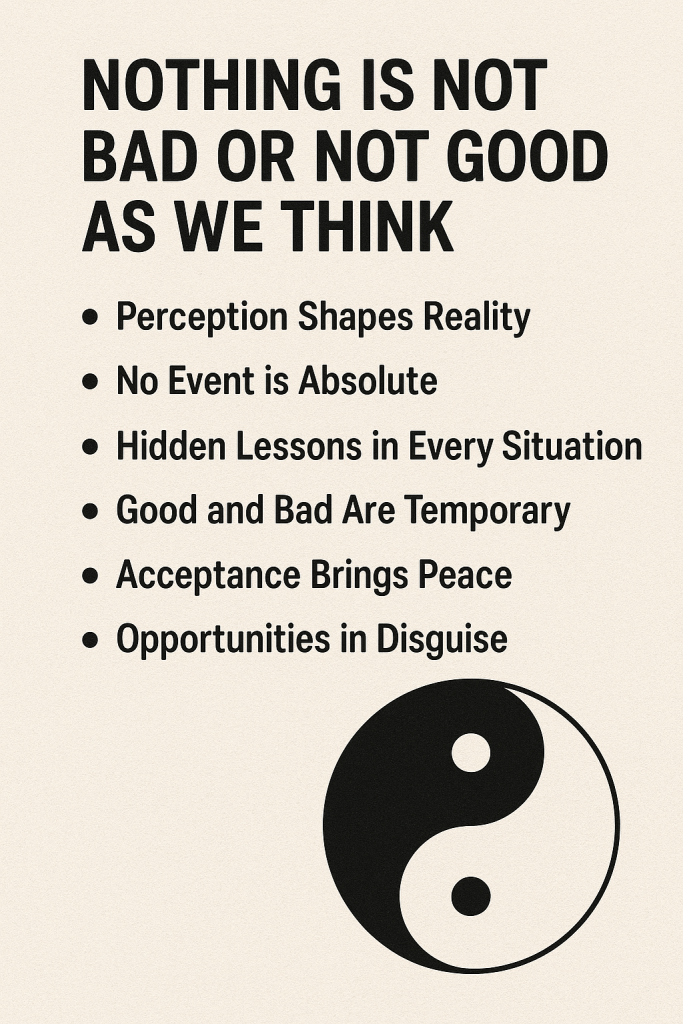
Nothing is Not Bad or Not Good as We Think

Introduction

Life often surprises us with situations that we quickly label as good or bad. But in reality, many things are neither completely good nor completely bad—it is our perception that shapes how we feel about them.


Key Points

  • Perception Shapes Reality
    • What feels like a setback today may turn into a blessing tomorrow.
    • Example: Losing a job can seem bad, but it may lead to better opportunities.
  • No Event is Absolute
    • Life events are neutral; it is we who add the meaning.
    • Something that feels painful to one person might feel like growth to another.
  • Hidden Lessons in Every Situation
    • Even challenges carry lessons, strength, and wisdom.
    • What seems “bad” can make us stronger and more resilient.
  • Good and Bad Are Temporary
    • Joy and sorrow are like waves—they come and go.
    • Nothing remains permanent; every phase changes with time.
  • Acceptance Brings Peace
    • Instead of labeling things as good or bad, accepting them as experiences brings calmness.
    • This mindset helps us handle stress with balance.
  • Opportunities in Disguise
    • Difficulties often open doors we would never notice otherwise.
    • The key is to stay open-minded and patient.

Conclusion

Nothing in life is completely good or bad—it is our thoughts and judgments that create those labels. When we look at situations with an open and neutral mind, we find peace, growth, and unexpected opportunities. Life is a teacher, and every moment—whether pleasant or painful—has a purpose.

Mastering Emotional Resilience: How to Stay Strong in Tough Times

Life is full of challenges, but emotional resilience helps us navigate difficulties without losing hope. Here’s how you can build resilience and stay strong during tough times.

1. Accept That Challenges Are a Part of Life

  • Struggles and setbacks are normal.
  • Instead of resisting them, embrace them as opportunities to grow.

2. Develop a Positive Mindset

  • Focus on solutions rather than problems.
  • Look for lessons in difficult situations.
  • Practice gratitude to shift your perspective.

3. Manage Your Emotions Effectively

  • Don’t suppress emotions—acknowledge and process them.
  • Journaling, meditation, or deep breathing can help.
  • Take a break if emotions feel overwhelming.

4. Strengthen Your Support System

  • Surround yourself with positive, supportive people.
  • Don’t hesitate to seek help from friends, family, or professionals.
  • Talking about your feelings can lighten the burden.

5. Build Healthy Coping Mechanisms

  • Exercise, sleep, and healthy eating improve mental strength.
  • Engage in hobbies that bring you joy and relaxation.
  • Avoid unhealthy coping strategies like overeating or excessive screen time.

6. Cultivate Self-Compassion

  • Be kind to yourself—don’t judge yourself harshly.
  • Treat yourself with the same kindness you’d show a friend.
  • Learn from mistakes instead of dwelling on them.

7. Stay Adaptable and Open to Change

  • Life doesn’t always go as planned—be flexible.
  • Develop problem-solving skills to adjust to new situations.
  • Accept what you can’t change and focus on what you can control.

8. Set Small, Achievable Goals

  • Break big problems into smaller steps.
  • Celebrate small wins to boost motivation.
  • Progress, no matter how small, keeps you moving forward.

9. Practice Mindfulness and Stress Management

  • Stay present and avoid overthinking the past or future.
  • Meditation, yoga, and deep breathing can help manage stress.
  • Focus on what you can do now.

10. Keep a Long-Term Perspective

  • Tough times don’t last forever.
  • Remind yourself of past difficulties you’ve overcome.
  • Every challenge makes you stronger and wiser.

Final Thoughts

Emotional resilience isn’t about avoiding difficulties—it’s about facing them with strength and confidence. By developing a positive mindset, managing emotions, and staying adaptable, you can handle life’s challenges with grace and resilience.

Embracing Change: Overcoming Fear and Thriving in Uncertainty

Why Do We Struggle with Change?

  1. Fear of the Unknown
    • Stepping into the unfamiliar creates anxiety and fear.
    • Humans tend to resist situations they cannot predict or control.
  2. Comfort Zone Attachment
    • We prefer routines that feel safe and predictable.
    • Change threatens our established comfort and forces adaptation.
  3. Emotional Resistance
    • Change often involves loss (habits, people, roles).
    • Emotional ties to the past make it harder to let go.
  4. Cognitive Bias
    • “Status quo bias” makes us prefer what we already know.
    • Overestimating risks while underestimating benefits adds to hesitation.
  5. Fear of Failure
    • Concerns about not succeeding in a new environment or role can paralyze action.
    • Self-doubt amplifies resistance to change.

How to Embrace Change Effectively

  1. Acknowledge the Discomfort
    • Understand that resistance is a natural reaction.
    • Accept your feelings without judgment.
  2. Shift Your Perspective
    • View change as an opportunity for growth rather than a threat.
    • Focus on potential benefits and new experiences.
  3. Break It Down
    • Tackle change in smaller, manageable steps.
    • Celebrate progress to build momentum.
  4. Reframe Fear as Excitement
    • Recognize that fear and excitement can feel similar.
    • Shift your mindset to focus on positive anticipation.
  5. Practice Self-Compassion
    • Be kind to yourself during the adjustment period.
    • Remember, it’s okay to struggle while adapting.
  6. Stay Curious and Open
    • Approach change with a mindset of learning.
    • Ask, “What can this teach me?” rather than resisting outright.
  7. Seek Support
    • Share your feelings with friends, family, or mentors.
    • Community and guidance can ease the transition.
  8. Visualize Success
    • Imagine yourself thriving in the new scenario.
    • Positive visualization helps reduce anxiety and motivates action.
  9. Build Resilience
    • Use challenges as an opportunity to strengthen adaptability.
    • Regularly step out of your comfort zone in small ways to prepare for bigger changes.
  10. Focus on What You Can Control
    • Identify aspects of the change you can influence.
    • Taking action where possible reduces helplessness.

Conclusion

Change is inevitable, and while it may be uncomfortable, it is also essential for growth and progress. By understanding why we resist it and adopting strategies to embrace it, we can navigate life’s transitions with confidence and optimism.

Be Proactive, Not Reactive

Introduction

Life constantly throws challenges and opportunities at us. How we handle them defines the quality of our journey. Being reactive—waiting for situations to unfold before acting—can lead to stress and missed opportunities. On the other hand, being proactive allows us to take control, plan ahead, and create positive outcomes. Proactive people don’t wait for things to happen; they make things happen.

1. What Does It Mean to Be Proactive?

  • Being proactive means taking initiative, anticipating challenges, and acting before situations demand it.
  • It’s about focusing on solutions rather than being overwhelmed by problems.

2. The Problem with Being Reactive

  • Reacting often means making decisions based on emotions, like panic or frustration.
  • It leads to rushed actions and a feeling of being out of control.

3. Benefits of Being Proactive

  • Better Control: You direct your life instead of letting circumstances dictate your path.
  • Improved Planning: You’re prepared for challenges before they arise.
  • Reduced Stress: Tackling problems early prevents them from becoming crises.
  • More Opportunities: A proactive approach often opens doors that others miss.

4. Examples of Proactive vs. Reactive

  • Proactive: Saving money regularly for emergencies.
    Reactive: Borrowing money last minute when faced with unexpected expenses.
  • Proactive: Seeking feedback at work to improve performance.
    Reactive: Waiting for a problem to occur before addressing it.

5. Steps to Be Proactive

  • Set Clear Goals: Know what you want and work steadily toward it.
  • Plan Ahead: Break tasks into smaller steps and start early.
  • Anticipate Challenges: Think about potential obstacles and prepare solutions.
  • Take Responsibility: Acknowledge your role in shaping outcomes instead of blaming circumstances.

6. Building a Proactive Mindset

  • Focus on what you can control and let go of what you can’t.
  • Practice mindfulness to stay calm and think clearly.
  • Surround yourself with people who encourage growth and positivism.

7. Overcoming Challenges to Stay Proactive

  • Stress and uncertainty can make it easy to fall back into reactive habits.
  • Build small habits like daily planning and reflecting on your actions to stay proactive.

8. Proactive People Inspire Change

  • Your proactive mindset can influence others to take charge of their lives.
  • Together, proactive actions can lead to broader positive changes in communities and workplaces.

Take Charge of Your Life

Life may not always go as planned, but a proactive mindset helps you navigate its twists and turns with confidence. Start small—create a goal, plan ahead, and take the first step. Being proactive isn’t just about solving problems; it’s about creating opportunities and leading a purposeful life. Remember, proactive people shape their destiny, while reactive people let circumstances define them.

Trust the Process: Finding Strength in the Journey

Trusting the process means having faith in the journey, even when the outcome isn’t immediately clear. It’s about believing that every step has a purpose and that growth comes with time.

1. Understand the Concept

  • Trusting the process is about patience and perseverance.
  • It acknowledges that progress isn’t always linear but is still meaningful.

2. Focus on the Present

  • Concentrate on the steps you can take today rather than worrying about the future.
  • Mindfulness can help you stay grounded in the moment.

3. Set Small, Achievable Goals

  • Break your journey into smaller milestones.
  • Celebrate small wins to stay motivated and positive.

4. Let Go of Perfection

  • Accept that mistakes are part of the process.
  • View setbacks as learning opportunities rather than failures.

5. Trust in Your Efforts

  • Believe that consistent action will lead to results over time.
  • Remind yourself that hard work pays off, even if it’s not immediately visible.

6. Seek Inspiration

  • Learn from stories of others who succeeded by trusting the process.
  • Their journeys can remind you that patience leads to rewards.

7. Be Open to Growth

  • Recognize that challenges and changes help you grow stronger and wiser.
  • Embrace the lessons that come along the way.

8. Practice Patience

  • Understand that good things take time.
  • Resist the urge to rush the outcome and trust that it will happen at the right time.

9. Stay Positive

  • Surround yourself with encouraging people, books, and content.
  • Focus on the progress you’ve made instead of dwelling on what’s left to achieve.

10. Believe in the Bigger Picture

  • Trust that everything is working together for your good, even if it’s not apparent now.
  • Have faith in the process, knowing that it’s leading you to where you’re meant to be.

11. Keep Moving Forward

  • Take consistent action, no matter how small.
  • Progress, even at a slow pace, is still progress.

12. Reflect and Adjust

  • Regularly reflect on your journey to appreciate how far you’ve come.
  • Be open to adjusting your approach while staying committed to your goals.

Trusting the process requires patience, effort, and faith. By adopting this mindset, you can navigate life’s challenges with resilience and confidence, knowing that every step contributes to your growth and success.

Why Every Ending is a New Beginning: Embracing Change in 2025

The end of one chapter often marks the start of something new. As we step into 2025, it’s the perfect time to embrace change and welcome fresh opportunities. Here’s why every ending can be seen as a new beginning:

1. A Chance to Reflect and Learn

“Life can only be understood backwards, but it must be lived forwards.” – Søren Kierkegaard

  • Endings give us a moment to pause and reflect on what worked and what didn’t.
  • Lessons learned from past experiences can guide better decisions in the future.

2. Room for Growth

“Every next level of your life will demand a different you.” – Leonardo DiCaprio

  • Closing old chapters creates space for personal and professional growth.
  • It’s an opportunity to step out of your comfort zone and explore new possibilities.

3. The Power of Fresh Starts

“It’s never too late to be what you might have been.” – George Eliot

  • A new year like 2025 symbolizes renewal and hope.
  • Starting fresh allows us to set goals and intentions with clarity.

4. Letting Go of the Past

“Some of us think holding on makes us strong, but sometimes it is letting go.” – Hermann Hesse

  • Holding onto the past can weigh us down.
  • Embracing change means letting go of what no longer serves us, be it habits, relationships, or mindsets.

5. Building Resilience

“The oak fought the wind and was broken, the willow bent when it must and survived.” – Robert Jordan

  • Every ending teaches us resilience and the ability to adapt to change.
  • This adaptability is crucial for navigating life’s uncertainties.

6. Opportunities to Redefine Ourselves

“It’s not what we have, but what we do with what we have, that defines who we are.” – J.K. Rowling

  • Each ending offers a chance to redefine who we are and what we stand for.
  • Use 2025 to align your actions with your values and aspirations.

7. The Excitement of the Unknown

“Go confidently in the direction of your dreams. Live the life you have imagined.” – Henry David Thoreau

  • The unknown can be daunting but also exciting.
  • New beginnings come with endless possibilities and the thrill of discovery.

8. Strengthening Relationships

“In the middle of every difficulty lies opportunity.” – Albert Einstein

  • Changes often bring new people into our lives and strengthen existing bonds.
  • Embrace the chance to connect, network, and grow alongside others.

9. A Reminder of Life’s Cycles

Life is a series of endings and beginnings, much like the seasons.

  • Accepting this natural cycle helps us move forward with grace and optimism.

10. Empowering Yourself for 2025

“The best way to predict the future is to create it.” – Peter Drucker

  • View 2025 as a blank canvas to design the life you want.
  • Take small, consistent steps toward your goals, and celebrate every milestone.

Final Thoughts

“Every sunset brings the promise of a new dawn.” – Ralph Waldo Emerson
Every ending holds the seed of a new beginning. Embracing change with an open heart and mind can turn challenges into stepping stones for growth. In 2025, let go of fear and welcome the opportunities that come your way.

From Stagnation to Success: The Power of Growth Challenges

Stepping out of your comfort zone is one of the most empowering actions you can take for personal growth. While it can feel uncomfortable at first, embracing growth challenges leads to a more fulfilling and successful life.


1. Understanding the Comfort Zone

  • Your comfort zone is a mental space where you feel safe, familiar, and secure.
  • It often involves routine habits and predictable outcomes.
  • While it feels comforting, staying here limits personal development and potential.

2. Why It’s Important to Step Out

  • Personal Growth: Facing challenges leads to skill development and improved resilience.
  • New Experiences: It opens doors to new opportunities, relationships, and experiences.
  • Increased Confidence: Each time you face something difficult, you build more self-assurance.
  • Expanded Mindset: You start seeing the world and your capabilities in a broader light.

3. Common Fears of Leaving the Comfort Zone

  • Fear of Failure: You may worry about not succeeding, but failure is often the best teacher.
  • Fear of the Unknown: The unfamiliar can be intimidating, but it’s where growth happens.
  • Fear of Judgment: Concern about how others perceive you can hold you back, but remember, growth is personal, not public.

4. Steps to Break Free

  • Start Small: Begin with manageable challenges that push you just beyond your current limits.
  • Set Goals: Clear goals provide direction and make challenges feel achievable.
  • Embrace Discomfort: Understand that discomfort is a sign of growth, not a barrier.
  • Seek Support: Surround yourself with people who encourage and support your growth.

5. Benefits of Embracing Challenges

  • Increased Creativity: When faced with new situations, you learn to think outside the box.
  • Better Problem-Solving: You develop sharper skills in handling tough situations.
  • Personal Fulfillment: Overcoming challenges boosts your sense of achievement and satisfaction.
  • Growth Mindset: Regularly stepping out of your comfort zone fosters a mindset that thrives on learning and development.

6. Embrace the Journey

  • Growth is a journey, not a destination. The more you push yourself, the more you expand your capabilities.
  • Celebrate small wins along the way to stay motivated.

Conclusion:

Breaking free from your comfort zone might be intimidating at first, but it’s essential for growth. Embrace the challenges, take small steps, and trust in the process. You’ll soon realize that growth and transformation are waiting just outside your comfort zone.

You Get What You Fight For, Not What You Wish For

Understanding the Concept:

  • The phrase emphasizes that achieving goals requires action and effort, not just hopes or dreams.
  • It’s a reminder that success is earned through hard work, not simply wished for.

The Power of Action:

  • Simply wishing for something doesn’t lead to results. You need to take deliberate steps toward your objectives.
  • Action transforms dreams into reality and creates tangible results.

Setting Clear Goals:

  • Define what you truly want in life, whether it’s a career goal, personal development, or relationships.
  • Write down specific, measurable goals to keep you focused.
  • Break larger goals into smaller, actionable steps to make them more achievable.

Embracing Challenges:

  • Understand that obstacles are part of the journey. Fighting for your dreams means facing challenges head-on.
  • Learning to navigate difficulties builds character and perseverance.

Building Resilience:

  • Develop a resilient mindset to overcome setbacks. The fight for your goals will strengthen your character and determination.
  • Adopt a growth mindset: view challenges as opportunities for learning and improvement.

Taking Responsibility:

  • Own your choices and their outcomes. Recognize that your efforts directly impact your results.
  • Avoid blaming external factors; instead, focus on what you can control.

Staying Committed:

  • Consistency is key. Regularly work towards your goals, even when motivation wanes.
  • Create a routine that incorporates daily or weekly actions toward your goals.

Celebrating Progress:

  • Acknowledge and celebrate small victories along the way. This boosts morale and keeps you motivated.
  • Reflect on how far you’ve come to maintain perspective during tough times.

Adopting a Positive Mindset:

  • Cultivate optimism. A positive attitude helps you stay focused on your goals and keeps you motivated during challenges.
  • Practice gratitude to appreciate what you have while working toward what you want.

Learning from Failure:

  • Accept that failure is often part of the process. Each setback is an opportunity to learn and grow.
  • Analyze what went wrong, adjust your strategy, and keep moving forward.

Visualizing Success:

  • Use visualization techniques to imagine yourself achieving your goals. This can increase motivation and reinforce your commitment.
  • Create a vision board to serve as a constant reminder of what you’re fighting for.

Staying Flexible:

  • Be open to adjusting your plans as needed. Sometimes, the path to your goals may change unexpectedly.
  • Adaptability allows you to stay on track, even when faced with unforeseen circumstances.

Finding Your Why:

  • Identify your deeper motivations for pursuing your goals. Understanding your “why” can drive you to fight harder.
  • Write down your reasons for wanting to achieve your goals; revisit them when your motivation dips.

Conclusion:

  • Remember, wishing alone will not bring about change. It’s the effort and determination you invest in your goals that will ultimately lead to success.
  • Fight for what you desire, and you will see results! Taking action is the key to turning dreams into reality.