Quantum Superposition: You Can Be More Than One Version of Yourself

Introduction

In quantum physics, superposition means a particle can exist in multiple states at the same time until someone observes it. This mind-bending idea isn’t just for scientists. It mirrors our personal journey. In life, we often forget that we too carry many possible versions of ourselves waiting to unfold.


1. You carry many possibilities within you

In superposition, a particle can be here and there.
In life, you can be strong and scared. Brave and unsure. Learning and leading.
You don’t have to fit into one fixed label.

Your identity is a wide horizon, not a locked room.


2. You don’t have to decide who you are immediately

Superposition teaches that reality settles only when observed.
Similarly, you don’t need to rush your life decisions.
Career, relationships, dreams — these don’t always need instant clarity.
Give yourself permission to explore before choosing.


3. You can reinvent yourself anytime

Just like a particle collapses into a specific state when observed, you can choose which version of yourself to activate today.
Want to be more confident? More disciplined? More patient?
You can select that version and let it grow.

The choice becomes the turning point.


4. Your circumstances do not define your potential

Superposition reminds us that there is always more happening beneath the surface.
Your potential isn’t limited by your past or present situation.
There are countless paths hidden inside you, waiting to be chosen.


5. You are allowed to grow in different directions

People often feel pressure to be consistent, predictable, or a “single type” of person.
But you can be a creative thinker and a practical planner.
A dreamer and a doer.
A calm person and a bold decision-maker.

Life becomes richer when you embrace your complexity instead of hiding it.


6. Your future is a collection of possibilities

Superposition shows that reality isn’t fixed.
Your future isn’t fixed either.
Small shifts in choice, mindset, and habits can unlock entirely new paths.

Every day, you decide which version of yourself steps forward.


Final Thoughts

Quantum superposition gently reminds us that we are not stuck. We are not one-dimensional. We are not limited to a single identity or destiny. Within each of us lives a constellation of possibilities, waiting to be chosen at the right moment.

You are allowed to evolve.
You are allowed to change.

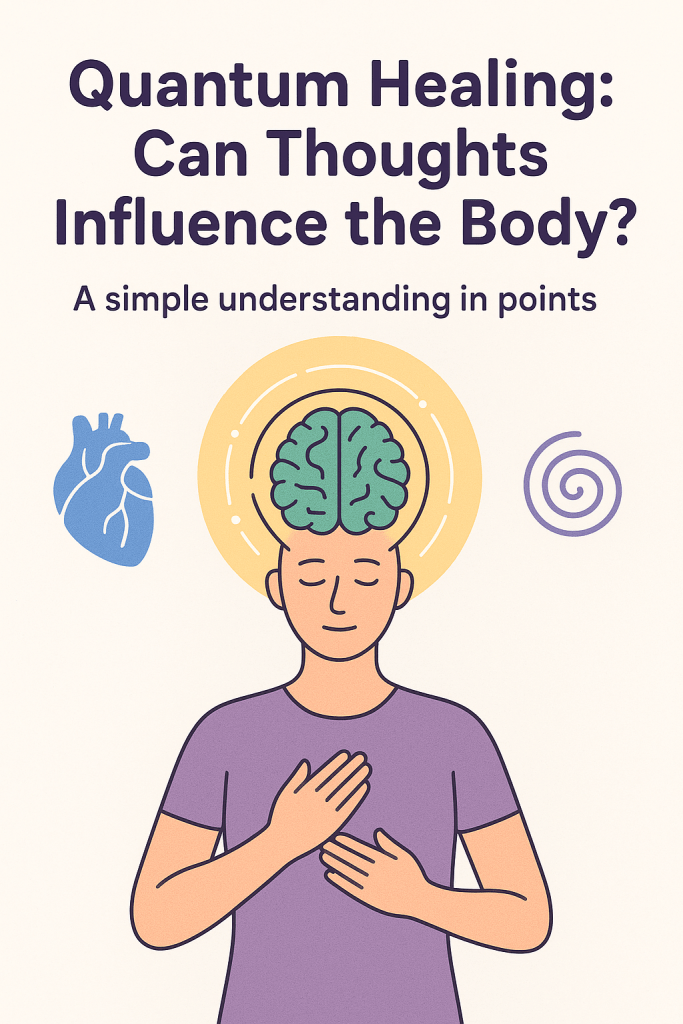
Quantum Healing: Can Thoughts Influence the Body?

1. Introduction: What is Quantum Healing?

  • Quantum healing is the idea that the mind and body are deeply connected.
  • It suggests that your thoughts, emotions, and beliefs can influence your physical health.
  • This concept is inspired by principles from quantum physics, which show that energy and consciousness can affect matter.

2. Everything in the Body Is Energy

  • At the smallest level, your body is made of atoms and energy—not just solid matter.
  • Your heartbeat, breathing, emotions, and thoughts all produce energy signals.
  • If your energy is balanced, you feel healthy; if it is disturbed, you feel unwell.

3. Thoughts Create Real Changes in the Body

  • When you think positively, your brain releases “good chemicals” like dopamine and serotonin.
  • When stressed or worried, your brain releases cortisol, which can weaken immunity.
  • This shows that thoughts have a direct physical impact.

4. The Observer Effect: Why Attention Matters

  • In quantum physics, particles behave differently when observed.
  • Similarly, when you focus your mind on healing, your body responds to that attention.
  • Meditation, prayer, and positive intention activate the body’s natural repair systems.

5. Emotions Carry Energy

  • Joy, gratitude, and love create high-energy states that support healing.
  • Fear, anger, and sadness create low-energy states that may slow down healing.
  • Shifting emotional energy can shift physical well-being.

6. Placebo Effect: Proof That Belief Heals

  • Doctors around the world have seen patients recover simply because they believed a treatment would work.
  • The mind convinced the body to heal—this is a real scientific example of quantum-like healing.

7. Daily Practices That Encourage Quantum Healing

  • Meditate for a few minutes every day to calm your energy.
  • Use positive affirmations (“My body is healing. I am strong.”).
  • Practice gratitude to raise emotional energy.
  • Visualize healing, imagining your body becoming healthier.
  • Stay conscious of your thoughts—replace negative ones gently.

8. Final Thoughts

  • Quantum healing doesn’t replace medical treatment, but it supports it.
  • Your mind is powerful—your thoughts can influence your body more than you realize.
  • When you change your thoughts, you change your energy.
  • When you change your energy, your body responds.

Peaceful Eternal Life

🌸 Introduction

Everyone seeks peace — not just in moments, but in life itself. A peaceful eternal life is about living with calmness, clarity, and contentment that lasts beyond temporary highs and lows. It’s not about how long we live, but how peacefully we live.


☀️ 1. Peace Begins Within

  • True peace starts from the mind and heart, not from the outside world.
  • Calm thoughts create calm actions.
  • When you learn to quiet your inner noise, life automatically feels lighter.

“Peace comes from within. Do not seek it without.” – Buddha


🌊 2. Let Go of What You Can’t Control

  • Life becomes peaceful when we stop fighting every situation.
  • Acceptance is the first step to inner harmony.
  • Control your reactions, not the world around you.

“The greatest weapon against stress is our ability to choose one thought over another.” – William James


🌿 3. Live with Kindness and Compassion

  • A peaceful heart is a kind heart.
  • Helping others, forgiving mistakes, and spreading love bring eternal satisfaction.
  • Compassion connects us to something divine and everlasting.

🌤 4. Stay Grateful Every Day

  • Gratitude transforms ordinary days into blessings.
  • Appreciate simple joys — sunrise, laughter, loved ones, good health.
  • Gratitude invites peace and pushes away negativity.

“Gratitude turns what we have into enough.” – Anonymous


🌙 5. Connect with the Spiritual Side

  • Meditation, prayer, or quiet reflection can calm your soul.
  • Believe that life has a higher purpose beyond material success.
  • Spiritual awareness helps you feel eternal peace, beyond fear or loss.

🌻 6. Live in Harmony with Nature

  • Nature teaches balance and serenity.
  • Spend time under the sky, near trees or water — it heals silently.
  • When you live close to nature, you live close to peace.

🌈 7. Simplicity is the Secret

  • The less you chase, the more you rest.
  • Simplify your wants, declutter your mind, and value peace over possessions.
  • Eternal peace comes when you stop competing and start living mindfully.

🌟 Conclusion

Peaceful eternal life isn’t a faraway dream — it’s a state of being we can nurture every day.
It’s in our thoughts, choices, and the love we share.
When you live with peace in your heart, you live eternally — even in moments.

“Peace is not the destination, it is the way.” – Thich Nhat Hanh

Learn Their Game, Don’t Play It

Introduction

In life, we often meet people who are competitive, manipulative, or cunning. They play “games” to control situations or take advantage of others. Instead of falling into their traps, the smartest move is to understand their game without becoming part of it.

Here’s how you can practice this mindset:

1. Awareness Is Your First Shield

  • Know that not everyone has pure intentions.
  • Observe patterns in people’s words and actions.
  • Awareness protects you from surprise moves.

2. Understand the Rules They Follow

  • Manipulators thrive on lies, gossip, or emotional control.
  • Watch how they operate — their strengths and weaknesses.
  • Once you know their rules, they can’t use them against you.

3. Don’t Mirror Their Behavior

  • Fighting fire with fire only burns you too.
  • Stay true to your values, even if others play dirty.
  • Rise above instead of sinking to their level.

4. Protect Your Energy

  • Don’t waste energy competing in useless battles.
  • Walk away when the “game” has no real value.
  • Sometimes silence is the strongest response.

5. Stay Strategic, Not Emotional

  • People who play games often target emotions.
  • Respond with calm logic, not anger or impulse.
  • Self-control keeps you stronger than any trick.

6. Use Knowledge as Power

  • Once you know how the game works, you gain the advantage.
  • You can predict moves, set boundaries, and protect yourself.
  • But remember: knowledge is for defense, not manipulation.

Conclusion:
Life will always have people who try to play games with you. The key is simple — learn their game, but don’t play it. Understanding makes you wise, and restraint makes you powerful. Your dignity and peace are worth more than winning a dirty battle.

🌿 Visualization Exercises for Mental Relaxation

Life often feels heavy with worries and endless tasks. One gentle way to relax the mind is through visualization exercises—using the power of imagination to create peaceful mental images.


🌸 What is Visualization?

  • Visualization is a mental technique where you picture calming scenes, places, or experiences in your mind.
  • It helps your brain and body feel as if you are truly there, creating relaxation.
  • Simple, safe, and can be practiced anywhere.

“The mind is everything. What you think, you become.” – Buddha


🌊 Simple Visualization Exercises

  1. Peaceful Beach Scene
    • Close your eyes and imagine waves gently washing the shore.
    • Feel the breeze, hear the waves, and sense the warmth of the sun.
    • Stay in this image for 2–3 minutes.
  2. Forest Walk
    • Picture yourself walking on a soft forest path.
    • Hear birds singing, smell fresh earth, and feel calm with every step.
    • Let the greenery soothe your mind.
  3. Light and Energy Visualization
    • Imagine a warm golden light above your head.
    • Slowly let it flow through your body, melting away stress.
    • Feel lighter and more refreshed.
  4. Safe Place Technique
    • Create a mental image of a place where you feel completely safe.
    • It could be a childhood home, a mountain cabin, or even a dream space.
    • Visit this place in your mind whenever you feel anxious.

“Imagination is the beginning of creation.” – George Bernard Shaw


🌼 Benefits of Visualization

  • Reduces stress and anxiety.
  • Improves focus and mental clarity.
  • Creates a sense of inner peace and balance.
  • Helps the body feel physically relaxed.

“Your calm mind is the ultimate weapon against your challenges.” – Bryant McGill


🌙 Final Thought

Visualization is like giving your mind a mini-vacation. Just a few minutes daily can restore calm, energy, and clarity. Close your eyes, breathe deeply, and paint a peaceful picture in your mind.

Calmness and Clarity in Everyday Life

🌿 Introduction

Life today often feels rushed, noisy, and overwhelming. Between responsibilities, technology, and constant demands, our minds rarely find rest. Yet, calmness and clarity are not luxuries—they are essential for balance, decision-making, and happiness. With simple practices, we can bring peace into our everyday life.


🌸 Simple Ways to Cultivate Calmness and Clarity

  1. Start Your Day Slowly
    • Avoid rushing into your phone or work.
    • Begin with a few minutes of quiet breathing, stretching, or gratitude.
  2. Practice Mindful Breathing
    • A few deep breaths can instantly reduce stress.
    • Breathing anchors the mind and helps you focus better.
  3. Declutter Your Surroundings
    • A clean space clears mental clutter.
    • Keep only what is useful and meaningful around you.
  4. Take Short Breaks
    • Step away from work, screens, or noise.
    • Even 5 minutes of silence refreshes the mind.
  5. Limit Information Overload
    • Too much news, social media, or notifications creates anxiety.
    • Be selective with what you consume daily.
  6. Spend Time in Nature
    • Walking in a park, sitting under a tree, or listening to birds brings instant calm.
    • Nature naturally clears the mind.
  7. Write It Out
    • Journaling helps release confusion and emotions.
    • Clarity often comes when thoughts are on paper.
  8. Stay Present
    • Worrying about the future or replaying the past disturbs peace.
    • Focus on what you can do right now.
  9. Practice Gratitude
    • Recognize small blessings daily.
    • Gratitude shifts the mind from chaos to calm.
  10. End the Day with Reflection
    • Review your day with kindness, not judgment.
    • Let go of stress before you sleep.

🌟 Conclusion

Calmness and clarity don’t come from escaping life—they come from how we live each moment. By slowing down, simplifying, and staying present, we can handle challenges with peace instead of pressure. A calm mind sees clearly, and a clear mind lives fully.

Time is the Greatest Currency

Introduction

People often believe that money is the most powerful resource, but in reality, time is the greatest currency we have. Unlike money, time cannot be saved in a bank, borrowed, or replaced. Once it’s gone, it’s gone forever. The way we spend our time shapes our happiness, relationships, and success in life.


Why Time is More Valuable than Money

  • Money can be earned, lost, and earned again, but time can never return.
  • Everyone, no matter how rich or poor, gets the same 24 hours a day.
  • Time is the foundation on which all achievements are built.

How Time Works Like Currency

  • Every day, we spend time on different activities, just like we spend money.
  • Using time on growth, learning, or meaningful relationships is like making a smart investment.
  • Wasting time on unimportant things is like losing money on a bad deal.

Using Time Wisely

  • Prioritize what truly matters: health, family, and personal growth.
  • Learn to say no to distractions and unnecessary commitments.
  • Manage time effectively by setting goals and avoiding procrastination.
  • Remember: spending quality time with loved ones creates memories that money can’t buy.

The Real Wealth

  • True wealth isn’t measured by how much money you have, but how wisely you use your time.
  • At the end of life, people don’t wish for more money—they wish for more time with the people they love.
  • Balancing work, rest, and joy makes life meaningful.

Conclusion

Time is life’s greatest currency. Use it with care, spend it on things that bring happiness and growth, and never waste it on what doesn’t matter. Once time is gone, it never comes back—so value every moment.

Life Never Stops Teaching Us

Introduction

Life is the greatest teacher we will ever have. Unlike classrooms or formal education, life teaches us through experiences—some sweet, some bitter, but all meaningful. Each day holds lessons waiting to be discovered, and the best part is that the learning never ends.

Lessons from Life

  • Life is the best teacher
    Books may give us information, but real wisdom comes from living through ups and downs.
  • Every experience carries a lesson
    Joy teaches gratitude, while pain builds strength. Both are equally important for growth.
  • Success is a reminder of effort
    Achievements show us the importance of dedication, focus, and belief in ourselves.
  • Failures are stepping stones
    Mistakes guide us toward better choices and remind us that failure is not the end but a new beginning.
  • People shape our learning
    Some people inspire us with kindness, others test our patience, and a few show us whom not to trust. Every person leaves a lesson behind.
  • Challenges bring growth
    Life’s struggles are not punishments but opportunities to become stronger, braver, and wiser.
  • Change keeps us adaptable
    Seasons, situations, and circumstances keep changing. Accepting change teaches us flexibility and resilience.
  • Small things hold deep wisdom
    A sunrise inspires hope, a smile spreads joy, and silence teaches peace. Life whispers wisdom in simple ways.

Conclusion

Life never stops teaching us. The journey of learning doesn’t end with age, success, or status—it continues every day in different forms. The real secret is to keep an open heart and mind, so that every experience, whether good or bad, becomes a stepping stone to wisdom and growth. If we remain lifelong learners, life will always guide us toward becoming our best selves.

Boundaries = Peace: Protecting Your Energy

🌸 Introduction

Peace of mind is not about having a quiet life—it’s about protecting your energy. Many times, we lose our inner calm because we don’t set clear boundaries with people, work, or even ourselves. Setting boundaries is not selfish—it’s self-care.


🌿 Why Boundaries Are Important

  • Boundaries help you say yes to what matters and no to what drains you.
  • They create space for your own growth and happiness.
  • Without boundaries, people may take your time and energy for granted.
  • Protecting your energy helps you stay emotionally balanced.

🌼 Signs You Need Better Boundaries

  • You feel tired and drained after meeting certain people.
  • You often say “yes” when you want to say “no.”
  • You feel guilty for putting yourself first.
  • You don’t have time for things that bring you joy.

🌻 How to Set Healthy Boundaries

  1. Know Your Limits – Be clear about what feels right and what doesn’t.
  2. Learn to Say No – Respectfully decline things that exhaust you.
  3. Communicate Clearly – Express your needs without fear.
  4. Protect Your Time – Avoid overcommitting yourself.
  5. Let Go of Guilt – Remember, self-care is not being rude.

🌷 Benefits of Boundaries

  • More mental peace and less stress.
  • Healthier and more respectful relationships.
  • More time for self-care and passions.
  • Stronger confidence and self-respect.

🌸 Conclusion

Boundaries are not walls—they are doors that let peace in and keep negativity out. When you protect your energy, you create space for joy, balance, and growth. Remember: Boundaries = Peace.

Conscious Mind and Unconscious Mind

Introduction

Our mind is like an iceberg – the part we see is small, while most of it lies hidden below the surface. The conscious mind is what we are aware of right now, and the unconscious mind silently works in the background, shaping our thoughts, habits, and behavior.


1. What is the Conscious Mind?

  • The conscious mind is the active and aware part of our thinking.
  • It deals with present thoughts, logical reasoning, and decision-making.
  • Example: When you read a book, solve a problem, or talk to someone – you use your conscious mind.

2. What is the Unconscious Mind?

  • The unconscious mind is the hidden part of the mind that stores feelings, memories, and habits.
  • It influences our actions and emotions without us realizing it.
  • Example: When you ride a bicycle after years, your unconscious mind helps you remember how.

3. Key Differences

  • Conscious mind → Aware, logical, short-term.
  • Unconscious mind → Hidden, emotional, long-term memory.
  • Conscious is like the tip of the iceberg, unconscious is the huge part under water.

4. Role in Daily Life

  • Conscious mind helps in planning and decision-making.
  • Unconscious mind stores beliefs, fears, and automatic habits.
  • Example: Brushing teeth daily becomes automatic because of the unconscious mind.

5. How They Work Together

  • The conscious mind gives instructions.
  • The unconscious mind carries them out repeatedly until they become habits.
  • Example: If you consciously repeat positive affirmations, your unconscious starts believing them.

6. Why Understanding Both is Important

  • Helps in self-improvement by changing negative habits.
  • Builds awareness of hidden fears and emotions.
  • Allows us to use the power of the unconscious mind for success, creativity, and confidence.

Conclusion

The conscious and unconscious minds are two sides of the same coin. The conscious mind decides what we want, while the unconscious mind helps us achieve it. By becoming more aware of how both work, we can shape our thoughts, habits, and future in a positive way.