
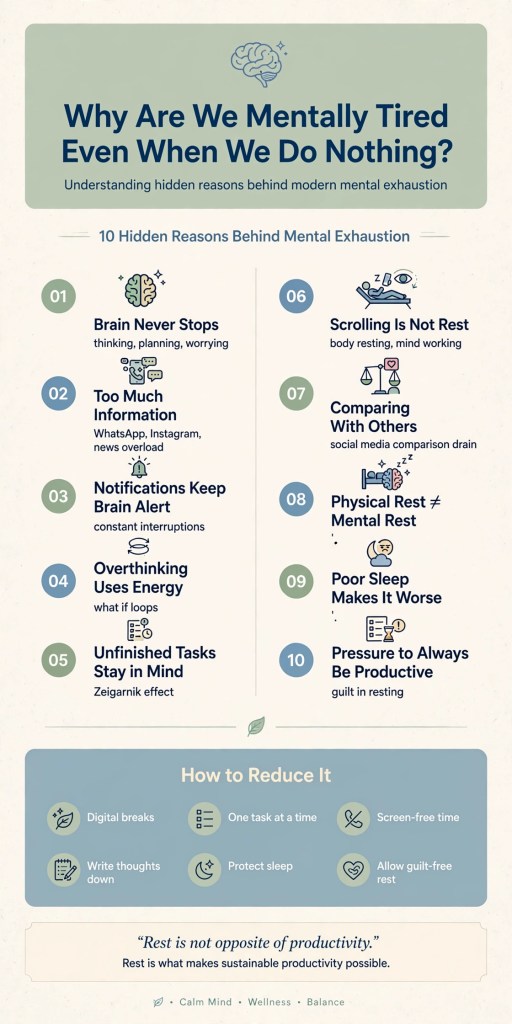
Understanding the hidden reasons behind modern mental exhaustion
Have you ever spent an entire day doing “nothing” and still felt completely exhausted?
You may not have attended meetings, travelled, studied for hours, or done heavy physical work. Yet, by the end of the day, your mind feels tired.
Why does this happen?
Mental tiredness is not always caused by physical activity. Sometimes, our brain is working continuously in the background—even when our body is resting.
🧠 1. Your Brain Never Really Stops
Even when you are sitting quietly, your brain may be:
- Thinking about yesterday
- Planning tomorrow
- Remembering unfinished tasks
- Worrying about problems
- Imagining different situations
- Processing conversations
So, “doing nothing” does not necessarily mean “thinking nothing.”
📱 2. Too Much Information
Every day, we receive an enormous amount of information through:
- WhatsApp messages
- Instagram and YouTube
- News
- Emails
- Advertisements
- College or workplace notifications
- Online conversations
Our brain constantly decides:
“Is this important?”
“Should I respond?”
“Should I remember this?”
This continuous processing can create mental overload.
🔔 3. Notifications Keep Our Brain Alert
A simple notification may take only a few seconds to check.
But every notification interrupts our attention.
Even when we do not open it, our mind may wonder:
“Who messaged me?”
“What happened?”
“Do I need to reply?”
Constant interruptions prevent the mind from experiencing genuine rest.
🤔 4. Overthinking Uses Mental Energy
Sometimes the biggest source of tiredness is not work—it is thinking about work.
We may repeatedly think:
- “What if something goes wrong?”
- “Did I say the wrong thing?”
- “What will others think?”
- “Should I have done something differently?”
- “What should I do next?”
The problem may be small, but repeated thinking makes it feel much bigger.
⏳ 5. Unfinished Tasks Stay in the Mind
An incomplete assignment, unanswered message or pending decision can remain in our thoughts.
Even when we are relaxing, our brain may keep reminding us:
“You still have something to do.”
This creates a feeling of being mentally busy without actually being productive.
📲 6. Scrolling Is Not Always Rest
Many people think:
“I’ll relax by scrolling through my phone.”
But social media requires constant attention.
We move quickly from:
Video → Message → Post → Advertisement → News → Video
The brain keeps receiving new information.
So, the body may be resting while the mind is still working.
🪞 7. Comparing Ourselves With Others
Social media often shows us carefully selected versions of other people’s lives.
We may see:
- Someone’s new job
- Someone’s vacation
- Someone’s achievement
- Someone’s beautiful home
- Someone’s success
Then we compare it with our own life.
This can create thoughts such as:
“Am I doing enough?”
“Why am I behind?”
“Should I be more successful?”
Constant comparison can quietly drain mental energy.
😴 8. Physical Rest Is Not Always Mental Rest
Sleeping or lying down gives the body rest.
But mental rest requires something more.
You may be physically comfortable while your mind is still:
- Planning
- Worrying
- Analysing
- Remembering
- Comparing
- Predicting
Therefore:
Resting your body and resting your mind are not always the same thing.
🌙 9. Poor Sleep Makes Mental Tiredness Worse
Sleep is essential for the brain to recover.
Late-night:
- Scrolling
- Studying
- Working
- Gaming
- Watching videos
can reduce the quality of rest.
The next day, even simple activities may feel difficult.
🌿 How Can We Reduce Mental Tiredness?
We don’t always need a complete break from life.
Small changes can help.
1. Take Short Digital Breaks
Keep your phone away for a few minutes and allow your mind to experience silence.
2. Do One Thing at a Time
Constant multitasking increases mental load.
Focus on one task before moving to another.
3. Spend Time Without a Screen
Try:
- Walking
- Gardening
- Reading
- Drawing
- Sitting outdoors
- Talking with someone
4. Write Down Your Thoughts
If your mind is crowded with unfinished tasks, write them down.
A simple list can tell your brain:
“I don’t have to remember everything.”
5. Protect Your Sleep
Create a regular sleep routine and reduce unnecessary screen use before bedtime.
6. Learn to Do Nothing Without Guilt
Sometimes, doing nothing is not laziness.
It is recovery.
🌱 The Importance of Mental Rest
We charge our phones when their battery becomes low.
But we often continue using our minds even when our mental battery is almost empty.
Mental rest gives us space to:
- Think clearly
- Control emotions
- Make better decisions
- Concentrate better
- Become more creative
- Handle stress more effectively
💡 Remember This
You don’t have to be physically busy to become mentally tired.
Sometimes, the exhaustion comes from:
Too much information + too many decisions + too much thinking + too little mental rest.
So, the next time you feel tired after “doing nothing,” don’t immediately call yourself lazy.
Ask yourself:
“Was my body resting, or was my mind actually resting too?”
 Pioneer Edge