
Nothing Is Personal, Yet Everything Feels Personal

Introduction

In everyday life, we often take words, actions, and silences to heart. A small change in behavior, a delayed response, or a critical comment can instantly make us question ourselves. Although logic tells us that most things are not meant personally, emotions often disagree. This inner conflict is what makes life feel heavy at times—nothing is personal, yet everything feels personal.

Why Everything Feels Personal

Human beings are emotional by nature. We connect experiences to our sense of self, which makes us interpret situations through a personal lens. When someone behaves differently, the mind immediately searches for a reason and often turns inward. This reaction is natural, but it is not always accurate.

Most Actions Reflect the Other Person

People respond based on their own stress, fears, priorities, and emotional capacity. Their words and behavior are shaped by their experiences, not by our value. Silence, distance, or harshness usually reflects what someone else is struggling with internally, even though it may feel directed at us.

How Overthinking Makes It Worse

When information is incomplete, the mind fills the gaps with assumptions. Overthinking turns neutral situations into personal failures. Emotions amplify this process, making us believe that we are the cause of every change or conflict, even when there is no clear evidence.

Understanding the Truth Without Ignoring Feelings

Saying “nothing is personal” does not mean dismissing emotions. Feelings are real and valid, but they do not always represent the full truth. The key is to acknowledge emotions without tying them to self-worth. This balance helps us stay grounded and emotionally healthy.

Letting Go of Unnecessary Emotional Weight

When we stop personalizing everything, relationships feel lighter. We react less and understand more. We learn to pause, reflect, and choose responses rather than acting from hurt. This shift reduces emotional exhaustion and brings inner calm.

Final Thoughts

Nothing is personal, yet everything feels personal because we care deeply. Growth begins when care is guided by awareness instead of assumption. By separating others’ actions from our self-worth, we create space for peace, clarity, and emotional resilience. What others do is about them; how we respond defines us.

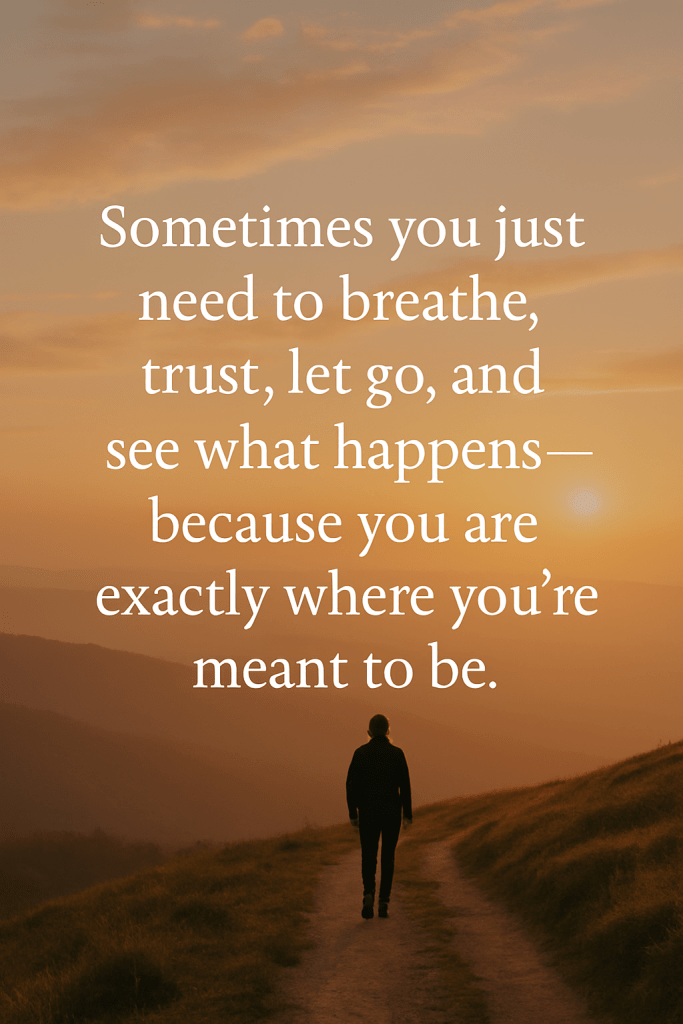
💫 You Are Exactly Where You’re Meant to Be

🌸 Introduction

There are times in life when we question everything — our choices, timing, and even our direction. We wonder if we’ve missed opportunities or fallen behind. But what if everything is actually happening just as it’s supposed to? What if, right now, you are exactly where you’re meant to be?
Sometimes, peace doesn’t come from changing your situation, but from trusting the path you’re already on.


Life unfolds with purpose


Every experience, whether joyful or painful, is shaping you into the person you’re meant to become. Nothing in your journey is wasted.

  1. God’s timing is perfect
    Delays aren’t denials. They are divine pauses, preparing you for something greater. You’re not late — you’re aligned with a higher plan.
  2. Every season has a reason
    Life has seasons of growth, waiting, and healing. Each one serves its own purpose in helping you evolve.
  3. Stop comparing your journey
    Someone else’s progress doesn’t define your own. Your path is uniquely yours, designed with care and intention.
  4. Embrace the present moment
    True peace comes from acceptance. When you stop resisting where you are, you begin to see the beauty hidden in this phase.
  5. Challenges are part of the process
    Struggles don’t mean you’re lost. Often, they’re lessons in disguise, guiding you toward greater strength and wisdom.
  6. You are growing, even in silence
    Growth isn’t always visible. Sometimes, God works quietly behind the scenes, aligning everything perfectly for your next step.
  7. Trust the divine plan
    Even when you don’t understand why things happen, believe that everything unfolds for your ultimate good.
  8. Be grateful for the now
    Gratitude transforms your outlook. When you focus on what’s good right now, life feels lighter and more meaningful.
  9. You are not behind — you’re becoming
    Every step, even the confusing ones, is leading you closer to where you’re supposed to be. You are learning, evolving, and becoming stronger with each experience.

Final Thoughts

Life isn’t a race, and you’re not missing out on anything meant for you. Every chapter — even the slow or difficult ones — is essential to your story. Trust that this moment has a purpose, even if you can’t see it yet.
When you let go of resistance and lean into faith, you’ll realize that you are right where you’re supposed to be — growing, healing, and preparing for what’s next.


🌼 Quote to Reflect On:

“Sometimes you just need to breathe, trust, let go, and see what happens — because you are exactly where you’re meant to be.”

🌟 Perception Is Everything: The Way You See Life Shapes Your Life

🔍 What Is Perception?

  • Perception is how you see, understand, and interpret the world around you.
  • It’s based on your thoughts, beliefs, experiences, and emotions.
  • Two people can go through the same situation but feel completely different—because of perception.

🌈 Why Perception Matters in Life

  • Your thoughts shape your reality.
    If you see problems, you feel stuck. If you see opportunities, you feel hopeful.
  • Perception affects your emotions.
    How you feel is often based on how you see what’s happening, not the event itself.
  • It guides your decisions.
    The way you view people, situations, or even yourself affects the choices you make.
  • It impacts your relationships.
    Misunderstandings often arise not from facts but from different perceptions.
  • It builds or breaks confidence.
    If you perceive yourself as capable, you’ll take action. If you don’t, you’ll hold back.

💡 Real-Life Examples

  • A rainy day:
    One person sees it as gloomy, another sees it as cozy and peaceful.
  • Criticism:
    One sees it as an attack, another sees it as a chance to grow.
  • Failure:
    Some see it as the end, others see it as feedback.

🔁 How to Shift Your Perception

  • Pause and reflect before reacting.
  • Ask yourself: “Is there another way to see this?”
  • Practice gratitude – it changes your focus from lack to abundance.
  • Surround yourself with positive influences – they shape your lens.
  • Challenge negative thoughts and replace them with balanced thinking.

🧠 Final Thought

“We don’t see things as they are, we see them as we are.”

When you change your perception, you change your life.
It’s not always the world that needs to change — sometimes it’s just how you’re looking at it.

Let It Go: Free Your Mind from What Doesn’t Deserve It

💭 1. Recognize What’s Taking Up Space in Your Mind

  • Not everything deserves your attention.
  • Ask yourself: Will this matter in a week, a month, or a year?

“You can’t control everything. Sometimes you just need to relax and have faith that things will work out.” – Unknown


🧠 2. Shift Your Focus

  • Focus on what you can control, not what you can’t.
  • Replace overthinking with action or reflection.

“Where focus goes, energy flows.” – Tony Robbins


🧹 3. Declutter Your Mind Like You Declutter a Room

  • Let go of negative thoughts, regrets, and what-ifs.
  • Journal it out or talk to someone you trust.

“Holding on is believing there’s only a past; letting go is knowing there’s a future.” – Daphne Rose Kingma


🛑 4. Set Boundaries with Yourself

  • Don’t let one small mistake or comment ruin your day.
  • Practice saying mentally: “This thought is not helping me.”

“You don’t have to attend every argument you’re invited to.” – Unknown


🧘 5. Practice Mindfulness

  • Stay grounded in the present moment.
  • Deep breathing, meditation, or a mindful walk can help you reset.

“Worrying is like paying a debt you don’t owe.” – Mark Twain


❤️ 6. Be Kind to Yourself

  • Stop punishing yourself for things out of your control.
  • Forgive yourself and move forward.

“Letting go means to come to the realization that some people are a part of your history, but not part of your destiny.” – Steve Maraboli


🔁 7. Let Go to Make Room for Better Things

  • When you stop holding on to the unnecessary, life becomes lighter.
  • You make space for peace, clarity, and true priorities.

“Some of us think holding on makes us strong, but sometimes it is letting go.” – Hermann Hesse


✨ Final Thought:

Letting go is not weakness—it’s wisdom.
Release what drains you and hold on to what lifts you.

Not Everything Is in Our Control: Learning to Let Go

Life doesn’t always go the way we plan. Sometimes, no matter how hard we try, things happen beyond our control. Learning to accept this truth can bring peace and strength.


1. Plans May Change — And That’s Okay

  • We may plan every detail, but life often surprises us.
  • Flexibility helps us handle sudden changes better.

2. We Can’t Control Other People

  • We can’t control how others think, feel, or act.
  • What we can control is our own response to them.

3. Unexpected Problems Will Arise

  • Health issues, weather changes, job losses—some things happen without warning.
  • Worrying doesn’t prevent problems; calm thinking helps us face them.

4. Letting Go Reduces Stress

  • Trying to control everything only makes us anxious.
  • Letting go gives us mental freedom and inner peace.

5. Focus on What You Can Control

  • Your attitude, choices, words, and actions are always in your hands.
  • Shifting focus here builds confidence and clarity.

6. Mistakes Happen – Learn, Don’t Blame

  • Blaming yourself for everything that goes wrong is unfair.
  • Learn the lesson, then move forward with kindness toward yourself.

7. Life Isn’t Always Fair

  • Not all efforts give the result we expect.
  • But showing up with honesty and effort still builds strength of character.

8. Accepting Uncertainty Brings Freedom

  • Life is uncertain, but that’s also what makes it interesting.
  • Accepting the unknown helps you live in the present.

9. Trust the Process

  • Sometimes delays or detours lead to better outcomes.
  • Have faith that things unfold for a reason, even if you don’t see it yet.

10. Peace Comes from Within

  • Control doesn’t create peace—acceptance does.
  • True peace comes when we stop fighting what we cannot change.

Final Thought:

You don’t have to control everything. You just need to manage your mindset, do your best, and let life flow. The rest will take care of itself.

Trust the Plan of the Almighty

Introduction
Life often throws us into situations where we feel lost, uncertain, or overwhelmed. In these moments, it’s easy to question what’s happening and why. However, trusting the plan of the Almighty can bring peace and guidance. Here’s a simple guide to understanding and embracing this trust.

1. Understand That There Is a Divine Plan

  • Everything Happens for a Reason: Believe that there is a higher purpose behind every event in your life, even if it’s not immediately clear.
  • Trust in the Almighty’s Wisdom: The Almighty knows what’s best for us, even when we can’t see the bigger picture.

2. Let Go of the Need for Control

  • Release the Pressure: Life can be stressful when we try to control every outcome. Trusting the Almighty allows you to let go and find peace.
  • Accept Uncertainty: Embrace the unknown, knowing that the Almighty has a plan in place for you.

3. Have Faith in Difficult Times

  • Stay Strong in Adversity: Difficult moments are often part of a larger plan that we don’t yet understand.
  • Believe in Growth: Challenges are opportunities for growth and learning, designed to strengthen your faith and character.

4. Practice Patience

  • Trust the Timing: The Almighty’s plan unfolds at the right time. Patience is key when waiting for things to happen.
  • Avoid Rushing: Don’t rush through life’s phases. Trust that everything will come together in due time.

5. Look for Signs of Guidance

  • Pay Attention to Life’s Nudges: Sometimes, the Almighty sends subtle signs to guide you in the right direction.
  • Be Open to Inspiration: Whether through a conversation, a book, or a feeling, the Almighty often provides inspiration that aligns with the greater plan.

6. Stay Grateful

  • Appreciate the Journey: Gratitude for both the good and challenging times helps you stay positive and trust the process.
  • Recognize Blessings: Even in tough times, look for the small blessings and be thankful for them.

7. Surrender to the Divine Will

  • Embrace Submission: Surrendering to the Almighty’s will doesn’t mean giving up; it means trusting that the path laid out for you is the best one.
  • Find Peace in Acceptance: Accepting the Almighty’s plan brings inner peace, knowing you’re on the right path.

Conclusion
Trusting the plan of the Almighty isn’t always easy, especially when life doesn’t go as we expect. However, by understanding that there’s a greater purpose, letting go of control, having faith, practicing patience, looking for guidance, staying grateful, and surrendering to the divine will, you can find peace and reassurance. Remember, the Almighty’s plan is always for your ultimate good, even when the road seems uncertain.