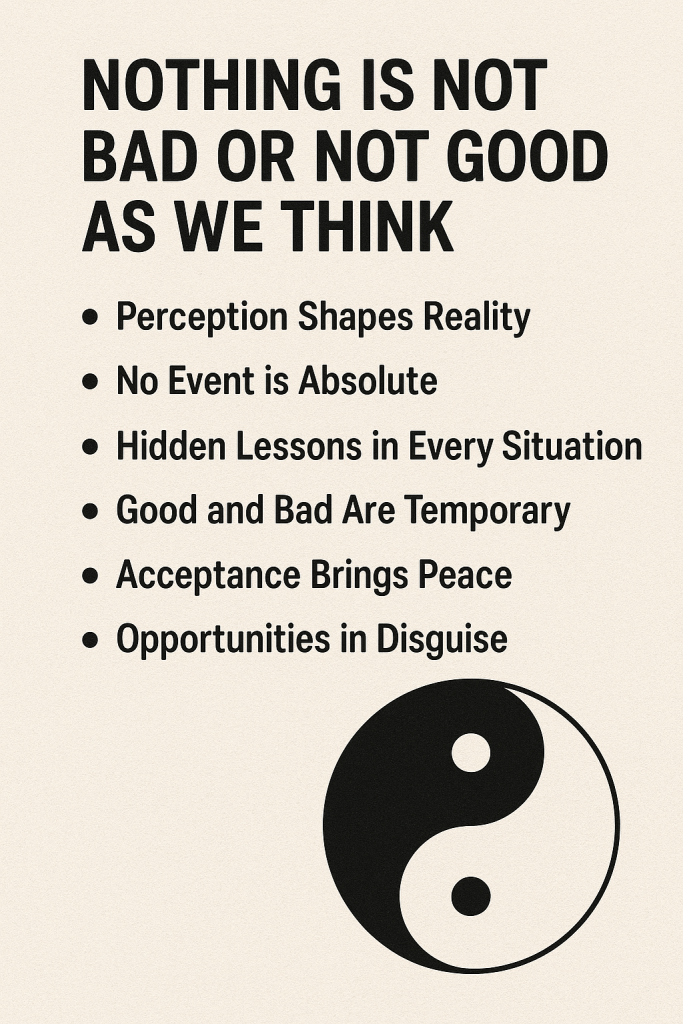
Nothing is Not Bad or Not Good as We Think

Introduction

Life often surprises us with situations that we quickly label as good or bad. But in reality, many things are neither completely good nor completely bad—it is our perception that shapes how we feel about them.


Key Points

  • Perception Shapes Reality
    • What feels like a setback today may turn into a blessing tomorrow.
    • Example: Losing a job can seem bad, but it may lead to better opportunities.
  • No Event is Absolute
    • Life events are neutral; it is we who add the meaning.
    • Something that feels painful to one person might feel like growth to another.
  • Hidden Lessons in Every Situation
    • Even challenges carry lessons, strength, and wisdom.
    • What seems “bad” can make us stronger and more resilient.
  • Good and Bad Are Temporary
    • Joy and sorrow are like waves—they come and go.
    • Nothing remains permanent; every phase changes with time.
  • Acceptance Brings Peace
    • Instead of labeling things as good or bad, accepting them as experiences brings calmness.
    • This mindset helps us handle stress with balance.
  • Opportunities in Disguise
    • Difficulties often open doors we would never notice otherwise.
    • The key is to stay open-minded and patient.

Conclusion

Nothing in life is completely good or bad—it is our thoughts and judgments that create those labels. When we look at situations with an open and neutral mind, we find peace, growth, and unexpected opportunities. Life is a teacher, and every moment—whether pleasant or painful—has a purpose.


Life Will Never Wait for Anyone

  1. Time Moves Constantly
    • Life is always in motion, and time never stops for anyone.
    • Every second that passes is a moment we can never get back, making it important to make the most of every day.
  2. Opportunities Come and Go
    • Life presents us with opportunities, but if we wait too long or hesitate, those chances may slip away.
    • Success often comes to those who act, not those who wait for the “perfect” moment.
  3. Embrace Change
    • Life is full of changes and uncertainties; it’s important to adapt and evolve with them.
    • Resisting change can hold us back, while embracing it can open new doors.
  4. Procrastination Is the Enemy
    • Delaying tasks or decisions often leads to missed opportunities.
    • Taking action, even in small steps, is key to progress and growth.
  5. Learn to Let Go
    • Holding on to the past or dwelling on missed chances can prevent us from moving forward.
    • Focus on what you can control in the present and future, rather than what has already passed.
  6. Seize the Moment
    • The present moment is all we truly have. Living mindfully helps us appreciate and make the most of each day.
    • Waiting for “tomorrow” often means never taking action. Start today.
  7. Life Is a Journey, Not a Race
    • While life doesn’t wait, it’s important to remember that everyone moves at their own pace.
    • It’s not about rushing through life but making sure we’re living meaningfully and purposefully.
  8. Pursue Your Dreams
    • Don’t wait for the “right time” to chase your passions or dreams. Start working towards them now, even if progress is gradual.
    • Life’s unpredictability means the perfect time may never come, so take action while you can.
  9. Build and Nurture Relationships
    • Don’t wait to express love or gratitude to the people in your life. Life’s fleeting nature means we may not always have the chance later.
    • Make time for loved ones, as relationships are one of the most valuable aspects of life.
  10. Live Without Regrets
    • At the end of the day, we are more likely to regret the things we didn’t do than the things we did.
    • Taking chances, making mistakes, and learning from them are all part of truly living.

Conclusion

Life will never pause or wait for anyone. The key to happiness and fulfillment lies in taking action, embracing change, and living fully in the present. Don’t wait for tomorrow to start living your best life—make every moment count today!

Finding Balance: Wisdom from Indian Women on Work and Life

In today’s busy world, finding a balance between work and personal life is really important, especially for women who have many different responsibilities. In this blog, we’ll take a close look at how working women manage to juggle it all. We’ll learn from some famous Indian women who have achieved success in their careers while also finding happiness in their personal lives.

Quotes from Indian Personalities:

Indra Nooyi: “Being a CEO doesn’t mean you’re done learning. Keep growing, thinking differently, and improving how you lead.” Indra Nooyi, former CEO of PepsiCo, highlights the importance of continuous learning and personal growth, showing that there’s always room for improvement even at the top.

Kiran Bedi: “Balance isn’t just about managing time. It’s about setting boundaries and enjoying the choices you make.” Kiran Bedi, India’s first female Indian Police Service officer, explains that balance comes from making mindful choices and respecting the limits we set for ourselves.

Naina Lal Kidwai: “There’s no one-size-fits-all solution for balance. It’s about figuring out what works best for you and making it happen.” Naina Lal Kidwai, former CEO of HSBC India, emphasizes the importance of self-awareness and customization in finding our own version of work-life harmony, reminding us that it’s a personal journey.

Strategies for Achieving Work-Life Balance:

  • Take Care of Yourself: Make time for activities that make you happy and healthy, like exercise, hobbies, and spending time with loved ones.
  • Set Boundaries: Decide when work time ends and personal time begins, and stick to those boundaries to avoid burnout.
  • Ask for Help: Don’t be afraid to delegate tasks at work and home to lighten your load and reduce stress.
  • Stay Present: Practice mindfulness by focusing on the present moment and avoiding distractions, which can help you feel more balanced and less overwhelmed.

Conclusion: By following the advice of these inspiring Indian figures, working women can find balance in their lives by making choices that prioritize their well-being and happiness. Whether it’s through self-care, setting boundaries, asking for help, or staying present, achieving work-life harmony is possible for everyone.

Living with Purpose: Embracing Slow Living, Minimalism, and Intentional Living

  • Introduction:
    • In our modern, fast-paced world, there’s a growing desire to slow down and live more intentionally.
    • Slow living encompasses mindfulness, simplicity, and intentionality as core principles.
  • Understanding Slow Living:
    • “The essence of life is not in the great victories and grand failures, but in the simple joys of everyday living.” – Mahatma Gandhi
    • Slow living encourages us to resist the urge to constantly rush through life and instead focus on being present and mindful in each moment.
    • It involves savoring experiences, cultivating gratitude, and prioritizing meaningful connections over material possessions or external achievements.
  • The Essence of Minimalism:
    • “Simplicity is the ultimate sophistication.” – N. R. Narayana Murthy
    • Minimalism is a lifestyle choice that advocates for intentional living with fewer material possessions and distractions.
    • By decluttering our physical and mental spaces, we create room for clarity, creativity, and peace of mind.
  • Benefits of Intentional Living:
    • “The mind is everything. What you think, you become.” – Swami Vivekananda
    • Intentional living involves aligning our actions with our values and priorities to live a more purposeful life.
    • It empowers us to make conscious choices, set meaningful goals, and cultivate habits that support our well-being and personal growth.
  • Practical Tips for Embracing Slow Living:
    • “Take rest; a field that has rested gives a bountiful crop.” – Osho
    • Prioritize self-care by incorporating practices like meditation, journaling, or spending time in nature.
    • Simplify your surroundings by decluttering your home, digital devices, and schedule to reduce overwhelm and create space for what truly matters.
    • Cultivate mindfulness by being fully present in each moment, practicing gratitude, and embracing the beauty of simplicity.
    • Set boundaries to protect your time and energy, saying no to activities or commitments that don’t align with your values or priorities.
  • Embracing slow living, minimalism, and intentional living offers a transformative path to a more fulfilling and meaningful life. By adopting these principles and practices, we can cultivate greater happiness, contentment, and inner peace amidst the chaos of modern life.