💫 You Are Exactly Where You’re Meant to Be

🌸 Introduction

There are times in life when we question everything — our choices, timing, and even our direction. We wonder if we’ve missed opportunities or fallen behind. But what if everything is actually happening just as it’s supposed to? What if, right now, you are exactly where you’re meant to be?
Sometimes, peace doesn’t come from changing your situation, but from trusting the path you’re already on.


Life unfolds with purpose


Every experience, whether joyful or painful, is shaping you into the person you’re meant to become. Nothing in your journey is wasted.

  1. God’s timing is perfect
    Delays aren’t denials. They are divine pauses, preparing you for something greater. You’re not late — you’re aligned with a higher plan.
  2. Every season has a reason
    Life has seasons of growth, waiting, and healing. Each one serves its own purpose in helping you evolve.
  3. Stop comparing your journey
    Someone else’s progress doesn’t define your own. Your path is uniquely yours, designed with care and intention.
  4. Embrace the present moment
    True peace comes from acceptance. When you stop resisting where you are, you begin to see the beauty hidden in this phase.
  5. Challenges are part of the process
    Struggles don’t mean you’re lost. Often, they’re lessons in disguise, guiding you toward greater strength and wisdom.
  6. You are growing, even in silence
    Growth isn’t always visible. Sometimes, God works quietly behind the scenes, aligning everything perfectly for your next step.
  7. Trust the divine plan
    Even when you don’t understand why things happen, believe that everything unfolds for your ultimate good.
  8. Be grateful for the now
    Gratitude transforms your outlook. When you focus on what’s good right now, life feels lighter and more meaningful.
  9. You are not behind — you’re becoming
    Every step, even the confusing ones, is leading you closer to where you’re supposed to be. You are learning, evolving, and becoming stronger with each experience.

Final Thoughts

Life isn’t a race, and you’re not missing out on anything meant for you. Every chapter — even the slow or difficult ones — is essential to your story. Trust that this moment has a purpose, even if you can’t see it yet.
When you let go of resistance and lean into faith, you’ll realize that you are right where you’re supposed to be — growing, healing, and preparing for what’s next.


🌼 Quote to Reflect On:

“Sometimes you just need to breathe, trust, let go, and see what happens — because you are exactly where you’re meant to be.”

Peaceful Eternal Life

🌸 Introduction

Everyone seeks peace — not just in moments, but in life itself. A peaceful eternal life is about living with calmness, clarity, and contentment that lasts beyond temporary highs and lows. It’s not about how long we live, but how peacefully we live.


☀️ 1. Peace Begins Within

  • True peace starts from the mind and heart, not from the outside world.
  • Calm thoughts create calm actions.
  • When you learn to quiet your inner noise, life automatically feels lighter.

“Peace comes from within. Do not seek it without.” – Buddha


🌊 2. Let Go of What You Can’t Control

  • Life becomes peaceful when we stop fighting every situation.
  • Acceptance is the first step to inner harmony.
  • Control your reactions, not the world around you.

“The greatest weapon against stress is our ability to choose one thought over another.” – William James


🌿 3. Live with Kindness and Compassion

  • A peaceful heart is a kind heart.
  • Helping others, forgiving mistakes, and spreading love bring eternal satisfaction.
  • Compassion connects us to something divine and everlasting.

🌤 4. Stay Grateful Every Day

  • Gratitude transforms ordinary days into blessings.
  • Appreciate simple joys — sunrise, laughter, loved ones, good health.
  • Gratitude invites peace and pushes away negativity.

“Gratitude turns what we have into enough.” – Anonymous


🌙 5. Connect with the Spiritual Side

  • Meditation, prayer, or quiet reflection can calm your soul.
  • Believe that life has a higher purpose beyond material success.
  • Spiritual awareness helps you feel eternal peace, beyond fear or loss.

🌻 6. Live in Harmony with Nature

  • Nature teaches balance and serenity.
  • Spend time under the sky, near trees or water — it heals silently.
  • When you live close to nature, you live close to peace.

🌈 7. Simplicity is the Secret

  • The less you chase, the more you rest.
  • Simplify your wants, declutter your mind, and value peace over possessions.
  • Eternal peace comes when you stop competing and start living mindfully.

🌟 Conclusion

Peaceful eternal life isn’t a faraway dream — it’s a state of being we can nurture every day.
It’s in our thoughts, choices, and the love we share.
When you live with peace in your heart, you live eternally — even in moments.

“Peace is not the destination, it is the way.” – Thich Nhat Hanh

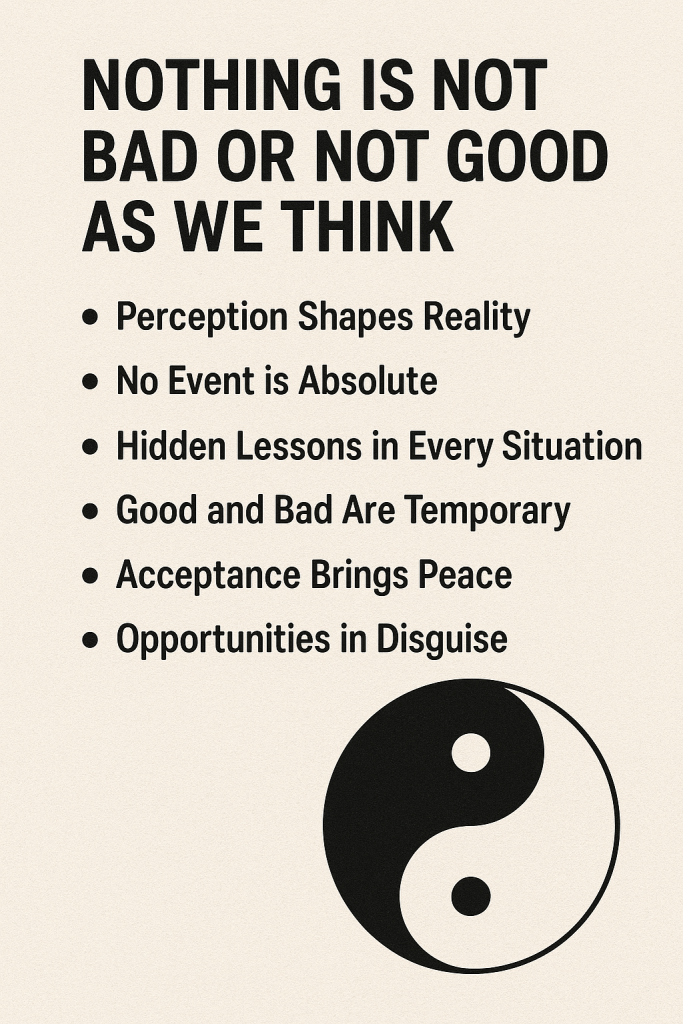
Nothing is Not Bad or Not Good as We Think

Introduction

Life often surprises us with situations that we quickly label as good or bad. But in reality, many things are neither completely good nor completely bad—it is our perception that shapes how we feel about them.


Key Points

  • Perception Shapes Reality
    • What feels like a setback today may turn into a blessing tomorrow.
    • Example: Losing a job can seem bad, but it may lead to better opportunities.
  • No Event is Absolute
    • Life events are neutral; it is we who add the meaning.
    • Something that feels painful to one person might feel like growth to another.
  • Hidden Lessons in Every Situation
    • Even challenges carry lessons, strength, and wisdom.
    • What seems “bad” can make us stronger and more resilient.
  • Good and Bad Are Temporary
    • Joy and sorrow are like waves—they come and go.
    • Nothing remains permanent; every phase changes with time.
  • Acceptance Brings Peace
    • Instead of labeling things as good or bad, accepting them as experiences brings calmness.
    • This mindset helps us handle stress with balance.
  • Opportunities in Disguise
    • Difficulties often open doors we would never notice otherwise.
    • The key is to stay open-minded and patient.

Conclusion

Nothing in life is completely good or bad—it is our thoughts and judgments that create those labels. When we look at situations with an open and neutral mind, we find peace, growth, and unexpected opportunities. Life is a teacher, and every moment—whether pleasant or painful—has a purpose.

Worrying Doesn’t Take Away Tomorrow’s Troubles — It Takes Away Today’s Peace

🌿 Introduction

  • We all worry — about the future, about people, about situations we can’t control.
  • But have you ever noticed that worrying rarely solves anything?
  • The famous quote reminds us: “Worrying does not take away tomorrow’s troubles — it takes away today’s peace.”

💭 1. Worry is a Thief of the Present

  • Worrying pulls your mind into the future.
  • You miss what’s happening right now — the beauty, the joy, the calm moments.
  • It’s like carrying an umbrella every day in fear of rain that may never come.

🌪 2. Worry Doesn’t Solve Problems

  • Planning helps. Preparing helps. But worrying just drains your energy.
  • It gives you a sense of false control, but no real solutions.
  • Most of what we worry about either never happens or isn’t as bad as we imagined.

🕊 3. Peace Is Found in the Present

  • Peace lives in this moment, not in the next hour or tomorrow.
  • When you’re too focused on “what if,” you lose the “what is.”
  • Mindfulness and deep breathing can help you stay grounded.

🌼 4. Worry Affects Your Health

  • Constant worrying causes stress, anxiety, and even physical illness.
  • It can disturb your sleep, your appetite, and your emotional balance.
  • Taking care of your mind is just as important as taking care of your body.

🌟 5. Choose Faith Over Fear

  • Let go of the need to control everything.
  • Have faith that life will unfold in its own time.
  • Replace worry with action — or acceptance.

💬 Quote to Remember

“Worrying is like a rocking chair. It gives you something to do but gets you nowhere.” — Erma Bombeck


🌈 Conclusion

  • Worrying doesn’t help the future — it only steals today’s peace.
  • Live each moment with calmness, hope, and faith.
  • You deserve a peaceful mind today — don’t let tomorrow take that away.

Be Proactive, Not Reactive

Introduction

Life constantly throws challenges and opportunities at us. How we handle them defines the quality of our journey. Being reactive—waiting for situations to unfold before acting—can lead to stress and missed opportunities. On the other hand, being proactive allows us to take control, plan ahead, and create positive outcomes. Proactive people don’t wait for things to happen; they make things happen.

1. What Does It Mean to Be Proactive?

  • Being proactive means taking initiative, anticipating challenges, and acting before situations demand it.
  • It’s about focusing on solutions rather than being overwhelmed by problems.

2. The Problem with Being Reactive

  • Reacting often means making decisions based on emotions, like panic or frustration.
  • It leads to rushed actions and a feeling of being out of control.

3. Benefits of Being Proactive

  • Better Control: You direct your life instead of letting circumstances dictate your path.
  • Improved Planning: You’re prepared for challenges before they arise.
  • Reduced Stress: Tackling problems early prevents them from becoming crises.
  • More Opportunities: A proactive approach often opens doors that others miss.

4. Examples of Proactive vs. Reactive

  • Proactive: Saving money regularly for emergencies.
    Reactive: Borrowing money last minute when faced with unexpected expenses.
  • Proactive: Seeking feedback at work to improve performance.
    Reactive: Waiting for a problem to occur before addressing it.

5. Steps to Be Proactive

  • Set Clear Goals: Know what you want and work steadily toward it.
  • Plan Ahead: Break tasks into smaller steps and start early.
  • Anticipate Challenges: Think about potential obstacles and prepare solutions.
  • Take Responsibility: Acknowledge your role in shaping outcomes instead of blaming circumstances.

6. Building a Proactive Mindset

  • Focus on what you can control and let go of what you can’t.
  • Practice mindfulness to stay calm and think clearly.
  • Surround yourself with people who encourage growth and positivism.

7. Overcoming Challenges to Stay Proactive

  • Stress and uncertainty can make it easy to fall back into reactive habits.
  • Build small habits like daily planning and reflecting on your actions to stay proactive.

8. Proactive People Inspire Change

  • Your proactive mindset can influence others to take charge of their lives.
  • Together, proactive actions can lead to broader positive changes in communities and workplaces.

Take Charge of Your Life

Life may not always go as planned, but a proactive mindset helps you navigate its twists and turns with confidence. Start small—create a goal, plan ahead, and take the first step. Being proactive isn’t just about solving problems; it’s about creating opportunities and leading a purposeful life. Remember, proactive people shape their destiny, while reactive people let circumstances define them.

Thinking is the Root Cause of All Suffering

Understanding the Power of Thoughts

  • Our thoughts shape how we perceive and experience life.
  • Example: If you constantly think about failure, you may start to believe you’re not capable, even when there’s no real evidence to support that.

Negative Thinking Leads to Suffering

  • Dwelling on negative thoughts can create unnecessary mental pain.
  • Example: Worrying about things beyond your control, like what others think of you, can lead to anxiety and stress, even if the situation is harmless.

Overthinking Amplifies Problems

  • Thinking too much about a problem often makes it seem bigger than it is.
  • Example: If you overthink a minor mistake at work, it might feel like a disaster, causing you to feel more stress than the situation warrants.

Attachment to Thoughts Creates Suffering

  • Becoming too attached to certain ideas or outcomes can lead to disappointment and frustration.
  • Example: If you’re fixated on getting a promotion and it doesn’t happen, the attachment to that expectation can cause deep emotional pain.

The Illusion of Control Through Thinking

  • We often believe that by thinking more, we can control outcomes, but this can create stress.
  • Example: A person may obsess over how to make everything perfect in their life, only to feel overwhelmed when things don’t go as planned.

Judgmental Thinking Creates Unhappiness

  • Constantly judging yourself or others leads to dissatisfaction.
  • Example: If you compare yourself to others and think you’re not good enough, it can cause feelings of inadequacy and low self-esteem.

Living in the Past or Future Causes Suffering

  • When we focus on past regrets or future worries, we miss the present moment and create stress.
  • Example: Thinking about past mistakes or worrying about future problems robs you of the peace and joy available in the present.

Breaking Free from the Cycle of Thought-Based Suffering

  • Mindfulness helps reduce the power thoughts have over you by bringing focus to the present moment.
  • Example: Practicing meditation can help calm the mind and reduce overthinking, allowing you to experience life without being overwhelmed by thoughts.

Accepting Impermanence Reduces Suffering

  • Realizing that thoughts and emotions are temporary helps reduce suffering.
  • Example: Understanding that bad moods or stressful thoughts will pass can help you avoid getting stuck in negative thinking patterns.

Conclusion

  • Thinking, when not controlled, can become the root cause of much of our suffering.
  • Learning to manage our thoughts and staying present can help reduce mental stress and bring peace.

Trust the Plan of the Almighty

Introduction
Life often throws us into situations where we feel lost, uncertain, or overwhelmed. In these moments, it’s easy to question what’s happening and why. However, trusting the plan of the Almighty can bring peace and guidance. Here’s a simple guide to understanding and embracing this trust.

1. Understand That There Is a Divine Plan

  • Everything Happens for a Reason: Believe that there is a higher purpose behind every event in your life, even if it’s not immediately clear.
  • Trust in the Almighty’s Wisdom: The Almighty knows what’s best for us, even when we can’t see the bigger picture.

2. Let Go of the Need for Control

  • Release the Pressure: Life can be stressful when we try to control every outcome. Trusting the Almighty allows you to let go and find peace.
  • Accept Uncertainty: Embrace the unknown, knowing that the Almighty has a plan in place for you.

3. Have Faith in Difficult Times

  • Stay Strong in Adversity: Difficult moments are often part of a larger plan that we don’t yet understand.
  • Believe in Growth: Challenges are opportunities for growth and learning, designed to strengthen your faith and character.

4. Practice Patience

  • Trust the Timing: The Almighty’s plan unfolds at the right time. Patience is key when waiting for things to happen.
  • Avoid Rushing: Don’t rush through life’s phases. Trust that everything will come together in due time.

5. Look for Signs of Guidance

  • Pay Attention to Life’s Nudges: Sometimes, the Almighty sends subtle signs to guide you in the right direction.
  • Be Open to Inspiration: Whether through a conversation, a book, or a feeling, the Almighty often provides inspiration that aligns with the greater plan.

6. Stay Grateful

  • Appreciate the Journey: Gratitude for both the good and challenging times helps you stay positive and trust the process.
  • Recognize Blessings: Even in tough times, look for the small blessings and be thankful for them.

7. Surrender to the Divine Will

  • Embrace Submission: Surrendering to the Almighty’s will doesn’t mean giving up; it means trusting that the path laid out for you is the best one.
  • Find Peace in Acceptance: Accepting the Almighty’s plan brings inner peace, knowing you’re on the right path.

Conclusion
Trusting the plan of the Almighty isn’t always easy, especially when life doesn’t go as we expect. However, by understanding that there’s a greater purpose, letting go of control, having faith, practicing patience, looking for guidance, staying grateful, and surrendering to the divine will, you can find peace and reassurance. Remember, the Almighty’s plan is always for your ultimate good, even when the road seems uncertain.