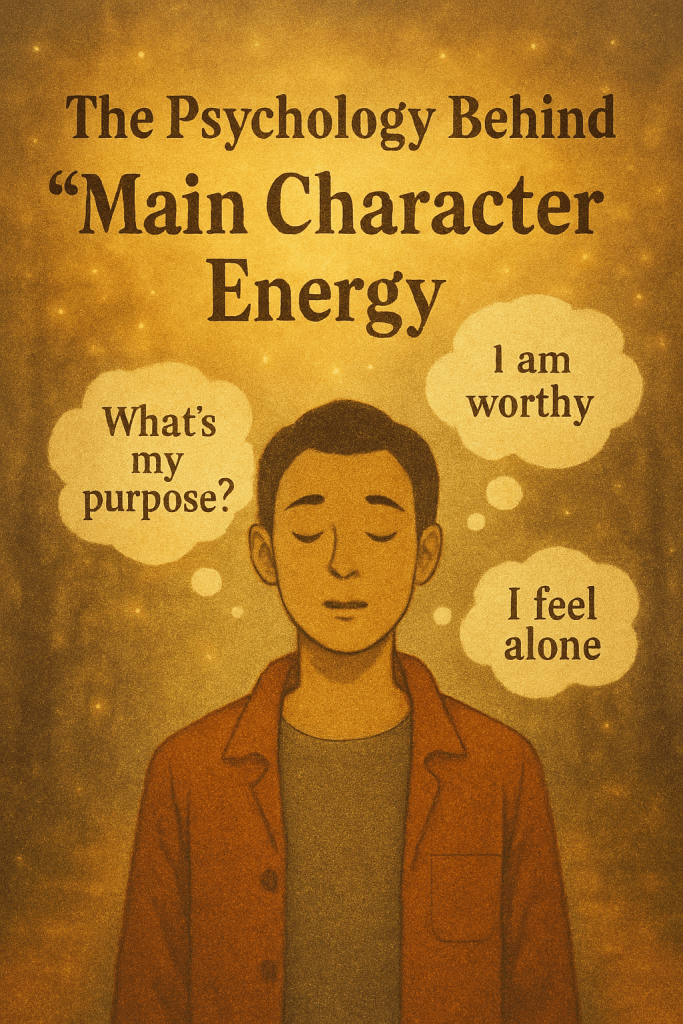
The Psychology Behind “Main Character Energy”

In recent years, you might have heard phrases like “I’m in my main character era” or “Live like the main character.” But what does it really mean? And why is it trending?

Let’s break it down simply.


🌟 What Is “Main Character Energy”?

Main Character Energy (MCE) is a mindset where a person sees themselves as the lead in their own life story. It’s about confidence, self-awareness, and making choices that align with your values, not just blending into the background.

“You are the author of your own story. Don’t hand the pen to someone else.”


🧠 Why It Feels So Good (Psychological Reasons)

  1. Boosts Self-Esteem
    • When you feel like the ‘main character,’ you value yourself more.
    • Example: Dressing up just for a walk because it makes you feel good.
  2. Encourages Mindfulness
    • You become more aware of your surroundings and actions.
    • Example: Drinking coffee slowly while enjoying the moment, like you’re in a movie scene.
  3. Helps Create a Strong Identity
    • You start asking: What kind of person do I want to be?
    • This leads to intentional decisions, not just going with the crowd.
  4. Inspires Personal Growth
    • Main characters overcome challenges.
    • Example: You treat a bad day not as the end—but as the middle of your character arc.
    “You either walk inside your story and own it, or you stand outside and hustle for your worthiness.” — Brené Brown

🎬 Main Character Energy vs. Narcissism

It’s important to note that MCE is not about being self-obsessed or thinking others are less important.
It’s about:

✅ Confidence — not arrogance
✅ Self-love — not selfishness
✅ Growth — not perfection

“You can be the main character of your life without needing to be the center of everyone else’s.”

✨ Practical Ways to Step into Your Main Character Energy

  1. Create Your “Main Character” Morning Routine
    • Start your day with intention. Stretch, journal, listen to music that motivates you.
    • Example: Brew your coffee slowly, stand by the window, and soak in the moment — like the intro scene of a movie.
  2. Dress for the Mood You Want to Create
    • Wear outfits that make you feel confident, even if you’re not going anywhere fancy.
    • Example: Wear that bold shirt or lipstick just because it feels you.
  3. Narrate Your Day (Internally or Out Loud!)
    • Turn simple moments into powerful scenes.
    • Example: Walking to the bus stop? Imagine you’re the hero heading to an important mission.
  4. Celebrate Small Wins Like Big Victories
    • Whether it’s finishing a to-do list or making it through a hard day, clap for yourself.
    • Example: Treat yourself to a solo coffee date after a productive week.
  5. Set a Soundtrack for Your Life
    • Make playlists that match your vibe — “Confidence Mode,” “Healing Era,” or “Rising Strong.”
    • Music/podcast makes every moment feel cinematic and empowering.
  6. Say Yes to Solo Moments
    • Take yourself out for a nature walk, or bookstore visit. You don’t need company to enjoy your life.
    • Example: A quiet Sunday spent journaling and reflecting can feel like a self-love scene.

📖 Final Thought

You don’t need to wait for someone to give you permission. You are already the main character.
Every small act of self-care, courage, and intention writes a better version of your life story.

“The moment you start acting like life is a movie, everything changes. The mood, the energy, the plot—it’s all in your hands.”


The Science of Manifestation: Does It Really Work?

1. Understanding Manifestation

  • Manifestation is the belief that thoughts shape reality.
  • Based on the Law of Attraction, it suggests that positive thinking leads to positive outcomes, while negative thinking attracts obstacles.
  • People use manifestation techniques like visualization, affirmations, and goal-setting to attract success, love, or happiness.

2. The Brain’s Role in Manifestation

While manifestation is often linked to spirituality, science explains how it works through psychology and neuroscience:

🔹 Reticular Activating System (RAS) – The Mind’s Filter

  • The RAS in the brain filters information and directs attention to what matters.
  • If you constantly think about success, your brain notices more opportunities that align with that goal.

🔹 Neuroplasticity – Rewiring Thought Patterns

  • The brain can form new neural pathways based on repeated thoughts.
  • Positive thinking and affirmations strengthen confidence and motivation, making success more achievable.

🔹 Self-Fulfilling Prophecy – Turning Beliefs into Reality

  • If you believe in a goal, you subconsciously take actions that lead to achieving it.
  • Example: If you believe you are confident, you act confidently, which makes others perceive you that way.

🔹 Psychological Priming – Preparing for Success

  • When you visualize success, your brain creates a mental rehearsal, making the real experience feel more familiar and achievable.

3. Common Myths About Manifestation

It’s not just wishful thinking – You must take action.
It’s not an instant solution – Results take time and effort.
It doesn’t work for everything – External factors like luck, timing, and competition still play a role.


4. Practical Steps to Manifest Your Goals

Be Clear About What You Want → Define specific, realistic goals.
Visualize Success Daily → Picture yourself achieving your goal with strong emotions.
Take Consistent Action → Manifestation works when combined with real effort (e.g., learning new skills, networking).
Practice Gratitude → A positive mindset attracts more opportunities and motivation.
Replace Self-Doubt with Confidence → Shift from “I can’t” to “I will.”


5. The Truth: Does Manifestation Really Work?

  • Yes, but through mindset shifts and action.
  • Science supports that focused thinking, goal-setting, and belief in success increase the chances of achieving it.
  • Manifestation alone won’t create results—it must be paired with hard work and persistence.

6. Manifest with Action

Manifestation is a powerful tool for motivation and confidence, but it’s not magic. The best way to turn dreams into reality is to think it, believe it, take action, and stay consistent.

Your thoughts create your path, but your actions build the road!

The Psychology of Habit Formation: Creating Lasting Change

Introduction

  • Habits influence our everyday actions and overall life outcomes.
  • Understanding habit formation can help you create positive, lasting changes.
  • By applying specific strategies, you can build habits that stick.

1. What Are Habits?

  • Habits are automatic behaviors ingrained through repetition.
  • Examples include checking social media as soon as you wake up or drinking coffee every morning.
  • These behaviors become second nature over time.

2. The Habit Loop

  • Cue: The trigger that initiates the habit.
    • Example: Hearing your morning alarm (cue) prompts you to get out of bed and make coffee (routine).
  • Routine: The behavior you perform in response to the cue.
    • Example: After hearing the alarm, you automatically go to the kitchen to brew coffee.
  • Reward: The positive feeling or outcome you get from the routine.
    • Example: The enjoyment and energy boost from drinking coffee reinforces the habit.

3. Start Small

  • Begin with small, easy-to-achieve actions.
  • Example: If you want to start meditating, begin with just 2 minutes a day instead of trying to meditate for 20 minutes.
  • Small steps are less overwhelming and build confidence as you progress.

4. Be Consistent

  • Repetition is crucial to solidifying a habit.
  • Example: If you want to develop a habit of writing daily, start by writing for just 10 minutes every day.
  • Consistent practice over time makes the habit automatic, regardless of initial motivation levels.

5. Reward Yourself

  • Use positive reinforcement to make the habit enjoyable.
  • Example: After completing a workout, reward yourself with a relaxing shower or a healthy smoothie.
  • Small rewards can keep you motivated and make the habit more sustainable.

6. Know Your Triggers

  • Identify and understand what triggers your habits.
  • Example: If watching TV in the evening leads you to snack mindlessly, recognize the trigger and replace it with a healthier habit, like drinking herbal tea.
  • Being aware of triggers allows you to modify or avoid them, leading to better habits.

7. Push Through the Plateau

  • Be prepared for periods where progress seems to stall.
  • Example: You might initially lose weight quickly with a new exercise routine, but then hit a plateau. Stay committed, as consistency will eventually yield results.
  • Recognizing that plateaus are normal helps you stay motivated through the tough times.

8. Make It Easy

  • Simplify the habit to increase your chances of success.
  • Example: If you want to read more, keep a book on your nightstand so it’s the last thing you see before bed, making it easy to pick up and read.
  • Reducing barriers to action makes it easier to maintain the habit over time.

9. Get Support

  • Leverage social support and accountability to stay on track.
  • Example: Join a book club if you want to read more. Discussing books with others will keep you motivated to continue reading.
  • Support from others makes it easier to stick with your habits and provides encouragement during challenges.

10. Think About Your Identity
– Align your habits with the person you want to become. – Example: Instead of saying, “I want to exercise more,” think, “I am a person who values fitness and health.” – When your habits reflect your identity, they become more natural and sustainable over time.

Conclusion

  • Understanding the psychology behind habit formation is key to creating lasting change.
  • Start with small, consistent steps and use rewards to reinforce your progress.
  • Be mindful of triggers, simplify your habits, and seek support from others.
  • Focus on aligning your habits with your desired identity to make them long-lasting and impactful.

Thoughts Vs. Thinking: Understanding the Difference

When we talk about our minds, we often use the terms “thoughts” and “thinking” interchangeably. However, they actually refer to different processes. Let’s explore the differences in simple comparison points.

1. Definition

  • Thoughts: Thoughts are individual ideas, images, or sensations that arise in our minds. They can be triggered by external stimuli, memories, or spontaneous mental activity.
  • Thinking: Thinking is the cognitive process of actively engaging with thoughts to analyze, synthesize, evaluate, and make decisions. It involves using reasoning and logic to work through information and problems.

2. Nature

  • Thoughts: Thoughts are often spontaneous and can occur without conscious effort. They can be random and fleeting, reflecting a wide range of subjects from mundane daily activities to deep philosophical questions.
  • Thinking: Thinking is deliberate and controlled. It involves focusing mental effort on a specific topic or problem. It requires intention and concentration to engage in this process.

3. Duration

  • Thoughts: Thoughts are usually brief and transient. They can come and go in an instant, sometimes without us even realizing it.
  • Thinking: Thinking can be sustained over longer periods. When we think, we might spend several minutes to hours concentrating on a particular subject or solving a complex issue.

4. Control

  • Thoughts: We have limited control over our thoughts. They can be influenced by our environment, emotions, and subconscious mind. Intrusive thoughts can sometimes enter our mind without our consent.
  • Thinking: We have more control over thinking. We can decide what to think about and direct our mental energy towards specific goals or problems. Thinking can be guided and structured.

5. Examples

  • Thoughts: Examples of thoughts include:
    • “I need to buy milk.”
    • “What a beautiful sunset!”
    • “I wonder what my friend is doing right now.”
  • Thinking: Examples of thinking include:
    • Planning your day or week.
    • Solving a math problem or puzzle.
    • Writing an essay or report.
    • Making a decision about a significant life event.

6. Impact

  • Thoughts: Thoughts can have an immediate impact on our emotions and mood. For example, a happy thought can make us feel joyful, while a distressing thought can cause anxiety or sadness.
  • Thinking: Thinking has a more profound and long-term impact. It helps us understand complex issues, make informed decisions, solve problems, and plan for the future. Effective thinking can lead to better outcomes in various aspects of life.

7. Frequency

  • Thoughts: Thoughts are constant and occur throughout the day. We have thousands of thoughts daily, many of which we may not even be consciously aware of.
  • Thinking: Thinking is less frequent and more effortful. It requires us to consciously engage our cognitive faculties and is often triggered by specific needs or challenges.

8. Purpose

  • Thoughts: The purpose of thoughts can be varied and sometimes seemingly purposeless. They can be reflections, reminders, or spontaneous ideas without immediate relevance.
  • Thinking: The purpose of thinking is goal-oriented. It aims to solve problems, make decisions, create plans, or understand complex concepts. Thinking is often purposeful and directed towards achieving a specific outcome.

9. Mental Effort

  • Thoughts: Thoughts require minimal mental effort as they often occur automatically.
  • Thinking: Thinking requires significant mental effort and concentration. It involves critical and analytical skills to process information effectively.

Conclusion

Understanding the difference between thoughts and thinking can help us better manage our cognitive processes. While thoughts are spontaneous and constant, thinking is a deliberate and controlled activity that allows us to engage deeply with our mental content. Recognizing these distinctions can improve our mental clarity, decision-making abilities, and overall cognitive well-being. By harnessing the power of thinking, we can turn our fleeting thoughts into meaningful actions and solutions.