This blog is a handy guide that helps you streamline your daily tasks, save and grow your money, and get better at handling your feelings. It’s filled with easy-to-follow advice that makes a big difference in how you work, spend, and feel. Dive into our Pioneeredge.io site for practical tips and tricks that make life smoother and more fulfilling.
Not knowing what will happen next can be more painful than facing a hard truth.
Our mind keeps searching for answers that aren’t clear yet.
2. The mind wants control
The human mind likes to plan and predict.
When life becomes uncertain, we feel lost and anxious.
We overthink and imagine the worst outcomes.
3. The unknown creates fear
We fear what we can’t see or understand.
Even bad news feels easier than waiting and wondering.
Uncertainty fills our thoughts with “what ifs.”
4. It drains emotional energy
We move between hope and worry, again and again.
It’s mentally tiring and emotionally exhausting.
The heart feels heavy because there’s no clear answer.
5. The truth brings relief
Once we know the truth, we can accept it and move forward.
Truth gives direction, while uncertainty keeps us stuck.
6. Acceptance is the key
Life will always have unknowns.
Accepting uncertainty brings peace.
Trust that time will reveal the answers when you’re ready.
7. The hidden lesson
Uncertainty teaches patience and faith.
It helps us grow stronger and more flexible.
Sometimes, not knowing is life’s way of helping us learn to let go.
Final Thought
The pain of not knowing is real, but it’s also temporary. When we stop fighting the unknown and trust the process, peace slowly finds its way back to us. 🌿
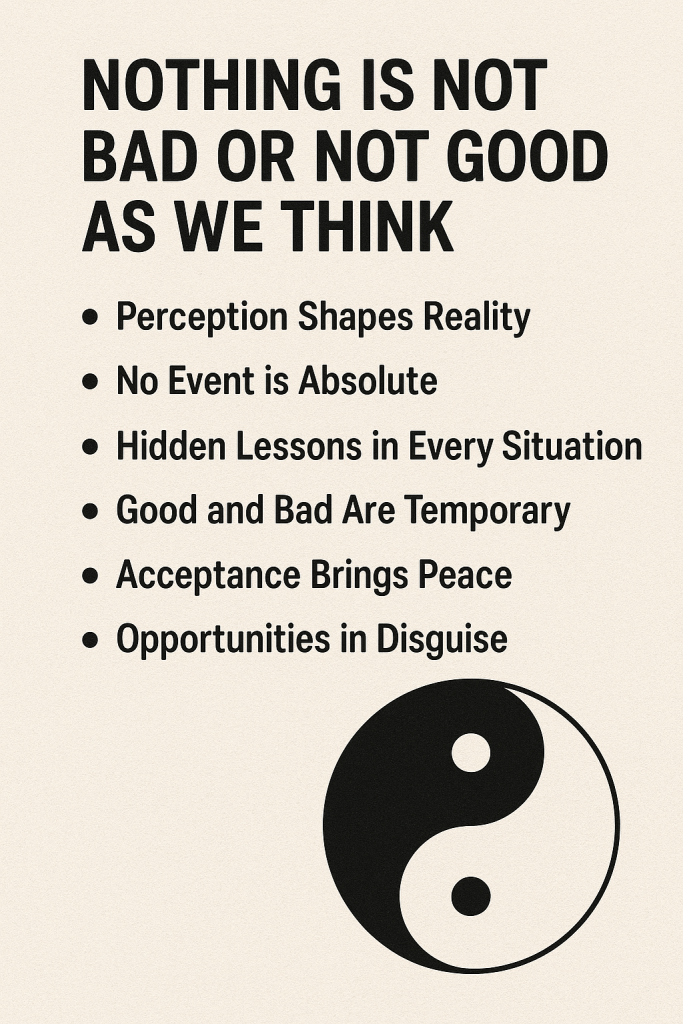
Life often surprises us with situations that we quickly label as good or bad. But in reality, many things are neither completely good nor completely bad—it is our perception that shapes how we feel about them.
Key Points
Perception Shapes Reality
What feels like a setback today may turn into a blessing tomorrow.
Example: Losing a job can seem bad, but it may lead to better opportunities.
No Event is Absolute
Life events are neutral; it is we who add the meaning.
Something that feels painful to one person might feel like growth to another.
Hidden Lessons in Every Situation
Even challenges carry lessons, strength, and wisdom.
What seems “bad” can make us stronger and more resilient.
Good and Bad Are Temporary
Joy and sorrow are like waves—they come and go.
Nothing remains permanent; every phase changes with time.
Acceptance Brings Peace
Instead of labeling things as good or bad, accepting them as experiences brings calmness.
This mindset helps us handle stress with balance.
Opportunities in Disguise
Difficulties often open doors we would never notice otherwise.
The key is to stay open-minded and patient.
Conclusion
Nothing in life is completely good or bad—it is our thoughts and judgments that create those labels. When we look at situations with an open and neutral mind, we find peace, growth, and unexpected opportunities. Life is a teacher, and every moment—whether pleasant or painful—has a purpose.
Life often gives us emotions we don’t want—sadness, anger, disappointment, or fear. Many people try to hide these feelings or push them away, but doing so only makes the pain heavier. True strength lies in accepting your emotions, not suppressing them.
✨ Simple Points to Remember
Acceptance is the first step to healing – When you allow yourself to feel, you give space for recovery to begin.
Suppression creates stress – Bottled-up emotions don’t disappear; they show up as anxiety, irritability, or even health issues.
Feeling is not weakness – It takes courage to admit when you’re hurt or struggling.
Expression brings clarity – Talking, journaling, or creative outlets help you understand your emotions better.
Acceptance leads to growth – Once you face your feelings, you can learn from them and move forward stronger.
Peace comes with honesty – Pretending drains energy; being truthful with yourself brings inner calm.
You’re not alone – Everyone experiences pain, and sharing it can connect you with others who understand.
🌸 Final Thought
Remember, acceptance is not about giving up—it’s about letting go of denial. When you accept what you feel, you open the door to healing, growth, and peace.
Life doesn’t always go as planned. We all face situations we wish were different, but resisting reality only leads to frustration. True peace comes when we accept life as it is and make the best of it. Here’s why and how you should embrace reality:
1. Fighting Reality Only Brings Stress
The more you resist what is happening, the more you suffer.
Acceptance doesn’t mean giving up; it means making peace with what is.
2. Life Is Unpredictable
No matter how much you plan, things will sometimes take unexpected turns.
Learning to adapt makes life smoother and less stressful.
3. Change Is Constant
Nothing stays the same forever—situations, people, and emotions change.
Accepting this helps you stay open to new possibilities.
4. Growth Comes from Acceptance
Instead of asking, “Why me?” ask, “What can I learn from this?”
Every situation, good or bad, teaches something valuable.
5. You Can’t Control Everything
Focus on what you can control—your actions, thoughts, and responses.
Let go of things that are beyond your control.
6. Accept Yourself As You Are
Perfection is an illusion.
Embrace your strengths and weaknesses instead of chasing unrealistic standards.
7. People Won’t Always Act as You Expect
You can’t control how others behave, but you can control how you react.
Letting go of expectations reduces disappointment.
8. Accepting Reality Brings Inner Peace
The moment you stop resisting life, you feel lighter and free.
Happiness comes from making peace with what is, not from wishing things were different.
Final Thought
Acceptance is not about giving up; it’s about moving forward with clarity. Life becomes easier when you stop fighting reality and start working with it. Embrace the present, learn from the past, and trust the journey ahead. 💙
Life is full of changes and experiences that remind us that nothing lasts forever, and that includes both the positive and negative moments. The concept of “nothing is personal or permanent” encourages us to live with a sense of detachment, resilience, and acceptance. Here’s a simple breakdown:
Life Is Fluid
Everything around us, from relationships to situations, changes over time.
What feels permanent today may evolve or fade tomorrow.
Don’t Take Things Personally
People’s actions or words are often more about them than about you.
Avoid internalizing others’ behavior, as it may be influenced by their own struggles and experiences.
The Impermanence of Emotions
Both joy and sorrow are temporary. Emotions come and go, so learning to navigate them without being overwhelmed is crucial.
Realizing this helps reduce stress and anxiety, making it easier to let go of difficult feelings.
Change Is Inevitable
Change is the only constant in life. Whether it’s in your career, relationships, or personal growth, change will come.
Embrace the ebb and flow of life rather than resisting it.
Let Go of Attachments
The more we cling to people, places, or things, the more we may feel hurt when they change or leave.
Letting go doesn’t mean abandoning relationships but rather accepting that everything has its time.
The Temporary Nature of Pain
Pain, disappointment, and challenges don’t last forever. Every hardship eventually comes to an end, and growth can come from it.
Trust that better days are ahead, even when things seem tough.
The Power of Acceptance
By accepting the impermanence of life, we become more adaptable, resilient, and peaceful.
Acceptance allows us to find meaning in both the good and bad times.
Freedom in Letting Go
Letting go of the need for control or perfection allows us to experience life more fully.
When we stop fearing change, we can embrace opportunities with openness and curiosity.
Embrace the Present Moment
Since nothing is permanent, the present moment is all we truly have.
Focusing on the now allows us to live with intention and appreciate life as it unfolds.
Live with Grace
Understanding that everything is temporary encourages us to live with grace—taking life one step at a time, letting go when necessary, and adapting as we go along.
By understanding that nothing is personal or permanent, we cultivate resilience, peace, and acceptance, making it easier to navigate the unpredictability of life.
The World is a Drama Stage: We Are All Actors Playing Our Roles
Life is often compared to a drama stage, where each person plays a unique role. This analogy helps us understand our purpose and interactions in the world. Let’s explore this concept through simple points, enriched with quotes from the Quran and famous personalities.
1. The Stage is Set by God
Divine Director: Imagine God as the director of this grand play. He has crafted the script and set the stage for all of us.
Life’s Blueprint: Every event and circumstance in our lives is part of this divine blueprint, guiding us through our roles.
Quranic Insight: “He knows what is before them and what is behind them, and to Allah are all matters returned.” (Quran 22:76)
2. We Are All Actors
Unique Roles: Each person is an actor with a specific role to play. These roles vary greatly, from family members and friends to professionals and citizens.
Purposeful Actions: Our actions and decisions are like lines and movements in a play, contributing to the overall story.
William Shakespeare: “All the world’s a stage, and all the men and women merely players. They have their exits and their entrances; And one man in his time plays many parts.”
3. Interconnected Stories
Interacting Characters: Just like in a play, our lives are interconnected. We interact with other ‘actors,’ influencing and being influenced by them.
Collaborative Plot: These interactions create a complex, collaborative plot that weaves individual stories into a larger narrative.
Helen Keller: “Alone we can do so little; together we can do so much.”
4. Learning and Growth
Lessons Through Roles: Each role we play teaches us something. Challenges and triumphs alike are opportunities for learning and personal growth.
Character Development: Just as characters in a play evolve, we too develop and grow through our experiences.
Albert Einstein: “Life is like riding a bicycle. To keep your balance, you must keep moving.”
5. Acceptance and Adaptability
Embrace Your Role: Understanding that we are actors can help us accept our roles with grace. This acceptance brings peace and reduces resistance to life’s changes.
Adapt to Change: Just as actors adapt to different scenes, we must adapt to the changing circumstances in our lives, trusting that each change has a purpose.
Quranic Wisdom: “Allah does not burden a soul beyond that it can bear…” (Quran 2:286)
6. Emotional Expression
Full Spectrum of Emotions: Like actors, we express a wide range of emotions. Joy, sorrow, love, and anger are all parts of the human experience.
Authentic Performance: Embracing our emotions authentically helps us live fully and connect with others meaningfully.
Maya Angelou: “We are more alike, my friends, than we are unalike.”
7. Ultimate Purpose
Spiritual Journey: Viewing life as a play directed by God can deepen our spiritual understanding. It reminds us that there is a higher purpose behind our existence.
Divine Connection: Recognizing our roles can strengthen our connection to the divine, helping us live with intention and gratitude.
Quranic Reflection: “And He found you lost and guided [you].” (Quran 93:7)
Conclusion
Seeing the world as a drama stage where we are all actors can transform our perspective on life. It encourages us to embrace our roles, learn from our experiences, and trust in the divine direction guiding us. By playing our parts with authenticity and grace, we contribute to the beautiful, intricate story of life. As Rumi beautifully said, “We are all actors in this play, in this theatre of God’s creation.”






 Pioneer Edge