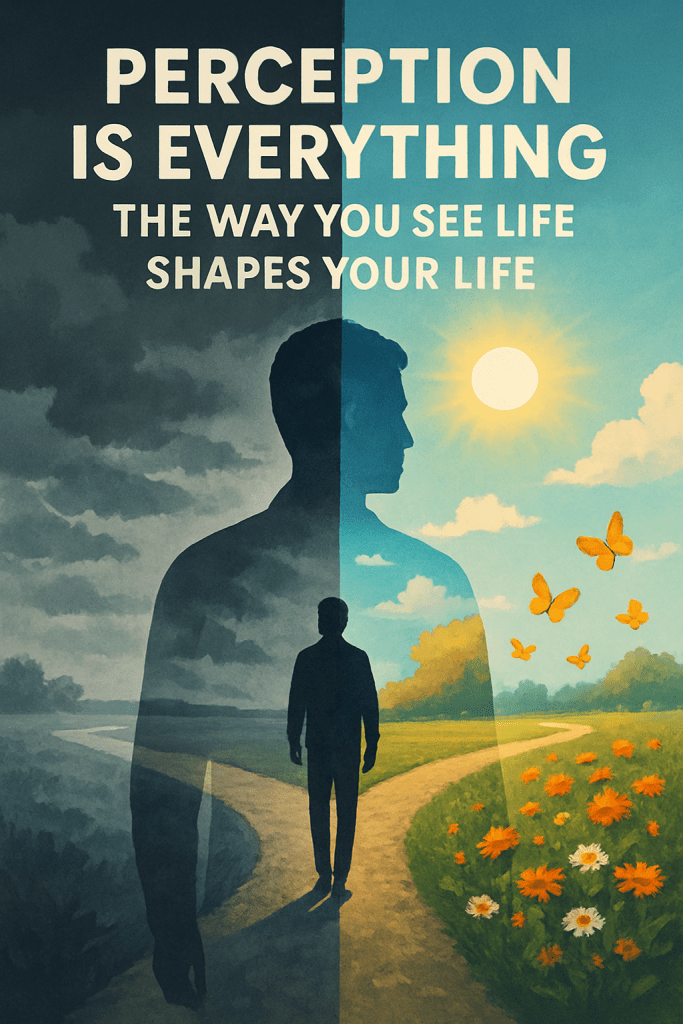
🌟 Perception Is Everything: The Way You See Life Shapes Your Life

🔍 What Is Perception?

  • Perception is how you see, understand, and interpret the world around you.
  • It’s based on your thoughts, beliefs, experiences, and emotions.
  • Two people can go through the same situation but feel completely different—because of perception.

🌈 Why Perception Matters in Life

  • Your thoughts shape your reality.
    If you see problems, you feel stuck. If you see opportunities, you feel hopeful.
  • Perception affects your emotions.
    How you feel is often based on how you see what’s happening, not the event itself.
  • It guides your decisions.
    The way you view people, situations, or even yourself affects the choices you make.
  • It impacts your relationships.
    Misunderstandings often arise not from facts but from different perceptions.
  • It builds or breaks confidence.
    If you perceive yourself as capable, you’ll take action. If you don’t, you’ll hold back.

💡 Real-Life Examples

  • A rainy day:
    One person sees it as gloomy, another sees it as cozy and peaceful.
  • Criticism:
    One sees it as an attack, another sees it as a chance to grow.
  • Failure:
    Some see it as the end, others see it as feedback.

🔁 How to Shift Your Perception

  • Pause and reflect before reacting.
  • Ask yourself: “Is there another way to see this?”
  • Practice gratitude – it changes your focus from lack to abundance.
  • Surround yourself with positive influences – they shape your lens.
  • Challenge negative thoughts and replace them with balanced thinking.

🧠 Final Thought

“We don’t see things as they are, we see them as we are.”

When you change your perception, you change your life.
It’s not always the world that needs to change — sometimes it’s just how you’re looking at it.

Unmasking Bias: Seeing Through the Blind Spot

We often believe we see the world clearly, making judgments based on facts and logic. However, the reality is far more complex. Our minds are susceptible to biases that can cloud our judgment and distort our perception of reality. One of the most insidious of these biases is the “biased blind spot,” where we fail to recognize our own biases while readily identifying them in others.

  1. The Nature of Bias:
    • Bias refers to the inclination or prejudice for or against something or someone, often based on factors like race, gender, or personal experiences.
    • Biases can be implicit (unconscious) or explicit (conscious) and influence our thoughts, feelings, and behaviors in subtle ways.
  2. The Blind Spot Effect:
    • The biased blind spot, also known as the “bias blind spot,” describes our tendency to recognize biases in others while failing to acknowledge our own.
    • This blind spot can lead us to believe that we are objective and impartial, despite evidence to the contrary.
  3. Types of Bias:
    • Confirmation Bias: We seek out information that confirms our existing beliefs and ignore evidence that contradicts them.
    • Attribution Bias: We attribute our successes to internal factors (skill, talent) and our failures to external factors (luck, circumstances).
    • In-group Bias: We favor members of our own group over those outside it, leading to favoritism and prejudice.
    • Implicit Bias: Unconscious attitudes or stereotypes that influence our understanding, actions, and decisions.
  4. Impacts on Decision-Making:
    • The biased blind spot can distort our decision-making processes, leading to flawed judgments and missed opportunities.
    • In professional settings, biases can affect hiring, promotions, and performance evaluations, perpetuating inequalities and hindering diversity and inclusion efforts.
  5. Overcoming the Blind Spot:
    • Recognizing and acknowledging our biases is the first step toward overcoming the biased blind spot.
    • Engaging in self-reflection, seeking feedback from others, and considering alternative perspectives can help mitigate the influence of biases.
  6. Cultivating Awareness:
    • Education and training programs can raise awareness of biases and their impact on decision-making.
    • Creating environments that encourage open dialogue and constructive criticism can foster a culture of inclusivity and accountability.
  7. Embracing Diversity:
    • Embracing diversity and inclusion fosters innovation, creativity, and resilience within organizations and communities.
    • By valuing diverse perspectives and experiences, we can challenge our own biases and broaden our understanding of the world.
  8. Conclusion:
    • The biased blind spot reminds us that none of us are immune to biases, no matter how rational or well-intentioned we may be.
    • By acknowledging our biases and actively working to counteract them, we can strive for fairness, equality, and empathy in our interactions and decision-making processes.
    • Let’s embrace the journey of self-awareness and continuous learning, recognizing that overcoming biases is a collective effort that benefits us all.