This blog is a handy guide that helps you streamline your daily tasks, save and grow your money, and get better at handling your feelings. It’s filled with easy-to-follow advice that makes a big difference in how you work, spend, and feel. Dive into our Pioneeredge.io site for practical tips and tricks that make life smoother and more fulfilling.
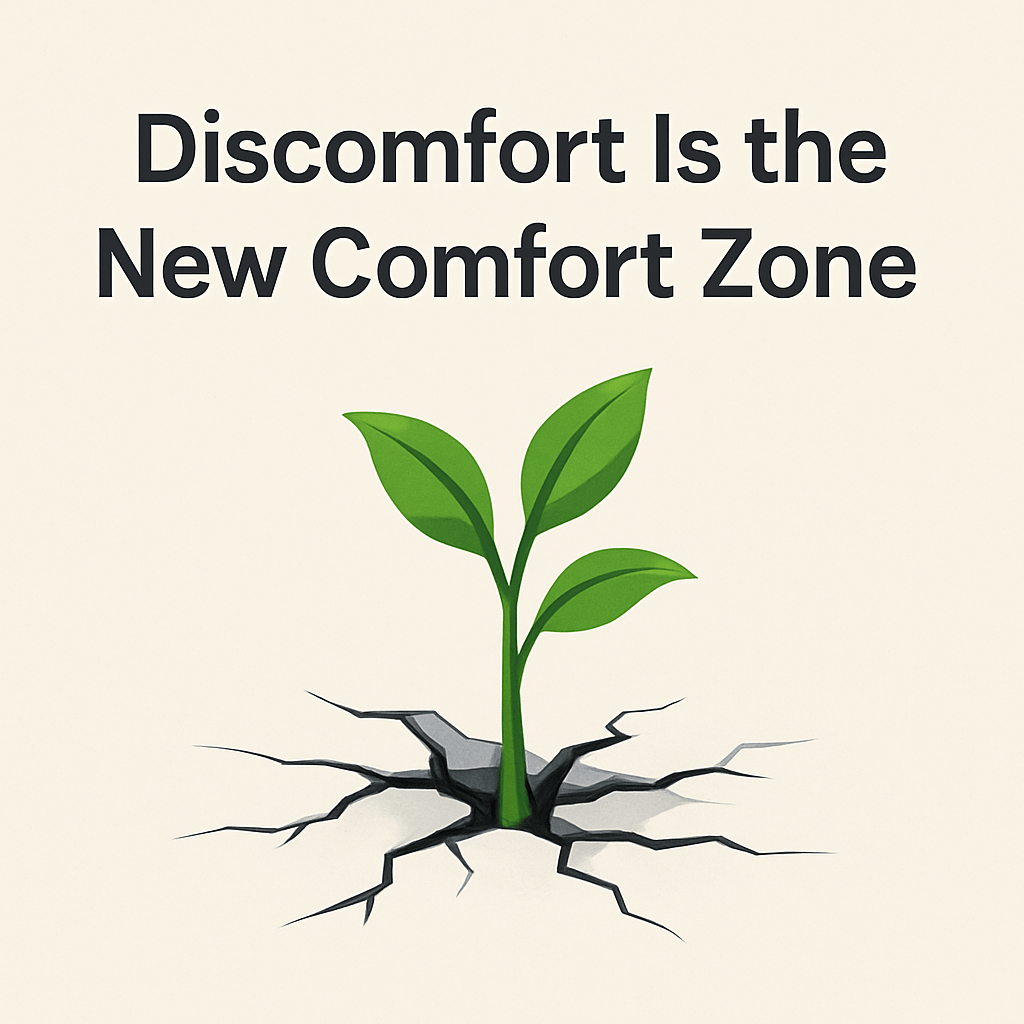
In today’s fast and ever-evolving world, growth begins where comfort ends. What used to feel “safe” and “predictable” often leads to stagnation. The new-age mindset says it loud and clear:
“If it doesn’t challenge you, it won’t change you.” – Fred DeVito
🔹 Why Discomfort Should Be Welcomed:
Discomfort sparks growth. When you face new challenges, your brain and character evolve. “Life begins at the end of your comfort zone.” – Neale Donald Walsch
Comfort zones breed fear of change. Staying safe often means missing opportunities. “Don’t fear failure. Fear being in the same place next year.”
Every breakthrough starts with uncertainty. The best ideas and personal revolutions happen in moments of doubt. “Growth is uncomfortable because you’ve never been here before.”
Discomfort builds resilience. Facing new experiences strengthens your mental muscles. “Pain is temporary. Quitting lasts forever.” – Lance Armstrong
You stop surviving and start thriving. Stepping into discomfort turns potential into progress. “Get comfortable with being uncomfortable.” – Jillian Michaels
🔹 Examples of Productive Discomfort:
Speaking in public for the first time.
Starting a business or switching careers.
Saying “no” when you’re used to pleasing others.
Waking up early for your goals.
Having difficult but honest conversations.
🔹 How to Embrace Discomfort:
✅ Start small – take micro-risks daily. ✅ Reframe discomfort as a teacher, not a threat. ✅ Reflect regularly – see how far you’ve come. ✅ Surround yourself with people who push you.
“Discomfort is a sign that you’re on the right path.”
🔹 Final Thought:
Discomfort isn’t a punishment — it’s a signal that you’re evolving. The more you stretch yourself, the more powerful and authentic your life becomes.
“Your comfort zone is beautiful, but nothing ever grows there.”
Introduction The 80/20 Principle, also known as the Pareto Principle, is a powerful concept that can transform the way you approach work, life, and success. It suggests that 80% of your results come from just 20% of your efforts. By focusing on the most impactful tasks, you can achieve more with less effort. Here’s how you can apply the 80/20 Principle in simple, easy steps.
Step 1: Understand the 80/20 Principle
Basic Idea: The 80/20 Principle means that a small portion of your activities (20%) is responsible for the majority of your outcomes (80%).
Example: In a business setting, 20% of your clients might generate 80% of your revenue. In your personal life, 20% of your daily activities might bring 80% of your happiness.
Step 2: Identify Your 20%
Review Your Activities: Make a list of all your tasks, projects, or activities.
Find the Key Contributors: Identify the 20% that brings the most value, whether it’s in your work, studies, or personal goals.
Focus on Impact: Concentrate your time and energy on these high-impact tasks. These are the tasks that move the needle the most.
Step 3: Minimize the Less Important 80%
Assess the Rest: Look at the remaining 80% of your activities. These usually have less impact on your overall success.
Eliminate or Reduce: Cut out or reduce time spent on low-impact tasks. These could be time-wasters or tasks that don’t contribute significantly to your goals.
Delegate if Possible: If certain low-impact tasks still need to be done, delegate them to others or find more efficient ways to handle them.
Step 4: Apply the 80/20 Principle to Different Areas
Work: Focus on the 20% of tasks that contribute most to your productivity, income, or job satisfaction.
Learning: Spend more time on the 20% of learning activities that lead to the greatest improvement in your skills or knowledge.
Personal Life: Identify the 20% of relationships or activities that bring you the most joy and fulfillment. Prioritize these in your daily life.
Step 5: Continuously Review and Adjust
Regular Assessment: Periodically review your tasks and priorities to ensure you’re still focusing on the right 20%.
Stay Adaptable: As your goals and life circumstances change, be ready to adjust which tasks are most important.
Keep Optimizing: Use the 80/20 Principle as a guide for ongoing improvement. Continuously refine your focus to achieve even better results.
Conclusion The 80/20 Principle is a simple but effective way to enhance your productivity and focus on what truly matters. By identifying and prioritizing the 20% of tasks that yield the most significant results, you can work smarter, not harder. Remember, the key to success isn’t doing more; it’s doing more of what really counts.
“Success is about making a difference, not getting praise.” – Confucius
True success comes from the positive impact you create, not from the applause you receive.
Focusing on results ensures that your efforts lead to meaningful change.
2. Substance Over Style
“Don’t aim for success if you want it; just do what you love and believe in, and it will come naturally.” – David Frost
Prioritizing genuine achievements over the appearance of success leads to more fulfilling outcomes.
Authenticity in your work resonates more deeply than superficial recognition.
3. Contribution Over Credit
“It is amazing what you can accomplish if you do not care who gets the credit.” – Harry S. Truman
Focusing on contributions allows for greater collaboration and more significant achievements.
When results are the priority, collective success becomes more important than individual accolades.
4. Lasting Legacy Over Temporary Fame
“What you leave behind is not what is engraved in stone monuments, but what is woven into the lives of others.” – Pericles
Achievements that make a lasting impact are more valuable than fleeting recognition.
A legacy built on real results endures longer than any award or title.
5. Progress Over Praise
“The only limit to our realization of tomorrow will be our doubts of today.” – Franklin D. Roosevelt
Striving for continuous improvement leads to ongoing success.
Progress is fueled by the pursuit of results, not by the desire for recognition.
6. Value Over Validation
“Success usually comes to those who are too busy to be looking for it.” – Henry David Thoreau
Delivering value through your work attracts success naturally.
Seeking validation can distract from achieving true excellence.
7. Actions Over Appearances
“Well done is better than well said.” – Benjamin Franklin
Concrete actions speak louder than words or public recognition.
Demonstrating results through actions is more impactful than merely talking about intentions.
8. Purpose Over Popularity
“Your purpose in life is to find your purpose and give your whole heart and soul to it.” – Buddha
Pursuing a meaningful purpose drives you to achieve real results.
Popularity may come and go, but a strong sense of purpose leads to lasting success.
9. Quality Over Quantity
“It is quality rather than quantity that matters.” – Lucius Annaeus Seneca
Delivering high-quality work yields better results than producing large volumes with less care.
Quality results are more likely to create a lasting impact and earn respect.
10. Endurance Over Entitlement
“The only place where success comes before work is in the dictionary.” – Vidal Sassoon
Enduring effort and hard work are necessary for achieving significant results.
Expecting recognition without putting in the effort undermines genuine success.
11. Integrity Over Influence
“Integrity is doing the right thing, even when no one is watching.” – C.S. Lewis
Upholding integrity ensures that your results are achieved through ethical means.
Influence and recognition should come as a result of honest effort and true achievements.
While recognition feels rewarding, it’s the results that truly define success. By focusing on the impact you create rather than the applause you receive, you achieve meaningful change. Prioritizing substance, contribution, and progress ensures your efforts lead to lasting achievements. Quality work, driven by purpose and integrity, holds more value than superficial validation. Consistent actions and resilience build a legacy that outlasts temporary fame. True success comes from the difference you make, not the praise you get. Focus on delivering real results, and recognition will naturally follow.
In the hustle and bustle of daily life, staying organized and on top of tasks can feel like an uphill battle. This is where to-do lists come in as invaluable allies. Let’s explore the fundamental aspects of to-do lists and unveil why they are crucial for unlocking your productivity potential.
What are to-do lists?
To-do lists are lists of tasks or activities that you need to complete within a certain timeframe.
They can range from simple handwritten notes to sophisticated digital apps, tailored to suit individual preferences.
Why are to-do lists important?
Organization: To-do lists help you organize your tasks and prioritize them based on their importance and urgency.
Clarity: They provide clarity on what needs to be done, reducing the mental clutter and anxiety associated with trying to remember everything.
Focus: To-do lists keep you focused on the tasks at hand, preventing distractions and ensuring that you stay on track towards your goals.
Productivity: By breaking down larger tasks into smaller, actionable steps, to-do lists make tasks more manageable and increase your overall productivity.
Accountability: To-do lists hold you accountable for your tasks, serving as a tangible reminder of your commitments and deadlines.
How to create an effective to-do list:
Start with Brain Dump: Begin by listing down all the tasks that come to mind without worrying about the order or priority.
Prioritize: Once you have a comprehensive list, prioritize tasks based on their importance and urgency. Consider using techniques like the Eisenhower Matrix or the ABC method.
Break it Down: Break down larger tasks into smaller, actionable steps to make them more manageable and less overwhelming.
Set Realistic Goals: Be realistic about what you can accomplish within a given timeframe and avoid overloading your to-do list with too many tasks.
Review and Update: Regularly review and update your to-do list as new tasks arise or priorities change. This ensures that your list remains relevant and actionable.
To-do lists are simple yet powerful tools that can revolutionize the way you approach your tasks and goals. By incorporating them into your daily routine, you can enhance your productivity, reduce stress, and achieve greater success in both your personal and professional life. Start creating your to-do list today and experience the transformative impact it can have on your productivity!





 Pioneer Edge