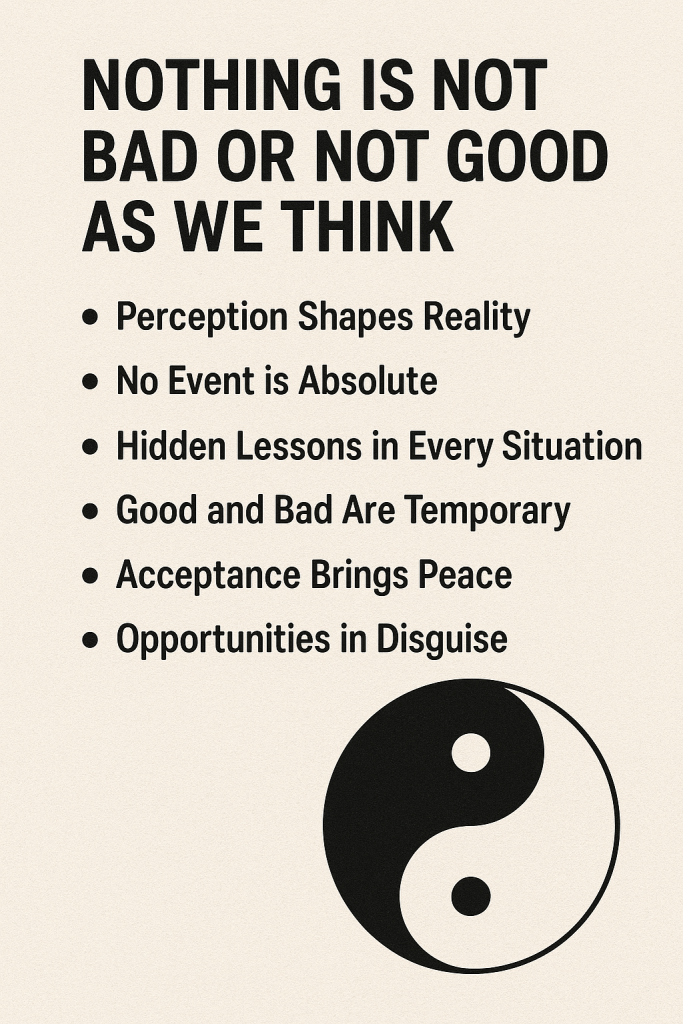
Nothing is Not Bad or Not Good as We Think

Introduction

Life often surprises us with situations that we quickly label as good or bad. But in reality, many things are neither completely good nor completely bad—it is our perception that shapes how we feel about them.


Key Points

  • Perception Shapes Reality
    • What feels like a setback today may turn into a blessing tomorrow.
    • Example: Losing a job can seem bad, but it may lead to better opportunities.
  • No Event is Absolute
    • Life events are neutral; it is we who add the meaning.
    • Something that feels painful to one person might feel like growth to another.
  • Hidden Lessons in Every Situation
    • Even challenges carry lessons, strength, and wisdom.
    • What seems “bad” can make us stronger and more resilient.
  • Good and Bad Are Temporary
    • Joy and sorrow are like waves—they come and go.
    • Nothing remains permanent; every phase changes with time.
  • Acceptance Brings Peace
    • Instead of labeling things as good or bad, accepting them as experiences brings calmness.
    • This mindset helps us handle stress with balance.
  • Opportunities in Disguise
    • Difficulties often open doors we would never notice otherwise.
    • The key is to stay open-minded and patient.

Conclusion

Nothing in life is completely good or bad—it is our thoughts and judgments that create those labels. When we look at situations with an open and neutral mind, we find peace, growth, and unexpected opportunities. Life is a teacher, and every moment—whether pleasant or painful—has a purpose.

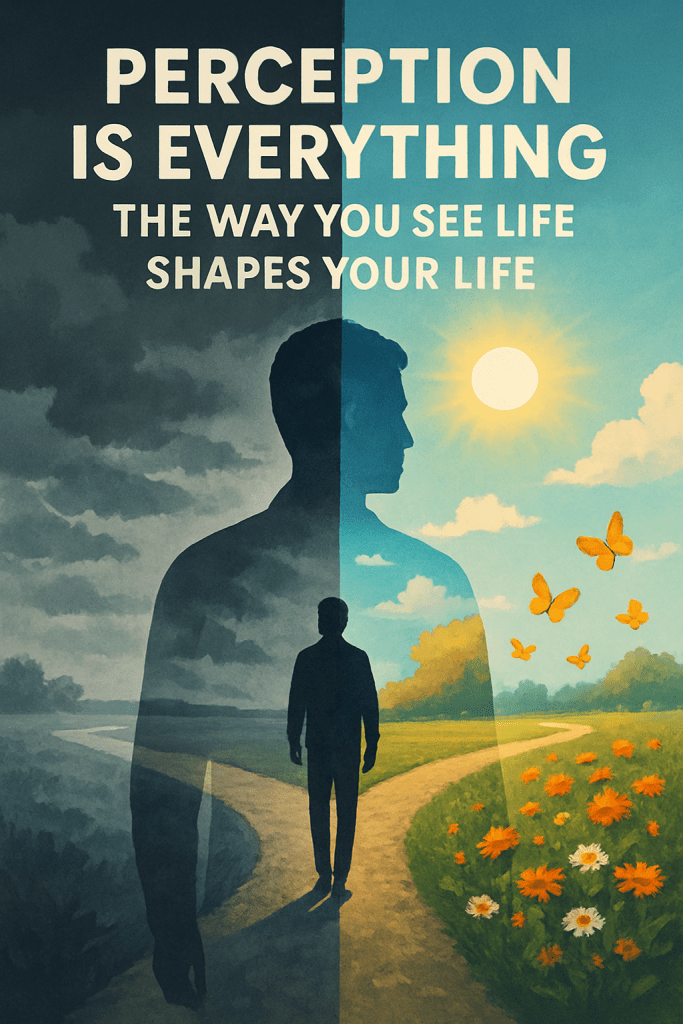
🌟 Perception Is Everything: The Way You See Life Shapes Your Life

🔍 What Is Perception?

  • Perception is how you see, understand, and interpret the world around you.
  • It’s based on your thoughts, beliefs, experiences, and emotions.
  • Two people can go through the same situation but feel completely different—because of perception.

🌈 Why Perception Matters in Life

  • Your thoughts shape your reality.
    If you see problems, you feel stuck. If you see opportunities, you feel hopeful.
  • Perception affects your emotions.
    How you feel is often based on how you see what’s happening, not the event itself.
  • It guides your decisions.
    The way you view people, situations, or even yourself affects the choices you make.
  • It impacts your relationships.
    Misunderstandings often arise not from facts but from different perceptions.
  • It builds or breaks confidence.
    If you perceive yourself as capable, you’ll take action. If you don’t, you’ll hold back.

💡 Real-Life Examples

  • A rainy day:
    One person sees it as gloomy, another sees it as cozy and peaceful.
  • Criticism:
    One sees it as an attack, another sees it as a chance to grow.
  • Failure:
    Some see it as the end, others see it as feedback.

🔁 How to Shift Your Perception

  • Pause and reflect before reacting.
  • Ask yourself: “Is there another way to see this?”
  • Practice gratitude – it changes your focus from lack to abundance.
  • Surround yourself with positive influences – they shape your lens.
  • Challenge negative thoughts and replace them with balanced thinking.

🧠 Final Thought

“We don’t see things as they are, we see them as we are.”

When you change your perception, you change your life.
It’s not always the world that needs to change — sometimes it’s just how you’re looking at it.

🌿 Stillness is Strength: The Power of Doing Nothing

In today’s fast-paced world, doing nothing is often misunderstood as laziness or a waste of time. But in reality, stillness is a hidden strength.


🌸 What Is Stillness?

  • It means mental and physical rest.
  • It’s about being present without constant activity.
  • Stillness doesn’t mean inactivity—it means intentional rest.

🌟 Why Stillness Matters

  • Restores mental energy and reduces fatigue.
  • Improves focus and clarity.
  • Helps you listen to your inner voice.
  • Creates space for creativity and problem-solving.

💥 The Power of Doing Nothing

  • Your brain needs quiet time to recharge.
  • Moments of stillness lower stress and anxiety.
  • Helps you respond calmly instead of reacting impulsively.
  • It builds emotional strength and patience.

📌 Real-World Examples

  • Great thinkers like Einstein and Newton had breakthroughs during quiet moments.
  • Many CEOs and leaders schedule “thinking time” daily.
  • Artists, writers, and creators often find ideas in silence.

🧘 Simple Ways to Practice Stillness

  1. Take short breaks during the day—no phone, no tasks.
  2. Sit quietly for 5–10 minutes every morning or night.
  3. Go for a silent walk in nature.
  4. Try mindful breathing or meditation.
  5. Schedule time to just “be” instead of always “doing.”

💡 Final Thought

In a world that praises constant hustle, doing nothing is a radical act of self-care. Stillness helps you recharge, reconnect, and rediscover your true strength. Remember, you don’t always need to move to make progress.