
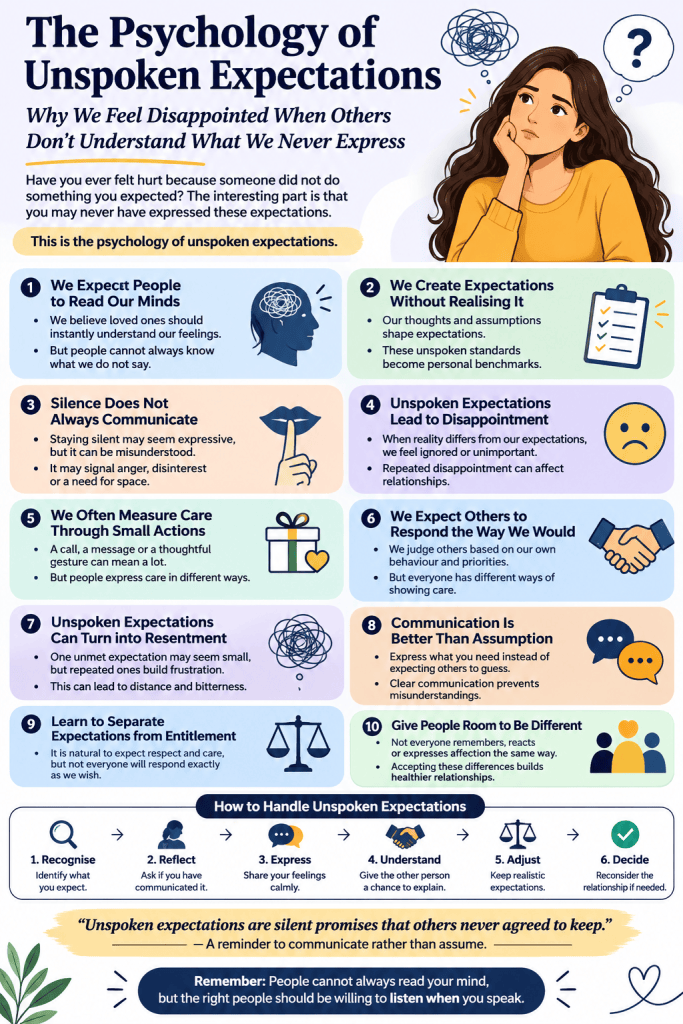
Why We Feel Disappointed When Others Don’t Understand What We Never Express
Have you ever felt hurt because someone did not do something you expected them to do? Perhaps you expected a friend to check on you, a family member to understand your silence, or a colleague to recognise your efforts.
The interesting part is that you may never have expressed these expectations. Yet, when others fail to meet them, disappointment follows.
This is the psychology of unspoken expectations.
1. We Expect People to Read Our Minds
- We often believe that people who care about us should automatically understand our feelings.
- We expect them to notice our silence, mood and behaviour.
- But people cannot always understand what we do not communicate.
Example: You feel upset because your friend did not call, although you never told them that you needed support.
2. We Create Expectations Without Realising It
- Sometimes, expectations develop from our own thoughts and assumptions.
- We imagine how others should behave towards us.
- Gradually, these assumptions become personal standards.
Example: You always remember someone’s special occasions and expect the same attention in return.
3. Silence Does Not Always Communicate Feelings
- Staying silent may seem like a way of expressing hurt.
- But the other person may interpret it as anger, disinterest or a need for space.
- Silence can create confusion instead of understanding.
4. Unspoken Expectations Lead to Disappointment
- When reality does not match our expectations, we feel ignored or unimportant.
- We may think, “If they really cared, they would have understood.”
- Repeated disappointment can slowly affect relationships.
5. We Often Measure Care Through Small Actions
- A phone call, a message, a thoughtful gesture or a simple question can mean a lot.
- We sometimes use these actions to measure how much someone values us.
- However, people express care in different ways.
6. We Expect Others to Respond the Way We Would
- We often judge others based on how we treat them.
- If we make time for someone, we expect them to make time for us.
- But everyone has different priorities, emotional capacities and ways of expressing affection.
7. Unspoken Expectations Can Turn into Resentment
- One disappointment may seem small.
- But repeated unmet expectations can build frustration.
- Eventually, we may become distant without explaining the real reason.
8. Communication Is Better Than Assumption
- Express what you need instead of expecting others to guess.
- Ask for support when you need it.
- Explain what hurt you without blaming the other person.
- Clear communication prevents unnecessary misunderstandings.
9. Learn to Separate Expectations from Entitlement
- It is natural to expect respect, honesty and consideration.
- But expecting everyone to respond exactly as we wish can create emotional pressure.
- Healthy relationships need mutual understanding, not constant mind-reading.
10. Give People Room to Be Different
- Not everyone remembers things the way you do.
- Not everyone expresses affection through words.
- Not everyone understands emotions in the same way.
- Accepting these differences helps us build more realistic relationships.
How to Handle Unspoken Expectations
- Recognise: Identify what you are expecting from someone.
- Reflect: Ask yourself whether you have communicated it.
- Express: Share your feelings calmly and clearly.
- Understand: Give the other person a chance to explain.
- Adjust: Keep realistic expectations.
- Decide: If an important need is repeatedly ignored even after communication, reconsider the relationship’s boundaries.
Final Thought
Not every disappointment means someone does not care. Sometimes, it means two people have different expectations that were never discussed.
Do not expect people to understand every feeling you keep hidden. Give communication a chance before allowing assumptions to create distance.
“Unspoken expectations are silent promises that others never agreed to keep.”
A reminder to communicate rather than assume.
Remember: People cannot always read your mind, but the right people should be willing to listen when you speak.

