
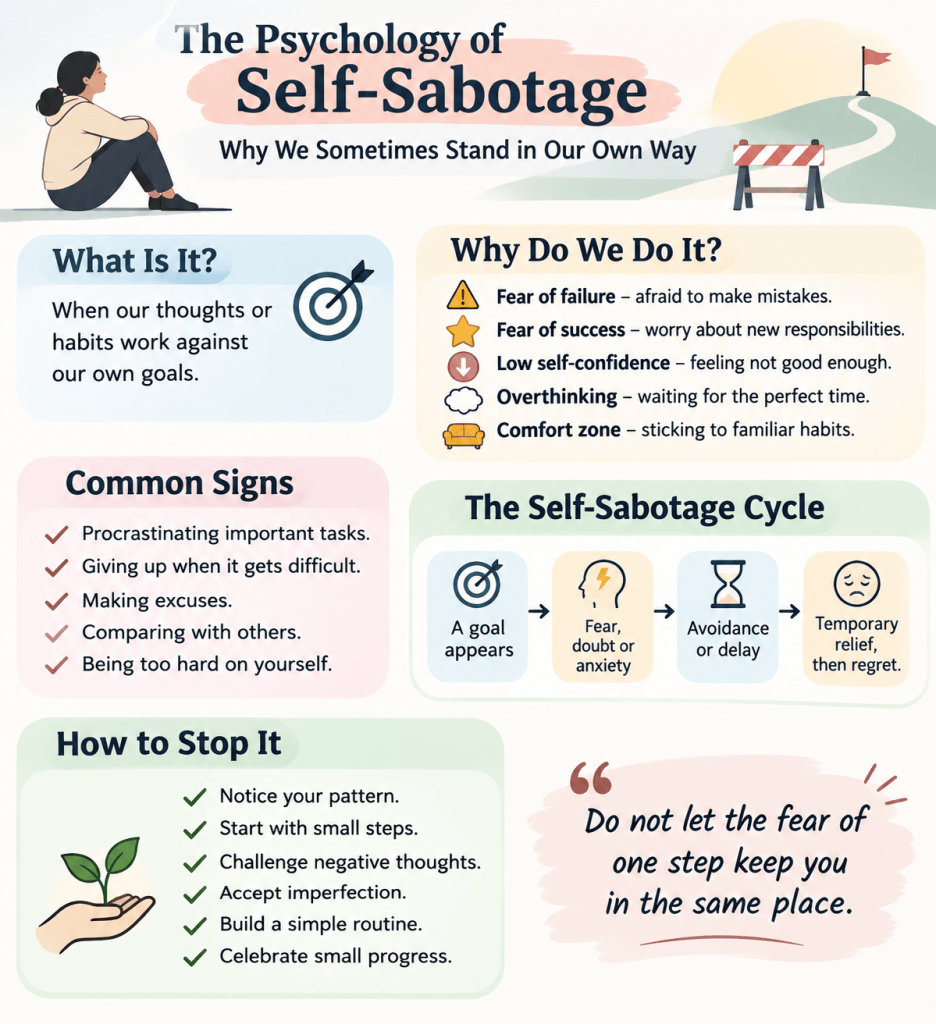
Have you ever wanted something badly but done things that moved you further away from it?
You plan to start a new habit, but keep postponing it. You get an opportunity, but suddenly doubt yourself. You want to move forward, yet something inside you holds you back.
This behaviour is often called self-sabotage.
1. What Is Self-Sabotage?
Self-sabotage happens when our thoughts, habits, or actions work against our own goals.
- You want to succeed but avoid taking the first step.
- You want peace but keep replaying painful memories.
- You want to improve but remain trapped in familiar habits.
- You want change but fear leaving your comfort zone.
In simple words: Sometimes, the biggest obstacle between us and our goals is our own behaviour.
2. Why Do We Sabotage Ourselves?
1. Fear of failure
- We avoid trying because we fear making mistakes.
- We tell ourselves, “What if I fail?”
- Avoiding the task protects us from immediate disappointment, but it also prevents progress.
2. Fear of success
- Success may bring new responsibilities, expectations, and changes.
- We may worry about whether we can maintain our success.
- Sometimes, staying where we are feels safer than moving forward.
3. Low self-confidence
- We may believe we are not good enough.
- Even when opportunities appear, we doubt our abilities.
- We may give up before discovering what we can achieve.
4. Overthinking
- We analyse every possible outcome.
- We wait for the perfect time or perfect plan.
- Eventually, thinking replaces action.
5. Comfort in familiar habits
- The brain often prefers what feels familiar.
- Even an unhealthy routine can feel safer than an unfamiliar but beneficial change.
- As a result, we repeat behaviours we already know.
3. Common Signs of Self-Sabotage
Notice whether you regularly:
- Procrastinate on important tasks.
- Give up when progress becomes difficult.
- Compare yourself with others and lose motivation.
- Make excuses to avoid new opportunities.
- Set unrealistic goals and feel disappointed when you cannot meet them.
- Criticise yourself after small mistakes.
- Wait for motivation instead of building a routine.
One or two of these behaviours occasionally do not necessarily mean self-sabotage. Look for repeated patterns that interfere with your goals.
4. How to Stop Standing in Your Own Way
Step 1: Recognise the pattern
Ask yourself, “What do I repeatedly do that prevents me from moving forward?”
Awareness is the first step towards change.
Step 2: Start small
Do not wait until you feel completely ready.
- Read two pages.
- Work for ten minutes.
- Take one small step towards your goal.
Small actions make difficult tasks feel manageable.
Step 3: Challenge negative thoughts
Instead of thinking, “I cannot do this,” ask, “What can I learn if I try?”
A thought is not always a fact.
Step 4: Accept imperfection
- You do not need a perfect plan to begin.
- Mistakes are part of learning.
- Progress is more useful than waiting endlessly for perfection.
Step 5: Stop depending entirely on motivation
Build simple routines that help you act even when motivation is low.
Step 6: Celebrate small progress
Recognise your efforts, not just your final achievements. Every consistent action builds confidence.
5. A Question Worth Asking Yourself
When you find yourself delaying something important, pause and ask:
- Am I genuinely unable to do this, or am I afraid to try?
- Am I protecting my well-being, or avoiding temporary discomfort?
- What is the smallest action I can take today?
Answer honestly, without blaming yourself.
Self-awareness is not about criticising your behaviour. It is about understanding it well enough to change it.
Final Thoughts: Become Your Own Support System
Sometimes, we wait for the right opportunity, the right time, or the right circumstances. But even when those things arrive, our doubts may keep us from moving forward.
Self-sabotage is not proof that you are weak or incapable. It can reflect learned habits, fear, stress, or beliefs that no longer serve you.
You do not have to change everything overnight. Begin by noticing one pattern and choosing one different action.
Remember: You cannot always control the fear that appears before a new beginning, but you can learn not to let that fear make every decision for you.
“Do not let the fear of taking one step keep you trapped in the same place.”

